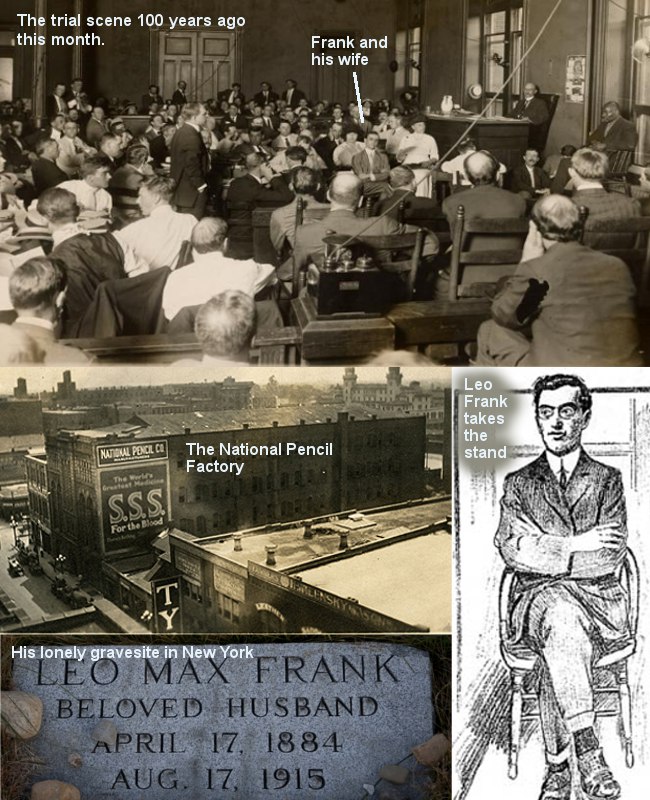
International Jew Study Hour, April 26 Anniversary of Mary Phagan’s Rape-Strangulation: How Jews use Shaming and Guilting Words Anti-Semite and Anti-Semitism to Racistly Attack Gentiles

Decoding Anti-Gentilism and Anti-Semitism of the Leo Frank Case, 100 Years of Review

Upon the centennial of Mary Phagan’s rape, strangulation and mutilation long ago on Georgia Confederate Memorial Day, Saturday, April 26, 1913, two pioneering spirits: Carolyn Yeager and Hadding Scott, debunk some of the major themes of anti-Gentile racism, claims of anti-Semitism and racist Jewish hatecrime hoaxes concerning the Leo Frank case. Multigenerational Jewish Academic Dishonesty (JAD) efforts have been relentlessly conducted by the well organized Jewish community beginning in 1913 and continue to this very day. For more than one hundred years, Jews have been publishing scholarly articles claiming Leo Frank is innocent, but using fallacious evidence to support their claims that does not stand up to 21st century scrutiny. Furthermore, the way Jews utilize this fabricated pseudo-history to re-write history is cite each others research until hundreds of Jews have spun this web of lies in peer reviewed journals for generations, thus eventually the quoting-each-others-lies becomes the “scholarly” popular culture orthodoxy. The poisonous Jewish pathological war of lies are then, as now, being used for anti-Gentile attacks against researchers that disagree with their conclusions. The weapon most often employed by Jews in these regards is the anti-Semitism, neo-nazi and national socialist canard. If Gentiles of the planet earth are going to liberate themselves from Jewish control they must seize back control from the occupiers of their own history. This Jewish-American culturewar is ultimately a life and death struggle for Gentiles against their traditional genetic enemies.

“He who controls the present controls the past, and he who controls the past controls the future” –George Orwell, 1984.

Jewish-American Genetic Race War in the Mainstream Media and Popular Culture:

Since 1913, through every kind of outreach and sensory medium available to the mainstream media and popular culture (scholarly articles, newspaper articles, books, movies, music, theater, drama etc..), Jews have been using the Leo Frank case to wage a vicious guilt and shaming culturewar against White Americans in its traditional multifront genetic racewars against Western Civilization. However, the good news is that this monumental and disingenuous centenarian Jewish fraud manufacturing campaign, now spanning more than 100 long years, has finally been deconstructed, thanks to numerous researchers who have worked tirelessly over the past few years to bring the frank truth to everyone about what really happened in 1913. Five years ago (2010) if you did research on the Internet about Mary Phagan, the only sources that would show-up on the search engine results pages go on to web sites alleging anti-Gentile conspiracies of Jewish race prejudice and an unfair trial for Leo Frank. Now in 2015 there is finally some balance for people to read both sides of the case. Take a look at the scholarly articles on The American Mercury about the Leo Frank case to learn what really happened more than 100 years ago. Subversive Jewish organizations like ADL and SPLC are attempting to conflate the articles about the Leo Frank case on The American Mercury with anti-Semitism, National Socialism, Hitlerism and Neo-Nazism.

Gentile Liberation Requires a 100 Year Audit on All Jewish and Pro-Frank Sources About the Case Since 1913

Fight Back and Join our struggle to regain control of our history. The next 100 years must and will be devoted to educating the human race about the innate nature of their Jewish pathological tendencies to compulsively lie and studying how they falsify history by the strategy of quoting and re-quoting each others mendaciously fabricated research, all to create a fake historical consensus over the generations that Leo Frank was innocent, didn’t have a fair trial and anti-Jewish conspiracies were “behind it all”.

We are calling on you to help us do a very deep fact checking audit of all major books written about the Frank-Phagan affair over the last 100 years. Please help us and join our efforts.

We can fight back by giving students and educators access to the primary sources of the Leo Frank Case to fact check the claims about Jewish falsification of their own history and ours (Gentiles). By studying the secondary sources of this case from the last 100 years and comparing them against the primary sources of the case, students will gain a multigenerational education about the collective Jewish genetic algorithm and how it produces high-intelligent, high-functioning, pathological liars and tribal paranoiacs with obsessive-compulsive and fragile egos. Students will study how Jews aggressively transform history to be falsified into an “us verses them” formulation that strokes their infantile racial-narcissism and perpetuate their disingenuous persecution and noble victimhood.

Please download (right mouse click on link if using PC) this excellent program and listen to it: http://leofrank.org/audio/caroyln-yeager-hadding-scott/mary-phagan-leo-frank-international_jew-study-hour.mp3

If you enjoyed this one hour radio program about the murder of Mary Phagan and Leo Frank’s murder case, please visit Carolyn Yeager’s website: http://www.CarolynYeager.Net

An archive of this program is at www.Archive.org The Internet Archive: https://archive.org/details/mary-phagan-leo-frank-international_jew-study-hour
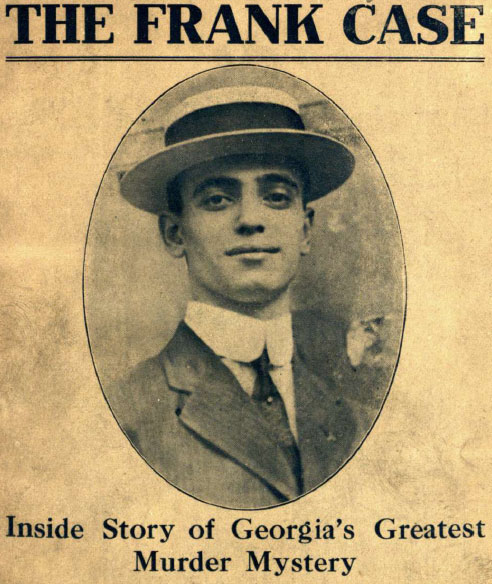
131st Happy Birthday Leo Max Frank (Born April 17, 1884): Extremely Rare Leo Frank Case Book Written and Published in 1913, Now Transformed Into 6 Hour Audiobook by Margaret Huffstickler, 2015

The Leo Frank Case, Inside Story of Georgia’s Greatest Murder Mystery

Complete History of the Sensational Crime and Trial, Portraits of Principals

Price 25 cents (Just Kidding: Free!)

Published by the Atlanta Publishing Company, Atlanta, Georgia 1913

01 Title Page – Leo Frank Case 1913 Atlanta Georgia’s Greatest Murder Mystery Complete History of the Sensational Crime and Trial, Portraits of Principals

02 Table of Contents – Leo Frank Case 1913

03 Preface – Leo Frank Case 1913

04 Chronology of the Crime – Leo Frank Case 1913

05 Chapter I – Crime Discovered – Leo Frank Case 1913

06 Chapter II – Police Reach Scene – Leo Frank Case 1913

07 Chapter III – Frank Views Body – Leo Frank Case 1913

08 Chapter IV – Mother Hears of Murder – Leo Frank Case 1913

09 Chapter V – Crime Stirs Atlanta Leo – Leo Frank Case 1913

10 Chapter VI – Leo Frank is Arrested – Leo Frank Case 1913

11 Chapter VII – The Inquest Starts – Leo Frank Case 1913

12 Chapter VIII – Frank’s Story – Leo Frank Case 1913

13 Chapter IX – Dictograph Incident – Leo Frank Case 1913

14 Chapter X – Conley Enters Case – Leo Frank Case 1913

15 Chapter XI – Conley in School – Leo Frank Case 1913

16 Chapter XII – Racial Prejudice Charge – Leo Frank Case 1913

17 Chapter XIII – Plants Charged to Frank – Leo Frank Case 1913

18 Chapter XIV – South’s Greatest Legal Battle – Leo Frank Case 1913

19 Chapter XV – The State’s Chain – Leo Frank Case 1913

20 Chapter XVI – Perversion Charged – Leo Frank Case 1913

21 Chapter XVII – Salacious Stories Admitted – Leo Frank Case 1913

22 Chapter XVIII – Frank’s Alibi – Leo Frank Case 1913

23 Chapter XIX – Attorneys Threatened – Leo Frank Case 1913

24 Chapter XX – Frank’s Own Story – Leo Frank Case 1913

25 Chapter XXI – Lawyers Laud and Denounce Frank – Leo Frank Case 1913

26 Chapter XXII – Fear of Lynching Precedes the Verdict – Leo Frank Case 1913

ALL SIX HOURS embedded here for your listening enjoyment:


Bibliography: Sources and References
The Internet Archive @ www.Archive.org —

The Leo Frank Case, Atlanta Georgia’s Greatest Murder Mystery by Margi H.
https://archive.org/details/LeoFrankCaseAtlantaGeorgiaGreatestMurderMystery1913_201503

March 2015, Centennial Audiobook: A Full Review of the Leo Frank Case by Tom Watson Published in Watson’s Magazine, March 1915.

Booklet Number 2 of 5 from Tom Watson’s Series on the Leo Frank Case in Watson’s Magazine, Jan, March, August, September and October of 1915.

‘A Full Review of the Leo Frank Case’ by Tom Watson published in ‘Watson’s Magazine’, March 1915, transformed into audiobook by Alex Linder of Vanguard News Network and VNNForum Audiobooks (with commentary) http://vnnforum.com/showthread.php?t=225075&page=17

‘A Full Review of the Leo Frank Case’ by Tom Watson Published in Watson’s Magazine, March 1915, transformed into audiobook by Oscar Turner of Omniphi Media (no commentary about text).

‘A Full Review of the Leo Frank Case’ by Tom Watson Published in Watson’s Magazine, March 1915, transformed into audiobook by Vanessa Neubauer of National Vanguard Audiobooks (no commentary about text).
http://nationalvanguard.org/2015/03/audio-book-tom-watson-a-full-review-of-the-leo-frank-case

‘A Full Review of the Leo Frank Case’ by Tom Watson, published in ‘Watson’s Magazine’, March 1915, transformed into audiobook by John de Nugent, March 2015 (with commentary).

Click to play here: [sc_embed_player fileurl=”http://leofrank.org/audio_books/de_nugent/Tom%20Watson%20-%20A%20Full%20Review%20of%20the%20Frank%20Case%20March%201915%20-%20read%20by%20John%20de%20Nugent.mp3″]

Download audio file

One hundred years ago Tom Watson published his second major article of a 5-part evolving and developing Leo Frank Series (This one being part 2 out of 5) in Watson’s Magazine, March 1915.

A Full Review of the Leo Frank Case

Watson’s Magazine, Volume 20 Number 5, March 1915

On the 23rd page of Puck, for the week ending January 16, 1915, there is, in the smallest possible type, in the smallest possible space, at the bottom of the page, the notice of ownership, required by law.

Mankind are informed that Puck is published by a corporation of the same name, Nathan Strauss, Jr., being President, and H. Grant Strauss being Secretary and Treasurer. You are authorized, therefore, to give credit to the Strauss family for the unparalleled campaign of falsehood and defamation which Puck has persistently waged against the State of Georgia, her people, and her courts. Inasmuch as the Strauss family once lived in Georgia, and are loudly professing their ardent devotion to the State of their birth, you may feel especially interested in Puck.

Looking over the pages of this Strauss publication, I find a characteristic thing: on page 22, there is an illustrated advertisement of “Sunny Brook Whiskey” which is recommended as “a delightful beverage, and a wholesome tonic.” To give force to the words of testimonial, there is a picture of an ideally good-looking man, and this smiling Apollo is pointing his index finger at a large bottle of the delightful Sunny Brook fire-water.

On the next page, is a strikingly boxed advertisement of “The Keely Cure Treatment,” with references to such nationally known stew-it-out resorts as Hot Springs, Arkansas; Jacksonville, Florida; and Atlanta, Georgia. The advertisement states that the Keely Cure is “John Barleycorn’s Master,” and that during the last thirty-five years half-a-million victims of the drink appetite have been cured.

Therefore, the Strauss magazine is open to contributions from both sides. Those who don’t want the Keely Cure, are told where to get the liquor; while those who have had too much of the liquor, are told where to get the Keely Cure. In either event, the Strauss family continue to do business, and to add diligent shekels to the family pile.

Puck is one of those magazines which indulges in fun, for the entertainment of the human race. You can nearly always tell what sort of a man it is, by the jokes he carries around with him. In parallel column to the ad. of the Sunny Brook Whiskey, Puck places a delicate little bit of humor, like this:

“We stand behind the goods we sell!”
The silver-throated salesman said.
“No! No!” cried pretty, blushing Nell,
“You see, I want to buy a bed!”

Another bit of refined fun, which is so good that the Strauss family went to the expense of a quarter-page cartoon, represents a portly evangelical bishop, seated in the elegant room of a young mother, who is at the tea-table, close by, pouring “the beverage which cheers but not inebriates.” Her little boy sits on the bishop’s knee, and the kindly gentleman, with one hand on the lad’s plump limb, exclaims, “My! My! What sturdy little legs!” and the boy answers, “O, you ought to see mother’s!” and the mother is in arm’s length of the bishop!

The tone of Puck, and its sense of responsibility to its readers, when discussing matters of the gravest public concern, is shown by its treatment of the profoundly serious and important subject of Prohibition. I quote what Puck says, not to exhibit Richmond Pearson Hobson, or the pros and cons of Congressional legislation on that question, but to exhibit the levity and dishonesty of Puck:

Congress was treated to an excellent vaudeville a few days ago as part of the prohibition propaganda engineered by that earnest young white-ribboner, Richard Pearson Hobson. From all press reports of the session, it must have been an inspiring sight.

Mr. Hobson had placed in the “well” of the House—the big space in front of the clerk’s desk—twenty large lettered placards pointing out the alleged evils of the “liquor curse.” Some of those placards were: “Alcoholic Dogs Had More Feeble and Defective Puppies,” “Destructive Effect of Alcohol on Guinea Pigs,” etc.—New York Tribune.

Puck has long pointed out the terrible effects of alcoholic indulgence among our canine friends. It feels, with Mr. Hobson, a heartfelt pity at the picture of a tipsy terrier going home to a boneless doghouse and a hungry litter. But Mr. Hobson’s flapdoodle did not stop here. He rants:

“The national liquor trust in America opened four different headquarters in Alabama and conducted the major part of the great campaign against me, with their one hundred stenographers and eight hundred men on the salaried payroll. I found out also that Wall Street—and I am not guessing—raised a fund which was sent there to defeat me.”—New York Tribune.

Poor old Wall Street! No sooner is it out of the doldrums of an enforced vacation than it is dragged into action to lead that peerless force of “one hundred stenographers and eight hundred salaried men” against Mr. Hobson. It is a heart-rending picture, this spectacle of impoverished financiers passing ’round the hat to collect a fund to be used in behalf of the Demon Rum. Wall Street reeks with whiskey—if we believed the oratory of Prohibition’s Alabama advocate.

But, to continue:

That whiskey is killing daily more men in the United States than the war is taking away in Europe, was one of the statements emphasized by Mr. Hobson.—New York Tribune.

Is it to be wondered that the cause of Prohibition, championed with such rubbish as this, met with a decisive and well-deserved defeat?

The prominent feature of this number of Puck, is another full-page cartoon, by Hy Mayer, representing Leo Frank, this time, as an innocent prisoner barred from his freedom by the symbolic columns of “Wisdom, Justice, and Moderation,” as they appear on Georgia’s coat of arms. The Strauss accusation is, that the State has falsified her own motto, and converted her temple into a Bastille, through whose bars the innocent Frank is gazing outward for the liberty of which he has been so unlawfully deprived.

A paragraph on another page runs thus:

IN SAFE HANDS AT LAST.

Perhaps the Georgia mob that hooted its way to fame outside the court-room where Frank was being tried for his life will now pack up its carpet-bags and journey to Washington.

The Supreme Court of the United States would doubtless be tremendously overawed by a demonstration of mob violence on the part of an Atlanta delegation.

What are people to do, when mercenary detectives, and newspapers, and Hessians of the pen, hire themselves to push a propaganda of libel and race prejudice, in the determined effort to hide the evidence of Frank’s guilt, nullify the calm decisions of our highest court, and substitute the clamor of Big Money for the stern, impartial mandate of the Law?

In this same issue of the Strauss magazine, is another cartoon, by M. De Zayas, labeled, “ALONE IN HER SHAME!” The subject of odium is the State of Georgia, and she is pictured as being pointed at by the scornful fingers of all the other States.

If this kind of thing could work a mercurial public into hysteria, or hypnotize a governor into blue funk, what rich criminal would ever go to the scaffold? If Big Money can hire Hessians enough to fight Frank’s way out of the consequences of his awful crime, what is it that Big Money cannot do?

In the same Strauss magazine for January 30th, there is a still more insulting and defamatory cartoon. We reproduce it, for the information of our readers. It pictures the State of Georgia as a masked ruffian, with a coil of rope in his hand, trying to seize Leo Frank, and lynch him, without a legal trial. The witnesses to the scene are Uncle Sam, and a touring-car full of the other States in the Union! A guide, with a megaphone, is proclaiming the infamy of Georgia.

In all of the months during which William J. Burns has been working these agencies to create sentiment in favor of Frank, not a page of the essential sworn testimony has been given to the public. On the contrary, the wildest rumors, and the most craftily devised falsehoods, have been put into circulation, in the effort to get a favorable verdict from unthinking editors and readers who are slow to suspect that there is a systematic campaign of willful lies.

Excuse me for speaking plainly, the time has come for it.

Let us begin with Collier’s. This is the weekly paper which has sold books in so many peculiar ways, and made a nation-wide campaign against patent medicines—and then stopped quite suddenly.

It is the paper which editorially accused the white women of the United States of squealing on their negro paramours, and thereby causing them to be lynched—to avoid scandal!

The exact language of Collier’s was—

It is well known that many identifications are mere hysteria, often for crimes that were never committed, and many charges and identifications are founded on something worse than hysterical invention; they are the easiest escape from scandal. Now these are not the things to say, no doubt. They altogether lack chivalry and the aristocratic virtues. But perhaps it is time to put justice and truth above “honor,” whatever that may be.

Thus spoke Collier’s editorially in October 1908.

Is Collier’s the kind of publication which you would select for the championship of Truth?

Is Collier’s the weekly that would go to great expense in the Frank case, for the holy sake of Justice?

C.P. Connolly had been with William J. Burns in the McNamara cases, and Burns took up Connolly in the Frank case, to blow some bugles through the Baltimore Sun, the daily paper of the worthy Abells. After the Abells got through with Connolly, Collier’s picked him up, and translated him to Atlanta. What did he do there? With whom did he talk? How did he try to get at the facts of the Frank case?

He did not go over the record, with the Solicitor who was familiar with it, and who proffered his services to Connolly for that very purpose!

If Connolly came for the truth, why did he not listen to both sides? Why did he not read the record? Or if he read it, why did he so grossly misrepresent it?

Let us examine a few of Connolly’s statements—statements which being accepted as true, have poisoned the minds of honest people throughout the Union, just as they were meant to do!

Connolly says—“Leo M. Frank is a young man of whose intellectual attainments any community might well be proud. Atlanta has been combed to find something against his moral character….but without success.”

There you have a flat, positive assertion that the city of Atlanta was diligently searched for witnesses who would testify against Frank’s moral character, and that none could be found.

What will be your amazement and indignation, when I tell you that numerous white girls and white women went upon the witness stand, and swore against Frank’s moral character?

One after another, those white accusers, braved the public ordeal and testified that Frank was lewd, lascivious, immoral!

Frank’s lawyers sat there in silence, not daring to ask those witnesses for the details upon which they based their terrible testimony.
Why did Frank’s lawyers allow that fearful evidence to have its full effect upon the jury, without asking those white women what it was they knew on Frank?

Suppose you had been accused in this case, and those same witnesses had testified against your character, would you have been afraid to cross-examine them?

Only a man who shrank from what those women could tell on him, would have let them go, without a single word! The State could not ask them for specific facts. The defendant alone had the legal right to ask for those—and the defense was afraid to do it.

Among those white witnesses were, Miss Marie Karst, Miss Nellie Pettis, Miss Maggie Griffin, Miss Carrie Smith, Mrs. C.D. Donegan, Miss Myrtie Cato, Mrs. Estelle Winkle, Mrs. M.E. Wallace, Mrs. H.R. Johnson, Miss Mary Davis.

Another white girl who did not know enough of Frank’s general character for lasciviousness, to swear against it, was offered by the State to prove that she went to work in Frank’s factory, and that Frank made an indecent proposal to her, on the second day!

Frank’s lawyers objected to the evidence, and Judge L.S. Roan ruled it out. But if Connolly was eagerly bent on finding the truth as to Frank’s character, he would certainly have heard of Miss Nellie Wood, who doubtless can tell Connolly at any time the exact language that Frank used in his effort to corrupt her.

When you pause to consider that here were many white witnesses, none of whom could be impeached, who took a solemn oath in open court, and swore to Frank’s immoral character—standing ready to bear the brunt of the cross-examination of the crack lawyer of the Atlanta bar—what do you think of Connolly, when he states that no such witnesses could be found? And what do you think of Burns, who pulled off the jackass stunt of afterwards offering “a reward” for any such witnesses?

With reference to his said offer of the $5,000 reward, this impostor, Burns, said on Feb. 3, in the Kansas City Star, which is (disinterestedly, no doubt) giving so much space to the campaign of slander against the people and courts of Georgia:

“Let me tell you this—no man has a more remarkable past than Frank. I investigated every act of his life prior to the accusation against him. There was not a scratch on it. Then I offered a reward of $5,000 to anyone who could prove the slightest immorality against him. No one, not even the Atlanta police, have attempted to claim it.”

Instead of his flamboyant and empty offer of $5,000, why didn’t Burns quietly take Rev. John E. White, or some other respectable witness, with him, and visit the white ladies who had already publicly testified to Frank’s lewd character?

Those white ladies were right there in Atlanta, while that noisy ass, Burns, was braying to the universe. The record showed him their names. If he wanted to know WHAT THEY COULD TELL ON FRANK, why didn’t he go and ask them?

He knew very well that nobody would claim his reward, for he knew that there wasn’t anybody who was fool enough to believe they could ever see the color of his money.

If he wants to learn the truth about Frank’s double life, he can go to those ladies now!

WHY DOESN’T HE DO IT? He can save his imaginary $5,000, and ascertain the truth, at the same time.

The mendacious scoundrel was quick enough to hunt up Miss Monteen Stover, and use his utmost efforts to scare her into changing her evidence. He went so far as to entrap her, in Samuel Boornstein’s office, where the attempt was made to hold her by force.

Other girl witnesses, in the case were subjected to persecution and threats, by these infamous Burns detectives, who wanted to change their evidence, as they did change the fearful evidence of Frank’s negro cook.

Why was Burns afraid to ask Mrs. Johnson, or Mrs. Winkle, or Mrs. Donegan what it was, that caused them to swear that Leo Frank is a libertine? Miserable faker! He didn’t want the truth.

Do William J. Burns and Luther Rosser mean to say that all these respectable white girls and ladies who swore to Frank’s immoral character, perjured themselves? If so, what motive did they have? And if Rosser was satisfied those ladies were swearing falsely, why didn’t he cross-examine them? Why was he afraid to ask them a single question?

Your common sense tells you why. Rosser feared what would COME OUT!

Another statement made by Connolly is, that the face of the dead girl “was pitted and seamed with indentations and scratches from the cinders, a bank of which stretched along the cellar for a hundred feet or more. There had evidently been a struggle.”

Again, Connolly says—

There were cinders and sawdust in the girl’s nose and mouth, drawn in, in the act of breathing, and under her finger nails. Her face had been rubbed before death into these cinders, evidently in the attempt to smother her cries.

Here the purpose of Connolly was, to make it appear that Mary Phagan had been killed in the basement, after a struggle, during which her mouth had been held down in the cinders, to stifle her screams!

In that event, of course, her tongue, her mouth, her throat, and perhaps her lungs would have shown saw-dust, and cinders.
There is absolutely no evidence in the record to support any such theory.

There was absolutely no evidence of any long “bank of cinders,” in the basement. There was, in fact, no such bank of cinders!

(See evidence of Defendant’s witness, I.U. Kauffman, pages 148, 149, 150. Also, evidence of Dobbs, Starnes, Barrett, &c.)

The evidence of all the witnesses is, that the girl’s tongue protruded from her mouth, and that the heavy twine cord had cut into the tender flesh of her neck, and that the blood-settlings showed the stopped circulation—manifest not only in her purple-black face, but under the blue finger nails.

There was no evidence whatever of cinders, ashes, or saw-dust in her mouth, in her throat, or in her lungs.

There was not a scintilla of evidence that she had met her death in the basement!

(See evidence of Dobbs, Starnes and Barrett.)

The sworn testimony in the record is, that, although the girl’s face was dirty from having been dragged by the heels through the coal-dust and grime, natural to the basement where the furnace was, the negro who first saw her that night, by the glimmer of a smoky lantern, telephoned to the police that it was a white girl. The officers, Anderson and Starnes, so testified!

Sergeant Dobbs swore that the body seemed to have been dragged by the heels, over the dirt and coal-dust, and that the trail led back from the corpse to the elevator. His exact words are, “It began immediately in front of the elevator, at the bottom of the (elevator) shaft.”

The word, “It,” refers to the trail of the dragged body; and the witness swore that the thought the condition of the girl’s face “had been made from the dragging.”

There was the unmistakable sign of the dragged body, as legible as the track of a foot on the soft ground; and the weight of the head and the friction, in dragging and bumping, would naturally cause soilure and abrasions. (The distance was 136 feet.)

W.E. Thomson whose booklet of 32 pages has been generously scattered “from the Potomac to the Rio Grande”—in the evident effort to reach all of his blood-relations who, as he tells us, are dissolutely distributed over the entire region between these two watercourses—W.E. Thomson says, on page 18 of his rambling, incoherent pamphlet.—

“There is not a shadow of doubt that she was murdered in this basement, on this dirty floor. The back door had been forced open by drawing the staple. This door opened out on an alley back of the building. There is every reason for believing that the murderer went out that door.”
Thomson argues that Jim Conley did the work.

But why did Jim Conley have to draw the staple, and leave the building by that door? Conley had the run of the building, was in it that fatal Saturday, was there when the white ladies and girls left, and was gone, in the usual way, when Newt Lee came on duty for the evening, as night watch.

The basement door was not then open. But the crime had already been committed, and the dead body lay there in the gloom. Whose interest would it serve to afterwards draw the staple, and give the door an appearance of having been forced?

When William J. Burns came to Atlanta, last Spring, and began his campaign of thunder and earthquake, he deafeningly shouted to the public at every step he took. His very first whoop was, that a careful examination of the facts in the case showed that the crime had been committed by “a degenerate of the lowest type.” Burns roared the statement, that the guilty man had never been suspected, and was still “at large.”

Burns yelled that this unsuspected criminal of the lowest type was hiding out, somewhere nearer to the North pole than Atlanta; and, with an ear-splitting noise, Burns set out to find that man. Burns said he was “utterly confident” he would find this man—who was expected to wait calmly, until Burns could nab him.

As everybody who read the papers last summer knows, that was precisely the theory upon which Burns started to work. He went on a wild-goose chase, into the Northern States, and was gone for months, working the Frank case. Working it how? Hunting for what?

He didn’t have to go North to find evidence against Jim Conley. Every bit of evidence against Jim was right there, in Atlanta.

Burns has never produced a single witness from the North. Not a scrap of testimony resulted from all his months of labor in the North! What was he doing there?

From day to day, and week to week, he put out interviews in which he declared he was making “the most gratifying progress.”
“Progress,” at what? “Gratifying,” how?

My own idea was, that Burns spent his time chasing around after opulent Hebrews; and that his gratifying progress consisted of relieving the prosperous Children of Israel of their superfluity of ducats. It takes money to stimulate the activities of such a peculiar concern as the Burns Detective Agency.

In one of his many interviews, published in the papers of Cain and Abel, this great detective, Burns, said, “The private detective is one of the most dangerous criminals that we have to contend with.”

I considered that the superbest piece of cool effrontery that a Gentile ever uttered, and a Jew ever printed. You couldn’t beat it, if you sat up of nights, and drank inspiration from the nectar Jupiter sips.

Week after week, Burns pursued the pleasures of the chase, up North, presumably bringing down many a fat Hebrew. He not only got a magnificent “bag” of rich Jews, but, with the unholy appetite of an Egyptian turning the tables on the Chosen People, he spoiled them to such an extent that it was a “battue.”

Having bled these opulent Hebrews of the North until they were pale about the gills, and mangled in their bankbooks, William J. came roaring back Southward, oozing newspaper interviews at every stop of the cars. Burns said he had his “Report” about ready. That Report was going to create a seismitic upheaval. That Report would astound all right-thinking bipeds, and demonstrate what a set of imbeciles were the Atlanta police, the Atlanta detectives, the Pinkerton detectives, the Solicitor-General, the Jury, the Supreme Court, and those prejudiced mortals who had believed Leo Frank to be the murderer of Mary Phagan.

Naturally, the public held its breath, as it waited for the publication of this much-advertised Report. At last, it came, and what was it? To the utter amazement of everybody, it consisted of an argument by Burns on the facts that were already of record. He did not offer a shred of new evidence.

His only attempt at new testimony was the bought affidavit of the Rev. C.B. Ragsdale, who swore that he overheard Conley tell another negro that he had killed a girl at the National Pencil Factory.

So, after all his work in the North, and after all his brag about what he would show in his Report, Burns’ bluff came to the pitiful show down of a bribed witness who was paid to put the crime on the negro.

As Burns said, “the private detective is the most dangerous criminal we have to contend with.” “We” have so found.

Commenting upon the Connolly articles, the Houston, Texas, Chronicle says, editorially:

Collier’s Weekly has espoused Frank’s cause in its usual intense way, and has put the work of analyzing the facts into the hands of a man who does not mince words; and, while one may not be willing to agree with all of its contentions, there is one point on which it hits the bullseye—that of the speech of the solicitor general, or prosecuting attorney.

In what manner had Collier’s hit the bull’s eye?

According to Collier’s, the speech was “venomously partisan,” and the wish is editorially expressed that all lawyers in the United States could read it and let that paper know what they think of it. So presumably it was stenographically reported, and it may safely be assumed that Collier’s quotes correctly. It says the Reuf case, the Rosenthal murder and other crimes in which Jews played a part were dragged into the argument.

Elevating himself to the pinnacle of moral rectitude, the editor of the Chronicle says—

In England, where trials are conducted more nearly along proper lines than they are anywhere else in the world, a crown’s counsel who would make a denunciatory or emotional appeal to a jury would be adjudged in contempt.

With such a speech, and a crowd which had already prejudged the case filling the court house, a fair trial in the meaning of the constitution and the law was impossible.

In England it would have been different, says the Chronicle.

Yes, it would. In England, Leo Frank would have long since gone the way of Dr. Crippin, and suffered for his terrible crime.

But was Dorsey’s speech such a venomous tirade? Was he in contempt of court in his allusions to Reuf and Hummel and Rosenthal? Did Dorsey bring the race issue into the case?

Solicitor General Hugh M. Dorsey’s speech was stenographically reported. It makes a booklet of 146 pages. On pages 2, 3, and 4, Mr. Dorsey deals with the race issue and deplores the fact that the “defense first mentioned race.”

Mr. Dorsey says, “Not a word emanated from this side, not a word indicating any feeling against…..any human being, black or white, Jew or Gentile.
“But, ah! the first time it was ever brought into this case,—and it was brought in for a purpose, and I have never seen two men manifest more delight or exultation than Messrs, Rosser and Arnold, when they put the question to George Kendley at the eleventh hour.

“A thing which they had expected us to do, and which the State did not do, because we didn’t feel it and it wasn’t in this case.

“I will never forget how they seized it, seized with avidity the suggestion, and you know how they have harped on it ever since.

“Now, mark you, they are the ones that mentioned it, not us; the word never escaped our mouth.”

There sat Frank’s lawyers, two of the most aggressive fighters, men who rose to their feet, again and again, during the course of Dorsey’s speech, to deny his statements, and interject their own, but they did not utter a word of denial when he charged them to their teeth, in open court, with bringing into the case the evidence that Frank is a Jew. Nor did they challenge his statement that they had “laid for” him to do it, and had done it themselves when they saw that he did not mean to give them that string to harp on.

Having made his explanation of how the fact of Frank being a Jew got into the case, Dorsey paid this glowing tribute to the great race from which this degenerate and pervert sprung:

“I say to you here and now, that the race from which that man comes is as good as our race. His ancestors were civilized when ours were cutting each other up and eating human flesh; his race is just as good as ours,—just so good, but no better. I honor the race that has produced D’Israeli,—the greatest Prime Minister that England has ever produced. I honor the race that produced Judah P. Benjamin,—as great a lawyer as ever lived in America or England, because he lived in both places and won renown in both places. I honor the Strauss brothers—Oscar, the diplomat, and the man who went down with his wife by his side on the Titanic. I roomed with one of his race at college; one of his race is my partner. I served with old man Joe Hirsch on the Board of Trustees of the Grady Hospital. I know Rabbi Marx but to honor him, and I know Doctor Sonn, of the Hebrew Orphan’s Home, and I have listened to him with pleasure and pride.

“But, on the other hand, when Becker wished to put to death his bitter enemy, it was men of Frank’s race he selected. Abe Hummel, the lawyer, who went to the penitentiary in New York, and Abe Reuf, who went to the penitentiary in San Francisco, Schwartz, the man accused of stabbing a girl in New York, who committed suicide, and others that I could mention, show that this great people are amendable to the same laws as you and I and the black race. They rise to heights sublime, but they sink to the depths of degradation.”

After Rosser and Arnold had dragged the Jewish name into the case, could Dorsey have handled it more creditably to himself, and to those Jews who believe, with Moses, Abraham, Isaac, and Jacob, that crime must be punished?

Read again what Dorsey actually said as stenographically reported, and remember that Connolly pretended to have read it before he wrote his articles, and then sift your mind and see how much respect you have for a writer who tries to deceive the public in that unscrupulous manner.
C.P. Connolly makes two statements about the law of Georgia.

On Dec. 14, 1915, he stated in Collier’s that, “By a constitutional amendment, adopted in 1906, the Supreme Court of Georgia cannot reverse a case on other than errors of law.”

This remarkable statement he varies somewhat, in his article published Dec. 19, 1915.

Under a constitutional amendment adopted in 1906, the Supreme Court of Georgia is not allowed to reverse any capital case where no error of law has been committed in the trial, no matter how weak the evidence may be, and cannot investigate or pass upon the question of guilt or innocence.

Since the days of Magna Charta, it may be doubted whether any State, set up under English principles, could legally deprive reviewing courts of the right to annul a verdict which has no evidence to support it. In such a case, the question of evidence would become a question of law. Without due process of law, no citizen can be robbed of life, liberty, or property; and, while it is the province of the jury to say what has been proved, on issues of disputed facts, it is for the court to decide whether the record discloses jurisdictional facts.

It necessarily follows that, if a record showed that no crime had been committed, or, if committed, the evidence failed to connect defendant with it, the verdict would have to be set aside, as a matter of law.

The constitutional amendment of 1906, to which Connolly refers, had for its main purpose the creation of a Court of Appeals, as an auxiliary and a relief to the Supreme Court. In doing this, the legislature had to divide appealed cases between the two courts. The new law provided that the Supreme Court should review and decide those civil cases which went up from the Superior Courts, and from the courts of ordinary, (our chancery courts) and “all cases of conviction of a capital felony.”

To the Court of Appeals, was assigned those cases going up from city courts, and all convictions in criminal cases less than a capital felony.

The Supreme Court of Georgia in every open case of motion-for-new-trial, is now constantly passing upon the sufficiency of the evidence to support the verdict; and the Court passed upon that very question, in Frank’s first motion for new trial.

I cannot imagine anything that would cause a more universal wave of protest, than an effort to emasculate our Supreme Court, by robbing it of the time-honored authority to review all the evidence in contested cases; and to decide, in the calm atmosphere of the consulting room,—remote from personalities, passions, and the dust of forensic battle—whether the evidence set out in the record is sufficient to support the verdict.

If Connolly’s idea of the change made in 1906 were correct, it would lead to the preposterous proposition, that the Supreme Court might have before it a case of a man condemned to death for rape, when the evidence showed that there had been no penetration. The Court would have to let the man die, because the judge below had committed no error of law! Would it not be the greatest of errors of law, to allow a citizen to be hanged, when there is no proof of a crime? Would it be “due process of law,” to kill a man, under legal forms, without evidence of his guilt?

Those men who alleged that Connolly is a lawyer, also allege that Burns is a detective. Both statements cut a large, and weird figure, in the realm of cheap, ephemeral fiction. If being a lawyer were a capital offense, and Connolly, were arraigned for the crime, the jury would not only acquit him without leaving the box, but would find a unanimous verdict of “malicious prosecution.”

If being a detective were virulent, confluent small-pox, the wildest advocate of compulsory vaccination would never pester Burns. It is as much as Burns can do, to find an umbrella in a hall hat-rack.

A prodigious noise has been made over the alleged statement of Judge L.S. Roan, who presided at Frank’s trial, that he did not know whether Frank was guilty or innocent. All of that talk is mere bosh. What Judge Roan said was exactly what the law contemplates that he shall say! The law of Georgia, constitutes the trial judge an impartial arbiter, whose duty it is to pass on to the jury, in a legal manner, the evidence upon which the jury are to act as judges.

They are not only the judges of the evidence, but the sole judges of it. The slightest expression of an opinion from the bench, as to what has or has not been proven, works a forfeiture of the entire proceeding.

In no other way, can a defendant be tried constitutionally, by his peers, than by clothing the twelve jurors whom he, in part, selects as his peers, with full power to adjudge the facts.

(I am confident that it is the intention of the law to also make these peers of the accused the full judges of the law, to exactly the same extent that they are absolute judges of the facts; but that is a question not germane to the Frank case.)

Now, if Connolly and Collier’s had taken the pains to examine our law, they would have realized that the legal intendment of Judge Roan’s declaration was no more than this:

“It is not for me to say whether this man is innocent or guilty. That is for the jury. They have said that he is guilty, and I find that the evidence sustains the verdict. Therefore, I refuse to grant the motion for new trial.”

In ninety-nine cases out of a hundred, our judges utter some such words as those, in charging the jury, and in passing upon motions for new trial.

I will say further, that a lack of definite opinion as to the guilt or innocence of the defendant at the bar, is an ideal state of mind for the presiding judge.

We are all so human, that if the judge feels certain of the guilt, or innocence of the accused, he will “leg” for one side or the other.
So well is this understood, that the trial judge almost invariably takes pains to say to the jury—

“Gentlemen, the court does not mean to say, or to intimate what has, or has not, been proven. That is peculiarly your province. It is for you to say, under the law as I have given it to you, whether the evidence establishes the defendant’s guilt beyond a reasonable doubt, &c.”

There isn’t a lawyer in Georgia who hasn’t heard that kind of thing, times without number.

If Judge L. S. Roan did, indeed, keep his mind so far above the jury-function in this case, that he did not form an opinion, either way, he maintained that ideal neutrality and impartiality which the Law expects of the perfect judge.

The St. Louis Post-Dispatch is another paper that has taken jurisdiction of the Frank case. It employs another famous detective for the defense, a New York person, named George Dougherty. Every detective who favors Frank is a famous detective, a scholar, a gentleman, a deep thinker and a model citizen—just as Frank is.

Those detectives and police officers who testify the other way, are bad men, the scum of the earth, crooks, rapscallions, liars, and pole-cats.

The famous detective, George Dougherty, appears to have studied the case hurriedly. He says—

And the office in which Frank was charged with having committed immoral attacks was in direct line of possible observation from several people already in the building, whose approach Conley would have known nothing of.

George D. is mistaken. Frank and the other man took the women to a place where they were not “in direct line of possible observation,” &c.
The famous detective again says—

Another point: Conley’s statement is that Frank knew in advance that Mary Phagan was to visit the factory that day for the purpose of getting her pay. There is no reasonable cause for believing this to have been true; no other employee went there that day to be paid. If Frank did not know that Mary Phagan was to be there, Conley’s entire story falls. And, as a matter of fact, there seems to be more reason to believe that he did not, than there is to believe that he did.

Now, what will you think of this famous detective, when I tell you that page 26 of the official court record of this case shows, that Monteen Stover swore she went there to get the wages due her, and was at the office of Frank at the fatal half-hour during which he cannot give an account of himself?

George Dougherty does not even know that Frank, in his statement to the jury, stated that Miss Mattie Smith came for her pay envelope, that Saturday morning, and also for the wages due her sister-in-law; and that he gave to the fathers of two boys the pay envelopes for their sons.

This makes five other employees—two in person, and three by proxy—who were there for the wages due them, on the identical day when Mary Phagan went for her pay, and disappeared—the very day when Dougherty asserts, “no other employee went there that day to be paid!”

(See Frank’s statement, page 179.)

Is it any marvel that the public has been bamboozled, and the State of Georgia made the object of condemnation, when famous detectives write such absurdities, and respectable papers publish them?

The State of Georgia has no press agent, no publicity bureau, no regiment of famous detectives, no brigade of journalistic Hessians. The State can only maintain an attitude of dignified endurance, while this mercenary, made-to-order hurricane of fable, misrepresentation and abuse passes over her head.

All she asks of an intelligent, fair-minded public is, to judge her by the official record, as agreed on by the attorneys for both sides. All that she expects from outsiders is, the reasonable presumption that she is not worse than other States, not worse than Missouri which tried the Boodlers of St. Louis, not worse than California which tried the grafters and the dynamiters; not worse than Virginia, which tried and executed McCue, Beattie and Cluverius, on less evidence than there is against Frank.

The New York World, owned by the Pulitzers, said in its report of the case:

May 24—On evidence of Conley, Frank was indicted for murder.

July 28—Trial of Frank began.

Aug. 24—Conley testified Frank entrapped the girl in his office, beat her unconscious, then strangled her.

Aug. 25—Jury found Frank guilty of murder, first degree.

“On evidence of Conley,” Frank was indicted and convicted, according to the Pulitzers. Of course, the general public does not know that Frank could not have been convicted upon the evidence of Conley, a confessed accomplice. The general public—which includes such lawyers as Connolly—cannot be supposed to know that the law does not allow any defendant to be convicted upon the evidence of his accomplice.

In the St. Louis Post-Dispatch (which I believe is also a Pulitzer paper) there are two recent letters by Wm. Preston Hill, M.D. Ph.D., in which the State of Georgia is violently arraigned.

Wm. Preston Hill, M.D. Ph.D., starts out by stating that “anybody who has carefully read the proceedings in the murder trial of Leo Frank must be convinced…the whole trial was a disgraceful display of prejudice and fanatical unfairness….This whole proceeding is a disgrace to the State of Georgia, and will bring on her the just contempt of the whole civilized world.

“Everywhere thoughtful men will judge Georgia to be filled with semi-barbarous fanatical people of low mentality, and strong, ill-controlled passions, a race to be avoided by anybody who cares for liberty, order or justice.”

Then to show what a thoughtful man is Wm. Preston Hill, M.D. Ph.D., and how carefully he has read the record in the case, he proceeds to state that “Frank was convicted on the unsupported evidence of a dissolute negro of bad character” who was contradicted in 22 different instances!

Then Wm. Preston Hill, M.D. Ph.D., gives himself away by advising people to study the case—how?

By an examination of the record that went up to the Supreme Court?

Oh no! Study it by the paid columns of C.P. Connolly, who got his ideas of the case from the rascally and mendacious poseur, William J. Burns.

In the Chicago Sunday Tribune of December 27, 1914, appears a full page article beginning, “Will the State of Georgia send an innocent man to the gallows?”

The writer of the article is Burton Rascoe. The entire article proceeds upon the idea that poor little Mary Phagan was a lewd girl; that she had been immorally intimate with two employees of the factory; that Jim Conley, drunk and hard-up, wanted her pay envelope; that he seized her, to rob her, and that he heard some one calling him, and he killed her.

Mr. Rascoe says that, ordinarily, juries are instructed that they are to assume the defendant is innocent, until he is proven guilty, but that in Frank’s case, it was just the opposite.

Mr. Rascoe says that, during the trial, men stood up in the audience and shouted to the jury: “You’d better hang the Jew. If you don’t, we’ll hang him, and get you too.”

The Chicago Tribune claims to be “the world’s greatest newspaper,” with a circulation of 500,000 for the Sunday edition.

It is therefore reasonable to suppose that at least two million people will get their ideas of the case from this special article, in which the public is told that Judge Roan allowed the audience to intimidate the jury by shouting their threats, to the jury, while the trial was in progress.

Of course, any one, who will stop and think a moment, will realize what an arrant falsehood that is.

Had any such thing occurred, the able, watchful, indefatigable lawyers who have been fighting nearly two years to save Frank’s life, would have immediately moved a mistrial, and got it.

No such incident ever has occurred, in a Georgia court-room.

And no white man in Georgia was ever convicted on the evidence of a negro!

As a specimen of the misrepresentations which are misleading so many good people, take this extract from the article in the Chicago Tribune:

It has been declared by Burns, among others, that the circumstantial evidence warranting the retention of Conley as the suspected slayer was dropped and Conley was led to shoulder the blame upon Frank in somewhat the following manner:

“What do you know about this murder?”

“Nothing.”

“Who do you think did it?”

“I don’t know.”

“How about Frank?”

“Yes. I confess. He’s the one who did it.”

“Sure he was. That’s the fellow we want.”

And forthwith Frank was locked up as a suspect.

In fact, the statements of Mr. Rascoe, like those of C.P. Connolly, are re-hashes from Wm. J. Burns.

Does not the Chicago Tribune know that Burns was expelled from the National Association of Police Chiefs?

Does not the Tribune know that Burns’ confidential man in this Frank case, Lehon, was expelled from the Chicago police force, for blackmailing a woman of the town?

Does not the Tribune know that the detectives bribed Ragsdale and Barber, the preacher and the deacon, to swear this crime onto the negro, Jim Conley?

Does not the Tribune know that the official records in the U.S. Department of Justice disclose the fact that Attorney-General Wickersham, and President Taft set aside some convictions in the Oregon land cases, upon the overwhelming evidence that Burns is a crook, and corruptly obtained those convictions?

As already stated in this Magazine, Conley’s evidence is not at all necessary to the conviction of Frank. Eliminate the negro entirely, and you have a dead case against this lewd young man, who had been pursuing the girl for nearly two months, and who, after setting a trap for her, on Memorial Day, 1913, had to use such violence to overcome her struggle for her virtue, that he killed her; and then had the diabolical cruelty to attack her character, after she was dead.

Mr. L.Z. Rosser telegraphed to a Northern newspaper a long statement in which he says—

Leo M. Frank is an educated, intelligent, normal man of a retiring, home making, home loving nature. He has lived a clean, honest, busy, unostentatious life, known by few outside of his own people. In the absence of the testimony of the negro, Jim Conley, a verdict of acquittal would have been inevitable.

If Mr. Rosser believed that Leo Frank was the pure young man and model husband, why did he sit silent while so many white girls and ladies swore to Frank’s lascivious character?

Do you suppose that any power on earth could have produced twenty white women of Atlanta who would have sworn that Dr. John E. White’s character is lascivious? Or that Judge Beverly Evans’ character is lascivious? Or that Governor Slaton’s character is lascivious?

The ex-lawyer from Montana—C.P. Connolly—says in Collier’s:

The State contended that Frank murdered Mary Phagan on the second floor of the pencil factory. There was found four corpuscles of “blood”–a mere iota–on the second floor. The girl was brutally handled and bled freely, not only from the wound in her head, but from other parts of her body.

“Four corpuscles of blood—a mere iota—on the second floor.”

That is what Connolly says. But what says the official record?

On page 26, Mr. R. P. Barrett, the machinist for Frank’s factory, testifies, that on Monday morning, early, he discovered the blood spots, which were not there the Friday before! He says—

“The spot was about 4 or 5 inches in diameter, and little spots behind these in the rear—6 or 8 in number. It was blood.”
Here we have one of Frank’s responsible employees swearing positively to a five-inch splotch of blood, with 6 or 8 smaller spots leading up to the main spot, as large as the lid of the average dinner-pail; and Connolly tells the public that “four corpuscles, a mere iota,” were all that were found!

When a man makes public statements of that kind, after having gone to Atlanta ostensibly to study the record, is he honestly trying to inform the public, or is he dishonestly trying to deceive it?

Mell Stanford swore, “These blood spots, were right in front of the ladies’ dressing room,” where Conley said he dropped the body of the girl, after Frank called on him for help.

Mrs. George Jefferson, also a worker in Frank’s place, swore that they found the blood splotch, “as big as a fan.”

Mrs. Jefferson had been working there five years. She knew paint spots when she saw them, and told of the maroon red, and red lime, and bright red, but she added, in answer to Frank’s attorney, “That spot I saw was not one of those three paints.”

She swore that the spot was not there Friday, April 25th. They found it Monday morning at about 6 or 7 o’clock. “We saw blood on the second floor, in front of the girl’s dressing room. It was about as big as a fan.”

The foreman of the metal room, Lemmie Quinn, also testified to seeing the blood spots, Monday morning. Quinn was Frank’s own witness.

J.N. Starnes, police officer, testified (page 10 of the official record) that he saw the “splotches of blood.” “I should judge the area of these spots to be a foot and a half.”

Capt. Starnes saw the splotches of blood on Monday morning, April 28th, opposite the girl’s dressing room; and they looked as if some white substance had been swept over them, in the effort to hide them.

Herbert Schiff, Leo Frank’s assistant superintendent, also swore to the blood spots. He saw them Monday morning.

These witnesses were unimpeachable. Five of them worked under Frank, and were his trusted and experienced employees. They were corroborated by the doctors who examined the chips cut out of the floor. Those blood-stained chips are exhibits “E.,” in the official record!

Yet, C.P. Connolly, sent down to Georgia to make an examination into actual facts, ignores the uncontradicted evidence, and tells the great American public, that on the second floor, where the State contends the crime was committed, there were found “four corpuscles of blood,” only “a mere iota.”

Upon consulting an approved Encyclopedia and Dictionary, which was constructed for the use of just such semi-barbarians as we Georgians, I find that the word “corpuscle” is synonymous with the word “atom.” Further research in the same Encyclopedia, leads me to the knowledge, that an atom is such a very small thing that it cannot be made any smaller. It is, you may say, the Ultima Thule of smallness. The point of a cambric needle is a large sphere of action, compared to a corpuscle. The live animals that live in the water, and sweet milk, which you and I daily drink, are whales, buffaloes, and Montana lawyers, compared to a corpuscle. The germs, microbes, and malignant bacteria, that swim around invisibly in so many harmless-looking liquids, are behemoths, dragons and Burns detectives, compared to a corpuscle.

The smallest conceivable thing—invisible to the naked eye—is what Connolly says they found, on that second floor; and they not only found one of these infinitely invisible things, but four!

I want to deal nicely with Connolly, and therefore I will say that, as a lawyer and a journalist, I consider him a fairly good specimen of a corpuscle. What he is, as a teller and seller of “The Truth about the Frank case,” I fear to say freely, lest the best Government the world ever saw arrest me again, for publishing disagreeable veracities.

Pardon me for taking your time with one more exposure of the impudent falsehoods that are being published about the evidence on which Frank was convicted. In his elaborate article in the Kansas City Star, A.B. Macdonald says—

The ashes and cinders were breathed before she died in the cellar, while she was fighting off Conley. In his drunken desperation lest she be heard and he be discovered he ripped a piece from her underskirt and tried to gag her with it. It was not strong enough. Then he grabbed the cord.

The testimony proved that cords like that were in the cellar. He tied it tightly around her neck. It was proved at the trial that a piece of the strip of underskirt was beneath the cord, and beneath the strip of skirt were cinders. That proves beyond doubt that both were put on in the cellar.

Having strangled her to death and eternal silence the negro had leisure to carry her back and hide her body at (fig. 12) where it was dark as midnight.

Then he sat down to write the notes. Against the wall opposite the boiler was a small, rude table with paper and pencil. Scattered around in the trash that came down from the floors above to be burned were sheets and pads of paper exactly like those upon which the notes were written.
The pad from which one of the notes was torn was found by the body by Police Sergeant L.S. Dobbs, who so testified.

Here we have a graphic, gruesome picture of a fight between the girl and the negro, down in the cellar. He overcomes her, and in her death struggles, she breathes her nose, mouth and lungs full of ashes and cinders. The negro tears off a strip from her clothing, and binds it round her neck. “It was not strong enough. Then he grabbed the cord.”

In the next line, Macdonald tells you that the strip of clothing was so strong that it remained underneath the cord, and that, beneath this strip, were cinders. “That proves beyond a doubt that they were both put on in the cellar.”

It is sufficient to say that the evidence of Newt Lee, of Sergeant L.S. Dobbs, officer J.N. Starnes, and both the examining physicians, (Doctors Hurt and Harris) totally negatives the statement of Macdonald about the cinders under the girl’s nails, the cinders packed into her face, and the cinders breathed into her nose, mouth and lungs. There was nothing of the kind. Macdonald made all that up, himself, aided by Connolly’s imagination and Burns’ imbecility.

(See official record, pages 3, 4, 5, 6, 7, 8, 9, 10, 11, and evidence of the doctors as per Index.)

But let me ask you to fix your attention on the specific statement of Macdonald, that the cord pressed down upon the strip of clothing, one being under the other, and that the cinders were under this inner choke-strip. Now, turn to page 48 of the official record, and see what Dr. Harris testified. He swore that she came to her death from “this cord” which had been tied tight around her neck. He did not say a word about any strip of clothing around her neck, under the cord, nor a word about any cinders, ashes or dust, under the cord—not one word!

Turn to page 46, and read the testimony of Dr. J.W. Hurt. He said, “There was a cord round her neck, and this cord was imbedded into the skin.” Not a word about any strip of cloth under the cord! Not a word about cinders, ashes, or dust under the cord, or on her neck.

Sergeant Dobbs after saying that “the cord was around her neck, sunk into her flesh,” added that “she also had a piece of her underclothing around her neck.” “The cord was pulled tight and had cut into the flesh and tied just as tight as could be. The underclothing around her neck was not tight!”

Sergeant Dobbs, swearing that the cord had cut into the flesh, shows that there was no cushion of cloth to keep it from doing that very thing. Not a word did he say about cinders under her nails, under the cord, under the strip of underclothing, or in her nose, mouth and lungs.

In other words, the official record shows Macdonald’s version of the evidence to be a reckless fabrication!

Can you picture to yourself, in the sane recess of your own mind, a Southern negro, raping and killing a white girl, and then dragging her body back to a place “where it was dark as midnight;” and then, after all his terrific struggle with his victim, hunting around in the trash to find a pencil and some pads—two different colors—and seating himself, leisurely, at “a small rude table near the boiler,” to scribble a few lines of information to mankind as to how he came to commit the crime?

Can you picture to yourself a common Georgia nigger, killing a white woman in that way, and then seating himself near her corpse, deep down in a dark cellar, to indulge in literary composition?

Jim Conley, you see, had not only murdered the girl down there below the surface, but was writing notes close to where the dead body lay, with the intention of carrying the notes out there to where “it was as dark as midnight,” to lay them by the dead girl’s head.

Then, he meant to get so scared that he would violently break out of the basement door, into the alley, rather than walk out, as usual, up stairs.
Macdonald doesn’t know much about Southern niggers, but he understands us white folks. Just tell us any old ludicrous yarn, and keep on telling it in the papers; and, if nobody denies it, we will all believe it.

There was not a scratch on the nose of the dead girl, and yet all these reckless writers tell the public she was held face downward by her murderer, and that her face was ground into the cinders, to smother her screams. How could the nose escape bruises in such a frightful process, and how could she fail to have cinders and coal-dust in her mouth and nose? There were none!

In the Philadelphia Public Ledger, there is a copyrighted article by Waldo G. Morse, whose legend runs, “Councillor, American Academy of Jurisprudence.” Councillor Morse begins on the Frank case, by asking a question, and quoting himself in reply—

May a mob and a Court scare away your lawyers, a sheriff lock you away from the jury which convicts you, and may the sheriff then hold and hang you? Yes, say the Georgia Courts and so also says the United States District Judge in Georgia. Says the Supreme Court of the United States: “We will hear arguments as to that, and in the meantime we will defer the hanging.”

The fancy picture of a Georgia mob, putting Rube Arnold, Luther Rosser, the Haas brothers, and the governor’s own law firm to ignominious flight, and of the sheriff ruthlessly locking Frank away from the jury—and all this being done with the hearty approval of Judges Roan and Hill, the State Supreme Court, and Federal-judge William Newman—is certainly a novel picture to adorn the classic walls of the American Academy of Jurisprudence.
Councillor Morse proceeds as follows—

This is no mere question of a single life, but one for every man. Shall you be put on trial for your life or your liberty and shall timid or careless lawyers lose or dishonest lawyers barter away your rights?

We wish for the honor of the bar and the dignity of the Court that the lawyers had stood their ground and had braved the mob and that their client had joined in the defiance, inquiring from every juror, face to face, whether the verdict of guilty was the verdict of that individual juror. Such is due process of law.

Was Rosser “timid,” in Frank’s case? I would like to see Rosser, when one of his timid spells gets hold of him.

Were Rosser and Arnold and the Haas brothers not only timid, but “careless?” Councillor Morse, spokesman for the American Academy of Jurisprudence (whatever that is) accuses these Georgia lawyers of cowardice, or culpable negligence, in their defense of Leo Frank!

What? Is nobody to be spared? Shall no guilty Georgian escape? Must the propagandists of this Frank literature slaughter his own lawyers? Is it a misdemeanor, per se, to be Georgian?

“For the honor of the bar.” Waldo Morse wishes that Rosser and Arnold, and Haas, and the governor’s law firm, “had stood their ground.” Then, they did not stand their ground, and they dishonored the bar.

That’s terrible. Surely it is a cruel thing to stand Luther Rosser up before the universe, in this tremendous manner, and arraign him for professional cowardice. What say you, Luther? Are you guilty, or not guilty?

But Waldo Morse relentlessly continues—

Might not the result have been different? Jurors have been known to change their verdict when facing the accused. We hope that the Court may declare that no man and no State can leave the issue of life as a bagatelle to be played for, arranged about and jeopardized by Court and counsel in the absence of the man who may suffer.

So, you see, Frank’s lawyers are accused, in a copyrighted indictment, of playing with their client’s life, “as a bagatelle;” and of jeopardizing that life, with a levity which showed an utter lack of a due sense of professional responsibility.

That’s mighty rough on Rosser, and Arnold, and Haas, and Governor Slaton’s law firm.

What will be your opinion of Councillor Morse, when I tell you that Frank’s lawyers did demand a poll of the jury, and each member was asked whether the verdict was his verdict, and each juror answered that it was.

And each juror, months afterwards, made written affidavit to the same effect, utterly repudiating the charges of mob intimidation.
Councillor Morse proceeds—

Shall a man charged with an infamous crime be faced by a jury of 12 men, each one ready to announce their verdict of his guilt? May he ask each man of the 12 whether the verdict be his? Yes, has answered the common law for centuries. The accused may not even waive or abandon this right.

That’s absurd. The accused may waive or abandon “this right,” and nearly every other. There are Courts in which the accused is constantly waiving and abandoning his Constitutional right to be indicted by a grand jury, and tried by a petit jury. In almost every case, the accused waives his legal right to actual arraignment, oral pleading, and a copy of the indictment. Almost invariably, he waives the useless and perfunctory right of polling the jury. If he likes, he can go to trial with eleven jurors, or less, and he may waive a legal disqualification of a juror. In fact, the accused, who can waive and abandon his right to the jury itself, can of course, waive any lesser right. This may not be good law in the American Academy of Jurisprudence, but it is good law among good lawyers.

Councillor Morse says that “for centuries” it has been the common-law right of the accused to ask each juror “whether the verdict be his.” This cock-sure statement of what the English common-law has been “for centuries,” would have had considerable weight, had the Councillor cited some authorities.

It was in 1765, that Sir William Blackstone published the first volume of his Commentaries; and at that time, the accused, in a capital case, did not even have the right to be defended by a lawyer. At that time, there were upwards of 116 violations of law, punishable by death, some of these capital offenses being petty larcenies, and others, trivial trespasses. In all those terrible cases, the accused was denied a lawyer, at common law; and these fearful conditions were not materially changed, until Sir Samuel Romilly began, his noble work of law reform, in 1808. At that time, it was death to pick a pocket, death to cut a tree in a park, death to filch from a bleachfield, death to steal a letter, death to kill a rabbit, death to pilfer five shilling’s worth of stuff out of a store, death to forge a writing, death to steal a pig or a lamb, death to return home from transportation, death to write one’s name on London bridge. Sir Samuel was not able to accomplish a great deal, before his suicide in 1818; but another great lawyer, Sir James Mackintosh, took up the work, Lord Brougham assisting. It was not until near the middle of the last century, that the Draconian code was stripped of most of its horrors, and the prisoner’s counsel was allowed to address the jury. (See McCarthy’s Epochs of Reform, pages 144 and 145. Mackenzie’s The 19th Century, pages 124 and 125.) Therefore, when any Councillor for an American Academy of Jurisprudence glibly writes about what have been the common-law rights of the accused “for centuries,” he makes himself ridiculous.

As a general rule, a prisoner may waive any legal privilege; and whatever he may waive, his attorney may waive; and this waiver can be made after the trial and will relate back to the time when he was entitled to the privilege. This waiver may be expressed, or it may be implied; it may be in words, and it may be in conduct.

In Blackstone’s Commentaries, nothing is said on the point of the prisoner’s presence, when the verdict comes in. Unquestionably, it is the better practice for him to be in court. But if his attorneys are present, and they demand a poll of the jury, expressly waiving the presence of their client, they have done for the accused all that he could do for himself, were he in court—for the prisoner is not allowed to ask the jurors any questions. The judge does that. Hence, Frank lost nothing whatever by his absence; and when he failed to make that point, as he stood in court to be sentenced and was asked by the judge, “What have you to say why sentence should not be pronounced on you?” he ratified the waiver his lawyers had made. He continued that ratification, for a whole year.

Not until after two motions for new trial had been filed, did Frank raise the point about his absence at the time the verdict came in; and, if he is set free on that point, the world will suspect that Rosser and Arnold, laid a trap for the judge.

Does it seem good law to Councillor Morse, that a man whose guilt is made manifest by the official record, should be turned loose, to go scot free, on a technical point, which involves the repudiation of his own lawyers, and the retraction of his own ratification which had lasted a year? Is there no such thing as a waiver by one’s attorneys and a ratification by one’s prolonged acquiescence?

Now before going into close reasoning on the established facts in the case, allow me to call your attention to this point:

Whoever wrote those notes that were found beside the body seems to say that she had been sexually used. “Play with me.” “Said he would love me.” “Laid down.” “Play like night witch did it,” but that long tall black negro “did (it) by hisself.”

Those words are inconsistent with a crime whose main purpose was murder. Uppermost in the mind of the man who dictated those notes, was quite another idea. Consistent with that idea, and not with murder alone, are the words “Play with me, said he would love me, laid down,” (with me) “and play like the night witch did it.”

All have claimed that the words “night witch” meant “night watch.” It may not be so. For the present, I only ask you to consider that the State’s theory all along, has been that Leo Frank was after this girl, to enjoy her sexually, and that the murder was a crime incident to her resistance.
The girl worked for Frank, and he knew her well. He had sought to push his attentions on her. She had repulsed him. She had told her friend George Epps that she was afraid of him, on account of the way he had acted toward her.

He had refused, on Friday afternoon, to let Helen Ferguson have Mary’s pay-envelope, containing the pitiful sum of one dollar and twenty cents. He thus made it necessary for Mary to come in person for it, which she was sure to do, next day, since the universal Saturday custom is, to pay for things bought during the preceding week and buy things, for the next.

Why did not Frank give Mary’s pay envelope to Helen, when Helen asked for it, on Friday? It had been the habit of Helen to get Mary’s envelope, and Frank could hardly have been ignorant of the fact.

Did he refuse to let Helen have Mary’s pay, because it was not good business?

That hypothesis falls, when we examine Frank’s own statement to the jury. On page 179 of the record, he tells the jury that Mattie Smith came for her pay-envelope on Saturday morning, the 26th of April, and she asked for that of her sister-in-law, also, “and I went to the safe….and got out the package…and gave her the required two envelopes.”

Therefore, Frank himself was in the habit of letting one employee have another’s pay envelope. On that same morning, he gave the pay-envelopes of two of the boys to their fathers, Graham and Burdette. (Page 181.)

Why did Frank make an exception of Mary Phagan, this one time? Why did he discriminate against her, and only her, that week-end?
Be the answer what it may, the girl, all diked out in her cheap little finery for Memorial Day, comes with her smart fresh lavender dress, the flowers on her hat, the ribbons on her dress, her gay parasol, and her best stockings and silk garters—comes into the heart of the great city, about noon, goes immediately to Frank’s office for her one dollar and twenty cents, is traced by evidence, which Frank dared not deny, into his office—and, is never more seen alive.

Is there any reasonable person, on the face of God’s earth, who wouldn’t say Frank must account for that girl?

When a mountain of evidence piled up, on the fact of the girl’s going to him, he then admitted that she did go to him, somewhere around 12 o’clock that day.

He says that a little girl whom he afterwards learned to be Mary Phagan, came to him for her pay-envelope.

He pretended not to know that a girl of her name worked for him, until he consulted the pay-roll! He went through the motion of looking at the pay-roll for the purpose of ascertaining whether such a human being worked in his place! After having found her name on the list, he then admitted that a girl named Mary Phagan had been working there.

What sort of impression does this make on you, in view of the fact that four white witnesses swore they had seen Frank talk to her, and that, in doing so, he called her “Mary?”

Why did Frank, when her dead body was found in the basement, feign not to know her, and say that he would have to consult the pay-roll?
The girl, dressed up for a Holiday, was in Frank’s office, at about the noon hour of that fatal day—and those two were alone!
Frank is driven to that dreadful admission. Inexorable proofs left him no option.

By his own confession, he is alone with the girl, the last time any mortal eye sees her alive!

She is in the flush of youthful bloom. She is nearly fourteen years old, buxom, and rather large for her age. She has rosy cheeks, bright blue eyes, and golden hair. She is well-made, in perfect health, as tempting a morsel as ever heated depraved appetite. Did Leo Frank desire to possess the girl? Was he the kind of married man who runs after fresh little girls? Had he given evidence, in that very factory, of his lascivious character?

The white ladies and girls whose names have already been given, swore that Frank was just that kind of a man; and neither Frank nor his battalion of lawyers have ever dared to ask those white women to go into details, and tell why they swore he was depraved!

Does it make no impression on your mind, when you consider that tremendous fact?

We start out, then, with a depraved young married man whose conduct, in that very place, is proved to have been lascivious. Did he desire Mary Phagan? Had he “tried” her? Did he want to “try” her, again?

One white girl swore that she had seen Frank with this hand on Mary’s shoulder and his face almost in hers, talking to her. One white boy swore that he had seen Mary shrinking away from Frank’s suspicious advances. Another white boy swore that Mary said she was suspicious and afraid of Frank. Another white girl swore she heard him calling her “Mary,” in close conversation.

How many witnesses are necessary to prove that the licentious young Jew lusted after this Gentile girl?

The record gives you four.

(See the evidence of Ruth Robinson, J.M. Gantt, Dewey Howell and W.E. Turner.)

Why, then, did she continue to work there?

She needed the money, and felt strong in her virtue: she never dreamed of violence.

She kept on working, as many poor girls do, who cannot help themselves. Freedom to choose, is not the luxury of the poor.

But let us pass on. The fatal day comes, and Mary comes, and then her light goes out—the pretty little girl who had dressed up for the Holiday and gone out, radiant with youth and health and beauty, to enjoy it, as other young girls all over the South were doing. She goes into Frank’s own private office, and that’s the last of her.

What became of her? Tell us, Luther Rosser! Tell us, Herbert Haas! Tell us, Nathan Strauss! Tell us, Adolph Ochs! Tell us, Rabbi Marx! Tell us, William Randolph Hearst!

What became of our girl?

YOUR MAN, FRANK, HAD HER LAST: WHAT DID HE DO WITH HER?

So far as I can discover, the only theory advanced by the defenders of Leo Frank, is hung upon Jim Conley. They claim that Jim darted out upon Mary as she stepped aside on the first floor, cut her scalp with a blow, rendered her unconscious, pushed her through the scuttle-hole, and then went down after her, tied the cord around her neck, choked her to death, hid the body, wrote the notes, and broke out by the basement door.

If the defense has any other theory than this, I have been unable to find it. And they must have a theory, for the girl was killed, in the factory, immediately after she left Frank’s private office. There is the undeniable fact of the murdered girl, and no matter what may be the “jungle fury” of the Atlanta “mob,” and of the “semi-barbarians” of Georgia, these mobs and barbarians did not kill the girl.

Either the Cornell graduate did it, or Jim Conley did it.

Did Jim Conley do it? If so, how, and why? What was his motive, and what was his method?

The defense claims that he struck her the blow, splitting the scalp, on the first floor, where he worked, immediately after she left Frank’s office on the second floor.

They claim that the negro then dragged the unconscious body to the scuttle-hole, and flung her down that ladder.

What sort of hole is it? All the evidence concurs in its being a small opening in the floor, with a trap-door over it, and only large enough to admit one person at a time. (It is two-feet square.)

Reaching from the opening of this hole, down to the floor of the basement, is a ladder, with open rungs.

Now, when Jim Conley hit the girl in the head, and split her scalp, they claim he pushed her through the trap-door, so that she would fall into the basement below.

But how could the limp and bleeding body fall down that ladder, striking rung after rung, on its way down, without leaving bloodmarks on the ladder, and without the face and head of poor dying Mary being all bunged up, broken and cut open, by the repeated beatings against the “rounds” of the ladder?

How could that bleeding head have lain at the foot of the ladder, without leaving an accusing puddle of blood? How could that bleeding body, still alive, have been choked to death in the cellar, leaving no blood on the basement floor, none on the ladder, none at the trap-door, none on the table where they claim the notes were written, and none on the pads and the notes?

Not a particle of the testimony points suspicion toward the negro, before the crime. He lived with a kept negro woman, as so many of his race do; but he had never been accused of any offense more grave than the police common-place, “Disorderly.” (His fines range from $1.75 to $15.00.)
He was at the factory on the day of the crime, and Mrs. Arthur White saw him sitting quietly on the first floor, where it was his business to be. After the crime, there was never any evidence discovered against him. He lied as to his doings at the time of the crime, but all of these were consistent with the plan of Frank and Conley to shield each other. Frank was just as careful to keep suspicion from settling on the negro, as the negro was to keep it from settling on Frank.

You would naturally suppose that the white man, reasoning swiftly, would have realized that the crime lay between himself and the negro; and that, as he knew himself to be innocent, he knew the negro must be guilty.

Any white man, under those circumstances, would at once have seen, that only himself or the negro could have done the deed, since no others had the opportunity.

Hence, the white man, being conscious of innocence, and bold in it, would have said to the police, to the detectives, to the world—
“No other man could have done this thing, except Jim Conley or myself; and, since I did not do it, Jim Conley did. I demand that you arrest him, at once, and let me face him!”

Did Frank do that? Did the Cornell graduate break out into a fury of injured innocence, point to Conley as the criminal, and go to him and question him, as to his actions, that fatal day?

No, indeed. Frank never once hinted Conley’s guilt. Frank never once asked to be allowed to face Conley. Frank hung his head when he talked to Newt Lee; trembled and shook and swallowed and drew deep breaths, and kept shuffling his legs and couldn’t sit still; walked nervously to the windows and wrung his hands a dozen times within a few minutes; insinuated that J.M. Gantt might have committed the crime; and suggested that Newt Lee’s house ought to be searched; but never a single time threw suspicion on Jim Conley, or suggested that Jim’s house ought to be searched.
Did the negro want to rob somebody in the factory? Could he have chosen a worse place? Could he have chosen a poorer victim, and one more likely to make a stout fight?

Mary had not worked that week, except a small fraction of the time, and Jim knew it. Therefore he knew that her pay-envelope held less than that of any of the girls!

Did Jim Conley want to assault some woman in the factory? Could he have chosen a worse time and place, if he did it on the first floor at the front, where white people were coming and going; and where his boss, Mr. Frank, might come down stairs any minute, on his way to his noon meal?
No negro that ever lived would attempt to outrage a white woman, almost in the presence of a white man.

Between the hour of 12:05 and 12:10 Monteen Stover walked up the stairs from the first floor to Frank’s office on the second, and she walked right
through his outer office into his inner office—and Frank was not there!

She waited 5 minutes, and left. She saw nobody. She did not see Conley, and she did not see Frank.

Where were they? And where was Mary Phagan?

It is useless to talk about street-car schedules, about the variations in clocks, about the condition of cabbage in the stomach, and about the menstrual blood, and all that sort of secondary matter.

The vital point is this—

Where was Mary, and where was Frank, and where was Conley, during the 25 minutes, before Mrs. White saw both Frank, and Conley?
Above all, where was Frank when Monteen Stover went through both his offices, the inner as well as the outer, and couldn’t find him?
She wanted to find him, for she needed her money. She wanted to find him, for she lingered 5 minutes.

Where was Frank, while Monteen was in his office, and was waiting for him?

THAT’S THE POINT IN THE CASE: all else is subordinate.

Rosser and Arnold are splendid lawyers; no one doubts that. They were employed on account of their pre-eminent rank at the bar. I have been with them in great cases, and I know that whatever it is possible to do in a forensic battle, they are able to do.

Do you suppose for one moment that Rosser and Arnold did not see the terrible significance of Monteen’s evidence?

They saw it clearly. And they made frantic efforts to get away from it. How?

First, they put up Lemmie Quinn, another employee of Frank, to testify that he had gone to Frank’s office, at 12:20, that Saturday, and found Frank there.

But Lemmie Quinn’s evidence recoiled on Frank, hurting the case badly. Why? Because two white ladies, whom the Defendant put up, as his witnesses, swore positively that they were in the factory just before noon, and that after they left Frank, they went to a café, where they found Lemmie Quinn; and he told them he had just been up to the office to see Frank.

Mrs. Freeman, one of the ladies, swore that as she was leaving the factory, she looked at Frank’s own clock, and it was a quarter to twelve.
Mrs. Freeman testified that as she passed on up the stairs in the factory building, she saw Frank talking to two men in his office. One of these men was no doubt Lemmie Quinn. At any rate, after she had talked to the lady on the fourth floor (Mrs. White) and had come down to Frank’s office to use his telephone, the men were gone; and when she met Quinn at the café, he told her that he had just been up to Frank’s office. Hence the testimony of Mrs. Emma Clarke Freeman, and Miss Corinthia Hall, smashed the attempted alibi. And of course the abortive attempt at the alibi, hurt the case terribly.

Let me do Mr. Quinn the justice to say, that he merely estimated the time of day, by the time it would have taken him to walk from his home; and that he admitted he had stopped on the way, at Wolfsheimers, for 10 or 15 minutes—all of which is obvious guess-work. He frankly admitted that when he met Mrs. Freeman and Miss Hall at the Busy Bee Café, he told them he had just been up to Frank’s office.

Secondly, the able lawyers for the defense endeavored to meet Monteen Stover’s evidence by the statement of Frank himself. This statement is so extraordinary, that I will quote the words from the record:

“Now, gentlemen, to the best of my recollection, from the time the whistle blew for twelve o’clock until after a quarter to one when I went up stairs and spoke to Arthur White and Harry Denham, to the best of my recollection, I did not stir out of the inner office, but it is possible that to answer a call of nature or to urinate I may have gone to the toilet. Those are things that a man does unconsciously and cannot tell how many times nor when he does it.”

Here then was the second of the two desperate, but futile, attempts to account for the whereabouts of Frank, at the fatal period of time when he and Mary are both missing.

Pray notice this: Frank’s first statement made a few hours after Mary’s corpse was found, made no mention of Lemmie Quinn’s coming to the office after Hattie Hall left. The effort to sandwich Quinn between Hattie Hall and Mrs. White, was a bungle, and an afterthought. It showed he felt he must try to fill in that interval and the failure showed his inability to do it. Hence he is left totally unaccounted for, during the half-hour when the crime was committed.

Frank’s final statement—the one he made to the jury—hurt him another way: he said he was continuously in his inner office, after Hattie Hall left, whereas Mrs. Arthur White on her unexpected return to the factory surprised him in his outer office where he was standing before the safe with his back to the door. He jumped when she spoke to him, and he turned round as he answered.

He did not explain what he was doing at the safe at that time 12:35, and the State’s theory is, that he had been putting Mary’s mesh bag and pay-envelope in the safe.

The only material thing about it is, that he was out of his inner office at 12:35, and not continuously in it up to nearly 1 o’clock, as he declared he was. And he had never even attempted to explain why he was at the safe at that time.

The fact that Conley may have been missing too, is secondary, and more doubtful. Monteen did not come there to look for him. Her mind was not on Jim Conley.

Monteen’s mind was on her money and the man who had it. She went there to find Frank. She says—“I went through the first office into the second office. I went to get my money. I went in Mr. Frank’s office. He was not there.

I stayed there 5 minutes, and left at 10 minutes after 12.”

Mrs. Freeman and Miss Hall had already been there; Lemmie Quinn had already been there; and these visitors, having gone up to Frank, came down again. Next comes pretty Mary Phagan, and she goes up to Frank, and Frank receives her in his private office; and when Monteen comes up into that same office, in her noiseless tennis shoes, at 5 minutes after twelve, neither Mary nor Frank were to be heard or seen. O! where were they, THEN?
To the end of time, and the crack of doom, that question will ring in the ears and the souls of right-feeling people.

Frank says he may have unconsciously gone to the toilet. Then he has unconsciously PUT HIS FEET IN THE MURDERER’S TRACKS!

The notes make Mary Phagan go to the same place, at the same time; and the blood spots and the hair on the lathe show that she died there!

On page 185 of the official record, Frank says—

“To the best of my knowledge, it must have been 10 or 15 minutes after Miss Hall left my office, when this little girl, whom I afterwards found to be Mary Phagan, entered my office and asked for her pay envelope. I asked for her number and she told me; I went to the cash box and took her envelope out and handed it to her, identifying the envelope by the number.

“She left my office and apparently had gotten as far as the door from my office leading to the outer office, when she evidently stopped, and asked me if the metal had arrived, and I told her no. She continued her way out, &c.”

Note his studied effort to make appear that he did not even lift his eyes and look at this rosy, plump and most attractive maid. He does not even know that she stopped at his inner office door, when she spoke to him. She evidently stopped, apparently at the door; he does not know for certain; he was not looking at her to see. She spoke to him, and he to her, but he does not know positively that she stopped, nor positively where she was, at the time. He did not recognize her at all. She gave him her number, and he found an envelope to match the number, and he gave it to the little girl, whom he afterwards found to be Mary Phagan! “Found,” how? By looking at the pay-roll, and seeing that Mary’s name corresponded with the number that was on the pay envelope!

Let me pause here long enough to remind you that J.M. Gantt, Dewey Howell, W.E. Turner and Miss Ruth Robinson, all swore positively that Frank did

know Mary Phagan, personally, by sight and by name.

But what follows after Mary leaves Frank’s office?

He says—“She had hardly left the plant 5 minutes when Lemmie Quinn came in.”

But Miss Corinthia Hall, and Mrs. Emma Clarke Freeman, and Quinn himself, made it plain that Quinn had already been there and gone, before they arrived.

When did they arrive? And when did they leave?

They came at 11:35 and left at 11:45! They were Frank’s own witnesses, and they demolished the Lemmie Quinn alibi and Frank’s own statement!

What can be said in answer to that? Nothing. It is one of those providential mishaps in a case of circumstantial evidence, that makes the cold chills run up the back of the lawyer for the defense.

I know, for I have had them run up my back; I know them, of old.

See if you get the full force of the point. Remember that Frank’s lawyers put up Mrs. Freeman and Miss Hall, to account for Frank at the fatal period when he seemed to be missing. Evidently, they were expected to account for Frank up to Lemmie Quinn’s arrival, and after that, Lemmie was to do the rest. But Mrs. Freeman and Miss Hall not only arrived too soon, but got there after Lemmie! When they left at 11:45, by the clock in Frank’s office, they went to the café, and who should be there but Lemmie, and Lemmie, in the innocence of his heart, said he had just been up to Frank’s office.

Mary Phagan, as all the evidence shows, was at that time on her way to the fatal trap!

The evidence of Frank’s three witnesses, Miss Hall, Mrs. Freeman and Lemmie Quinn, proves that he told the jury a deliberate falsehood when he said that Quinn was with him, after Mary Phagan left.

That’s the crisis of the case!

Desperately he tries to show where he was, after the girl came; and, desperately, he says that Quinn came after Mary left, and that Quinn knows he was there in his office, after Mary had departed.

Ah no! The great God would not let that lie to prosper!

Mrs. Freeman, Miss Hall, and Quinn put themselves in and out—there and away, come and gone, before Mary came—and where does that leave Frank?

The plank he grabbed at, he missed. The straw he caught at, sunk with him. When Lemmie Quinn fails him, he sinks into that fearful unknown of the half hour when the unexpected Monteen Stover softly comes into the outer office, goes right on into Frank’s inner office, seeking her money, and cannot find Frank!

The place is silent; the place is deserted; she waits five minutes, hears nothing, and sees nobody. Then she leaves.

Where were you, Leo Frank?

And where was our little girl?

Desperately, he says he may have gone to the closet.

Fatefully, the notes say Mary went to the closet.

Fatally, her golden hair leaves some of its golden strands on the metal lever, where her head struck, as Frank hit her; and her blood splotched the floor at the dressing room, where Conley dropped her.

What broke the hymen? What tore the inner tissues?

What caused the dilated blood vessels?

What laceration stained the drawers with her vaginal blood?

How came the outer vagina bloody?

Who split her drawers all the way up?

Who did the violence to the [private] parts that Dr. Harris swore to?

The blow that bruised and blackened, but did not break the skin, was in front, over the eye, which was much swollen when the corpse was found. The blow that cut the scalp to the bone and caused unconsciousness, was on the back of the head.

Who struck her with his fist in the face, and knocked her down, so that, in falling, the crank handle of the machine cut the scalp and tore out some of her hair?

How did anybody get a chance to hit her in the back of the head, and not throw her on her face? Would a negro go for a cord with which to choke a white woman he had assaulted? Would a negro have remained with the body, or cared what became of it, and taken the awful risks of getting it down two floors to the basement? Would a negro have lingered by the corpse to write a note on yellow paper, and another note on white paper? Would a negro have loafed there to compose notes at all? What negro ever did such a thing, after such a crime?

Place in front of you a square piece of blank paper, longer than it is broad; an old envelope will do. This square piece of paper, longer than it is broad, will represent the floor of the building—the second floor, upon which Mary Phagan was done to death.

Draw a line through the middle of the square, from top to bottom, cutting the long square into two lesser squares. These will sufficiently represent the two large rooms into which the second floor was divided by a partition. Mark a place in the center of the partition, for the door which opens one room into the other.
Where was Frank’s office?

It was at the upper right-hand corner of the room, to your right, as the square lies lengthwise before you.

Mark off a small square at that corner, for Frank’s office.

Mark off a small square, in the left hand corner of the second room, and run a line through it, to divide this small closet, into two divisions.

One of these small divisions was the water-closet of the men; the other, of the women! You cannot crumple a piece of paper in the one, without being heard in the other!

We naturally turn to Frank, and we naturally ask him—

What did Mary do, after you gave her the pay-envelope? Where did she go?

He cannot answer.

But thereupon we take it up, another way, and we ask him this question—

Where were YOU after Mary left? Did you stay in your office? Did you go anywhere, and do anything?
Now, follow the facts closely:

Frank’s own detective, Harry Scott, in his energetic efforts to find the criminal, pinned Frank down, as to where he was, after 12 o’clock.

Frank told Harry Scott, in the hearing of John Black, that he was continuously in his office, during the 45 minutes AFTER MARY HAD COME AND GONE.
The white lady, Mrs. Arthur White, returned at 12:35, and found Frank in his office, standing before the iron safe. He jumped nervously, when he heard her.

Now, then: Monteen Stover went to Frank’s office, after Mary had gone away from it, AND BEFORE MRS. WHITE CAME BACK, AT 12:35.
Where was Frank, then?

Right there, in that fateful half-hour, lies the crime.

Who is the criminal?

If Frank had been in his office, Monteen would, of course, have seen him when she went to it—and he would have seen her.
He did not see her, and therefore did not know that she had been there, until after he had told Harry Scott, positively and repeatedly, that he was in his office, THEN.

It was afterwards, when the unimpeachable Monteen told what she knew, that Frank saw how he had boxed himself up.

Then it was, that such a persistent and desperate effort was made to get Monteen’s evidence out of the way.

Then it was, that Burns in person tried first to persuade, and then to bulldoze her.

(Why don’t some of Frank’s paid champions dwell on that ugly phase of his case?)

The enormous weight which Frank’s lawyers and detectives (Burns and Lehon) attached to Monteen’s evidence, is the best proof that Monteen’s evidence clinches the guilt of Frank. When Frank told Scott and Black that he was in his office, continuously, after Mary left, he knew the vital necessity of accounting for his whereabouts, at that particular time.

He knew it, even then!

His definite, positive placing of himself, during that particular half-hour, shows that he knew it.

BUT HOW CAME HE TO KNOW IT?

If some one else made away with the girl, he did not THEN know when the deed was done.

If he was as innocent as you and I, he did not then know, any better than you and I then did, the vast materiality of his whereabouts, at any one half-hour of that fatal day.

How came he, at that time, to be so extremely careful to account for himself, for that special half-hour, and why did he lie about it?

He does not deny what he told Scott and Black; he does not accuse Monteen of a perjury for which she had no motive; he stated to the jury that he might have gone to the water-closet, on a call of nature, which he curiously said is an act that a person does “without being conscious of it.”

If Frank told Scott and Black a deliberate falsehood as to his whereabouts, that is a powerful circumstance against him.

If he was actually out of his office, just after Mary left, that, also, is a powerful circumstance against him, provided he cannot tell where he was.

If, in giving the only possible account of himself, he puts himself at the water-closet, then the crime gets right up to him, provided Mary was ravished and killed, in that same room.

Now, where was Mary ravished and killed?

The blood-marks and the hair say, in that same room!

And the notes say, in that same room!

The blood-marks tell where she was; and if Frank went out of his office, to go to the closet, he went right there!

The notes make Mary say that she went to the closet, “to make water,” and, if she did, she went right there.

If a negro seized her, raped her and killed her, he had to be right where Frank says he was, when absent from his office.

But if Frank was in his office, and Monteen is a liar without motive, how could a negro come up from the lower floor (where Mrs. White saw him,) and commit the crime, without Frank hearing, or seeing a single thing to excite his suspicion?

Where is the negro who would go that close to a white man’s office, when he knew the white man was there, to commit such a fiendish crime upon a white girl? And how did the negro, by himself, get the body from the second floor, down to the basement?

Mary’s body was found on the night of Saturday the 26th. It appeared to have been dead a long time. “The body was cold and stiff.” The notes were lying close by.

Newt Lee went on duty for the night, as usual, that Saturday night, and it was he who found the body on that night, at about 3 o’clock.

Therefore, you have a clear case of murder, on Saturday, sometime after the noon hour, and before Newt Lee came on duty as night-watchman, at 6 o’clock.

Conley was not back in the building that day, after 1 o’clock. Frank was. The record shows this.

The circumstances conclusively prove that somebody did the deed, during the half-hour following Mary’s coming to Frank’s office.

Frank admits that he is the last white person with whom she was ever seen. The blood and the notes say she was assaulted on Frank’s floor, near the closets, which she and Frank both used.

The notes make her go to the closet, to answer a call of nature, immediately after she left Frank!

She did not go up stairs; she had no work to do in the factory, that day; and if she went to the toilet at all, she went there from Frank’s office.

She never again appeared down stairs; or out of doors.

If she had gone up stairs, Mrs. White and others would have known it. If she had gone down stairs, both Frank and Conley would know it.
Yet at 12:35, Mrs. White saw Frank, but did not see the girl.

She had disappeared, during the very time that Frank disappears; and when Frank gets back into his office, at 12:35, that little girl is out there near the toilet, in the next room, choking to death.

It was Frank who was close to her; it was the negro who was down stairs.

No wonder Frank “jumped,” when Mrs. White came up, behind, and spoke.

No wonder he hurried Mrs. White out of the building, hesitated to allow J.M. Gantt to go in for his shoes, and refused to let Newt Lee enter.
By all the evidence, Frank and Jim were the only living mortals in that part of the house, at that time. Mary undoubtedly was there, at the time, by Frank’s own line of defence.

There was one short sentence Capt. J.N. Starnes’ re-direct examination, that did not rivet my special attention at first. That sentence was—
“Hands folded across the breast.”

That simple statement came back, again and again, knocking at the door, as if it were saying, “Explain me!”

How did it happen that a girl who had been raped or murdered—or both—was found with her hands folded over her breast?

How could a girl who had been knocked in the head, on the first floor, and tumbled down into the basement, through a scuttle-hole, and over a ladder, as Defendant claims, have her hands resting quietly on her bosom?

Frank’s theory represents Jim as attacking Mary on the first floor, finishing her in the basement below, then writing the notes, breaking the door, and speeding away.

That theory does not account for those folded hands.

A girl knocked on the head, into unconsciousness, and then choked to death with a cord, does not fold her own hands across her bosom. O no!

In the agony of death, her arms will be spread out. And if, hours later, those arms are found across her bosom, the little hands meeting over the pulseless heart, be sure that somebody who remembers intuitively how the dead should be treated, has put those agonized hands together!

There were the indisputable and undisputed facts: a bloody corpse, with a wound in the head, torn underclothing, privates bloody, a tight cord sunk into the soft flesh of the neck, the face blackened and scratched by dragging across a bare floor of cinders and grit, and yet when turned over and found “cold and stiff,” the testimony curtly adds—

“Hands folded across the breast.”

How did that happen? Who folded those little hands across the heart which beat no more?

In vain, I searched the evidence. Nowhere was there an explanation. In fact, nobody had seemed to be struck by that brief, clear statement of Capt.
Starnes, which everybody conceded to be strictly true:

“Hands folded across the breast.”

Mind you, when she was found in the basement, she was lying on her face, not directly on her stomach, but so much so that they had to “turn her over,” to see her face, and wipe the dust and dirt off, for the purpose of recognition. (See official record, pages 7, 8 and 9.)

Lying on her face! Had to turn her over, and “the body was cold and stiff.” But the frozen hands—where were they? “Folded across the breast.”
Then, they had become rigid in that position! They had not come off the bosom, even when the body was turned over! They had remained across the breast, while the body was being dragged.

Dr. Westmoreland and Dr. Harris would probably agree, for at least one time, and both would say, as competent experts, that those hands, (to remain fixed under those circumstances,) had been placed across the girl’s bosom, before the stiffness set in.
Death froze them there!

You may read every line of the evidence on both sides, as I did, and you will not find any explanation of those folded hands—hands folded as no murdered woman’s were ever found before, except where somebody, not the murderer, instinctively followed universal custom, and folded them!
Can you escape that conclusion? No, you can’t. At least, I couldn’t, and I have been reading and trying murder cases, nearly all my life.

Then, as a last resort, in my efforts to satisfy myself about that unparalleled circumstance of the folded hands, I decided to turn to Jim Conley’s evidence, saying to myself, as I did so, “If that ignorant nigger explains that fact, whose importance he cannot possibly have known, it will be a marvelous thing.” So I turned to Conley’s evidence, searching for that one thing. On page 55, I found it. Here it is:

“She was dead when I got back there, and I came back and told Mr. Frank, and he said ‘Sh-sh!’….The girl was lying flat on her back and her hands were out, this way. I put both of her hands down, easy, and rolled her up in the cloth….I looked back a little way and saw her hat and piece of ribbon and her slippers, and I taken them and put them all in the cloth.”

The girl was lying flat on her back, hands out this way—and he illustrated. “I put both of her hands down.” Then, they were not only out, but up—as if the pitiful little victim had been pushing something, or somebody, off!

Those dead hands are fearful accusers of the white men who now say that Mary Phagan did not value her virtue.

Only the other day, there was issued by the Neale Publishing Company, a new book of war experiences, written by a Philadelphia surgeon, Dr. John H. Brinton; and he relates some vivid incidents showing the rapid action of the rigor mortis—the “instantaneous rigor,” following mortal wounds received in battle. He made a special study of the dead, on the field which the North calls Antietam. (Our name for it is, Sharpsburg.)

On page 207, Dr. Brinton speaks of the cornfield and sunken road, so famous to the literature of the War; and he says, “Dead bodies were everywhere…..Many of these were in extraordinary attitudes, some with their arms raised rigidly in the air….

I also noticed the body of a Southern soldier….The body was in a semi-erect posture….One arm, extended, was stretched forward…..His musket with ramrod halfway down, had dropped from his hand.”

This Southern soldier had been lying in the road, had half risen to load and shoot, had been shot while driving the ramrod home, and the gun had dropped; but the soldier himself remained, face to the foe, half-erect, with “one arm extended, and stretched forward.”

Brave Southern soldier! Death itself could not rob him of the proofs of his unfailing heroism.

Brave Southern girl! Death itself would not rob Mary Phagan of the proofs, that she fought for her innocence to the very last.

Shame upon those white men who desecrate the murdered child’s grave, and who add to the torture of the mother that lost her, by saying Mary was an unclean little wanton.

Jim Conley had no motive to describe her hands as being uplifted; and he, an ignorant negro, could not have realized the stupendous psychological significance of it.

Providence was against Frank in this case. The stars in their courses fought against him, as they fought against Sisera. His lawyers must have felt it.

Providence was against him, in the time of Monteen Stover’s unexpected visit to his office.

Providence was against him, in the unexpected return of Mrs. White.

Providence was against him, in the fatal break-down of his alibi.

Providence was against him, in the apparently trivial fact that Newt Lee’s call of nature, Saturday night, did not occur on any of the floors above the basement—all of which had closets—but occurred in the basement, where the closet was close to the dead girl.

Providence was against him, in the fact that Barrett worked that crank handle, the last thing on Friday evening, and was thus able to credibly swear that it had no woman’s hair on it, then.

Providence was against him, in that Stanford swept the whole floor Friday, and was thus able to credibly swear that there was no blood on it, then.

Providence was against him, when he was forced into explaining his absence from his office by unwittingly putting himself at the place of that woman’s hair and those fresh blood spots.

Providence was against him, when that cold and stiff girl was found in the basement, with “hands folded across the breast,” for that fact—apparently little—imperiously demands explanation!

And when you start out to hunt for the explanation which you know must exist, you search every nook and cranny in the case without finding it, until you read a line or two which the negro did not understand the meaning of—and which, so far as I can learn—has never been the subject of comment, on either side.

It happened to flash across me, that I had recently read something similar, in the book which Walter Neale had sent me for review; and then I saw the meaning of Mary’s hands being in such a position upward, that Jim had to put them “down.”

No negro could have invented that. No negro could have known the importance of that. Apparently, the lawyers did not pay any attention to it. Am I mistaken in doing so? Am I wrong in saying that this little fact absolutely establishes the truth of the State’s theory?

How, else, do you account for the hands folded across her breast, so rigidly that when her body had been dragged, and then turned over, the rigid posture of the hands was maintained, by the frozen muscles?

To save your life, you cannot explain it, except by saying that somebody, almost immediately after the girl’s death, put her hands in that position. She didn’t do it.

Who was that somebody?

Not the man who killed her, you may be dead sure.

But the nigger says, he did it.

Then you may stake your life on the proposition, that the nigger didn’t kill her.

Negroes who assault and murder white women, don’t loiter to fold hands, write notes, and pick up hats, ribbons and slippers.

Negroes who assault and murder white women, have never failed to hit the outer rim of the sky-line, just as quick as their heels can do it.

But as it was the nigger who put down the girl’s hands, and folded them across her breast, soon after her life went out, who did kill her?

THE ONLY OTHER POSSIBLE MAN, IS FRANK.

Was it Frank, and not the nigger, who was “lascivious,” at that factory? Twelve white women swore, “Yes.”

Was it Frank, and not the nigger, who had been after this little girl. Three white witnesses swear, “Yes.”

How many more witnesses do you want, than fifteen white ones?

And yet the Burnses, and Connollys, and Pulitzers, and Abells, and Ochses, and Thomsons and Rossers are still telling the outside world that the virtuous Frank was convicted on race prejudice, and the evidence of one besotted negro!

Was any State ever so maligned, as Georgia has been?

Let me call your attention to another little thing in the negro’s evidence which there was no need to “make up.” It is his statement that he wrote, at Frank’s dictation, four notes before Frank was satisfied. Why say four, when only two were found? The negro in testifying at the trial, knew that only two notes were found, yet he swore to writing four.

At least, I so understand his words, which were—

“He taken his pencil to fix up some notes….and he sat down and I sat down at the table and Mr. Frank dictated the notes to me. Whatever it was, it didn’t seem to suit him, and he told me to turn over, and write again, and I turned the paper and wrote again, and when I had done that, he told me to turn over and write again, and I turned over and I wrote on the next page, and he looked at that, and kinder liked it, and he said that was all right. Then he reached over and got another piece of paper, a green piece, and told me what to write. He took it and laid it in his desk.”

If that doesn’t make four notes, I don’t understand the language in the record; and if it means four, when only two were found and introduced into the case, it shows, at least, that the negro was not making up a tale to fit the known facts.

The negro said another thing that he could not have “made up,” because he does not even yet realize the meaning of it. The lawyers made no allusions to it. Jim said—“When I heard him whistle (the signal Frank had often used when he had lewd women with him) I went…on up the steps. Mr. Frank was standing up there at the top of the steps, and shivering and trembling, and rubbing his hands like this—.

He had a little rope in his hands—a long wide piece of cord. His eyes were large and they looked right funny…..

He asked me, “Did you see that little girl who passed up here a while ago?”

Jim told him he had seen two go up, and only one come down.

Mind you, Frank had not heard Monteen Stover, whose tennis shoes made no noise; and Frank knew nothing of her visit at all. When he asked Jim if he had seen that little girl, Frank meant, “Did you see the Phagan girl?”

Frank’s purpose was, to learn whether Jim had seen the little girl, who was then lying out there in the metal room, with a piece of that cord around her neck. If the negro had answered, “No, I didn’t see any girl,” Frank would never have said another word to him about her. It was only after he found out that Jim had seen her go up, but not come down, that he had to take Jim into his confidence one more time.

Much has been said about the improbability of Frank making a confidante out of a negro of low character. Does an immoral white man make a confidante out of a negro of high character? Will a respectable negro act as go-between, procurer, or watch-out man, for a white hypocrite who is one thing to his Rabbi and his Bnai Brith, and quite a different thing to the cyprians of the town?

Suppose I can show you from the official record that Frank’s lawyers knew that the murder was committed on Frank’s floor, back there where the blood and hair were found, won’t you be practically certain that they also knew Frank to be guilty?

Come along with me, and see if I don’t prove it to you:

Leo Frank employed Harry Scott, a detective, to ferret out the criminal, and Scott went into the case with great vigor. In fact, he soon showed altogether too much vigor to suit Frank, and Herbert Haas. Herbert became alarmed—why? And Herbert told Scott to first report to him, Herbert, whatever he might discover, before letting any one else know. Herbert Haas was chairman of the Frank Finance Committee, and he was one of the lawyers for the defense.

Scott did not like to be shut off from the police, and confined to a Herbert Haas investigation, and so he remonstrated with the Chairman of the Finance Committee.

But before Scott was fired, he had drawn from Frank two material statements. One was, his alleged continuous presence in his office after Hattie Hall left; and the other was, his answer to Mary Phagan, when she asked him if the metal had come.

Frank told Scott that when Mary asked him whether the metal had come, he replied, “I don’t know.” At that time, Frank was not aware of the fact that Monteen Stover could prove that he was absent from his office when Mary was being murdered.

What did Mary’s question about the metal prove? That her mind was on her work. She had lost nearly the whole week, because the supply of metal had run out. They were expecting more. If it had come, she could go back to work in that metal room, next Monday. Therefore, when she asked Frank, “Has the metal come?” her thoughts were on her work and she was eager to know whether she could return on Monday to resume it. “Has the metal come?” Equivalent to, “Will there be any work for me next week? Must I lose another week, or can I come back Monday?”

This was the meaning of the question. What was the meaning of Frank’s answer?

If he said, “I don’t know,” the girl would naturally suggest, or he would, that they go back there, to that metal room, and see.

Can you escape this conclusion? If he didn’t know whether the metal was there or not, the only way to tell for certain, was to go and look. If he was doubtful, the girl would want to go and look to see if it was there, for the girl wanted to resume her work.

Now, if that answer, “I don’t know,” were allowed to stand, Rosser realized, quick as lightning, that it led to the inevitable conclusion that the girl went back to the metal room to see about it, and was assaulted there!

Consequently, Frank not only changed his answer of, “I don’t know,” into a positive, “No;” but Rosser went at Scott, hammer and tongs, to badger him into saying that he may have been mistaken, and that Frank may have said, “No,” instead of, “I don’t know.”

But the point is this: If Rosser had not felt certain that the blood and the hair proves that Mary was killed on Frank’s floor, near Frank’s closet, and at about the time Frank puts himself at the closet, what would Rosser have cared whether Mary went to the metal room, or not?

If Jim Conley killed Mary on the first floor, or in the basement, it did not at all matter whether she went to the metal room, either with Frank, or by herself.

The strenuous effort of Rosser to escape from that answer of “I don’t know,” proves what he knows. He knows very well that the girl was killed on the second floor. Otherwise, you cannot understand why Frank was made to change his statement, and why such herculean strength was used to get a change out of Harry Scott.

The difference between “No,” and “I don’t know,” is a difference between tweedledum and tweedledee, unless Mary was murdered on Frank’s floor.

Rosser knew, just as you must now see, that if Frank told the girl, “I don’t know,” he might just as well have admitted that he and Mary went back there together, where the blood and hair were found.

The answer of, “I don’t know,”—suggesting as it did, an inspection of the room, to see about the metal—is the only plausible way to account for the girl’s being back there, unless indeed the notes speak the truth about her going to the closet.

(See Harry Scott’s evidence in record.)

Rosser’s desperate struggle to get away from the “I don’t know,” is wonderfully illuminating as to what was in Rosser’s mind. If he had placed the slightest reliance on the theory that the negro killed the girl, he would not have cared a button whether Frank went with Mary to see about the metal. If Rosser had not been absolutely certain that the girl was attacked and killed, back there, he would not have struggled so hard to keep her and Frank away from there. If Rosser had believed for a moment that Mary went on down stairs, after she left Frank, and was killed by the negro down stairs, he wouldn’t have wasted a breath over that question of whether Frank said, “No,” or said, “I don’t know.”

If the girl was killed down stairs, it would not have hurt Frank’s case in the least, if he had boldly admitted that, after telling Mary, “I don’t know,” he had gone back there with her to see. It is to be presumed that he, as well as she, wanted the work to go on; and therefore he, also, would be interested in the matter, with a view to her return on Monday.

Suppose he had said, “Yes, Mary came to my office, got her money, and we went back to the metal rom to see if the expected metal had come; and, after that, she went on down stairs, and I went back into my office, and saw no more of her.”

Where would have been the danger of his saying that? She was with him in the office; he admits that, after the evidence forces him to it; but why not go a little farther, and admit that he and she went to the metal room, before she left his floor?

Ask Rosser to tell you the answer to that question. Ask your own intelligence! What danger, was to be dreaded, in allowing Frank to say that he and Mary went to the metal room, even for one single minute?

If she was killed on the first floor—no matter who did it—there was no danger in letting Frank admit that he went to the metal room with her.

If she was killed in the basement—no matter who did it—there was no danger in the admission that she and Frank went to the metal room.

But Rosser’s desperate drive, to remove the very idea of her going to the metal room with Frank, proves the immense importance he attached to it. He could not allow it, he dared not allow it! Mary and Frank must not for an instant be allowed in the metal room, during that fatal half-hour!

WHY NOT?

Is there any possible answer, but the one? And that is—Mary’s tress of golden-brown hair is hanging out there in that room, on the crank of Barrett’s machine; and Mary’s life-blood is out there, on that recently swept floor!

Rosser said in his heart, “I dare not let Frank go there!”

When you test the theory that Conley alone did the deed, you have no evidence to rest it on. Jim never bothered those white girls, did not act like a negro who had committed the unpardonable crime on a white woman, did not try to lay suspicion on anybody, and went about his work as usual, on Monday and Tuesday.

There is absolutely no evidence against the negro, upon which the State could have made the shadow of a case.

When you test in your mind the hypothesis that Frank and Jim both committed the crime, you make some slight headway, for Jim and Frank shielded each other, until Frank was jailed. But this is not enough to implicate both, in the actual crime. It is enough to prove a common guilty knowledge of the crime, but it does not shut out the idea of Conley’s being accessory to the fact, after the deed was done.

It is only when you test in your mind the theory that Frank alone committed the crime, that all proved circumstances harmonize, and interlink to make the chain.

Twelve white girls swore that Frank had a lascivious character; and they learned what he was, inside this very factory.

One of his own witnesses, a white girl, swore to this immoral conduct, inside this very factory.

Conley mentioned the names of the white women and the white man who came into this very factory, to engage in vice with Frank, and one of these persons corroborated Conley on the witness stand.

White witnesses swore that Frank had been after little Mary, ever since March, inside this very factory.

Frank laid a trap for Mary, by forcing her to come back inside this very factory, when he might have sent her money by Helen Ferguson.

Mary walks into the trap inside that factory, and it closes on her.

God in Heaven! was guilt ever plainer, and more deliberately diabolical?

And are we to be dictated to by mass-meetings in Chicago, and by circular letters from New York and New England, when this awful crime stares us in the face?

Nothing corroborates Frank when he says that Conley alone committed the crime; and every undisputed fact is against that hypothesis.

Everything corroborates Conley, when he says that Frank did it, and he himself became mixed up in it, afterwards.

And if there is one feature of the case more convincing than another it is, that Frank was at least as careful to shield Conley from suspicion, AT FIRST, as Conley was, to shield Frank.

Until Frank himself was arrested, he tried to set the dogs on Lee and Gantt, BUT NEVER ONCE ON JIM CONLEY!

At first, Frank and Conley both acted like a pair who held a guilty secret between themselves.

Ah, it is a heartrending case. Big Money may muzzle most of the papers, hire the best legal talent, and bring remote popular pressure to bear upon our governor, but all the money in the world cannot destroy the facts, nor answer the arguments based on those facts.

Let me refer to the negro’s explanation of how it happened—my reference being confined strictly to facts where there is abundant corroboration.

Jim says he heard steps of two persons going back to the metal room; and Frank himself, states that Mary inquired about whether the metal had come, which would give her more work next week. What more natural than that Frank, when the girl asked, “Has the metal come?” should say, “Let’s go back there and see?”

What more natural than that she should go? And what more in keeping with Frank’s proved character, and his proved desire for this girl, than that he should make indecent advances to her, back there, where no one is in sight or hearing?

Jim says Frank called him by their agreed signal of stamping on the floor, and whistling, and that when he went up, Frank, looking wild and excited, told him, in substance, that he had tried the girl, that she had refused, that he had struck her, and he guessed he had hit her too hard; she had fallen, and in falling had hit something; she was unconscious.

Jim says he went back there where the girl lay, at the lathe, where her hair was found in the handle; and she was lying motionless with the cord around her neck. “The cloth was also tied around her neck, and part of it was under her head like to catch blood.”

All the witnesses swore to the strip of cloth; and the hair on the metal handle of the lathe was as fully identified as Mary’s, as hair could be under those circumstances. Frank’s own witness, Magnolia Kennedy testified that the hair looked like Mary’s; and Miss Magnolia was herself the only other girl there whose hair was at all like the golden brown of Mary Phagan’s.

Frank’s own machinist found the hair on the metal handle, and swore positively it was not there when he quit using that very machine—handle and all—Friday night, before the Saturday of the crime.

Mr. Barrett, the machinist, found the hair on the handle when he went back to the machine Monday morning. He was not at the factory Saturday. No one is shown to have been in that room Saturday. How did that long, golden-brown, woman’s hair get on that metal crank, where Barrett found it?

No girl or woman could be produced who pretended she was in the metal room on Saturday. No girl or woman could be found who could explain about the hair. Why not? Half-a-dozen of Frank’s own employees, several of them his own witnesses, swore to finding the hair, soon Monday morning; and they swore that it was not there Friday.

Why couldn’t it be accounted for?

The only answer is, Mary in falling, after Frank struck her and gave her that bruise on the eye, hit the metal handle, and it ripped her scalp and tore out some of her hair.

In no other way under the sun can that hair on the machine be explained.

Then the blood on the floor at the dressing room, some 23 feet from where the girl fell: whose blood?

All the witnesses say it was not there Friday when they quit work. Mell Stanford had swept the whole 2nd floor, and tidied up, generally; and he swore positively the blood spots were not there Friday. Barrett swore they were not there Friday. But the blood spots were there early Monday morning, seen by numbers of the employees, and denied by none. Schiff, the assistant superintendent, admitted it, Quinn admitted it, the men saw it, the women saw it, chips were cut out of the floor, and the doctors saw it.

Whose was it?

Not there Friday evening, right there Monday morning, whose was it?

If not Mary’s blood, produce your explanation! If not Mary, somebody else bled there. Who bled there, between Friday and Monday, if not Mary Phagan?

The question can not be answered, save in one way. You know quite well that if money or skill, or hard work, could have accounted for those guilty stains on that floor, the man or the woman who bled there would have been produced.

Conley says he dropped the girl on the floor, and that the blood spattered where those spots were found. Take that explanation, or go without one, for I assure you the court record offers no other. Frank in his own statement could only offer the explanation that Duffy or Gilbert when injured in the metal room, months before, might have bled there. Gilbert went on the stand and swore to his cut finger, but said none of the blood had dropped anywhere near those spots.

The futile effort to account for the blood, only deepens the significance of the fact that it was there, and adds fearful weight to the evidence of R.P. Barrett and Mell Stanford, that it was not there on Friday.

Jim says he and Frank carried the body down, in the elevator, to the basement. He says they had wrapped her up in a cloth which was taken off in the basement. He said that Frank made him promise to return to the plant, that afternoon, to help him dispose of the body, but he did not go back.

I have on purpose left out everything but the barest outline. Conley did go home and did not return, whereas Frank was back—we don’t know exactly when—and sent Newt Lee away at 4, when Newt wanted to go in and sleep.

A white man, whose character is not assailed, swears that he wanted permission to go into the factory at 6 o’clock, and that Frank not only first tried to dodge back out of sight into the gloom of the building, but lied to him about the sweeping out of the shoes, and then sent a negro to watch him.

Then the negro who was a trusted night-watchman—and whom Frank detailed to watch Gantt—swears that when he went down into the basement at 7 o’clock in the course of his regular rounds of the big building, less than an hour after Frank had gone, the light that had always been kept burning brightly there, by Frank’s own orders, had been turned down. “It was burning just as low as you could turn it, like a lightning bug. I left it Saturday morning burning bright.”

Who turned that light down?

Who went into that basement, after Newt went off duty early Saturday morning? Who was there during Saturday? What was the motive, in turning the light down and leaving it so? The motive was, to prevent Newt from seeing that corpse.

Not a single employee of the plant said that he or she had been in the basement that day. The light could not turn itself down. It was not a case of gas burning dim and low, for it burned brightly again when turned up.

Somebody turned down the light—who?

Over the telephone came the inquiry to Newt—“How is everything?” That was an hour or so after Frank had left. He had never done that before. He does not even claim that he had. But he explains it by saying he wanted to know whether Gantt had gone! What danger did he apprehend from Gantt?

Why was Gantt on Frank’s nerves? Newt swears that Frank did not mention Gantt, but simply asked. “How is everything?”

Was it not the jangling nerves and haunting suspicions, whose question really meant, “Have you found anything? Have you seen the dead girl? Is the murder out?”

Minola McKnight’s repudiated affidavit is in this terrible record, and in those statements which she verified and swore to in the presence of Mr. George Gordon, her attorney, she tells of that night of horror at Frank’s home.

You will probably suspect that if Newt Lee had not had occasion to go to the closet in the basement that night, Mary Phagan’s body never would have been found, for the going to the closet took him close to the corpse, and he saw it!

Frank did not intend for the corpse to be found; and he meant to creep back into the basement next day, and bury that girl in the dirt floor!

That door worked on a slide. It did not open, as door shutters usually do. It was locked and it was barred, usually. On Saturday night, Newt looked that way, and it was closed. He did not notice the bar, or the staple. On Sunday morning, the door was subjected to close examination. The witnesses say the staple had been drawn, and the bar taken down. But the door was completely closed!

Would a frightened, fleeing negro rapist and murderer, have pried out the staple, lifted off the bar, and then carefully, from the outside, pushed the door to, on the slide?

Why should Jim Conley break the basement door, when he could walk out, in front, on the first floor where he was sitting when Mrs. White saw him?

And why should any frightened and fleeing negro, too scared to walk out of the unlocked doors, break that door, and then carefully close it?

To me, it looks like a careful plan for somebody, to go in, without being seen. To me, it looks as if somebody, who had the run of the plant, came down there, pried out the staple, and lifted the bar, without opening the door at all. The opening was to be from the outside, next day.

Jim Conley could have unlocked that door easier than he could draw the staple. He could have lifted the bar and gone out, without violence, easier than he could go out by a burglarious breaking.

It wasn’t a question of going out; it was a question of coming in!

Do you say that Frank could have left the door unlocked, with the bar merely lifted off? The answer to that is, had he done so, he would have had to involve persons who had the keys!

To unlock from the inside, there must be an unlocker, on the inside.

Now, if Frank had unlocked the door, as well as removed the bar, the crime would have come home, right then, to one of the men who toted the keys. And a narrowing circle would have brought that search right up to him and Conley—for all the others could easily account for themselves at the exact half-hour of the crime.

Frank’s defenders claim that Conley broke open the basement door to get out.

What will you think of their sincerity and honesty, when I tell you page 21 of the agreed record shows that the negro was sitting near the front door, up stairs on the 1st floor, at about 1 o’clock, when Mrs. J.A. White passed him and went out at the front door?

What hindered the negro from walking out of the front door? The crime had been committed; the corpse was in the basement; and there was Jim sitting between the upper stairway and regular entrance door.

What need for him to squeeze through that scuttle hole, return to the basement, and break out the back way, in the alley? All he or Frank had to do, to get out, was to do what Mrs. White did—walk out. But if somebody wanted to come back around the back way, and glide into the basement unseen, then a sliding door, left in such a manner that it could be pushed back, from the outside, was necessary.

Another queer thing is, that Jim said that they left the corpse on the floor in front of the elevator, but that he flung the ribbon, hat and slippers into the trash-heap near the furnace, where Frank wanted body and all burnt that afternoon.

Now, when the body was found, it had been dragged from the elevator back to near the basement door, the ribbon, slippers and hat were at the same place, and only two notes—a white one and a yellow one—were lying near the girl’s head. Did Frank, who is a small man, drag that body away from the elevator? Did he gather up all her things and lay them by her? Did he select two of the notes, and destroy the other two? Did the other two notes go with her mesh bag and pay-envelope?

It is certainly a peculiar detail that Newt Lee, when an accident took him to the toilet near the corpse, saw the leg, first. In being dragged by the feet, and on the side face, at least one of the legs would be exposed.

Nobody but Frank and Conley are entrapped by that providential clockwork of the fatal half-hour.

Conley admits himself caught, and is being punished for it.

But it catches Frank, also; and where two criminals are involved in a crime against a white girl, the white man is the more apt to be the leader, the principal, especially in a case like this where ten white women swore to Frank’s lewd character, and three white witnesses swore that he had been after this very girl.

What is a demonstration of any man’s guilt, on circumstantial evidence? It is that degree of moral certainty which arises from the evident fact that, under those circumstances, no one else could have committed the crime.

Given a murder, and a state of facts which excludes everybody except the accused, and the accused is the guilty man, necessarily.
When it is admitted that somebody committed a crime, and the testimony shows that nobody but the Defendant could have done it, human Reason is satisfied, and so is the Law.

Let your mind rest upon one other very significant fact.

The ignorant negro who is accused of the crime, stood, a terrific cross-examination, lasting eight hours. The strongest criminal lawyer of the Atlanta bar wore himself out on Jim Conley, without damaging Jim’s evidence in the least.

On the contrary, the educated white man who is accused of the crime made a statement covering 45 large pages of closely printed matter, and refused to offer to answer one single question!

His defenders paint him as a man of intellectual gifts of which any community should be proud, as a man of spotless morals, as a man who is unjustly accused, foully convicted, and eager for vindication.

Why, then, did he shrink from a cross-examination? Why did he fear an ordeal through which the illiterate negro triumphantly passed?
In its tenderness to the accused, our law will not permit an examination of the defendant, unless he voluntarily consents. So just was the horror of our ancestors against that system of torture to compel confessions which popery had introduced into Europe, that they swung the pendulum back to the other extreme, and screened the prisoner from any question, whatever.

It is an unwise thing to give to the guilty an immunity from answering fair questions, for no innocent man could ever be hurt by it. But leaving all that out, a defendant can say—and often does say—“Ask me any fair question, and I will answer it.” Such an offer always makes a most favorable impression. The jury and the public at once begin to feel confident of the innocence of an accused, when he shows confidence in it himself.

Here was a college graduate, an intellectually superior man, environed by a terrible array of suspicious circumstances, with the whole republic looking on at his trial, with a mother and father intensely agitated, and the Hebrews of the Union, profoundly concerned.

What a magnificent opportunity for an innocent man to rise before the court and country, panoplied in the armor of conscious rectitude, and say to the State of Georgia—

“I have nothing to conceal. There are no guilty secrets in my soul. The more carefully you open my book of life, the more clearly will my innocence be seen. If I have not spoken to your satisfaction, and given a full account of myself, ask me about it! Put your questions. I am not afraid. No answer of mine can uncover a guilt that does not exist. Therefore I do not fear your questions: ask them!”

Wouldn’t that have been the attitude and the feeling of Nathan Strauss, for instance, had he been in Frank’s place?

What, then, is the net result of all this evidence, direct and circumstantial? It is this:

Leo Frank was a lecherous hypocrite, a moral pervert; a model, to Rabbi Marx, but a rake—and something more—to women would allow it;
He wanted this little girl, and the opportunity came on Saturday, April 26th, 1913;

She goes into his possession, and is found in his possession—but when she goes in, she is alive and well, and when found, she is cold and stiff, with the dried blood matted in her golden hair, and a tightly tied cord cutting into her soft neck.

Alive and dead, she is that day in Frank’s possession, and he cannot trace her out of it! To say that the negro shared that possession with him, may be true, but it does not help Frank.

At most, that gives him an accomplice, and the negro is even now being punished for that!

Mary goes into Frank’s house alive; she is soon afterwards found there, dead, cold and stiff; no mortals had the opportunity to assault and kill her, save Frank and Conley.

Say that the negro did the deed without the white man, and you cannot travel at all; no evidence whatever supports the theory.

Say that the white man did it, and then called for the negro’s help in getting rid of the body—and all the evidence harmonizes, facts link into facts, to make the iron chain of conviction.

On the great Knapp case, the fame of Daniel Webster, as a criminal lawyer, mainly rests; and in that case of circumstantial evidence the verdict of “Guilty” had no stronger support than was given to the verdict against Frank. In the Knapp case, the prosecution aided the State of Massachusetts by employing the greatest lawyer and forensic orator the American bar could boast. In the Frank case, the young Solicitor stood alone, and fought the strongest team of attorneys that money could enlist. Against Frank’s dozens of lawyers, detectives, press-agents, &c., the State of Georgia has arrayed nobody, save her regular officers of the Law.

In the Knapp case, Mr. Webster indignantly answered the friends of the defendant, who claimed that a popular clamor had been excited against the accused. He turned upon these too-zealous champions of the prisoner and exclaimed—

“Much has been said, on this occasion, of the excitement which has existed, and still exists, and of the extraordinary methods taken to discover and punish the guilty. No doubt there has been, and is, much excitement, and strange indeed were it, had it been otherwise. Should not all the peaceable and well-disposed naturally feel concerned, and naturally exert themselves to bring to punishment the authors of this secret assassination? Was it a thing to be slept upon or forgotten? Did you, gentlemen, sleep quite as quietly in your beds after this murder as before?

Was it not a case for rewards, for meetings, for committees, for the united efforts of all the good, to find out a band of murderous conspirators, of midnight ruffians, and to bring them to the bar of justice and law? If this be excitement, is it an unnatural or an improper excitement?

“It is said that even a vigilance committee was appointed….They are said to have been laboring for months against the prisoner.

“Gentlemen, what must we do in such a case? Are people to be dumb and still, through fear of overdoing? Is it come to this, that an effort cannot be made, a hand cannot be lifted, to discover the guilty, without its being said, there is a combination to overwhelm innocence?

“Has the community lost all moral sense? Certainly a community that would not be roused to action, upon an occasion such as this was, a community which should not deny sleep to their eyes, and slumber to their eye-lids, till they had exhausted all the means of discovery and detection, must, indeed, be lost to all moral sense, and would scarcely deserve protection from the laws.”

Thus thundered Daniel Webster, rebuking those men of New England who blamed the people of Massachusetts for being aroused over the murder of an old man.

Great God! What would Webster have said to those New York preachers, and those Northern papers, who are so fiercely misrepresenting and denouncing the people of Georgia, for being aroused over the murder of a little girl?

Nobly expounding the purpose of the penal law, Mr. Webster said—

“The criminal law is not founded on a principle of vengeance. The humanity of the law regrets every pain it causes, every hour of restraint it imposes, and more deeply still, every life it forfeits. But it uses evil as the means of preventing greater evil. It seeks to deter from crime, by the example of punishment. This is its true, and only true main object. It forfeits the life of the murderer, that other murders may not be committed. When the guilty, therefore, are not punished, the law has, so far, failed of its purpose; the safety of the innocent is, so far, endangered. Every unpunished murder takes away something from the security of every man’s life.”

In pressing the case on Leo Frank, the State of Georgia has been free from any hostility toward a Jew; the State has sternly prosecuted him because he is a murderer.

In pressing the case against Leo Frank, we have felt none of the fury of prejudice and race hatred; we have demanded his punishment as a protection to other innocent Mary Phagans, as well as a vindication of the law, to strike terror into other Leo Franks.

We respectfully ask the other States of the Union to usurp no further jurisdiction over us than a high court of review would have—and that would be to examine the official record, as agreed upon by the attorneys on both sides, and judge us by that record.

If the sworn testimony supports the verdict of the jury, quit abusing us. If that sworn testimony not only sustains the evidence, but rendered any other verdict humanly impossible, quit talking about the semi-barbarians of Georgia, accusing them of Jew baiting, mob methods and jungle fury.

Unless Frank is entitled to immunity because he is a Jew, let the lightnings of Sinai strike him!

A married man, he was false to his young and buxom wife. A member of the Synagogue, he was false to the creed of his church. An educated Hebrew of splendid connections, he was false to the higher standards of his race. A citizen of Georgia, he was false to her Society, a canker and a pest. Subject to her laws, he broke them repeatedly, with shameless effrontery, in his place of business; and when one Gentile girl whom he lusted after persisted in repulsing him, he laid in wait for her, assaulted her, killed her, leaving her blood and her corpse in his place of business.

O my lords and gentlemen, what must we do to be saved from such men as these? Every race has them. Every State has them. Every nation has them.

Please God, I have written an argument that will vindicate our State, justify her courts, defy refutation, and stand unshaken to the end of time. That my work has been done voluntarily and without reward, or the remotest hope thereof, will not lessen its merit.

References and Sources:

Images of Tom Watson’s Leo Frank article from Watson Magazine, March 1915
http://www.leofrank.org/images/watsons-magazine-march-1915

January 2015, Centennial Audio Book Variations: U.S. Senator Tom Watson’s Jeffersonian Publishing Company: Watson’s Magazine, January, 1915, The Leo Frank Case

January 2015, Three Audio Book Versions of Tom Watson’s Magazine, January, 1915 article about ‘The Leo Frank Case’:

No commentary audiobook by Vanessa Neubauer from National Vanguard audiobooks http://www.nationalvanguard.org/2015/01/tom-watson-the-leo-frank-case/

No commentary audiobook by Omniphi, January 2015, on Tom Watson’s Magazine ‘The Leo Frank Case’, January 1915
http://www.leofrank.info/library/audiobooks/the-leo-frank-case-analysis-tom-watsons-magazine-january-1915-audiobook-2015.mp3

Alex Linder‘s centennial commentary, January 2015, on Tom Watson’s Magazine ‘The Leo Frank Case’, January 1915
http://www.leofrank.info/library/audiobooks/alex-linder-watsons-magazine-january-leo-frank-case-1915-audiobook-created-january-2015.mp3

John de Nugent‘s centennial commentary, January 2015, on Tom Watson’s Magazine ‘The Leo Frank Case’, January 1915

Click to play here: [sc_embed_player fileurl=”http://leofrank.org/audio_books/de_nugent/Tom%20Watson%20-%20The%20Leo%20Frank%20Case%20Jan%201915%20-%20read%20by%20John%20de%20Nugent.mp3″]

Download audio file

http://www.leofrank.info/library/audiobooks/john-de-nugent-watson-magazine-leo-frank-case-1915-january-audio-book-created-2015.mp3

Centennial Introduction January 2015:

100 years ago this month, January 1915, populist politician (U.S. Senator 1920 – 1922) and seasoned attorney, Tom Watson, published his first of five major articles about the Leo Frank case in his Watson’s Magazine (12 issues a year) in the specific issues January, March, August, September, and October of 1915.

Watson also published several articles about the Leo Frank case in his Jeffersonian newspaper from 1914 – 1917. About 90% of Watson’s authored newspaper articles about the Leo Frank case survived, while 100% of his magazine authored articles survived. We have archived Watson’s surviving articles about the Leo Frank Case from his weekly newspaper and monthly magazine in our Leo M. Frank Case Research Library. Please take the time to read all of Watson’s surviving articles about the Leo Frank case.

The Leo Frank Case by Tom E. Watson

Watson’s Magazine, Volume 20 Number 3, January 1915

An aged millionaire of New York had a lawyer named Patrick, and this lawyer poisoned his old client, forged a will in his own favor; was tried, convicted and sentenced—and is now at liberty, a pardoned man.

Through the falling out among Wall Street thieves, it transpires that the sensational clemency of Governor John A. Dix, in favor of Albert T. Patrick, was inspired by a mining transaction involving millions of dollars.

Patrick says, that he was “pardoned on the merits of the case.”

It was a negligible coincidence that his brother-in-law, Milliken, who had for years resisted the Wall Street efforts to get his Golden Cycle mine, yielded it, when Patrick got the pardon.

Such is life in these latter days, when Big Money makes and unmakes Presidents, makes and unmakes legislation, makes and unmakes the policies of the greatest Republic.

There was a man of the name of Morse; and he was a parlous knave, to be sure. He, also, lived in New York, and he was an adept in the peculiar methods of Wall Street.

To Charles W. Morse, it seemed good to organize an Ice Trust, and he did it. To prevent Nature from interfering too impertinently with his honest designs, he sent boats up the Hudson, to destroy the ice which was in process of formation on the river.

There is no law against the breaking of ice—so far as I know—and therefore the curses, the imprecations and the idle tears of the independent ice-dealers availed them nothing.

Summer came in due course; and with it came stifling heat in crowded tenements, the struggle for fresh air and the cool drink, and the sickness that pants for a chance to live. Charles W. Morse had the ice. Nobody else had any. Charles W. Morse made new rules for the ice market: he not only raised the price, but refused to sell any quantity of his frozen water for less than ten cents.

It seems a fearful thing that our Christian civilization should have reached a stage at which any one man, withholding a ten-cent block of ice, can condemn a sick child to death, but it is a fact. Unless the daily papers of New York and Jersey were the most arrant liars, the weaker invalids in the sardine-boxes, called tenements, died like flies.

Day after day, the editors pleaded with Morse, begging him to rescind the new rules and to sell to the poor the five-cent piece of ice that they had formerly been able to obtain.

The editorial appeals made to Morse might have softened the heart of the stoniest despot that ever sent human beings to the block, but they did not soften Charles W. Morse.

His relentless car was driven right on, day after day, week after week; and the victims that were crushed under his golden wheels, were pitiful little children.

Later, he made a campaign against the Morgan wolves of Wall Street, and he came to grief. The Morgan wolves turned upon him, and brought him down. His methods were the orthodox Morgan methods, but he was a poacher on the Morgan preserves; and so, he was sent to the penitentiary, not so much because he was a criminal, as because he was a trespasser.

Being in prison, Morse craved a pardon, and Abe Hummel was not at hand to get it for him. Abe was in Europe, for his health. Abe had got Morse a wife by the gentle art of taking her away from an older man. Morse had looked upon the wife of Dodge; and while doing so his memory went back to the time when King David gazed upon the unveiled charms of Bathsheba. Dodge could not be sent the way of Uriah, but the woman could be taken by the modern process of the divorce-court. Abe Hummel found the evidence; Abe managed the case; Abe mildly took a penitentiary sentence which rightly belonged to Morse; Abe spent a short while in prison, and Morse took Mrs. Dodge; Abe got out of jail and went to Europe—afterwards, Morse went to jail, and also went to Europe.

Morse was in the Atlanta penitentiary, and he was a very sick man. His lawyer said so; his doctor said so; the daily papers said so. Morse was suffering from several incurable and necessarily fatal maladies. His lawyer said so; his doctor said so; and the daily papers said so. Morse was a dying man; he had only a few days to live; his will had been made; the funeral arrangements were about complete; the sermon on the virtues of the deceased was in course of preparation; the epitaph was practically written; and all that Morse wanted was, that Dodge’s wife and his own should not have to bear throughout the remainder of her chequered existence, as the ex-wife of both Dodge and Morse, the bitter recollection that the man who took her from Dodge had died in prison.

Therefore, heavens and earth moved mightily for the pardon of Morse, the dying man. President Taft was so afraid that any delay might seem hard-hearted, and that Morse’s death in the penitentiary might haunt him with reproach the remainder of his life, he hurriedly pardoned one of the grandest rascals that ever was caught in the toils of the law.

Of course, the man was shamming all along; and with indecent haste he revealed himself as the robust, impudent, unscrupulous knave that he had been, when he was virtually murdering the destitute sick in New York.

These cases are cited because they are recent, and have been universally discussed. They are examples of what Big Money can do, when it has a fixed purpose to gull the public, influence the authorities, and use the newspapers to defeat Justice.

Let us now consider the undisputed facts in the case of Leo Frank, about whom so much has been said, and in whose interest Big Money has waged such a campaign of vilification against the State of Georgia.

Far and wide, the accusation has been strewn, that we are prejudiced against this young libertine, because he is a Jew. If there is such a racial dislike of the Hebrews among us, why is it that, in the formation of the Southern Confederacy, we placed a Jew in the Cabinet, and kept him there to the last? Why is it, we are constantly electing Jews to the State legislatures, and to Congress?

The law-partner of the best criminal advocate at our bar, is a Jew. I refer to Judge H.D.D. Twiggs of Savannah, and his able associate, Mr. Simon Gazan.

The law-partner of the Governor of Georgia, is a Jew. I refer, of course, to Mr. Benjamin Phillips, the partner of Hon. John M. Slaton.

The daughters of our best people are continually intermarrying with Jews; and Gentiles are associated with Jews in fraternal orders, volunteer military companies, banking and mercantile firms, &c., &c.

The truth of the matter is, that the lawyers and detectives employed to save Leo Frank were themselves the authors of the hue and cry about his being a Jew, and they did it for the sordid purpose of influencing financial supplies. Wealthy Israelites all over the land have been appealed to, and their race pride aroused, in order that the lawyers and the detectives might have the use of unlimited funds. The propaganda in favor of Frank has been even more expensive than that in favor of Morse.

The rich Jews of Athens, Atlanta, Baltimore, New York, Philadelphia, Chicago, &c., have furnished the sinews of war. I dare say the campaign has not cost less than half-a-million dollars. The lawyers have probably been paid at least $100,000. The Burns Detective Agency has no doubt fingered $100,000. The publicity bills in the daily papers must be enormous.

Under the law of Georgia, no man can be convicted on the evidence of an accomplice. The testimony in the case, apart from that of the accomplice, must be of such a character as to exclude every other reasonable hypothesis, save that of the defendant’s guilt.

Has any civilized State a milder code than that? Could any sane person ask that the law of Georgia should be more favorable to the accused?

The newspapers which sold themselves to the Burns propaganda, have said, and repeated, that Leo Frank was convicted on the evidence of a low-down, drunken negro.

It is not true. Under the law of Georgia, that cannot be done. And in the Frank case, it was not done.

Before going into the facts of this most horrible case, let us get our bearings by referring to other celebrated cases. Take, for instance, the case of Eugene Aram, which still possesses a melancholy interest, though the murderer paid his penalty 155 years ago. “The Dream of Eugene Aram” is one of Thomas Hood’s fine poems; and Bulwer made the story the basis of one of his best novels.

Eugene Aram, the learned, respected schoolmaster, was convicted upon the evidence of his accomplice. Apart from this, there was almost nothing against the accused. There was not even an identification of the skeleton of the deceased, which for thirteen years had been buried in a cave. For thirteen years the scholarly Aram had been leading a correct, quiet life, when he was arrested. His character, previous to the crime, was unblemished. Without the accomplice, there was no proof of the corpus delicti, nor of any motive; nor was there any corroboration that excluded the idea of defendant’s innocence.

But there was testimony to the effect that Aram was in company with Clark (the deceased) the last time Clark was seen in life; and Aram (like Frank) did not even try to tell what had become of the deceased.

This was the circumstance that weighed most against Aram—who confessed, after sentence of death!

One of the most celebrated of American cases was the murder of Dr. Parkman, of Boston, by Professor Webster, a man of great eminence and of spotless character, whose friends were numerous and of the highest standing. All New England was profoundly stirred when it was learned that Dr. Parkman had disappeared, and that he had last been seen entering the College where he went for the purpose of seeing Professor Webster on a matter of business.

In this case the controlling factor was, that Dr. Parkman had disappeared into the Professor’s rooms, and had never reappeared. What went with him? What became of him? Professor Webster could not answer.

When Rufus Choate, the greatest criminal lawyer in New England, was applied to by the friends of Professor Webster, he offered to take the case if they would consent for him to plead manslaughter. He meant to put the defense on the line, that the two men had had a quarrel in the laboratory; and that, in the heat of passion, the Professor had killed the Doctor.

Webster’s friends declined this proposition, and Choate refused the case.

Webster was convicted, and confessed, after sentence of death!

In the case of Henry Clay Beattie, the testimony was about on a par, in character and convincing power, with that against Frank; yet, Beattie continued to lustily cry out, “I am innocent!

They are about to commit judicial murder,” and there were numbers of our most intelligent people who believed what he said.

He, also, confessed after he lost hope of reprieve.

The standard books on evidence teach young lawyers that one of the most striking phases of human nature is, the inclination to believe.

Trained lawyers, entrusted with the lives of the Beatties, the Patricks, the Beckers, the Woodfolks, and the Franks, realize the value of the constant repetition, “I am innocent. I didn’t do it! They are about to commit judicial murder!”

Realizing it, they make use of it. Sometimes, they overdo it!

In the Tom Woodfolk case, a splendid gentleman and first-class lawyer, John Rutherford, actually worked himself to death, for a guilty monster who, among his victims, killed a pretty little girl.

In the Flanigan case, the best criminal lawyer in North Georgia, Hon. Bill Glenn, made himself a nervous wreck, toiling to save a wretched miscreant who was as guilty as hell, and who didn’t deserve a day out of the Book of Life of any respectable lawyer.

And I venture to predict that when Frank’s attorneys get through with their labors for this detestable Sodomite, they will never again be what they were—in health, standing, or practice.

Leo Frank came down from New York, to take charge of a factory where young Gentile girls worked for Hebrews, at a wage-scale of five or six dollars a week.

Leo Frank was a typical young Jewish man of business who loves pleasure, and runs after Gentile girls. Every student of Sociology knows that the black man’s lust after the white woman, is not much fiercer than the lust of the licentious Jew for the Gentile.

Leo Frank was reared in the environment of “the gentleman friend,” whose financial aid is necessary to the $5-a-week girl. He lived many years in that atmosphere. He came in contact with the young women who are paid the $5-a-week, and who are expected to clothe themselves, find decent lodgings, and pay doctor’s bills out of the regular wage of five dollars a week.

Leo Frank knew what this system meant to the girls. In fact, we all know what it means, but we don’t like to say so. We prefer not to interrupt our bounties to Chinese charities, or check our provisioning of Belgian derelicts.

How gay a life Leo Frank led among the wage-slaves of the North, we do not know; but when he arrived in Atlanta, he seems to have kept the pace, from the very beginning.

To his Rabbi, he was a model young man; to the girls in the factory, he was a cynical libertine. The type is familiar.

If the seducer wore a badge, as the policeman does, he would never seize his prey. If all the immoral men were to appear so, when they go to church, the hopeless minority of the virtuous might have to limit their devotional exercises to family prayer.

With prurient curiosity, Frank used to hover about the private room, where the girls changed their dresses, etc..

A girl from the fourth floor, spent some time, frequently, in this private room, in company with Frank, and they were alone. Neither Frank nor the woman from the 4th floor had any legitimate business alone in the private room of the girls. One of Frank’s own witnesses, a white girl, testified to these facts.

Such things cannot be done in a factory, without being known to somebody; and that somebody is sure to tell the others.

That is why Mary Phagan detested him and repulsed him. She was a good girl; and, while her poverty forced her to work under Frank, she was determined not to yield to him any dishonorable way. Her resistance had the natural result of whetting his depraved appetite.

The lawyers of the defense put Frank’s character in evidence, proving by certain witnesses that it was good. The prosecution had no right to question these witnesses as to details.

Then, the State put up witnesses who swore that Frank’s character, as to lasciviousness, was bad. Again, the State could not go into details. But the defense could have done so. The law allows a defendant, thus attacked, to cross-examine the witnesses, as to the particular facts and circumstances which cause them to swear that the defendant is a man of bad character.

In other words, the law of Georgia authorizes Leo Frank to have inquired of each one of these witnesses, — “What moves you to testify that I am lascivious? What is it that you know against me? What are the facts upon which you base your opinion? Tell me what you saw me do! Tell me what’s in your mind, and perhaps I can explain, rebut, and remove the evil effect of your testimony.”

That’s the position in which our law places a defendant. It gives him the privilege of sifting the witness, and of drawing from him the particular incidents, or circumstances, which have caused him to believe that the defendant is bad.

It often happens that, when the defendant cross-examines these witnesses against his character, they give flimsy and absurd reasons, thus bringing ridicule upon themselves, and vindication to the accused!

All lawyers know this; and all lawyers, who feel sure of their client, never fail to put these character-witnesses through a course of sprouts.

Confident of the integrity of their client, they know that a cross-examination of the character-witnesses will develop the fact, that they have been jaundiced by personal ill-will, and have made mountains out of mole-hills.

But Leo Frank’s lawyers did not dare to ask any character-witness why she swore that Frank was a man of lascivious character!

Messrs. Rosser and Arnold knew their client, Leo Frank; they did not dare to ask a single witness the simple question, “Why do you swear that Frank’s character is bad?”

They did not dare to ask, “What is it that you know on him?”

They KNEW that the answers would ruin whatever chance Frank had; and that it would be suicidal to ask those white girls to go into the details of Frank’s hideous private life.

In this connection, there is another ominously significant fact that should be weighed: Frank and his lawyers did not offer to allow him to be cross-examined. Under our law, it is the right of the defendant to make his statement to the jury, and his attorneys may direct his attention to any fact which he omits. But the State cannot ask him a single question, unless he voluntarily makes that proposition.

In this case, where the defendant claimed that the only material evidence against him was that of “a drunken negro,” an innocent man would have joyfully embraced the opportunity to save his life, and clear his name.

Isn’t it so? Can you imagine what objection you would have had to being questioned, had you been in Frank’s place? You are innocent; you could have accounted for yourself at the time Mary Phagan was being done to death; you would have gladly said, “Ask me any question you like. I have nothing to hide. I am not afraid of that negro. I know that I didn’t commit the crime. I know that I can tell you where I was, when Mary Phagan was killed.”

Did Frank do that?

No, indeed! He sat there and heard Jim Conley’s story. He sat there, and listened, hour after hour, as Luther Rosser, the giant of the Atlanta bar, cross questioned the negro, and vainly exhausted himself in herculean efforts to shatter the rock of Jim Conley’s simple and straightforward account of the crime.

He sat there as Jim Conley fitted the damning facts on him, Frank, and he did not dare to do what the negro had done. He did not dare to allow the Solicitor-General to cross-question him, as Rosser had cross-questioned Jim.

Innocent? Was that the courage of conscious innocence?

No. Frank prepared a careful statement, and recited it to the jury, and did not offer to answer any question. He knew that he could not afford it.

Helen Ferguson had often gotten Mary Phagan’s pay-envelope; and had Frank allowed Helen to do this, one more time, he would not now be where he is—and poor Mary Phagan would not be a memory of horror to him, and to us.

Why wouldn’t he let Helen Ferguson draw the pay-envelope that time? Ah, he wanted Mary to come back.

The next day was the Memorial Day; the next day is the Jewish Sabbath; the next day, in the morning, Mary Phagan is one of the sweetest flowers of the Sunny South; the next day, in the morning, she is seen of all men, rosy, joyous, pure and full of life and hope; the next day, in the morning, she goes to Frank for the withheld pay-envelope, with its poor one dollar and twenty cents; and when she is lost to sight, on her way to the den where Frank is waiting for her, SHE IS LOST FOREVER.

No man or woman ever sees her more, until the lifeless body is found in the basement.

There were scratch-pad notes lying beside her; and Frank says that the “drunken Jim Conley,” not only raped and killed the girl while he, Frank, was unconsciously at his usual work in his office, but that Conley alone got the body down to the basement, and then secured the scratch-pad, and composed those four notes.

In those notes, the negro is not only made to say that a negro “did it, by his self,” but the negro is described so particularly, that he can be advertised for; and no attempt is made to lay it on the white man who is the only other man in the building!

Marvelous negro, Jim.

Mary Phagan was barely fifteen years old [Actually, she was not quite fourteen. — Ed.], and the evidence is all one way, as to what kind of girl she had been. As far back as the early days of March, 1913, Leo Frank had begun to ogle her, hang about her, and try to lead her in conversation. The little white boy, Willie Turner, swore to it, and no attempt was made to impeach him. He saw Frank endeavor to force his attentions on Mary, in the metal room; and he saw the girl back off, and say to Frank that she must go to her work. He heard Frank when he made the effort to use the job-lash on Mary, saying to her significantly, “I am the Superintendent of this factory.”

What did that mean? He had not spoken to her about her work, or about the factory affairs. He was trying to get up a personal “chat,” as he had a habit of doing with other women of the place; and when she excused herself and was backing away from the man whom she instinctively dreaded, he used that species of employer’s intimidation, “I am the Superintendent of this factory.” Meaning what?

Meaning, “It lies in my power to fire you, if you displease me.”

Dewey Hewell, a white girl who had worked in the factory under Frank—and who knew him only too well—testified that she had heard Frank talking to Mary frequently, and had seen him place his hands on her shoulders, and call her by her given name.

Gantt testified that Frank noticed that he, Gantt, knew Mary Phagan, and remarked to him, Gantt, “I see that you know Mary, pretty well.”

Yet, Frank afterwards said that he did not know Mary Phagan!

Frank had been monkeying with girls who depended on him for work. Lascivious in character, according to twenty white girl witnesses, whom Rosser and Arnold dared not cross-examine. Leo Frank’s lewdness drove him toward Mary Phagan, as two white witnesses declared. She repulsed him, as the evidence of white witnesses showed.

Her work-mate applied for the pay-envelope on Friday, April 25th. Frank refused it, and Mary went for it on the morning of the 26th. She is seen to go up in the elevator towards Frank’s office on the second floor.

He says that she came to him in his office, and got her pay!

No mortal eye ever saw that girl again, until her bruised and ravished body—with the poor under garments all dabbled in her virginal blood—was found in the basement.

Where was Leo Frank?

It was proved by Albert McKnight that Frank went to his home, sometime near 1:30 o’clock that day, (his folks were absent) stood at the side-board in the dining room, for five or ten minutes, did not eat a morsel, and went out again, toward the city.

A determined effort was made to break down this evidence, but it failed.

On that same day, Frank wrote to his Brooklyn people, that nothing “startling” had happened in the factory, since his rich uncle had left. He stated that the time had been too short for anything startling to have happened. The tragedy had already occurred.

That night he did something which he had never done before: he called up the night-watchman, Newt Lee, and asked him over the telephone if anything had happened at the factory.

Mary Phagan’s body was lying in the basement; and in his agony of suspense and nervousness, Frank was trying to learn whether the corpse had been found!

At three o’clock that same night, Newt Lee found the body, and gave the alarm. Detective Sharpe called Frank over the telephone, asking that he come to the factory at once. Two men were sent for him, and he was found nervously twitching at his collar, and his questions were, “What’s the trouble? Has the night watchman reported anything? Has there been a tragedy?”

Why did he think there had been a tragedy at the factory?

If he had paid off Mary Phagan as he says, and she had gone her way out of the building and into the city—to see the Confederate Vets parade, or for something else—why was he calling up Newt Lee, Saturday night, asking if anything had happened at the factory?

NOBODY THEN KNEW THAT ANYTHING TRAGIC HAD HAPPENED TO MARY, ANYWHERE!

He was haunted by the dead girl who lay in the basement. To save his soul, he could not get her off his mind. The gruesome thing possessed him, held him, tortured him. Thundering in his brain, all the time, were the terrific words, “Be sure your sin will find you out!”

During the dreadful hours that followed Frank’s return to the factory, his agitated mind cast about for a theory, a scape-goat, that would keep the bloodhounds off his own trail. He insinuatingly directed suspicion toward Newt Lee, the negro who was never there at all during the middle of the days. He not only hinted at Lee, and suggested Lee, but after somebody had planted a bloody shirt on Lee’s premises, Frank asked that a search be made at Lee’s house. The bloody shirt was found, bloody on both sides. Unless the carrier of the dead body shifted it from one side to the other, there was no way to account for blood on both sides of any shirt. But, worst of all! whoever planted the dirty old shirt, and smeared the blood on it, forgot to saturate it with the sweat of a negro! There was none of the inevitable, and unmistakable African scent on that soiled garment—and yet the armpits of a laboring negro ooze lots of African scent.

Not only did Frank try to fix guilt on Lee, but he hinted suspicion of Gantt, the man who went to the factory on the fatal Saturday, after Mary had been killed, to get two pairs of old shoes which he had left on one of the upper floors.

Frank demurred at Gantt’s going in, and made up a tale about the sweeping out of a pair of old shoes along with the litter and trash. But Gantt caught Frank in the falsehood, by asking him to describe the shoes that had been swept out. Frank “fell to it,” and described one pair. “But I left two pairs!” exclaimed Gantt, and Frank was silenced. Gantt went up, got the shoes, and left. Yet Frank tried to fasten suspicion on him.

Now, use your mother wit:

Why did Frank [early on] never cast a suspicious eye, or a suspicious word, TOWARD JIM CONLEY?

He was ready to put the dogs on the tracks of Newt Lee, the negro who worked there at night. He was ready to lead the pack in the direction of Gantt, the white man who came on Saturday to get his old shoes.

But he was not ready to breathe the slightest hint toward Jim Conley, whom all the witnesses placed in the factory, WITH FRANK, during the very time that Mary Phagan must have been ravished.

Why did he keep the hounds off the trail of Jim Conley? Why did he point the finger of suspicion toward Gantt and toward Lee, and never toward Conley?

There is but one answer—and you know what that is. Frank could not put the dogs after Conley, WITHOUT BEING RUN DOWN, HIMSELF!

In vain did the detectives endeavor to trace evidence against Lee, and against Gantt. In vain, did they labor to get the trail away from that factory. It was right there, and no earthly ingenuity could move it.

On Monday, Frank telegraphed to Adolf Montag, who was in New York, that the factory had the case well in hand and that the mystery would be solved. He had employed a Pinkerton detective, and this detective, fortunately, pinned Frank down as to where he was, at the crucial hour, that Saturday.

Scott asked Frank—“Were you in your office, from twelve o’clock until Mary Phagan entered your office, and thereafter until ten minutes before one o’clock, when you went to get Mrs. White out of the building?”

And Frank, answering his own detective, said that he was. Thus, his own admission, before his arrest, placed him near the scene of the crime, AT THE TIME IT WAS COMMITTED.

Scott again asked—“Then, from 12 o’clock to 12:30, every minute of that half hour, you were at your office?”

Frank answered, “Yes.”

But he lied. The unimpeachable white girl, Monteen Stover, testified that she went to Frank’s office, during that half hour, AND NOBODY WAS THERE!

No wonder the infamous William J. Burns did his utmost, afterwards, to frighten this young woman and to force her to take back what she had sworn. No wonder he sent the Rabbi after her. He himself threatened her, and then entrapped her in the law office of Samuel Boorstein, and tried to hold her there against her will!

The brassy, shallow, pretentious scoundrel! He richly deserves to be in the penitentiary himself!

Mind you! When Frank told his detective, Scott, that he was in his office during the half-hour between 12 o’clock and half-past twelve, he did not know that Monteen Stover had been there. He had not seen her; he had not heard her. He was employed at something else, somewhere else. At what? And where?

In his statement, which he had had months to prepare, he said that he might have gone to the water closet.

In the note that lay beside Mary Phagan’s body, she is made to say that she was going to the water closet, when the tall negro, all by “his self,” assaulted her.
And it was on the passage to THIS toilet, (adjoining Frank’s own toilet,) that the crime was committed.

The water-closet idea is in those telltale notes—and where else? In Leo Frank’s final statement to the jury!

Would “a drunken brute of a negro,” after raping and killing a white woman within a few steps of a white man’s private office, with the white man inside of it, linger at the scene of his awful crime to compose four notes? Would he need any theory about the water closet?

Would he have been in an agony of labor to account for the presence of his victim, at that place? Not at all.

He would have left that point to take care of itself, and he would have struck a bee line for the distant horizon. Negroes committing rapes on white women, do not tarry. Never! NEVER!!

They go, and they keep going, as though all the devils of hell were after them; for they know what will happen to them, if the white men get hold of them.
Jim Conley—where was he, at the time when Frank was not in his office?

Mrs. Arthur White swore that Jim Conley, or a negro man that looked like him, was at his place of duty, downstairs. He was sitting down, and there was nothing whatever to attract any especial attention to him. This was at thirty-five minutes after twelve-and Mary Phagan had already been to Frank’s office, by his own statement, and had got her pay envelope, and gone away. Gone where?

Toward the toilet?

If so, Frank knew it, and Conley didn’t, for Conley was below, on another floor. Mrs. White puts him there.

Who, then, wrote the note about the water closet, and made Mary say she went to it “to make water?”

Where was Mary, when Monteen Stover looked into Frank’s vacant office? Where was Frank, THEN? The note said Mary went toward the toilet “to make water.” Frank’s statement was that he must have been at the toilet, when Monteen looked into his office. Great God! Then, Frank puts himself at the very place where the note puts Mary Phagan!

Did you ever know the circumstances to close in on a man, as these do on Frank?

Out of his own mouth, this lascivious criminal is convicted.

The men’s toilet used by Frank, and to which he said he may have unconsciously gone, was only divided by a partition from the ladies’ room to which the note said Mary had gone.

THEREFORE, FRANK PLACES HIMSELF WITH MARY, AT THE TIME OF THE CRIME!

Why did he pretend that he did not know Mary by sight? Why did he go to the Morgue twice, and shrink away without looking at her; and then afterwards, in his statement, describe her appearance on the cooling table, as fairly and as circumstantially, as though he had been a physician, making an expert examination?

Why was he so completely knocked up by suspense and anxiety, that he “trembled and shook like an aspen,” on his way to the police station?

And why, why did this white man never flare up with blazing wrath against the negro who accused him of the awful crime, and gladly embrace the opportunity to face the negro and put him to shame?

Where is the innocent white man who is afraid to face a guilty negro?

Where is the white man who would have tamely taken that Negro’s fearful accusation, as Frank took it? Would you have failed to face Conley?

Apart from every word that Jim Conley uttered, we have the following facts.

Frank’s bad character for lasciviousness; his pursuit of Mary Phagan, and her avoidance of him; his withholding her pay-envelope Friday afternoon and thus making it necessary for her to return to his office on Saturday; his presence in his office in the forenoon, and her coming into it at noon, to get the pay-envelope; her failure to reappear down-stairs, or up-stairs, and the absence of both Frank and Mary, from his office, during the half hour that followed Mary’s arrival in the office; the presence of Conley on the lower floor, at the necessary time of the crime; the inability of Frank to account for himself, at the necessary time of the crime; the utter failure of Frank to explain what became of Mary; his desperate attempt to place himself in his office at the time of the crime, and the unexpected presence of Monteen Stover there, and her evidence that he was out; his incriminating lie on that point, and his nervous hurry to get Mrs. White out of the building; his strange reluctance to allow Gantt to go in for his old shoes, and his falsehood on that subject; his refusal to allow Newt Lee to enter the building at 4 o’clock, P.M., although the night-watchman came at that hour, and begged to be allowed to go in and sleep; his conduct that night, calling up Lee, and asking the officers about the “tragedy,” when no tragedy had been brought home to him by any knowledge save his own; his efforts to throw the officers off the scent; his amazing failure to hint a suspicion of Jim Conley; his equally guilty fear of calling Daisy Hopkins to the stand—Daisy, the woman who was shown conclusively to have visited Frank at the factory, and who had no business there except in her peculiarly shameful line of business. It was this woman that Conley said he had watched through the keyhole, when Frank was sodomizing her, and Frank’s lawyers dared not put her up, as a witness.

The blood marks are found, in the direction of the men’s toilet and the metal room; and Mary’s bloody drawers and bloody garter-straps show that she bled from her virginal womb, before she died. Around her neck was the cord that choked her to death. On her head was the evidence of a blow.

Frank could not have been off that floor. He could not have been far away. He had been in his office, with Mary, just a few minutes before. He was back in his office, at 12:35, seen by Mrs. White, and jumping nervously as she saw him. He stated that his temporary absence from his office may have been caused by a call of nature. Such a call would have carried him directly toward the place where the note said Mary went, for the same purpose!

Had you been on the jury, with all these links of circumstances fastening themselves together in one great iron chain of conviction, what would you have believed, as to Frank’s guilt?

Now consider Conley:

He was Frank’s employee, and to some extent his trusty. Frank didn’t mind Conley’s knowing about Daisy Hopkins, and other things of the same kind. Frank did not want Rabbi Marx to know anything of his secret sins, but he did not care if Conley knew. Therefore, Conley was the person to whom he would naturally turn when the Mary Phagan adventure went wrong. Frank needed help to dispose of the body, for Frank had a vast deal at stake. His social position, his business connections, his fellowship in the B’nai B’rith, his standing in the synagogue, his wife and mother and father and uncle—all these imperatively demanded that Frank dispose of that terrible dead girl!

Would Conley have cared what became of her body?

Do negroes who violate white women stay to dispose of the bodies? Never in the world. Their first thought is to get away themselves, and they do it, whenever they can.

What hindered Jim Conley, if he was the rapist, from being in the woods, sixty miles away, by the time Mary’s body was found Sunday morning? Nothing!

If he had raped and killed the girl, he could securely have gone out of the building, out of the city, and out of the State, before anybody knew what had become of Mary Phagan.

Frank couldn’t afford to run!

He had to stay.

Ask yourself this question:

Was it more natural for a negro to rape a white girl, and stay where he was, in the belief that he could lay the crime on a white man; or was it more natural for a white man to do it, remain where he was, and hope to fix it on a negro?

It is unnecessary to relate Jim Conley’s evidence in detail. He made out a complete case against Frank, and he was corroborated by white witnesses at every point where any of the facts came within the knowledge of others. Of course, there could be no witnesses to what he and Frank did with Mary’s corpse, but so far as the physical indications of the crime existed, they contradicted Frank, and corroborated Conley.

According to the allegations made by Conley’s lawyer, William M. Smith, the friends of Leo Frank made strenuous efforts to corrupt Conley, then scare him, and perhaps poison him, before the trial came on.

William J. Burns afterwards made a fool of Smith; but Smith did not attempt to escape from the allegations which he had formally, in a legal paper, made against the friends of Frank. According to Smith, Conley’s life was in danger, and measures were taken to protect it.

This is the Smith that the New York Times, World, &c., made such a loud noise over, when he went into a deal with Burns, to play the Nelms case against the case of Frank.

The indictment against Frank was found by the grand jury, on May 24th, 1913. He had been in jail since the Coroner’s jury had committed him May 8th.

His trial commenced on the 28th of July, and more than 200 witnesses were examined.

On the 25th of August the Judge, L.S. Roan, charged the jury, and they went to their room for deliberation. In a comparatively short time, they returned, saying they had made a verdict, and defendant’s attorneys, waiving his personal attendance, polled the jury. That is, each juror was asked if the verdict of guilty was his verdict.

This perfunctory right is the only one that the law allows a defendant at that stage of the trial.

Frank was asked on August 26th what he had to say, as to why the sentence should not be pronounced on him. He had nothing of consequence to say, and he was sentenced to be hanged on October 10th, 1913.

On October 31, Judge Roan denied a motion for new trial, and the case was taken to the Supreme Court, which reviewed the evidence and sustained Judge Roan, Feb. 17, 1914.

An extraordinary motion for new trial was made and overruled in April, 1914.

Then, the lawyers of Frank raised the point, that he had not been personally present when the jury rendered their verdict. This was treated as trifling with the law and with the court.

It never was a right, under English and American law, for a defendant to be personally present all the time; and it is the law that whatever he can waive, during his trial, his attorneys can waive.

Had Frank been personally present, he could not have done anything more than his lawyers did; to-wit, poll the jury. That is a formal, valueless right which is almost never exercised, and which never has panned out results in Georgia.

Jurors do not bring in a verdict until they are agreed: the verdict is each juror’s verdict. Otherwise, there is a dead-lock and a mistrial.

After the best criminal lawyers of the Atlanta bar had exhausted themselves in behalf of Leo Frank, the case was given to that calliope detective, William J. Burns—the fussy charlatan who hunts for evidence with a brass band, and a searchlight.

With an uproarious noise, he invaded Georgia, and breezily assumed that the Frank case had just begun. He began it all over again. He went to the factory to look over the physical indications, just as though the crime had not been committed a year before Burns got to Atlanta.

He raised his voice, in a boastful roar, and invited mankind to watch him, “the Great Detective,” as he went sleuthing over the premises of that factory. The way the man talked was something phenomenal, prodigious, cyclonic, cataclysmic. Every morning the papers were full of Burns, the Great Detective. Every day we had to eat, drink and digest Burns. Every night we had to think, talk and dream about Burns. The whole State, and all the papers, got to looking toward Atlanta, as a Mussulman does toward Mecca, for Burns was there.

With inconceivable rapidity, Burns made up his mind, and announced his decision. Nay, he roared it from the castellated battlements, so that the whole human race could hear.

He had discovered that the crime on Mary Phagan had been committed by a moral pervert of the worst type. He had discovered that no one who had been suspected and arrested, was guilty. The miscreant who did the deed was “at large,” and Burns knew where to get him when he wanted him.

Then Burns shot out of Georgia, and went North—presumably to put his hands on that miscreant who had never been suspected, and who in Burns’ own words, “is at large.”

Everywhere that Burns went, the noise was sure to go.

The papers resounded with Burns. The Baltimore Sun, (Abell) the New York Times, (Ochs) the New York World, (Pulitzer) and other Hebrewish organs proclaimed the joyful news, “Burns clears Frank!”

It was airily assumed that Burns was the coroner’s jury, the grand jury, the petit jury, the judge, the witnesses, and the lawyers.

What did it matter to this asinine mountebank that Frank’s case had been given, to the fullest measure, the liberal metes of our statutory law?

Is every man to have two trials, because he wants them? Is any man entitled to exceptional rules, usages and privileges?

Did the gunmen who shot Rosenthal get two trials?

They also were Jews, and they also were vehemently “innocent.” Yet they confessed before execution.

Is the richly connected Jew, Frank, entitled to better treatment in Georgia, than those indigent Jews got, in New York?

The Abells, and the Ochses, and the Pulitzers, did not raise much fuss for the Hebrew gunmen.

If Mary Phagan had been a Jewess, and Frank a Gentile, would all this scurrilous crusade against Georgia have been waged in the Jewish papers?

If Frank had killed a Jew, as the New York gunmen did, would these Jewish millionaires be so lavish with their money and their abuse?

Do they imagine that we care nothing for the Mary Phagans that are left alive?

Is no check ever to be put upon the employers of girls, who insolently take it for granted that the girls can be used for lascivious purposes?

Shall the Law trace no deadline around the children of the poor, and say to arrogant wealth, “Touch them, at your peril?”

Upon what monstrous theory of shoddy aristocracy, and commercial snobbery, is based on the idea that, in pursuing Mary Phagan, entrapping her, ravishing her, and choking her to death, this lascivious pervert did not foully outrage every decent white man who has a pure daughter, granddaughter, sister or sweet-heart?

Burns rooted around in several Northern cities, endeavoring to discover the criminal who “is at large.” Burns failed to find this criminal. Then he returned to Atlanta, and began his virtuous efforts to suppress, and to invent evidence.

For his dastardly campaign against Monteen Stover, he richly deserves to be tarred and feathered in every State where he shows his brassy face.

For his abortive purchase of the affidavits of Rev. Ragsdale and the deacon, Barber, he richly deserves a penal term.

In May 1912, President Taft, upon the recommendation of Attorney-General Wickersham, set aside some verdicts in some Oregon cases, in the U.S. Courts, upon the express grounds that WILLIAM J. BURNS AND HIS AGENTS HAD PACKED THE JURY-BOXES!

No wonder Burns skipped out—the braggart, the faker, the crook, the coward!

His right hand man, Dan Lehon, was expelled from the Chicago police force for being a detected crook; and Lehon is a better man, and a braver man, than the contemptible Burns.

It was on this bought and perjured evidence that Frank endeavored to secure a new trial, by the extraordinary motion.

An effort to suppress evidence is indicative of guilt: Frank did that.

An effort to fabricate testimony is indicative of guilt: Frank did that.

An effort to seduce the attorney of an accessory, and to have that attorney betray his client, is indicative of guilt, especially when the attorney in question is willing, but not able, to shift suspicion to his own client.

Encircling Frank, and nobody else, are these convicting circumstances:

Motive; opportunity; unexplainable movements, sayings and conduct; contradictory statements; presence at the time and place of the crime; attempts to inculpate innocent persons; efforts to intimidate witnesses, suppress evidence, and use perjured affidavits; and lascivious character in dealings with the girls in that factory.

Frank wanted Mary Phagan, not to kill her, but to enjoy her. His murder of the girl was incidental.

He did not resolve to choke her to death, until after he realized that if she left there alive, she would raise the town, and he would be lynched by the infuriated people.

Then he called for Conley’s help, and his plan was, to make away with the corpse.

And because he had used Conley, and was therefore afraid of what he might say, Frank never once suggested to the policemen, or the detectives, to question Conley. Question Newt Lee, BUT DON’T QUESTION CONLEY, THE DAY MAN, WHO WAS THERE WHEN MARY WAS!

Why did Frank ignore THIS negro, at that time, and try to fasten the guilt on the other negro, Newt Lee?

Newt could not implicate Frank; Jim Conley could.

There you are; and all the lawyer-sophistry in Christendom cannot get away from it.

“A drunken negro!” That shibboleth, of late adoption, is now the burden of Frank’s statements. In his many newspaper articles, in the editorials which the Jewish papers publish, in Burns’ various proclamations and war whoops, in the pleas of the lawyers, it all simmers down to Jim Conley, “a drunken brute of a negro.”

When did Conley become the black beast of the case?

Burns himself did not make him the scape-goat when he uproariously bore down upon Atlanta, and lifted the floodgates of his jackass talk. At that time, the guilty man “is a pervert of the lowest type; he has never been arrested; he is at large.” Burns was going to spring a sensation by pouncing upon somebody that had never even been suspected. He was going to show the Atlanta police and the Pinkerton Detective Agency that they ought all to have gone to school to William J. Burns, The Great Detective. Conley was not at large; Conley had been arrested, investigated, and relegated to his proper position as accessory.

Therefore, Conley was not the imaginary man that Burns THEN had, in his omniscient optics.

Not until all his turbulent efforts to find a straw man had failed, did he and Lehon bribe the poor old preacher, Ragsdale, and his poorer deacon, Barber, to swear that they had heard Conley tell another negro that he had killed a white woman at the pencil factory. It was the clumsiest, Burnsiest piece of frame-up that I had ever read; and I immediately picked it to pieces, in the weekly Jeffersonian.

The papers had barely reached Atlanta for sale on the streets, before Ragsdale broke them down and confessed—and now Burns is afraid to put himself within the jurisdiction of the Georgia courts.

When did Frank discover that Jim Conley was a drunken brute of a negro? Not while employing him, for two years! Not while allowing him to remain inside the factory, that Saturday afternoon, when Newt Lee was not permitted to come in and go to sleep. Not while Frank’s own detective was probing, here and there, this one and that one, in the effort to find a lead. Not while the Coroner had the case in charge. Not once did Frank aid the police, the Pinkerton Detective, or the City detectives, by so much as a suspicious look toward the drunken brute of a negro.

Why not?

This young, lascivious Jew is a Cornell graduate, is as bright as a new pin, and keen as a needle; but in the tremendous crisis in which he found himself, that Saturday afternoon, his brain was in a turmoil, “a whirling gulf of phantasy and flame.” Hence, having made a terribly criminal mistake, he followed it up, as most criminals do, by making minor mistakes.

It was a mistake to move that bleeding body. It was a mistake to lie to Gantt about those old shoes. It was a mistake to refuse to let Newt Lee enter. It was a mistake to show so much anxiety to get rid of Mrs. White. It was a mistake to call up Newt Lee and inquire whether anything had happened at the factory. It was a mistake to ask the men, Rogers and Black, whether a tragedy had taken place at the factory. But of course, the crowning mistake was, to take Jim Conley into his confidence, in the mistaken effort to dispose of the corpse.

The one mistake in calculation led to the other, and these two led to the third; to-wit, the writing of those four notes, in which he made the dead girl say she had gone to the toilet “to make water.”

Are you to be told that a drunken brute of a negro would seize a white girl, inside a house, on a quiet legal holiday, violate her person, choke her to death with a cord, and then sit down to write four notes about it? Are you to be told that a drunken brute of a negro would attempt such a crime, within a few steps of the white man’s office; and would leave the stunned, unconscious victim on the floor while he searched around to find a cord with which to choke her to death? The hands of the drunken brute of a negro would have been as much cord as he wanted.

When you put Jim Conley in the place of the murderer of Mary Phagan, you cannot budge an inch. Nothing going before the crime, points at him. Nothing that is shown to have happened at the time and place of the crime, points to him. Nothing that occurred afterwards, points to him. Against Conley, the only testimony is that of Leo Frank!

Had the State endeavored to convict Conley, it would have been met at the very threshold by the law which mercifully says the accomplice cannot convict the accomplice.

Frank’s evidence against Conley stands alone! It has no corroboration whatsoever. And he is actuated by the irresistible motive to save his own neck.

Therefore, the case against Conley, is Frank, and nothing more.

When you put the negro in the place of the rapist and murderer, you confront the following difficulties:

Frank’s first intention to shield Conley from suspicion.

Frank’s attempts to cast suspicion on Lee and Gantt.

Frank’s fixed idea that a tragedy had happened in his place of business.

Frank’s haunting the Morgue, yet shrinking from the sight of Mary Phagan’s accusing face.

Frank’s refusal to face Conley, and to have a talk with him in the presence of witnesses.

Frank’s absence from his office, at the time of the crime, and his false statement that he was in the office, at that very time.

Frank’s efforts to “approach” Conley, intimidate him, or come to terms with him, as William M. Smith sets out in his statement to the court; and Frank’s attempts to make Monteen Stover perjure herself.

Frank’s bribery of Ragsdale, and the deal that was made with William M. Smith, by which he was to help slip the noose over the head of his own client, “the drunken brute of a negro.”

Was there ever a fouler attempt than that?

Was there ever a completer failure?

You cannot imagine that the intellectual Frank has not kept in the closest communication with his lawyers, his detectives, and his friends, in these almost superhuman efforts to save his guilty life.

It is not Jim Conley that has struggled to pull himself out of the meshes. It is not Jim Conley that endeavored to corrupt Frank’s witnesses, and seduce Frank’s lawyers. It was not Jim Conley that went out to hire a preacher and a deacon to swear away the life of Leo Frank!

It was not Jim Conley who attempted to use the purchased affidavits, to mislead the Court, befuddle the public, and escape Justice.

It was Frank, whose conduct before the crime points in the direction of guilt. It was Frank who could not be seen, heard, or accounted for at the time of the crime. It was Frank whose actions were suspicious after the crime. It was Frank whose conduct, since the trial, has been that of a desperate criminal, frantically and blunderingly endeavoring to escape the toils.

None of this will fit Jim Conley, or anybody else. It fits Frank! It cannot be made to fit anybody but Frank.

Then who is guilty?

Either the white man, or the negro, or both, ravished and killed that little girl.

The bloodmarks say she was killed on Frank’s floor, not far from his private office—AND NEAR HIS TOILET, WHERE HE SAYS HE MAY HAVE GONE—not on Conley’s floor, where Mrs. White saw the negro, at that time.

The note says she was killed on Frank’s floor, on her way to the toilet, where she had gone “to make water,” therefore, next to Frank’s toilet—not on Conley’s floor at all.

Did Conley leave the lower floor, come up to Frank’s floor, and do the deed? Why, Conley could not have known that Mary was not in Frank’s office, for that was where he had seen her go.

Conley did not know where Mary was at that time. Leo Frank was the only human being that knew where Mary was, at that identical moment!

He himself says that she had been in his office and had gone out; and he knew that she did not take the elevator up or down, but went towards the metal room, to see whether the metal which she was to work with had come.

He followed her, overtook her, solicited her, put his hands on her—and she screamed! Then he struck her, knocking her down, fiendishly mistreated her, and then, horror-struck at the sight, and terrified by his consciousness of consequences, he went and got the cord which choked her life out.

Take Jim Conley’s story, and every proved incident dove-tails into it.

Take Frank’s story, and every proved fact collides with it.

Then who is guilty?

Ah, who knows a man so well as his wife does? This young married man, who had a young wife, must have been outraging every feminine instinct of her honest nature, for at first, she would not go about him.

In your bitter time of trouble if your own wife, near by, holds aloof, there is something hideously wrong with you!

“Last at the Cross, and first at the grave,” women are true!

It makes terribly against Leo Frank that his young wife held back! What pressure finally conquered her reluctance?

Poor little Mary Phagan! The chiefest of poets has sung of the proud Roman lady who would not survive her honor; but, in the hearts of right thinking men, Lucretia, ravished by a King’s son, is no better than this daughter of the good old State of Georgia, who lost her life in defense of her chastity.

While the City witnessed the parade of the time-battered remnants of the Confederate armies that had given so many precious lives in defense of those things that men hold dear, only the angels and the Great God witnessed the struggles of Mary Phagan for the priceless jewel that good women hold dear. And there must have been blinding tears of unutterable pity, as those celestial witnesses looked down upon that frightful deed. Among all the horrible crimes that make humanity pale and shudder, there has been no blacker crime than that.

Only “a factory girl!” That’s what the papers kept on saying.

Yes; she was only a factory girl; there was no glamour of wealth and fashion about her. She had no millionaire uncle; she had no Athens kinspeople ready to raise fifty thousand dollars for her; she had no mighty connections to wield influence, muzzle newspapers, employ detectives, and manufacture public sentiment.

Only a factory girl; therefore the Solicitor-General has had no outside help, has found his path of duty one of arduous toil, has fought his way at every step in the case against overwhelming odds, and he won simply and solely because he had the Law, and the Evidence on his side.

Honor to Hugh Dorsey!

Just as Whitman of New York bravely met the hell-dogs of organized crime, and lashed them into cowed defeat, Dorsey triumphed over Big lawyers, Big detectives, Big money, and Big newspapers in Georgia.

And because an enthusiastic people caught up this young hero in their arms, after he had fought the good fight and won it, we are accused of saturating the court-room with the spirit of mob violence!

It’s an outrageous libel, on the State of Georgia!

No man ever had a fairer trial than Leo Frank, and no man was ever more justly convicted.

Never before did any criminal who had exhausted in his own behalf, every known right, privilege and precedent of the law, resort to such a systematic and unprecedented crusade against civilized tribunals, orderly methods, and legally established results.

If Frank’s lawyers, detectives and newspapers are to have their way, then the Code, the Jury System—proud achievements of the most illustrious lawyers that ever lived—will have suffered a degradation not known since the packing of juries in the New Orleans cases, a decade ago, so infuriated the people, that they rose in their wrath and wreaked vengeance upon those Italian assassins.

During all the stormy times of the Pitt-Eldon regime in England, our jury system rode triumphantly through its waves. One intrepid lawyer, Thomas Erskine, was able to vindicate the noble truth, that the effort of our judicial system is, to get twelve honest men in the jury box.

So proud was Erskine of the fact that our system, had come out of the terrible ordeal untarnished and with added glory, he took for his motto, to be emblazoned on the panels of his carriage—

“Trial by jury.”

That which the most consummate of English advocates gloried in, we are asked to be ashamed of; and we are asked to condemn the verdict of Frank’s jury, when Frank himself is utterly unable to show that the law did not give him the twelve honest men in the box.

What more could it have given? What more did it have to give?

Nobody compelled Frank to become a citizen of Georgia. He came of his own free will. Has he any more rights than a native?

If Frank had been living in London at the time he crushed the life out of that human flower, little Mary Phagan, he would have long since gone the swift road that Dr. Crippin traveled to his merited doom.

“Whosoever sheds man’s blood, by man shall his blood be shed.” So reads the sternly just law of the great old indomitable, unconquerable race from which we take so much of our religion, our law, and our democracy.

Is Frank to be an exception to Mosaic law? Is alleged race-prejudice to save him from the just penalties of the Code?

God knows, my sympathy is profound for those who sin through sudden passion, who are drawn astray by some irresistible temptation, who are lured to vice and crime by intense love or burning hate. For the man who kills another openly and who says to Society—“Yes, I did it! I had a right to do it. Here I am, take me, and try me!”—for such a man I have the broadest charity.

But for the man who waylays the road, or who basely stands outside a dwelling at night and murders the inmate—I have no pity whatsoever.

So, in a case like Frank’s, where a married man, a college-bred man, a man of the most creditable connections, deliberately lives a double life, debases himself to unnatural and inordinate lusts, and sets himself to the foul purpose of entrapping the one pure girl who was trying to save herself to be some good man’s wife—I admit, I freely admit, that it is in me to be as stern as the Law of the Twelve Tables.

Somebody must resist the dissolvent power of Big Money and a muzzled press, or Society will fall to pieces.

In all the imperial limits of Atlanta, were there not enough purchasable women, or lewd girls, to sate the lusts of Frank? Why was he so hell-bent to take this one little girl?

With his command of money and of opportunity, was he not the man of many flocks and herds?

Let us turn to The Book, and read the old, old story, ringing yet with the righteous wrath of the Prophet, and moving men’s hearts yet with its infinite pathos:

“And the Lord sent Nathan unto David—–
and he came unto him and said unto him—–
There were two men in one city—–the one
rich—–and the other—–POOR—–The
rich man had EXCEEDING MANY flocks and
herds—–but the poor man had NOTHING
—–save one—–little—–ewe lamb—–
which he had nourished up—–and it grew up
together with him and with HIS CHILDREN—-
it did eat of HIS OWN meat—–and drink of
HIS OWN cup—–and lay in his BOSOM—–
and was unto him as a DAUGHTER.

“And there came a traveler unto the rich man
—–and he spared to take of his OWN flock
and his OWN herd—–to dress for the wayfaring
man that was come unto him—–but
took—–the POOR MAN’S LAMB and dressed
IT for the man that was come unto him.

“And David’s anger was GREATLY kindled
against the MAN—–and he said to Nathan-
‘AS THE LORD LIVETH—the man that hath
done THIS thing shall surely die—–and he
shall restore the lamb FOURFOLD—–because
he did this thing and because he had no pity’
—–And Nathan said to David—–“THOU
—–art the man!”

Not long ago, a rich Hebrew, most influentially connected, stole two million dollars from the working people of New York, many of whom were Jews.

Henry Siegel stole the money under the familiar disguise of a commercial failure. He was tried and convicted—and sentenced to pay a fine of one thousand dollars, and to serve nine months in prison.

Whereupon, the Pulitzer paper, The World, admits that there does seem to be in this country one law for the rich and another for the poor.

Now, in the State of Georgia, we are doing our level best to prove that the law treats all men alike, and the Pulitzer paper is doing its best to defeat our aim.

The New York World has taken sides with the Negroes, against the white people of the South, on all occasions.

It claims that the Negroes are as good as we, and that the Negroes should enjoy social and political equality.

So extreme has been the Pulitzer paper on this line that it sharply reproved President Wilson in the matter of the William Monroe Trotter episode.

The New York World virtually says that the President deserved the insolence of the negro delegation, in that he had not interfered to prevent the heads of the Departments from requiring that the Negroes use separate water closets, &c.

Yet in the Frank case, the great point emphasized by the World and the other Jewish papers is, that a witness against Frank was a negro!

It seems that Negroes are good enough to fill our ballots, make our laws, hold office, sleep in our beds, eat at our tables, marry our daughters, and mongrelize the Anglo-Saxon race, but are not good enough to bear testimony against a rich Jew!

It is all wrong for us to disfranchise the Negroes, all wrong for McAdoo, Burleson and Williams to require them to eat in separate restaurants, use separate wash-rooms, and go to separate toilets; all wrong for the President to allow any difference between whites and blacks, but no negro must be taken as a witness against a Jew who can command unlimited money.

That sort of logic is a fair sample of all the Leo Frank special pleading. None of it would be tolerated a minute, if there had not been such a systematic propaganda in favor of this worst of deliberate criminals.

From the very necessity of the case, we have to take the evidence of Negroes in some cases—else Justice would be defeated.

Criminals do not summon the best men in the community to witness their crimes.

The murder in the brothel must of necessity be proved by bad women. No good woman is there to see it—nor any good man, either.

Time and again, in Georgia, as in all States, it has happened that the only witnesses to the crime were Negroes, or bad white men. What is the law to do, in such cases?

Must it let murder go unpunished, for the lack of white men of the best character?

Every case must of necessity stand on its own merits, and be judged by its surroundings. A witness, otherwise objectionable, may become invincible by reason of the nature of his association with the criminal, and with the res gestae of the crime.

In his proclamations to the public, Leo Frank stresses the point that the reviewing court has never passed upon the question of his guilt, or innocence.

In other words, he asserts positively, in a carefully prepared written statement, that the Supreme Court of Georgia has never reviewed the evidence in the case.

What an arrant falsehood!

Every tyro in the legal profession knows better.

In a first motion for a new trial there are three grounds which are so invariably taken, that even the form-books lay them down, as stereotyped.

The defendant always alleges that the verdict was strongly and decidedly against the evidence, against the weight of the evidence, and without evidence to support it.

Therefore, the Supreme Court had to pass on the evidence. The Supreme Court did pass on the evidence. And the Court did say that the evidence was sufficient to sustain the verdict.

There was no “mob” threatening the Supreme Court. There was no military display menacing the Supreme Court.

Those serene, experienced lawyers were not twelve terrified jurors, for whom Leo Frank is now so sorry.

On their oaths and their consciences, those superb lawyers, coolly deliberating in private and in the profoundest security, had to say whether the evidence set forth in the record was sufficient to warrant the verdict of those twelve jurors.

And those Justices, upon their oaths and their consciences, said the evidence was sufficient.

Yet Leo Frank has the brazen effrontery to argue that his case has never been tried, except by twelve men who were scared into a verdict by the Atlanta “mob.”

This attempt at misleading a sympathetic public is on a par with the efforts made to suppress testimony, to frighten those girl witnesses, and to buy up Ragsdale and his deacon.

It is on a par with that pulpit crusade they started in Atlanta. It is on a par with William J. Burns’ “utterly confident” explorations in Cincinnati and New York. It is on a par with Burns’ interviews with Conan Doyle, John Burroughs and whole lot of other people who have never seen the record in this case, nor been charged with the fearful responsibility of trying this man for his life.

The State of Georgia and its Judiciary, and the honest jurors who were sworn to try Frank, have been vilified, held up to scorn and made objects of derision and hatred, by irresponsible persons who know nothing of the evidence, except that Jim Conley is a negro.

The public has been gulled, again and again, by the noisy protestations of William J. Burns, and by the assurance that something wonderfully sensational would explode very soon.

But nothing ever comes of it. Every time there is a show down, it is the same old thing. The same old fatal pursuit of the girl by Frank; the same old undisputed and damnable fact of the little victim being lured back to his private office, to get the pitiful balance of her pitiful wage; the same old unexplained disappearance of the girl, and the same old utter inability of Frank to give an account of himself.

Let me quote one sentence from a masterful book which has recently been published, and which has been widely read. Its author is Edward A. Ross, Professor of Sociology in the University of Wisconsin; the name of the book is, “The Old World and the New.”

This expert in Sociology makes a study of Immigration, the changes brought about by it, the diseases, crimes and vices incident to this foreign flood, &c.

On page 150, he says—

“The fact that the pleasure-loving Jewish business men spare Jewesses, but PURSUE GENTILE GIRLS excites bitter comment.”

This bitter comment is made by the city authorities, who have had to deal with these pleasure-loving Jewish business men who spare the Jewish girls, and run down the Gentile girls!

If Professor Ross had had the Frank case in his mind, he could not have hit it harder.

Here we have the pleasure-loving Jewish business man.

Here we have the Gentile girl.

Here we have the typical young libertine Jew who is dreaded and detested by the city authorities of the North, for the very reason that Jews of this type have an utter contempt for law, and a ravenous appetite for the forbidden fruit—a lustful eagerness enhanced by the racial novelty of the girls of the uncircumcised!

The Frank case is enough to depress the most hopeful student of the times. It has shown us how the capitalists of Big Money regard the poor man’s daughter. It has shown us what our daily papers will do in the interest of wealthy criminals. It has shown us how differently the law deals with the rich man and the poor. It has shown us that some of our lawyers, members of the Bar Association, are ready to use crook detectives and crook witnesses to defeat Justice.

It has shown us that these lawyers are eager to have the Federal Courts step into the province of our State Courts, and set a precedent which would mean that whoever can hire the attorneys, can run the gamut of our State Courts, and then run the gamut of the Federal judiciary.

And the end will not even then be reached. If no court will disturb a righteous verdict, political pulls must be tried.

The most insidious, sinister and powerful pressure will be brought to bear upon the Pardon Board, and upon the Governor, to prevent the law from taking its course, and to give another depressing instance of “the difference, ’twixt the Rich and the Poor.”

It is fair and proper to assume that our State officials will do their duty, “without fear, favor, affection, reward, or the hope thereof.”

Collier’s, however, has taken it upon itself to announce that Leo Frank will not be executed.

Therefore, Collier’s has been guilty of forestalling the action of the Georgia Pardon Board, and the Georgia governor.

Collier’s is publishing a series of articles on the case. They are similar to Connolly’s rigmaroles in the Baltimore Sun. They repeat the one-sided statements of the Times and the World. Burns seems to have won the confidence of Mr. Connolly, and Mr. Connolly’s articles sound loudly of William J. Burns.

These newspaper articles of the propaganda of Big Money against the Law, are all based on Leo Frank’s ex parte statement, which he dared not submit to the test of a cross-examination.

Not one of these newspaper articles deals with the undisputed facts which form the chain of circumstantial evidence, solidifying the work of the direct testimony.

These intensely partisan articles are predicated upon the alleged fact, that some men on the streets of Atlanta said, “Hang the d-n Jew!” and upon the baseless assumption that the jury heard these cries, and were controlled by them.

Not once have these hirelings for the defence argued the actual, proved, material, controlling facts that compelled the verdict.

What do rich Jews care for Jews who are poor?

Suppose Leo Frank had been a moneyless Hebrew immigrant, recently arrived from Poland, and peddling about from house to house to get a few dollars for the wife and child he left behind in the war-zone, would the wealthy Jews, of Athens, Atlanta, Baltimore, Brooklyn, Philadelphia and New York be spending half-a-million dollars to save him from the legal consequences of premeditated and horrible crime?

Or suppose Mary Phagan had been Jacob Schiff’s daughter, or Belmont’s daughter, or Pulitzer’s daughter, or Och’s daughter, or Collier’s daughter, would Leo Frank be the subject of a propaganda of libelous misrepresentations of the people of Georgia?

It hasn’t been so long ago, since Collier’s published the slander on Southern white women, in which the editor alleged that the white women accused negro men of rape, TO HIDE THE SHAME OF CONSENT!

Having championed the negro rapist against the Southern white woman, Collier’s now champions an abnormal Sodomite, who comes as near carrying it on his face, as any lascivious degenerate ever did.

William J. Burns knows that he has discredited himself, and he is now using C.P. Connolly as his megaphone. C.P. Connolly is flooding the country with literature, finely gotten up on glossy paper, and illustrated by an idealized cut of the horribly sensual face of Leo Frank.

The purpose is to divide public opinion, create mawkish sentiment, and manufacture a sympathy which will influence the authorities. The most outrageous misrepresentations about the Atlanta “mob,” and the Atlanta military, and the terrorizing of the jury, are being recklessly circulated, to save as guilty a man as was ever arraigned, and to besmirch a State whose laws, juries and judges are notoriously inclined to the utmost verge of leniency.

There was no Big Money to push the case against Leo Frank. There were honest Atlanta police-officers, an honest Pinkerton detective, some white girls and white men who could neither be bullied nor bought; twelve honest jurors in the box and a just judge on the bench; an able, fearless and energetic Solicitor-General as the State’s representative; and a chain of proved facts and circumstances, which apart from negro evidence, excluded every other reasonable hypothesis, save that of the defendant’s guilt.

Above all, towered the Supreme Court of Georgia, which ignored the attempted intimidation of the Atlanta Journal—a Georgia paper that prostituted itself to the propaganda of Big Money and declared that the execution of this Beattie, this McCue, this Durant, this Leftie Louie, would be “judicial murder.”

Leo Frank and Mary Phagan, the pursuer and the pursued, the hawk and the dove, the wolf and the lamb—there they are! The bones of the little Georgia girl are mouldering in the ground, while Leo Frank poses for another photograph and composes another statement, and his rich, powerful champions declare defiantly that he will not be punished.

May the Almighty source of Justice and of Power, give to the Governor of Georgia the strength to withstand all blandishments, all improper influences, all mawkish appeals, and to stand firm, BY THE LAW, and do his duty, as the jurors and the judges have done theirs.

The systematic and hugely expensive campaign of slander that has been waged against the people of Georgia in regard to this case has logically and necessarily created this kind of a situation: to-wit—

If the Pardon Board, or the Governor, intervenes, that intervention will be inevitably understood to be a condemnation of the jury, of Judge L.S. Roan, of Judge Benjamin H. Hill, and of the Supreme Court.

The charges made by Frank’s lawyers, by Frank himself, by William J. Burns, by the big Jewish newspapers, and by Collier’s, strike at the integrity of our judicial system, and the racial fairness of our people.

The courts are accused of trying this man by riot and hysteria, instead of by evidence and law. The people are accused of condemning him because he is a Jew, and on the unsupported testimony of a negro!

Are those charges true? If they are, the courts and the people of Georgia are eternally disgraced.

The Big Money propagandists say that the charges are true.

Alleging them to be true, the propagandists demand that the Pardon Board and the Governor change the sentence of the Law.

Shall this charge be countenanced by the Pardon Board, and the Governor?

Shall wealthy outsiders invade the State of Georgia, and take this case into their own hands? Shall foreign influences usurp the functions of our courts, and dominate the administration of our laws?

No other State tries its criminals in the newspapers, in the pulpits, in the banks, or in the back-rooms where politicians juggle.

The daily papers and Collier’s did not attempt to dictate to Virginia, in the McCue and Beattie cases. Nor did the papers attempt to annul the law, to save the lives of the gunmen who shot the Jew gambler.

Infinitely worse than the Rosenthal case, infinitely worse than the McCue and Beattie cases, is that of Leo Frank, the libertine who kept after this little girl, and kept after her, AND KEPT AFTER HER, with the lust of a satyr, and the ruthless determination that she should not escape him.

All over this great Republic lawlessness is raging like the wild waves of a stormy sea. All over this Christian land the crimes against women are taking wider range, vaster proportions, and types more fiendish. The white-slaver stands almost openly in crowded streets, in waiting rooms, and at factory doors, with his net in his hands, ready to cast it over some innocent, unsuspecting girl. The lascivious employer—from the highest to the lowest, from the lawyer and politician who advertise for type-writers and stenographers, down to the department stores, the small factories, the laundries and the sweat-shops—are on the lookout for poor girls and young women who will exchange virtue for “a good time.”

Do not we all know it?

Where the girl is of the age of consent, and consents, it is bad enough, God knows!

But where the girl is good, and wants to stay so, and she is pursued, and importuned, and entrapped, and is not permitted to keep the one jewel that her poverty allows her, but is forcibly robbed of it, and then killed to hush her mouth—O what shall we say of that?

And what are we to think of the men, and the women, who can forget the poor, weak, lonely little heroine who died, for her honor—amid this magnificent people who rear monuments to regiments of strong men who have died for principle?

The Creator that made me, best knows how I revere brave and good men that stand the storm, resist temptation, keep to the right path, and go to their graves—martyrs to Faith, and Duty, and Honor—rather than surrender the glorious crown of Manhood.

But the words have never been coined which can express what a true man feels for the woman who is so great, in the divine simplicity of unconquerable innocence, that she, like the snow-white ermine of the frozen Arctic, will die, rather than soil the vestment that God gave her.

In this day of fading ideals and disappearing landmarks, little Mary Phagan’s heroism is an heirloom, than which there is nothing more precious among the old red hills of Georgia.

Sleep, little girl! Sleep in your humble grave! But if the angels are good to you, in the realms beyond the troubled sunset and the clouded stars, they will let you know that many an aching heart in Georgia beats for you, and many a tear, from eyes unused to weep, has paid you a tribute too sacred for words.

Further Reading:

A Mercury Exclusive: Tom Watson on the Leo Frank Case
http://theamericanmercury.org/2014/03/a-mercury-exclusive-tom-watson-on-the-leo-frank-case/

A Mercury Exclusive: Tom Watson on the Leo Frank Case

Exclusive to the American Mercury

by Bradford L. Huie

ON THE 100th anniversary of his initial article on the Leo Frank case, the American Mercury is proud to be the first online publication to present, in full, the groundbreaking series of articles about the case by populist reformer and muckraker Thomas E. Watson from his Watson’s Magazine for January, March, August, September, and October 1915. (ILLUSTRATION: A close-up view of the statue of Tom Watson that stands on the grounds of the Georgia capitol building. It has recently been ordered to be removed. The legend on its base reads: “A champion of right who never faltered in the cause.”)

Previously available only in scattered and tattered library archives and in imperfectly rendered scans of the originals, this important historical series has now been fully transcribed and digitized by Penelope Lee of the American Mercury staff.

Tom Watson is often mentioned in modern books and articles on the Frank case, but authors promoting the “received narrative” — that Frank was an innocent victim of anti-Semitism (and such are almost all authors today) — never cite him at length, only quoting a sentence or two, or even a fragment, to illustrate that he called rich Jews “rich Jews” — or that he was highly critical of Roman Catholicism — or some such selection designed to shock modern sensibilities to such an extent that any right-thinking man or woman would immediately conclude that nothing Tom Watson could say could possibly have any value.

But Tom Watson has a great deal to say of immense value to anyone who wants to fully comprehend the Leo Frank legal case — to anyone who wants to gain deeper insight into the mystery and intrigue surrounding the murder of Mary Phagan — to any honest man or woman who wants to understand how a strain of anti-Jewish feeling took root in the largely philo-Semitic South — and to anyone who cares about the influence of money and media on our justice system.

Nowhere, except in Watson’s articles, do we have such a fair and full exposition of the case against Frank, which was enough to convince three juries and the judges of courts all the way to the U.S. Supreme Court. Nowhere, except in these pieces, do we have even an intimation of the underhanded dealings of the Burns detective agency and the Haas Finance Committee in suborning perjury and purchasing false testimony. Nowhere except from Watson’s pen do we have such a brilliant analysis of the facts in the Brief of Evidence, even bringing out angles ignored by the able lawyers on both sides of the case. Nowhere except here do we find the story of the ironic tragedy of how a massive Jewish campaign to exonerate Leo Frank and “fight anti-Semitism” had, in the South, the opposite effect of that intended.

It’s little known today, but, in the early stages of the case, both the prosecution and defense tried to recruit Watson for their respective legal teams. According to the Leo Frank Case and Trial Research Library, “Ironically, the Leo M. Frank legal defense fund that began growing rapidly after the murder of Mary Phagan was used for the purpose of trying to hire one of the best and most influential criminal lawyers in the South, firebrand Tom E. Watson, to defend Leo M. Frank for $5,000 — an impressive sum by 1913 standards. The State’s prosecution team also attempted to recruit Tom Watson, but for a fraction of the offer made by the Leo M. Frank defense fund. Watson turned down offers from both parties.” Watson was later to be a U.S. Senator, and had earlier been a candidate for Vice President of the United States for the Populist Party, sharing the ticket with William Jennings Bryan for President.

One of the most preposterous allegations made by Frank partisans in recent years is that Watson’s “inflammatory” writings poisoned the atmosphere of the trial and swayed the jurors — a claim that makes one wonder just how familiar with the case these “expert” writers are after all, since Frank’s trial ended in August 1913, and Watson’s first public mention of the case wasn’t until March 1914.

Herewith, dear reader, with iterated thanks to Miss Lee for her monumental task of hand transcription of this book-length collection, we present the full Watson’s Magazine series on the murder of Mary Phagan and the trial and lynching of Leo Frank.

* * *

Centennial Republishing:

Tom Watson: The Leo Frank Case, Watson’s Magazine Issue January 1915

Tom Watson: A Full Review of the Leo Frank Case, Watson’s Magazine Issue March 1915

Tom Watson: The Celebrated Case of The State of Georgia vs. Leo Frank, Watson’s Magazine Issue August 1915

Tom Watson: The Official Record in the Case of Leo Frank, a Jew Pervert, Watson’s Magazine Issue September 1915

Tom Watson: The Rich Jews Indict a State! Watson’s Magazine Issue October, 1915


Leo Frank Meets Hollywood: The Knights of Mary Phagan (2015) $12,000,000 Budget – IMDb

From the IMDb Website:

Atlanta, Georgia is rocked when thirteen-year-old Mary Phagan is found murdered inside the pencil factory where she worked. Leo Frank, the factory’s Jewish owner, is convicted and sentenced to hang. The town’s hunger for justice, fueled by racism and the fever of the trial, forces the governor to re-examine the verdict. As Frank’s wife fights for his freedom, others attempt to take the law into their own hands. Based on True Events. Written by Anonymous. [bolding of text added for emphasis]

Read the original:

The Knights of Mary Phagan (2015) – IMDb

Prerelease predictions about the “Knights of Mary Phagan” made in January 2015:

Without knowing anything about the script of the movie, we are making the following psychic predictions of what “Knights of Mary Phagan” will be all about.

1. The Knights of Mary Phagan Hollywood movie will grotesquely exaggerate the Leo Frank trial by transforming the proceedings into a kangaroo court mockery of injustice favoring the racist Jewish Supremacist narrative that Leo Frank was innocent and framed by anti-Semitic Gentile Southerners. However in real life: The presiding Judge Leonard Strickland Roan rejected Leo Frank’s appeal for a new trial on 107 grounds! The Georgia Supreme Court’s appeals records indicate Leo Frank not only had had a fair trial, but the evidence (especially Leo Frank’s statement to the jury) easily proved his guilt well beyond a reasonable doubt. The majority decision of the Georgia Supreme Court ruled Leo Frank had a fair trial. Every level of the United States System of Justice rejected Leo Frank’s frivolous appeals. When the corrupt Governor John Slaton commuted Leo Frank’s death sentence to life in prison on June 21, 1915, Slaton stated on the last page of his official clemency order that he was sustaining the judge, jury and appellate tribunals. When the Georgia Board of Pardon’s and Paroles issued Leo Frank a posthumous pardon on March 11, 1986, they stated so that, “Without attempting to address the question of guilt or innocence,” thus officially he was not absolved of his conviction for the Phagan murder.

2. The Knights of Mary Phagan Hollywood movie will omit the fact that Leo Frank, while seated on the witness-stand changed the murder alibi he had maintained for 3.5 months, and supposed himself in the metal-room bathroom using the men’s toilet at the back of the second floor, suggesting an explanation of why Monteen Stover found his business office unoccupied by him between 12:05 p.m. and 12:10 p.m., which is at the exact same time he had formerly claimed to Atlanta police that he was alone with Mary Phagan in his office. (see testimony of Monteen Stover, Leo Frank’s retort on the witness stand about an “unconscious” visit to the men’s toilet)

3. The Knights of Mary Phagan Hollywood movie will fail to inform the viewer that Governor John M. Slaton was senior law partner and co-owner of the lawfirm that represented Leo Frank at his summer of 1913 trial. Governor Slaton’s lawfirm was officially known as, ‘Rosser, Brandon (Jewish), *Slaton* and Phillips (Jewish)’ and that Slaton earned a full 25% share of all the money made during Leo Frank’s expensive trial and appeals.

4. The Knights of Mary Phagan Hollywood movie will fail to mention that: 1. Leo Frank told Atlanta police on Sunday morning, April 27, 1913, that Mary Phagan had entered his office at 12:03 p.m. on Saturday, April 26, 1913 – the day of the murder. The movie will also fail to mention that: 2. Leo Frank changed the time of Phagan’s arrival to “12:05 to 12:10pm, maybe 12:07pm”, in a deposition he made to Atlanta police at the Stationhouse on Monday morning, April 28, 1913 (State’s Exhibit B, 1913, Atlanta Constitution, August 2nd, 1913). The movie will also fail to mention that: 3. Leo Frank changed the time Mary Phagan had arrived at his office to 12:10 p.m. when he testified under oath at the Coroner’s inquest May 5th, 1913 and May 8th, 1913. Finally the movie will fail to mention that: 4. Leo Frank changed the time Mary Phagan had arrived to his office at 12:12 p.m. to 12:17 p.m. when he testified to the jury from the witness stand.

5. The Knights of Mary Phagan Hollywood movie will fail to show the Atlanta Police found a forged blood-soaked shirt planted at Newt Lee’s shack in a burn barrel at the side of his residence that was meant to railroad the innocent Negro Nightwatchman that the racist Leo Frank tried to frame. The movie will fail to show that on Sunday, April 27, 1913, Leo Frank told Atlanta police that Newt Lee’s time card was punched perfectly every half hour on the evening of the murder, but on Monday April 28, 1913, Leo Frank told Atlanta police that Newt Lee missed 4 punches on his timecard slip, meaning there were 4 hours of unaccounted for time on Lee’s card (see: Defendant Exhibit A, Leo Frank trial brief of evidence, 1913).

6. The Knights of Mary Phagan Hollywood movie will transform the men who hanged Leo Frank into ravenous hot-headed, wild-eyed, booger eating hillbillies, dressed like redneck gummo toothless hayseed farmers with manure stained overalls, instead of the calm and deliberate elite men they were in real life, dressed in jackets and ties, including a former governor who was amongst the lynchers. See the lynching page for a member list of the lynch party.

7. The Knights of Mary Phagan Hollywood movie will make a mockery of legal history and falsify the testimony at the trial based on the brief of evidence to make it seem like Leo Frank was convicted without evidence. The movie will lie by omission. The trial will be a Jewish manufactured carnival of anti-Gentilism dishonoring Georgia jurisprudence and the official record.

8. The Knights of Mary Phagan Hollywood movie will transform Leo Frank from the real life sadistic and violent pedophile, into a misunderstood nice Jewish boy from Brooklyn, railroaded by racist Southerners.

9. The Knights of Mary Phagan Hollywood movie will transform the Solicitor General Hugh Dorsey, the lead prosecutor of Leo Frank, to be an unscrupulous and ambitious political climber – just as Hollywood did in the racist anti-Gentile 1988 miniseries ‘The Murder of Little Mary Phagan’.

10. The Knights of Mary Phagan Hollywood movie will portray mobs outside the courtroom swarming into a KKK carnival of racist anti-Semitic Hate frenzies with people shouting death threats and anti-Jewish hate-speech Mantras (see: The Leonard Dinnerstein and Abraham Foxman hatecrime hoax).

11. The Knights of Mary Phagan Hollywood movie will over play race cards, and promote anti-Christian, anti-Gentile, anti-White and Anti-Southern stereotypes implicitly and overtly.

More predictions to come…. In the mean time visit IMDB to learn about this vicious Hollywood hate movie coming out this Autumn 2015: http://www.imdb.com/title/tt3109010/

Last Updated: January 2015, Movie Release Date November 2015.

Jewish Supremacism and Racist Anti-Gentilism Prevails at New Georgia Encyclopedia www.GeorgiaEncyclopedia.org

Dear New Students of the Frank-Phagan Case,

The New Georgia Encyclopedia (NGE) with a disingenuous mask of academic legitimacy, openly falsifies the facts surrounding the principals and events associated with the 1913 murder of Mary Phagan and trial of Leo Frank. Their efforts appear to be part of a much broader Jewish Evolutionary Strategy (JES) propaganda campaign brought against European-Americans in an effort to guilt, shame and uproot White Gentiles away from any cultural or ethnic tendencies of solidarity, simply because some of their counterparts suspected, indicted, convicted and sentenced a Jewish serial pedophile to capital punishment for raping and strangling a 13 year old girl. For more than a century, well organized Jewish communities have continued to use the Frank-Phagan case as a deracinating morality tale against Gentiles, but it’s back-firing now that the official legal records of the Leo Frank trial and appeals have been published online at various Internet libraries. In order to redress the generations of falsified history, our research library is vigorously encouraging students and scholars to study Jewish evolutionary strategy (Kevin MacDonald) and draw parallels with it in conjunction to how Jewry has transformed the Leo Frank case into mawkish cultural phenomena and racist anti-Gentile mythologies.  Students of the Frank-Phagan case making the public aware of the malicious re-writing of history is a first step forward in bringing the truth to Americans.

Letter Writing Campaign

The Leo Frank research library is looking for independent research students to recruit a small dedicated group of people who will organize a professional letter writing campaign for the purpose of calmly contacting the New Georgia Encyclopedia (NGE) by snail-mail and email. By means of appeal to reason and politely pointing out all the errors and lies by omission that are being used by NGE to poison the minds of Georgia’s children and perpetuate Frank-Phagan case falsehoods amongst adults. For those interested in this scholarly effort please study the primary sources of the Frank-Phagan case at our library, and then carefully fact check the NGE web site to put together a list of items together, with the expressed purpose of contacting them about. The only way this effort would have even a fighting chance to succeed is by being calm, polite, fairmindedness and making appeals to reason in our direct communication with NGE.

References:

Leo Frank Case Entry at New Georgia Encyclopedia by Jewish Pseudo-historian Leonard Dinnerstein
http://www.georgiaencyclopedia.org/articles/history-archaeology/leo-frank-case

Tom Watson’s Jeffersonian Publishing Company
http://www.georgiaencyclopedia.org/articles/arts-culture/jeffersonian-publishing-company

Tom Watson
http://www.georgiaencyclopedia.org/articles/history-archaeology/thomas-e-watson-1856-1922

Hugh Dorsey
http://www.georgiaencyclopedia.org/articles/government-politics/hugh-m-dorsey-1871-1948

Concerning the Leo Frank Page at the Racist Anti-Gentile New Georgia Encyclopedia.

NGE contact page: http://www.georgiaencyclopedia.org/contact-us

1. “The degree of anti-Semitism involved in Frank’s conviction and subsequent lynching is difficult to assess, but it was enough of a factor to have inspired Jews, and others, throughout the country to protest the conviction of an innocent man.”

Yet, every level of the United States legal system, all the way up to the United States Supreme Court twice, in their majority and unanimous decisions denied Leo Frank’s appeals, the Georgia Supreme Court ruled Leo Frank had a fair trial and that the evidence of his trial sustained a guilty verdict. In 1986 the Georgia Board of Pardons and Paroles posthumously pardoned Leo Frank on a technicality without officially absolving him of the Phagan murder.

2. “One of the policemen knew the girl and identified her”.

Wrong, it was the nephew of officer W.W. “Boots” Rogers, named Grace Hicks who first identified the body of Mary Phagan, not the police.

3. “Frank claimed to have been in his office for about twenty minutes or more after Phagan left the previous day”.

No, Leo Frank said he was in his office every minute from noon to 12:45 p.m., that was his alibi for 3.5 months after his arrest on April 28, 1913, but at his trial, when he was seated on the witness stand August 18, 1913, Leo Frank said he might have unconsciously gone to the bathroom in the metal room to explain why his office was empty between 12:05pm and 12:10pm (also see Monteen Stover’s trial testimony).

Leo Frank seated on the witness stand at his trial Monday afternoon August 18, 1913:

Now, gentlemen, to the best of my recollection from the time the
whistle blew for twelve o’clock until after a quarter to one when I went
up stairs and spoke to Arthur White and Harry Denham, to the best of
my recollection, I did not stir out of the inner office; but it is possible that
in order to answer a call of nature or to urinate I may have gone to the
toilet. Those are things that a man does unconsciously and cannot tell
how many times nor when he does it. Now, sitting in my office at my
desk, it is impossible for me to see out into the outer hall when the safe
door is open, as it was that morning, and not only is it impossible for me
to see out, but it is impossible for people to see in and see me there.

This time segment the same period he told police months earlier (State’s Exhibit B, Monday, April 28, 1913; Atlanta Constitution August 2nd, 1913) Mary was in his office with him between 12:05 p.m. and 12:10 p.m.

Excerpt from Leo Frank’s deposition, April 28, 1913:

The office boy and the stenographer were in the office
with me until noon. They left about 12 or a little after. We have a day
watchman there. He left shortly before 12 o’clock. After the office boy
and the stenographer left, this little girl, Mary Phagan, came in, but at
the time I didn’t know that was her name. She came in between 12:05
and 12:10, maybe 12:07
, to get her pay envelope, her salary.

The prosecution built its case that Leo Frank murdered Mary Phagan in the metal room shortly after she arrived at about noontime. Jim Conley said he found Mary Phagan dead in the metal room’s bathroom after Leo Frank confessed to him about assaulting her there because she wouldn’t have sex with him (Frank).

4. “Another young factory worker who had come shortly afterward to collect her pay stated that Frank was not in sight when she arrived. She waited a few minutes and then left”.

The girl was Monteen Stover, and she specifically said she had gone to Franks office, waiting between 12:05pm and 12:10pm and found it unoccupied, not a few minutes, but 5 full minutes, this was the exact same time Frank said he was alone with Mary in his office (States Exhibit b), but on the witness stand Frank said he was in the metal room’s bathroom, the bathroom is the place where Jim Conley claimed to have found the dead body of Phagan. All things considered, isn’t that a bit incriminating?

5. “The night watchman, another early suspect in the case, told police that Frank called later in the day to see if everything was all right, which he had never done before. On the basis of this evidence Frank was arrested”.

This half-truth and lie by omission is part of the racist Jewish supremacist narrative that the cops arrested Leo Frank on scant evidence. Frank was arrested after he told the police on Sunday, April 27, 1913 at 8:26 a.m., that Newt Lees time card was punched perfectly every half hour, but on Monday, April 28, 1913, Frank told police that Newt Lee had missed 4 punches, giving Lee, 4 hours of unaccounted for time. This forged time card was submitted at the Leo Frank trial as Defendant’s Exhibit A. Police also found a forged bloody shirt at Newt Lees home and felt that it had been planted there to Frame Newt Lee, Because the Phagan murder notes also pointed to Newt Lee as the culprit. The murder notes described Newt Lee’s description perfectly. (see “Phagan death notes”)

6. “The police thereafter collected more “evidence” before deciding to put Frank on trial.”

This assertion is falsely insinuating that the evidence against frank was weak. Hair soaked in dried blood was found tangled around the handle of a lathe in the metal room, and a 5 inch wide blood stain was found on the floor in the metal room next to the metalroom’s toilet entryway. Former child laborers employed at the factory had stated that Frank was sexually harassing them, and that he knew definitely knew Mary Phagan by name. Leo Frank claimed he didnt know his employee Mary Phagan by name, which we know is likely false, since he paid her salary 52 times, for more than 2700 hours of labor. Also, Mary Phagan worked on the same Floor as Leo Frank and to reach the toilets Frank would have to pass by her work station. Leo Frank also told Pinkerton Detective Harry Scott that Mary Phagan had been sexually active with James Gantt, how could Frank know something so intimate about a girl he claimed he did not know?

7. “The Trial Based mainly on the testimony of the janitor, who had been held in seclusion for six weeks before the trial on orders from Solicitor General Hugh M. Dorsey, the jury convicted the defendant”.

False, The trial at the time was the longest and most expensive in Southern history, numerous witnesses testified and gave incriminating evidence against Frank. It was Monteen Stover who caused Leo Frank to change his alibi, an alibi Leo Frank maintained for 3.5 months. As discussed above, Leo Frank made an incriminating statement on the witness stand, August 18, 1913, saying he unconsciously went to the bathroom in the metal room, at the time he formerly told police he was alone with Mary Phagan. And Leo Frank before the trial claimed he never left his office between noon and 12:45pm.

8. “They also allowed evidence to be introduced suggesting that Frank had many dalliances with girls, and perhaps boys, in his employ”.

It was Leo Frank’s defense team who brought up the issue of his character first, opening the door for prosecutor Dorsey to challenge his reputation. Not the other way around.

9. “The Governor’s Decision. When all the court appeals had been exhausted, Frank’s attorneys sought a commutation from Georgia governor John M. Slaton.”

Why haven’t you mention that Governor John M. Slaton was part owner and senior law partner of the law firm that represented Leo Frank at his trial, the law group was called, ‘Rosser, Brandon, Slaton and Phillips’. Basically Slaton commuted the death sentence of his own law client. This law firm formed in early July 1913, weeks before the Leo Frank trial began. Isn’t that a conflict of interest? A part owner of the lawfirm representing Leo Frank at his trial, commuting the death sentence of its client?!? Is that not a gross betrayal of the Governor’s power to commute a convicted murderer’s death sentence?

10. “Slaton reviewed more than 10,000 pages of documents, visited the pencil factory where the murder had taken place, and finally decided that Frank was innocent.”

Wrong, the last page of Slatons 29-page commutation letter, Slaton says he is sustaining the verdict of the judge, jury and appeals courts, he says nothing about thinking Leo Frank is innocent. In fact he never says during in his entire life that he thought Leo was innocent. Also Slaton’s 29-page clemency order, conveniently disregarded the testimony of Monteen Stover, despite the Leo Frank defense, prosecution and judge ratifying the trial brief of evidence containing Stover’s testimony. What we might ask today is why have the vast majority of books left out Stover’s testimony and Leo Frank’s ineluctably incriminating response to it about an “unconscious” toilet visit?

11. “Conclusion, The Frank case not only was a miscarriage of justice but also symbolized many of the South’s fears at that time.”

Wrong, it was not a miscarriage of justice. Frank had a fair trial according to the trial judge and appeals courts. A pedophile pounded in the face of a 13-year old girl with his fists, before raping and strangling her, a Coroner’s inquest voted 7 to 0 (Coroner + 6 jurymen) against Leo Frank binding him over to a grandjury, the grandjury voted 22 to 0 (Judge + 21 grandjurymen) indicting Leo Frank of murder and finally the longest and most expensive trial at the time convicts Leo Frank 13 to 0 (Judge +12 jurors). Was there a miscarriage of justice when 42 people unanimously voted against Frank before his appeals? Was there a miscarriage of Justice when every level of the United States legal system left Leo Frank’s verdict of guilt undisturbed? Was it a miscarriage of justice when Governor Slaton said on page 29 of his commutation order he was sustaining the judge, jury and appellate courts? Was it a miscarriage of justice when the Georgia board of Pardons and Paroles refused to officially absolve Leo Frank of his guilt, when they issued him a pardon (re: without addressing his innocence or guilt)? Your falsely rendered conclusion based on the misrepresentation of Slaton’s commutation order is wrong and more broadly goes against every level of the United States system of justice from 1913 to 1986. Officially Leo Frank is still guilty and the evidence contained within the 1800 page Georgia Supreme Court records sustains his guilt.

“South’s fears at the time”

You are suggesting the natural fears that parents have of sending their pre-teen and teenage daughters and sons to work in the factory sweatshops of early 20th century America, as symbolizing why Leo Frank “did not receive justice”, but a “miscarriage of justice” – is truly grotesque on its face.

12. Frank’s Jewish identity compounded southern resentment toward him, as latent anti-Semitic sentiments.

False, the fact that Leo Frank was a German Jew, and a prominent one at that, helped him more than it hurt him. Jews had never or scarcely been known to commit such heinous crimes of sadistic violence. Moreover, Jews were considered White in the South, and held in high regard, because they were generally considered upstanding and law abiding people. Many Jewish factory owners had created hundreds of jobs for Southerners, including those who founded the National Pencil Company, even if the working conditions were far from ideal.

Why in your sources, do you not include, the murder of Mary Phagan by Mary Phagan Kean? But every other biased pro-Leo Frank source is included. You are poisoning the minds of children, teenagers, college students and adults with your biased “Encyclopedia”. An encyclopedia is supposed to be balanced and unbiased, instead you are using yours as a racist anti-Gentile and anti-Southern propaganda tool.

The above response sent to their contact page.

More Disinformation Sourced / Referenced by New Georgia Encyclopedia.

“This Day in Georgia History, May 05, 1913, Leo Frank Defended, Lemmie Quinn, foreman of Mary Phagan’s work area at the National Pencil Factory, testified he saw Leo Frank the Saturday of the murder and that all was perfectly normal. Furthermore he knew Frank well and was certain that he was not guilty of the murder. But detectives accused him of accepting a bribe from Frank to make those statements, an accusation Quinn firmly denied.”

http://georgiainfo.galileo.usg.edu/thisday/gahistory/05/05/leo-frank-defended

I call upon the New Georgia Encyclopedia to review the Coroner’s inquest in the Atlanta Constitution, Georgian and Journal, May, 1913, at www.Archive.org Internet Archive.

Lemmie Quinn signed an affidavit one week before the Coroner’s Inquest (State’s Exhibit S) stating he had gone to play billiards after he left the NPCo factory at a quarter to one (11:45 a.m.), and he does not ever mention coming back to the factory. Lemmie Quinn had been caught redhanded lying about coming back to the factory at 12:20pm to speak with Leo Frank. When the Coroner asked Leo Frank why he waited a week to bring forward this critical alibi witness to the police, Leo Frank said he wanted to wait for his lawyers permission first. The Coroner was incredulous as to be expected. Is this the behavior of an innocent man? What innocent man accused of murdering a child would wait a week to bring forward an alibi witness with the excuse he wanted his lawyers permission first (see: Leo Frank trial brief of evidence, State’s Exhibit S, 1913).

More Distortions Sourced / Referenced by New Georgia Encyclopedia:

“Leo Frank Trial Day 19, Frank Testified…. SNIP…. He said Mary came in for her pay soon after 12:00 noon on April 26th, returned a few minutes later to ask if the shipment of metal had arrived (Phagan’s job was putting metal tips on pencils), then left his office and he never saw her alive again. He worked on a financial report that afternoon, then went home. Frank said that Jim Conley’s testimony was all lies, and that he never saw Conley that day. Frank concluded by answering those who had questioned why he wouldn’t talk to the police or press: “Some newspaper man has called me ‘the silent man in the Tower.’ Gentlemen, this is the time and here is the place! I have told you the truth, the whole truth, and nothing but the truth.”

http://georgiainfo.galileo.usg.edu/thisday/gahistory/08/18/leo-frank-trial-day-19-frank-testified

Mary came for her pay soon after twelve noon?! Are you sure? because Leo Frank gave four different times concerning when Mary had arrived at his office.

1. On Sunday, April 27, 1913, Leo Frank told police, Mary Phagan had arrived in his office at 12:03pm.

2. On Monday, April 28, 1913, Leo Frank made a deposition at the station house to police in the presence of his lawyers, saying Mary Phagan arrived in his office “between 12:05 to 12:10pm, maybe 12:07pm”

3. On May 5th and 8th, Leo Frank told the Coroner’s Inquest, Mary Phagan arrived around 12:10 to 12:15pm,

4. At the trial Leo Frank stated to the jury Mary Phagan arrived at 12:12pm to 12:17pm.

So which is it New Georgia Encyclopedia?

Mary’s job was putting rubber erasers into the brass caps of pencils, not putting metal tips on pencils.

Leo Frank left out, “And Nothing but the truth” part, I wonder why you falsely added that part? And why did Leo Frank leave out that part? (see Leo Frank trial statement, August 18, 1913, Leo Frank trial brief of evidence). Check the official record documents, Leo Frank never said “And Nothing But the Truth”. Why did every witness at the trial say those words except Leo Frank?

New Georgia Encyclopedia Address:

New Georgia Encyclopedia
c/o Georgia Humanities Council
50 Hurt Plaza S.E.
Suite 595
Atlanta, GA 30303

GeorgiaEncyclopedia.Org

Dec 6th, 2014, a second letter was written to the Georgia Encyclopedia from another writer, asking for explanations.

DESCRIPTIONS OF ERRORS

1. The degree of anti-Semitism involved in Frank’s conviction and subsequent lynching is difficult to assess, but it was enough of a factor to have inspired Jews, and others, throughout the country to protest the conviction of an innocent man.

2. On April 26, 1913, Mary Phagan, the child of tenant farmers who had moved to Atlanta for financial gain.

3. “went to the pencil factory to pick up her $1.20 pay for the twelve hours she had worked that week”

4. A young factory girl had been brutally murdered; rumors spread that she had been sexually assaulted before her death.

5. “One of the policemen knew the girl and identified her.”

6. Frank claimed to have been in his office for about twenty minutes or more after Phagan left the previous day.

7. Another young factory worker who had come shortly afterward to collect her pay stated that Frank was not in sight when she arrived. She waited a few minutes and then left.

8. The police thereafter collected more “evidence” before deciding to put Frank on trial.

9. The Trial “Based mainly on the testimony of the janitor,”

10. Frank’s attorneys sought a commutation from Georgia governor John M. Slaton.

11. Slaton reviewed more than 10,000 pages of documents, visited the pencil factory where the murder had taken place, and finally decided that Frank was innocent. He commuted the sentence, however, to life imprisonment, assuming that Frank’s innocence would eventually be fully established and he would be set free.

12. Conclusion: The Frank case not only was a miscarriage of justice but also symbolized many of the South’s fears at that time. Workers resented being exploited by northern factory owners who had come south to reorganize a declining agrarian economy. Frank’s Jewish identity compounded southern resentment toward him, as latent anti-Semitic sentiments, inflamed by Tom Watson, became more pronounced. Editorials and commentaries in newspapers all over the United States supporting a new trial for Frank and/or claiming his innocence reinforced the beliefs of many outraged Georgians, who saw in them the attempt of Jews to use their money and influence to undermine justice.

13. Why don’t you use more balanced sources? Why only sources biased in Frank’s behalf?

Suggested Corrections to be Made:

1. Your comments about anti-Semitism are false and so are the claims he was suspected, indicted and convicted because of the common Jewish narrative about wide spread anti-Semitism in the South. This is a racist anti-White suggestion that race or religious prejudice railroaded Leo Frank. This is stated to distort the Leo Frank case on his behalf. No one is denying there weren’t black-white biases in the old south, but the Jewish-Gentile bias was virtually non-existent (Lindemann, Albert, (1991) Three Jews Accused).

2. Did you ever consider that Phagan’s family moved to Atlanta for a better life, other than for just “financial gain”? Did you have to put it in such terms “financial gain”? They were a family of poor tenant farmers, struggling to survive, doesn’t it seem they would strive to find a better life, other than for just Dinnerstein’s callous description “financial gain”. Most tenant farmers who moved to the city did so in the hopes for a higher quality of life.

3. If you look in the May, 1913, Atlanta Constitution newspaper issues, during the Coroner’s Inquest, you can see that a former paymaster, James Milton Gantt, said Mary Phagan’s normal wage was $4.05 for 55 hours, which is 7.5 cents an hour, not 10 cents as you have cited. The Atlanta Constitution newspaper reports from 1913 about the Frank-Phagan case, are on The Internet Archive (www.Archive.org).

4. Why do you say rumors? The undertaker and physicians that inspected her body, found her underwear torn open across the vagina and soaked with blood and discharge, and evidence of rape was testified about at the trial. Is this another anti-Semitic conspiracy theory when initially the physicians found evidence of rape? Are you basically trying to say the medical investigators were lying? spreading false rumors? Phagan’s underwear was ripped open across the vagina all the way to the right seem and examining doctors found evidence of violence inside the vagina, was the perpetrator just playing peek-a-boo? The con artist and pseudo-historian Leonard Dinnerstein is one of the only Frankites who claims Mary Phagan wasn’t raped.

5. One of the policeman did NOT know the girl and did NOT identify her, it was a police officer W.W. “Boots” Rodger’s niece, Grace Hicks who first identified the body of Mary Phagan.

6. Frank claimed he was in his office from NOON (12:00 p.m. to 12:45 p.m.) not 20 minutes as you claim. In the Leo Frank trial brief of evidence, you can read what he says about this fact.

7. Why don’t you say her name is Monteen Stover, and that she said 5 minutes Frank was out of his office, not a “few minutes”.  You are falsifying the Leo Frank trial brief of evidence State’s Exhibit B, Leo Frank’s deposition to Atlanta police at the stationhouse. Monteen Stover said she arrived in Leo Frank’s office at 12:05 p.m. and waited 5 minutes and then left at 12:10 p.m., because Frank’s office was empty, thus she was unable to collect her pay. Why are you also leaving out that Leo Frank made an unsworn deposition to the Atlanta Police, where he said Mary Phagan was in his office with him between 12:05 p.m. and 12:10 p.m.? Why did you leave out State’s Exhibit B from the Leo Frank trial? You can read the full interrogation / deposition in the August 2nd, 1913 issue of the Atlanta Constitution where it was republished (Internet Archive).

8. If you are going to put “quotes” around the word evidence, why don’t you at least tell us what that evidence is if you’re going to suggest it’s false, hollow or empty. Where is your mention of the death notes found next to Phagan’s body? What about the blood soaked shirt planted at Newt Lee’s home in his garbage burn barrel, which was a failed attempt to frame him? How about the evidence that on Sunday, April 27, 1913, Leo Frank told police Newt Lee had punched his time card perfectly every half hour on the evening of the murder, but the next day, Monday, April 28, 1913, Leo Frank told the police that Newt Lee didn’t punch his timecard perfectly every 30 minutes, and that Lee missed 4 hours worth of punches. Why don’t you mention this forged time card incident, its available for the world to see: Leo Frank’s defendant exhibit A in the Leo Frank trial brief of evidence.

9. Why don’t you mention Monteen Stover’s testimony in the Atlanta Constitution in May 1913, and at the trial July 31st, 1913: about Leo Frank being missing from his office for five minutes, between 12:05 p.m. and 12:10p.m. on the day of the murder? The exact time Leo Frank said Mary Phagan was alone with him in his office is also left out of your retelling, Why? Why don’t you mention that Leo Frank said he went to the bathroom in the metal room during this unaccounted for time at the trial? Why did you leave this critical evidence out of your retelling?

10. Why don’t you mention that on page 29 of the commutation ordered by John Slaton, that Slaton says he is SUSTAINING the verdict of guilt by the Judge, Jury etc… Why dont you mention that Slaton was senior partner in the lawfirm that represented Leo Frank at his trial in July/august 1913. The lawfirm “Rosser, Brandon, *Slaton* and Phillips” represented Leo Frank during his trial and appeals. Is there a reason you left this detail out of your retelling? Is there a reason why you left out this gross conflict of interest in your retelling of the Leo Frank case?

11. Show me one official document or newspaper article before Slaton’s death in 1955, quoting Slaton saying he thought Leo Frank was innocent. In fact why dont you read the last page of Slaton’s 29-page commutation order and tell everyone what it says.

12. Your conclusion is false, it’s racist anti-White, anti-Southern, anti-Christian, anti-Gentile hate what you are perpetuating. You are using this article to promote racist hate, prejudice, bigotry and lies against the South and Gentiles.

13. Your entire article uses biased sources, that are clearly on Frank’s side, you never bothered to use more balanced sources. Read the one star review about all of Leonard Dinnerstein’s books, so you can learn about his racist anti-Gentile and anti-Southern pathological lying.

What the reader wants to know New Georgia Encyclopedia is this:

Where is the evidence about Mary Phagan’s hair being found in the metal room, and blood on the floor, also found in the metal room next to the bathroom door?

Finally, Did you know that Leo Frank told the jury he might have “unconsciously” gone to the bathroom in the metal room during his trial statement to the jury? (Leo Frank trial brief of evidence, page 186, 1913) This was his way of accounting for his office being empty when Monteen Stover arrived and found it empty at a time Frank said he was there with Mary Phagan (State’s Exhibit B). Why did you leave this evidence out of your retelling? Why did you leave out the fact that the State’s case was built on the theory that Leo Frank murdered Mary Phagan in the metal room? Why did you leave out the testimony of Jim Conley where he states he found Mary Phagan dead in the metal room bathroom after Leo Frank admitted to him about assaulting her?

Your Sources for correct information?

Is ‘Academic Dishonesty’ Leonard Dinnerstein’s Middle Name?

First of all, Leonard Dinnerstein is a bigoted anti-Southern academic parasite, perverted intellectual and pseudo-historian, who has been caught red handed falsifying the official Leo Frank trial brief of evidence, suppressing testimony and generally turning the case of Mary Phagan’s murder and Leo Frank trial into a racist anti-Gentile hate crime hoax.

In your references, you use only pro-Leo-Frank sources, how about using the Murder of Mary Phagan by Mary Phagan Kean as a source? or The Frank Case, 1913, by Atlanta Publishing Company, which is another excellent source. How about including some sources that balance out the article, instead of making it biased on Leo Frank’s behalf and smearing Southerners with lies in your subtext and suppositions?

These newspapers are available online for reference at the Internet Archive: Atlanta Constitution, 1913; Atlanta Journal, 1913; Atlanta Georgian, 1913.

We are encouraging people to calmly and politely write this encyclopedia about their biased errors and to appeal to their reason.

To contact them calmly and politely by U.S. mail:

New Georgia Encyclopedia
c/o Georgia Humanities Council
50 Hurt Plaza S.E.
Suite 595
Atlanta, GA 30303

Murder of Mary Phagan 101 Years Ago Today, April 26, 2014: The Aborted Apotheosis of Leo Frank, part 1 and part 2

Published by admin, on April 26th, 2014

Mary Phagan

American Dissident Voices broadcast of April 26, 2014

Listen to the broadcast

Download

23:12

by Kevin Alfred Strom

LEO FRANK was a Jewish sex killer who was president of Atlanta’s B’nai B’rith — and who was re-elected to that post even after his conviction. Frank was tried and found guilty of the strangulation of a 13-year-old White girl who worked for him, Mary Phagan (pictured, artist’s depiction), who died exactly 101 years ago today.

In one of the first visible nationwide efforts of the Jewish power structure in this country, immediately after Frank’s conviction a frantic, expensive, dishonest, underhanded, and wildly over-the-top campaign was launched to clear his name and accuse others — a campaign which continues even to this day. In that campaign, the White people and institutions of the American South were falsely accused of an “anti-Semitism” that never existed, an accusation which triggered real anti-Jewish feelings there on a scale never seen before in history. As a direct result of that huge blunder, the B’nai B’rith founded in 1913 the central organ of Jewish propaganda and corrupt influence in this country, the Anti-Defamation League, or ADL.

What really happened to Mary Phagan on that fateful day? The best evidence — the evidence affirmed by the Atlanta coroner’s jury, the grand jury (which included several Jews), the trial jury, the Supreme Court of Georgia, and the Supreme Court of the United States — tells us this:

Thirteen-year-old child laborer Mary Phagan came to her place of work, Atlanta’s National Pencil Company, to pick up her pay from the company’s part-owner and supervisor Leo Frank,  around noon on Saturday, April 26, 1913. It was a holiday (Confederate Memorial Day), but she had to come in to get her pay because Frank had refused the day before to let one of Mary’s friends pick it up for her, as had been done in the past. Frank evidently wanted Mary herself to come to get her pitiful $1.20, alone, and on a Saturday holiday, too — when the offices would be deserted. Frank had a reputation for lasciviousness among quite a few of the employees of the firm, many of whom were teenage girls. He had more than once arranged for the factory’s Black sweeper, Jim Conley, to act as his lookout while he “chatted” for an hour or so all alone with one of the girls.

Mary came into the factory building, walked up the stairs to the second floor where Leo Frank’s office was, passing Jim Conley sitting quietly on the first floor on her way up. Conley had been seen by several people that day, apparently doing nothing but sitting there — a rather strange thing for a beer- and dice-loving social sort of man as Jim Conley to be doing on a holiday when he had no official duties at the place. Except for some workmen on the fourth floor far above, there was no one else in the building, and no one at all except Leo Frank on the second floor.

Leo Frank

Leo Frank

Mary met Frank in his office and asked for her pay. She also asked Frank if the supply of metal had come in, since, if it hadn’t, she wouldn’t work on Monday. Frank said “I don’t know,” and asked Mary to accompany him to the metal room, further back on the same floor, to see. Back they went, the lustful monster with evil intent, and the innocent girl, dressed up brightly for the holiday, taking the last steps of her life.

Once they were in the metal room, Frank made his planned indecent approach to Mary. We know that Frank moved in on her physically, because we also know that she resisted and was flung down by an apparently enraged Frank, striking the back of her head on a lathe handle and rendering her unconscious or at least helpless. Below, Conley heard the footsteps and a scream but did nothing — evidently screams weren’t uncommon during Frank’s ‘chats” with other girls. Nothing to worry about.

While Mary Phagan was unconscious or nearly so from the head wound he had inflicted on her, Leo Frank made an attempt to rape her: Her vagina had violence done to it, according to the physician who examined her dead body. Realizing soon after his lust had subsided that Mary, when she fully regained consciousness, would likely testify against him, ruining him for life and possibly sending him to prison, Leo Max Frank made a conscious decision to kill her. He obtained some strong cord from the supplies nearby, fastened it around her neck, and strangled her to death on the floor of the metal room, the cord deeply biting into her neck. He then ripped off a strip of her lacy underwear and fastened it so as to temporarily conceal her neck wound.

Just a few moments later, at around 12:05, Conley watched one of the factory’s other working girls, Monteen Stover, walk up the same set of stairs. Like Mary, she also was looking to collect her pay from Frank. Monteen entered Leo Frank’s office. But there was no one there. Monteen looked carefully in Frank’s outer office, then his inner office — both were empty. She looked down the hall and saw no sign of life. She decided to wait, and stayed in Frank’s office a full five minutes, until 12:10 according to the office clock. She gave up and left, and Conley saw her leave. Monteen Stover’s fruitless visit to Leo Frank’s empty office would be very significant in this case — because Leo Frank would later tell the police that he had been in his office continuously from noon to 12:35.

Some time after Monteen Stover left the building, Leo Frank, having completed his unspeakable acts of rape and murder, came looking for loyal Conley to help him dispose of the body and pin the crime on another Black man.

Frank told Conley that “I wanted to be with the little girl, and she refused me, and I struck her and I guess I struck her too hard and she fell and hit her head against something, and I don’t know how she got hurt.” Remember the piece of lacy underwear around her throat: unlikely to fool an investigator for even a minute, but possibly enough to keep Conley from knowing Mary’s real cause of death while he disposed of the body. Frank didn’t tell Conley that Mary was dead, but Conley quickly told him. Conley and Frank carried Mary’s body to the basement, near the maw of the factory furnace.

Frank gave Conley money, and promised him another $200 if he would return later and burn the body. Conley promised to do so — a promise he failed to keep. Frank did induce Conley to write several notes that were left near the body. These notes were ostensibly from Mary, and blamed the crime on a “tall, slim Negro” (Conley was short and chunky). The notes also described Mary’s attacker as “the night witch.” The description matched Newt Lee, the company’s night watchman, who was due to come on duty later that afternoon and work all night.

Conley never returned that day. Mary’s body still lay in the basement when Frank returned from lunch. Frank was unable to move her body by himself. When Newt Lee arrived at four — earlier than usual because Frank had told him he was going to a baseball game — Frank appeared extremely nervous and sent him away for a full two hours. When Lee said he’d prefer to sleep at the factory for those two hours, Frank absolutely insisted that he leave and come back at six.

At six, Frank had no possible excuse to send Lee away again. So when Conley utterly failed to return to perform the grisly task he had promised to do, Frank had no choice but to let Lee go on duty. Prior to Lee’s second arrival, Leo Frank had turned down the gas light in the basement as far as it would go without turning it completely off, doubtless hoping to delay the discovery of the body for as long as possible.  Frank was extremely nervous and jumpy on Lee’s return. He couldn’t even operate the time clock properly. An hour or so after he left for home, Frank called Lee on the telephone to “check and see if everything was all right” — something he had never done before.

The discovery of the body was long delayed. Newt Lee didn’t notice it until around three o’clock in the morning. When Frank was brought to the factory the next morning by police, he was so nervous he couldn’t even properly use his customary lock and key without fumbling. He told police that he’d been in his office from noon to 12:35, totally unaware that Monteen Stover would soon prove that to be a lie. He told police that he didn’t know Mary Phagan by name, despite interacting with her daily and filling our her pay stubs weekly for an entire year. And then Frank proceeded to tell police that he knew that a former company bookkeeper, James Gantt, was intimate with this the girl he didn’t know at all, Mary Phagan. (Gantt was actually arrested based on Frank’s insinuation, but was quickly cleared of any involvement in the crime.)

Frank looked at Newt Lee’s time card and declared that Lee had made all his rounds on time. But a few days later Frank produced a time card showing that Lee had missed several rounds, long enough for him to have returned home, changed out of his bloody clothing, and returned to the factory. And not too long after that, a bloody shirt was found in a barrel near Newt Lee’s residence — a shirt that was later proved to have been purposely smeared with blood and planted there by parties unknown. When the attempt to implicate Newt Lee failed, in large part because of proof that Mary Phagan died right around noon, Frank and his defenders would finally switch their accusations to another Black man, Jim Conley. According to researcher Bradford Huie:

“To implicate Conley, a corrupt Pinkerton agent named W.D. McWorth — three weeks after the entire factory had been meticulously examined by police and Pinkerton men — miraculously ‘discovered’ a bloody club, a piece of cord like that used to strangle Mary Phagan, and an alleged piece of Mary Phagan’s pay envelope on the first floor of the factory, near where the factory’s Black sweeper, Jim Conley, had been sitting on the fatal day. This was the beginning of the attempt to place guilt for the killing on Conley, an effort which still continues 100 years later. The ‘discovery’ was so obviously and patently false that it was greeted with disbelief by almost everyone, and McWorth was pulled off the investigation and eventually discharged by the Pinkerton agency.”

* * *

The Jewish media put forward two basic arguments for Frank’s innocence: 1) Leo Frank, they say, was tried and convicted for the murder of Mary Phagan mainly because he was a Jew — they say that “anti-Semitism” was rampant in the South, and an anti-Jewish mob intimidated the jury; and 2) They claim that the 1982 affidavit of Alonzo Mann, Frank’s office boy — who said that he saw James Conley carrying the body of Mary Phagan on that terrible day — proves that Conley, and not Frank, was the killer.

On my next American Dissident Voices program, I’ll show you that both of these arguments are utterly incredible. I’ll demonstrate that anti-Semitism was almost unknown in the South of 1913, and I’ll use Jewish sources and sources friendly to Frank — even one of the partners in the law firm that defended him — to prove it. I’ll also prove that Alonzo Mann’s dubious affidavit, even if true, changes absolutely nothing about the case.

* * *

I’ve given a lot of attention to the Leo Frank case over the last year here on National Vanguard and I’ve helped some other researchers and scholars who were digging into this amazing case — and I ended up being accused (with the usual wildly exaggerated mix of fact and fiction) by the Jewish Daily Forward and the ADL itself of being some kind of mastermind behind “at least four” of the Leo Frank-oriented sites that have sprung up in recent years. Well, it’s nice to get credit for my part in a noble task well done, but the effort to publish the hidden facts about this case has been largely spontaneous — a huge group effort involving dozens of researchers, scholars, writers, and publishers, men and women inspired to risk defamation and destitution because they hate lies and love the truth.

And this effort is succeeding: The major search engines now return many results from sites telling the righteous truth about the Frank case, from Metapedia’s articles to the huge Leo Frank Case and Trial Research Library, to the encyclopedic series on the case by Bradford L. Huie in The American Mercury, and many, many others, including pieces we’ve published on National Vanguard. The really heartening thing is that these independent media are often standing as high or higher than the Jewish groups’ own sites in terms of search rank, and therefore relevance and readership.

Just three of the increasingly popular sites which tell the truth about the Frank case.

Just three of the increasingly popular Web sites which tell the truth about the Frank case

I’ve given so much attention to this case because it’s important. It’s important to understand just how weak and insupportable the Jewish propaganda is about this case. It’s important for the memory of Mary Phagan and the peace of mind of her family to know that her real killer was justly convicted. It’s important to understand how the world’s wealthiest ethnic group tried to make Southern Whites feel guilty about an “anti-Semitism” that never existed. It’s important to understand how this same power structure has gone on to inculcate guilt in all White men and women for their supposed part in slavery and “racism” — with “evidence” just as thin, just as preposterous. And it’s very, very important to understand that with some dedication and courage and work, we can defeat these media liars in their own arena and change the minds of millions of people.

* * *

You’ve been listening to American Dissident Voices, the radio program of the reconstituted National Alliance membership organization, founded by William Luther Pierce in 1970. This program is published every week at whitebiocentrism.com and nationalvanguard.org. Please write to us at National Alliance, Box 172, Laurel Bloomery, TN 37680 USA. We welcome your support, your inquiries, and your help in spreading our message of hope to our people. Once again, that address is Box 172, Laurel Bloomery, TN 37680 USA. Until next week, this is Kevin Alfred Strom reminding you of the words of Richard Berkeley Cotten: “Freedom is not free; free men are not equal; and equal men are not free.”

Listen to the broadcast

Download

23:12
Second episode of this two part series:

The Aborted Apotheosis of Leo Frank, part 2

Published by admin, on May 3rd, 2014

Leo-Frank-seated

American Dissident Voices broadcast of May 3, 2014

Listen to the broadcast

by Kevin Alfred Strom

THE 1913 MURDER of child laborer Mary Phagan by her Jewish boss Leo Frank (pictured), which I detailed for you on last week’s program, was clearly established by the evidence and confirmed by every court and every jury which had jurisdiction over the case, including multiple appeals that ultimately ended up — twice — at the Supreme Court of the United States.

In every instance, the evidence was found to be sufficient to convict Leo Frank of Mary Phagan’s murder beyond any reasonable doubt. In every review, the procedure of the trial was found to be proper. In every appeal, no violation of the rights of the accused was found.

Yet the media — the daily press, books, film, and television — speak with one voice: Leo Frank, they say, was an innocent victim of Southern “anti-Semitism.” Hatred of Jews was responsible for his prosecution and conviction. An inflamed, bigoted mob intimidated the judge and jury. That is the “received narrative.” That is what the massive media power of the Jewish establishment have made “common knowledge” by incessant, one-sided repetition. But it’s utter nonsense.

Let’s look at what Abe Foxman, boss of the Jewish Anti-Defamation League, or ADL, has to say about the case. Leo Frank was president of Atlanta’s B’nai B’rith and it was in response to Frank’s conviction that the ADL was founded as a part of the B’nai B’rith in 1913. Foxman says:

“The murder of Mary Phagan was the catalyst for one of the most virulent anti-Semitic episodes in American history.” Really — one of the most virulent anti-Semitic episodes in American history! True, Leo Frank was lynched — after his death sentence was commuted by an outgoing governor who was a partner in the law firm that defended Frank. But there’s no evidence that the prosecution or conviction of Frank had anything to do with the fact that Frank was a Jew.

Foxman adds: “His trial was a spectacle; threats, intimidation, and a boisterous crowd outside chanting ‘kill the Jew’ and ‘hang the Jew’ could easily be heard through the courtroom’s open windows.” These alleged “anti-Semitic” mobs intimidating the jury never existed, and were reported by no newspapers, not even pro-Frank papers, at the time. The jurors specifically stated they heard no mobs, no threats, and were not intimidated in any way. Frank’s lawyers made no complaints or even mention of these supposed Jew-hating crowds during the trial — even a single instance of which would have been grounds for an immediate mistrial. The first intimation of these alleged mobs was many months after the trial when Frank’s legal team and Jewish advocacy groups were straining to find some pretext for yet another appeal.

Even the governor who commuted Frank’s sentence said there was no significant anti-Jewish feeling in the state. And the lynchers themselves made no statement whatever on that point — it was the governor who needed armed guards and who fled the state, not local Jews. The man who prosecuted Leo Frank,  Hugh Dorsey, himself had a law partner who was a Jew — Frank’s legal defense team did not. Even Abraham Foxman admits that “Leo Frank remains the only Jewish person ever to be lynched in the United States.” If this is “one of the most virulent anti-Semitic episodes in American history,” then one is forced to conclude that “anti-Semitism” in the United States has been a total and utter non-starter, almost non-existent.

Foxman goes on to say: “Frank, a northern Jew, was arrested, indicted and tried for Phagan’s murder without evidence.”

Without evidence! What about the evidence establishing that Mary Phagan was killed almost immediately after she entered Leo Frank’s office? What about the fact that no one saw Mary Phagan alive after she went to see Frank? What about the evidence establishing that the murder was committed on the second floor of the National Pencil Company offices — and that no one except Mary Phagan and Leo Frank were on that floor? What about the testimony of Jim Conley admitting that he helped Leo Frank conceal Mary Phagan’s body and that he regularly helped Frank as a lookout while Frank had secret liaisons with young girls and women? What about the testimony of the female workers who said that Frank was lascivious toward the girls in his employ and that he had specifically arranged to be alone with Mary that Saturday? What about the fact that Leo Frank was missing from his office at the same time the murder was being committed? What about the evidence that Leo Frank lied about being in his office at that time? What about Frank’s absurd claim that he didn’t know Mary by name — even though he somehow knew her well enough to tell the police that James Gantt was “intimate” with her — even though he worked with her daily, was seen talking to her and calling her by name, and filled out her pay stub every week with her initials for an entire year? And there’s much, much more. If you want to read the mountain of evidence adduced that shows Frank to be the murderer of Mary Phagan, it’s all available to you by reading the documents provided at the end of the text version of this broadcast.

No, Mr. Foxman’s “convicted …without evidence” claim is completely ridiculous, and the scholars, researchers, and publishers who have labored for years to bring the true evidence of this case to light are showing the world just how paper-thin the Jewish groups’ false version of events really is.

* * *

In all their endless propaganda books, plays, films, and articles on the Frank case, the Jewish media put forward only two basic arguments for Frank’s innocence: 1) Leo Frank was tried and convicted because he was a Jew and the motive was “anti-Semitism”; and 2) Alonzo Mann’s 1982 affidavit proves that Conley, and not Frank, was the real killer.

Let’s look at the accusation of widespread Southern “anti-Semitism.”

The South is a place where the vast majority of the population is deeply committed to Protestant, fundamentalist Christianity. The South, along with a few border states, is not called the “Bible Belt” for nothing. This was especially true in 1913.

The essence of fundamentalism is literalism — the belief that every word of the scriptures, the Hebrew scriptures I might add, was directly inspired by God and is literally true. The stories in the Bible are, in this view, absolutely inerrant, including God’s preference for the Jews as his “chosen,” holy people. The prophecies of the Hebrew scriptures are therefore infallible, including the central place held by Israel and the Jews in God’s plan. The law of Yahweh to bless and revere God’s Chosen is to be obeyed absolutely. The Old Testament is not minimized by fundamentalists, as it is by some mainstream Christians. It is to most Southerners God’s absolute truth, no less than the New Testament. And the Jewish God is to them the one and only God.

Most important of all, Jesus was born Jewish, spoke in the Jewish temples, and was in reality the prophesied Messiah of the Jews. Christ came from the Jews, and without the Jews Christ could never have existed.

The South is also the center of Christian Zionism. Many a ministry in the South has as its basis Genesis 12:3, in which God says of the Jews: “I will bless them that bless thee, and curse him that curseth thee.”

The Jewish writer Harry Golden stated in the American Jewish Committee’s magazine Commentary that, not too long after the establishment of the Jewish state, “Bonds for Israel” salesmen in the South would seek out Christians as donors, since they were almost all enthusiastic Zionists. This was — and is — the dominant Southern position. This was even more true during Leo Frank’s trial than it is today: The post-trial efforts of wealthy Jews to help Frank hurt the reputation of the Jews in the South, though as a whole it remains philo-Semitic.

In “Social Discrimination Against Jews 1830 – 1930” by John Higham, commissioned by the American Jewish Committee, the South was described as “historically the section least inclined to ostracize Jews.” The massive campaign during the Frank appeals to paint his prosecution and the South itself as “anti-Semitic” did stir up some feelings against the Jews, though. The revived 20th-century Ku Klux Klan, inspired in part by the resentment of Jewish intervention in Georgia affairs during the Frank case, was quite different from the original Klan in that it took an anti-Jewish position. The original Klan had numerous and notable Jewish members, including even Bernard Baruch’s father.

Law and tradition in the South — and in much of the North — forbade sexual interaction between the races, and violators were dealt with swiftly and harshly. But in the South of 1913, Jews were considered White. Even during his trial, the prosecutors and the defense and the newspapers all referred to Leo Frank as a “White man.” Marriage between Jews and Whites was not unknown. These are hardly the lineaments of hatred.

Even the man who commuted Leo Frank’s sentence to life in prison, Governor John Slaton, said of the “anti-Semitism” accusation:

“…[T]here never was any anti-Jewish feeling in Georgia until now… [T]here was another thing that roused bitterness against Frank, and it was outside interference. From all over the Union there came an attempt to govern Georgia’s action. Detectives were sent here, petitions circulated, resolutions passed, attacks made upon the State. Whether it should have aroused resentment may be a question, but that it did there is no question whatever.

“The Jews have always been our friends; we have here the best class of Jews. For a man to be known as a Jew was actually an asset to him in a business way. But among the thoughtless elements there has grown up – temporarily, I hope – a feeling that the Jews banded themselves together as a race or a religion to save a criminal, and out of that has grown a feeling of hostility.”

Even Leo Frank himself, in an interview with leftist Jewish editor Abraham Cahan in 1914, months after his conviction, denied that anti-Semitism played any role in his predicament, saying “Anti-Semitism is absolutely not the reason for this libel that has been framed against me. It isn’t the source nor the result of this sad story.”

* * *

The only remaining pillar supporting the Jewish claims that Leo Frank was innocent is the affidavit of Alonzo Mann, made by Mann in 1982. But Mann’s highly questionable statement, even if we accept it as true, proves nothing of significance. According to the researcher Bradford Huie:

In 1982 Alonzo Mann, who in 1913 at 13 years old had been the office boy for the National Pencil Company, made a sensation in the press by denying the sworn testimony he had made at the Leo Frank trial, and stating his belief that Jim Conley was the real killer of Mary Phagan. …Mann was poor, suffering with a heart condition, and facing considerable medical expenses when he “went public” with his claims.

In 1913, Mann had testified that he left the office on the day of the murder at 11:30 AM. In 1982, he changed the time and told a quite different story, as follows:

Mann said that he left the factory at noon, half an hour later than in his testimony. It was Confederate Memorial Day and a parade and other festivities were scheduled. Mann was to meet his mother, he says, but could not find her and “returned to work” shortly after noon. When he entered the building, he says, he saw Jim Conley carrying the limp body of a girl on the first floor: “He wheeled on me and in a voice that was low but threatening he said ‘If you ever mention this I’ll kill you.’”

Mann claims he then left the building and ran home, telling his mother what he’d seen. Mann says that his parents advised him to keep silent to avoid publicity. And he did keep silent for many, many years. (Jim Conley is reported to have died in 1957 — another report says 1962 — and presumably his death threat did not survive his demise.)

There are several problems with Mann’s story. First, if true, it proves only that at some point Conley was carrying Phagan’s body by himself, without Frank’s help. Conley already admits this — though he says that he found the body too heavy for himself alone while still on the second floor, and that the elevator brought them directly to the basement….

Why would a 13-year-old Alonzo Mann “return to work” on a holiday if he didn’t have to? And why “return to work” if he apparently wasn’t even scheduled to do so? Were office boys permitted to make their own hours in 1913? When other workers — such as Mary Phagan, for example — hadn’t sufficient supplies in their department, they were immediately laid off until the supplies came in. Surely such economy would dictate that office boys would only come in when authorized and asked to do so.

If Alonzo Mann had such a definite appointment to meet his mother in town — so definite as to cause him to return to work after just a few minutes when he failed to immediately find her — why, then, was she waiting at home just a few minutes after that?

Why would White parents, like Alonzo Mann’s, in the racially conscious and segregated Atlanta, Georgia of 1913, tell their White son not to tell the police about a guilty Black murderer, when the result of not telling the police would ultimately result in an innocent, clean cut, White man, Leo Frank — the man who gave their son a highly prized job — going to gallows as an innocent man?

And why would Alonzo Mann’s parents then allow their 13-year-old son to report to work at the huge and cavernous National Pencil Company factory on Monday morning, April 28, 1913 – two days after he was threatened with death by a murderer carrying a dead or dying White girl on his shoulder — knowing that the murderer would still be there, and knowing that there were many dark and secluded places in said factory where their son might come to harm? Jim Conley reported back to work that Monday, as did the approximately 170 other employees, who were naturally expected to be back at work after the holiday weekend. Jim Conley was not arrested until the first day of May….

If Jim Conley really attacked Mary Phagan at the foot of the stairs as Alonzo Mann suggests, why didn’t Leo Frank hear her screams or any sounds of a struggle? He was only 40 feet away.

No, Alonzo Mann’s story means nothing.

And it strains credulity beyond all reason to allege that Jim Conley — the only other possible suspect — was the real killer. Would Conley risk his own life for $1.20 — all that Mary Phagan had on her — as Frank’s defense team claimed? Would Conley, with no prior history of involvement with White women, attack a White teenager almost right at the entrance to the factory, where numerous people were passing all day long and had seen him sitting there? Would Conley — who could hear even footsteps on the floor above where his boss was sitting — dare to make an assault which might be clearly heard even if by chance not seen?

No, of the only two possible suspects, only one man is credibly charged with this horrible crime — and that man is Leo Max Frank.

In this series of two broadcasts, I have only been able to touch on the highlights of the Leo Frank case. I haven’t told you of the subornation of perjury by the Leo Frank defense team. I haven’t told you of the preposterous hoax of the alleged “bite marks” on Mary Phagan’s body, dreamt up decades later by Jewish “journalist” Pierre van Paasen and repeated as truth by the leading Jewish “scholar” on the case, Leonard Dinnerstein. I urge you to read the additional documentation I’ve linked to and provided at the end of the text version of this broadcast.

What I want you to take away from this amazing story is this: The network of lies that makes of Leo Frank a martyr and a saint, and that has outrageously defamed the White people of the South, is paper-thin. It will not stand up to examination. By dint of dedication and hard work, a group of fewer than 100 people has broken through the wall of censorship and made the truth known to the world. Anyone who searches for the truth on the Frank case can now find it, and it is prominent. The Dinnersteins and the Foxmans don’t have a monopoly on this subject anymore.

If we can do this on the Frank case, we can do it on other subjects as well: we can reach our people with the truth about race, about White genocide, about Jewish power, about eugenics, about history, and about self-determination for our people. Add your efforts to ours as we do exactly that.

* * *

You’ve been listening to American Dissident Voices, the radio program of the reconstituted National Alliance membership organization, founded by William Luther Pierce in 1970. This program is published every week at whitebiocentrism.com and nationalvanguard.org. Please write to us at National Alliance, Box 172, Laurel Bloomery, TN 37680 USA. We welcome your support, your inquiries, and your help in spreading our message of hope to our people. Once again, that address is Box 172, Laurel Bloomery, TN 37680 USA. Until next week, this is Kevin Alfred Strom reminding you to keep on thinking free.

Listen to the broadcast

Leo Frank case resources for further study:

The Murder of Little Mary Phagan by Mary Phagan Kean (Available on http://www.Archive.org) Written by Mary Phagan Kean, the great grand niece of Mary Phagan. A neutral account of the events surrounding the trial of Leo Frank.

American State Trials, volume X (1918) by John Lawson Tends to be biased in favor of Leo Frank and his legal defense team, this document provides an abridged version of the Brief of Evidence, leaving out some important things said and details when it republishes parts of the trial testimony. Be sure to read the closing arguments of Luther Zeigler Rosser, Reuben Rose Arnold, Frank Arthur Hooper and Hugh Manson Dorsey. For a more complete version of the Leo M. Frank trial testimony, read the 1913 Leo Frank Trial Brief of Evidence.

Argument of Hugh M. Dorsey in the Trial of Leo Frank Some but not all of the nine hours of arguments given to the Jury at the end of the Leo Frank trial. Only 18 Libraries in the world have copies of this book. This is an excellent book and required reading.

Atlanta Constitution newspaper covering the Leo Frank Case from 1913 to 1915. http://www.archive.org

Atlanta Georgian newspaper covering the Leo Frank Case from April though August, 1913. http://archive.org/details/AtlantaGeorgianNewspaperAprilToAugust1913

Atlanta Journal Newspaper, April, 28, 1913, through till the end of August, 1913, pertaining to the Leo Frank Case: http://archive.org/details/AtlantaJournalApril281913toAugust311913

Notes on the Case of Leo M. Frank, By Tom W. Brown, Emory University, Atlanta, Georgia, 1982.

Leo Frank Trial and Appeals Georgia Supreme Court File (1,800 pages).

Tom Watson on the Leo Frank Case, The American Mercury, 2014

Huge collection of images relating to the Leo Frank case

99 Years Ago Did Leo Frank Confess to Murdering Mary Phagan
http://nationalvanguard.org/2012/08/99-years-ago-did-leo-frank-confess/

One Hundred Arguments Why Leo Frank is Guilty of Murdering Mary Phagan
http://nationalvanguard.org/2013/04/100-reasons-proving-leo-frank-is-guilty/

Leonard Dinnerstein’s Pseudo-History About the Leo Frank Case
http://nationalvanguard.org/2012/10/the-leo-frank-case-a-pseudo-history/

Introduction to the Leo Frank Trial
http://nationalvanguard.org/2013/12/introduction-the-trial-of-leo-frank-begins/

The Leo Frank Trial Week One
http://nationalvanguard.org/2013/12/the-leo-frank-trial-week-one/

The Leo Frank Trial Week Two
http://nationalvanguard.org/2013/12/the-leo-frank-trial-week-two/

The Leo Frank Trial Week Three
http://nationalvanguard.org/2013/12/the-leo-frank-trial-week-three/

The Leo Frank Trial Week Four
http://nationalvanguard.org/2013/12/the-leo-frank-trial-week-four/

Leo Frank Trial Closing Arguments: Rosser, Arnold and Hooper
http://nationalvanguard.org/2013/12/the-leo-frank-case-arguments-of-hooper-arnold-rosser/

The Leo Frank Trial Closing Arguments of Hugh Dorsey
http://nationalvanguard.org/2013/12/1376/

The Anti-Defamation League of B’nai B’rith 100 Years of Jewish Hate
http://nationalvanguard.org/2013/10/adl-100-years-of-hate/

Aborted Apotheosis of Leo Frank Part 1
http://nationalvanguard.org/2014/04/the-aborted-apotheosis-of-leo-frank-part-1/

Aborted Apotheosis of Leo Frank Part 2
http://nationalvanguard.org/2014/05/the-aborted-apotheosis-of-leo-frank-part-2/

Who Really Solved the Murder of Mary Phagan?
http://nationalvanguard.org/2012/07/leo-frank-who-really-solved-the-mary-phagan-murder-case/

Tom Watson, The Leo Frank Case, January 1915.
http://nationalvanguard.org/2015/01/tom-watson-the-leo-frank-case/

Boycott: Sun Sentinel Newspaper, A Bastion of Racist Jewish Extremism

Journalist, David A. Schwartz, at the Sun Sentinel, is falsifying the legal history of the the Leo Frank trial, that occurred long ago in Atlanta, during the summer of 1913. Schwartz published pathological lies from ADL member, Lonny Wilk, who spoke about the case during a talk-back session after a showing of the disingenuous and subversive musical ‘Parade’. ADL’s Lonny Wilk, like many other anti-White activists, are claiming the pedophile Leo Frank, was convicted of raping and strangling his 13-year-old employee Mary Phagan, because of anti-Semitism, not the facts. The false accusation that Leo Frank was convicted because of anti-Semitism is a racist, anti-Gentile, judicial mockery and hate crime hoax of generational magnitude, traditionally perpetuated by Jewish paranoiacs, for more than one hundred years, to slander European-American Southerners. Leo Frank was hanged August 17, 1915, two years after his trial ended with a verdict of guilt, in fulfillment of the judge’s and jury’s death sentence originally rendered against him on August 25 & 26, 1913, at the Fulton County Superior Courthouse.

Leo Frank had appealed his case several times to both the Georgia and United States Supreme Courts, between August 27, 1913 and April, 1915. Every appellate court ruling left his verdict undisturbed and ruled his trial was infact fair in their majority decisions. The Georgia Supreme Court ruled the evidence presented at the trial of Leo Frank was sufficient for a verdict of guilt. Even the corrupt Governor of Georgia at the time, John Slaton, who was part owner and senior law partner of the Law firm, ‘Rosser, Brandon, Slaton and Phillips’ in a 29 page commutation decision in 1915, said he was sustaining the verdict of the jury and appeals decisions in his last words of the clemency document, before signing the executive order on June 21, 1915. The ‘Slaton’ in the lawfirm named, that represented Leo Frank during his trial, is indeed Governor John Slaton. This powerful lawgroup was formed by a merger of two separate firms in early July, 1913: Rosser and Brandon (Jew) merged with Slaton and Phillips (Jew).

In 1986, after years of circus-like media publicity stunts using the affidavit of a senile octogenarian, Jewish political pressure and behind the scenes dealings, the racist anti-Gentile ADL was able to secure a posthumous pardon for Leo Frank, but without exonerating him of his guilt for murdering Mary Phagan. What Lonny Wilk, David Schwartz and other racist anti-Gentile Jews fail to tell people is: Leo Frank made an incriminating admission during his trial, while he was seated on the witness stand on August 18, 1913, where he changed his alibi and supposed him directly at the scene of the crime, when the murder occurred in the National Pencil Company’s factory metal room. This fact is often left out of every retelling of the case by Jews, who also fail to mention Leo Frank changed the time of Mary Phagan’s arrival four separate times and was caught in a number of lies about his whereabouts.

Jewish Supremacism is a virulent cancer and Western Civilization’s foremost problem right now, but global efforts to combat this pervasive Jewish hate, bigotry, prejudice and racism are growing.

Please Boycott all advertisers of the Sun Sentinel newspaper.

QUOTE:

ADL ‘talk-back’ addresses Frank trial’s anti-Semitism (January 27, 2014|By David A. Schwartz, Staff Writer) The Slow Burn Theatre Company production of “Parade,” the story of the 1913 trial of Leo Frank in Marietta, Ga. and his lynching two years later, shows that bigots and anti-Semites must be exposed for who and what they are, Lonny Wilk, Anti-Defamation League Florida associate director, said Sunday during a “talk-back” with members of the audience at the West Boca Performing Arts Theatre.

“The impact of this story is something that needs to be told,” Wilk said. He implored the audience to tell family members, friends and neighbors about the production and “fill these seats” for the musical that runs through Feb. 9 at the theatre on the campus of West Boca Raton Community High School. Frank, a Jewish businessman from Brooklyn who moved to Atlanta to manage his family’s pencil business, was convicted of the rape and murder of a 13-year-old girl who worked at the company factory. After a trial marked by blatant anti-Semitism, Georgia’s governor reduced Frank’s death sentence to life in prison. A mob, which included many leaders of the community, dragged Frank from his prison cell and lynched him.

The Anti-Defamation League was formed in 1913 in Chicago, in part to combat the anti-Semitism displayed in the trial of Leo Frank. “The mission of the Anti-Defamation League was going to be to stop the defamation of the Jewish people and to secure justice and fair treatment for all,” Wilk said.

….

The anti-Semitic message is an important one to get out, audience member Elaine Polack of Boca Raton said.

“I wonder how many people were not aware of the anti-Semitic message,” her husband Rudy Polack said.

Ed Behar of Delray Beach said he stayed for the “talk-back” because “I believe the ADL is a beneficial organization. We need them as an advocate. Unfortunately, things like this can happen again.”

ADL ‘talk-back’ addresses Frank trial’s anti-Semitism

http://articles.sun-sentinel.com/2014-01-27/florida-jewish-journal/fl-jjps-talkback-0129-20140127_1_lonny-wilk-anti-semitism-semitism

Thank you to a viewer named Reuben for bringing this to our attention on Feb. 9, 2014.

Radio Program: Murder of Mary Phagan Podcast Series at White Network (Listen Now)

The Murder of Mary Phagan

An Eleven Part Series About the Murder of Mary Phagan, Episode One First Published on December 10, 2013 at Age of Treason Radio by Tanstaafl.

Listen to the Full Eleven Part Series Here:

References and Sources:

The Series About the Murder of Mary Phagan at The Internet Archive by Segment: https://archive.org/details/10TWnAgeOfTreasonRadio20140211

Age of Treason at Blogspot: http://age-of-treason.blogspot.com/

Age of Treason Radio Program: http://age-of-treason.com/age-of-treason-radio/

Discuss this Podcast: http://vnnforum.com/showthread.php?p=1629410

Arguments of Hugh M Dorsey https://archive.org/details/ArgumentsOfHughM.DorseyInTheLeoFrankMurderTrial

Chronology of the Leo Frank Epic Saga: http://www.leofrank.org/chronology/

Last Updated: January 2014

Jewish Educational Programs Poisoning Children’s Minds in American Middle Schools with racist anti-Gentile propaganda against European-American Southerners..

He who controls the present, controls the past and he who controls the past, controls the future. -George Orwell

The historical narrative of the well organized Jewish community is one that states in effect, “We Jews are under siege by non-Jews and when we Jews are not under siege by Gentiles, we might be soon, so watch out”. In a simplified analysis, the world view that emerges from the Jewish collective consciousness is one of paranoid mental illness: the world is out to get us, and it’s always the tribal, “us verses them” mind set. To maintain this narrative requires that racist anti-Gentile morality tales be relentlessly created out of thin air, by inverting all of reality through the lens of anti-Semitism, to the benefit of Jewish solidarity and detriment of Gentiles, in this case Southern European-Americans and African-Americans.

Stan Deaton

Please watch the two Leo Frank trial videos from ‘Today in Georgia History’ through the links below, watch them again until you captured a transcript of what was said by Stan Deaton. Pay special attention to not just the specific things he states as true history, but how it all together, as pieces of the puzzle, come to present the Leo Frank trial, woven as an injustice. In this example, American children are shown propaganda videos that transform Leo Frank from an accused serial pedophile and convicted child killer into the real victim of this legal affair, while 13 year old Mary Phagan is nothing more than an icon of irrational Southern solidarity. By giving a very narrow newspaper snapshot with two biased videos as background and foundation, one can see what the subtext of this Jewish propaganda class session is attempting to instill in the children via selectively conflicting perspectives on the Leo Frank case from a century old newspaper and the modern popular culture orthodoxy of the trial, instead of providing these students and teachers with all the newspaper accounts to learn what really happened. The Atlanta Constitution, Atlanta Journal and Atlanta Georgian newspapers that specifically mention the Murder of Mary Phagan and Trial of Leo Frank from April through August 1913 are available on www.archive.org the Internet archive, but for this Jewish educational poison, the children are given only a selectively racist anti-Gentile perspective of the case as the foundation. The poison seeds are then planted in the minds of these children that traditions of White solidarity as cultural heritage from the Old South are evil, because they lead to falsely manufactured blood libels against innocent Jews, framing them as pedophile stranglers. The underlying goal is to break ethnic solidarity in non-Jews and promote ethnic solidarity in Jews. The message is that Stan Deaton in the 21st century is telling you what really happened, and anything contrary to it is likely biased.

So what really happened in the Leo Frank case can be discovered by reading all the three Atlanta Daily newspaper accounts of the murder of Mary Phagan and Trial of Leo Frank, with The Leo Frank trial brief of evidence (1913) serving as the digest of what the defense and prosecution ratify in stone.

Title: Author Point of View in the Leo Frank Case Newspaper Coverage

Published by Georgia Historical Society.

Using newspaper coverage of the Leo Frank case to better understand author point of view and bias.

“Opening America’s Archives, Using Primary Sources Across Disciplines”

Contributor (s)
List the names of school affiliations of all contributors to this classroom activity.

Becky – Marta Puckett Middle School
Joannie – Camden Middle School

Standards:

Each activity should meet a Georgia Studies standard and Common Core State Standard. Separate the standards by commas.

Time Needed to Complete Activity: One class Period.

Overview
Students will read the article “Phagan Trial Will Be Great Legal Battle” and decipher the writer’s point of view and any biases he has.

Materials Needed:

A collection of newspaper articles on the Leo Frank Case from the Georgia Historical Society (Scroll down to the “Phagan Trial Will Be Great Legal Battle”:

LINK: http://georgiahistorytps.wordpress.com/set-2-civil-war-reconstruction-and-the-new-south/ss8h7-political-social-and-economic-changes-in-georgia-between-1877-1918/

VIDEO segments of the Leo Frank Trial:

One: http://www.todayingeorgiahistory.org/content/leo-frank-trial

Two: http://www.todayingeorgiahistory.org/content/leo-frank-lynching

Procedures

Teacher Task: Before presenting the assignment, give students background information on the Leo Frank Trial and show them the video clips. Afterwards, pass around copies of the article “Phagan Trial Will BE Great Legal Battle” for the students to read. Pu them in groups and have the students read silently to themselves. Encourage them to highlight and/or note of any phrases that include the writer’s personal biases or points of view on the trial.

As a group, have the students discuss their findings with each other and write them down. Plan on circling around to each group and asking them questions to help dissect biases in the article.

As a class, go over the students’ findings. Discuss the effects of point of view and biases. Ask “how can a person’s biases affect the way WE view a person or event years later?” Also ask them: How can we study biases? Do they reveal how people at the time thought? Or just how an individual thought? Or perhaps both?

Perhaps relate this to a contemporary discussion people are having about a controversial topic in the news (gun control for instance). When people in the future read articles written in 2013, about gun control, will the biases in those articles be a reflection of the way people thought in 2013? Is it a bad idea to learn the history of someone or something by reading and analyzing something biased?

Educational Program Source:

http://www.scribd.com/doc/131870093/Author-Point-of-View-in-Leo-Frank-Case-Newspaper-Coverage

Further Reading:

Visit the Leo Frank Library newspaper page http://www.leofrank.org/newspapers to determine if the two videos by Stan Deaton are biased in favor of Leo Frank.

Southern Poverty Law Center, Winter 2013 Report: Neo-Nazis Behind Leo Frank Propaganda Sites

Intelligence Report, Winter 2013, Issue Number: 152

Neo-Nazis Behind Leo Frank Propaganda Sites

Just over a century ago, on Aug. 25, 1913, a Georgia jury found factory superintendent Leo Frank guilty of the horrific murder of 13-year-old Mary Phagan, whose strangled corpse was found in the basement of Atlanta’s National Pencil Company, which Frank ran. Frank, who was 29 at the time, was said to have flirted with the young girl and was supposedly the last person to see her alive. A jury sentenced him to death for the crime.

In 1915, Georgia’s governor, citing concerns about a miscarriage of justice, commuted Frank’s sentence. Soon after that, a mob calling itself the “Knights of Mary Phagan” kidnapped Frank from prison and lynched him.

The Frank case reawakened the Ku Klux Klan, sparking its so-called “second era,” and inspired a wave anti-Semitic sentiment. And though Frank was posthumously pardoned in 1986, 100 years after the fact, his case remains a cause célèbre among American anti-Semites. In August, The Jewish Daily Forward published a groundbreaking article exploring the modern Leo Frank propaganda industry and the websites it has produced.

Most serious historians of the period have concluded that Leo Frank, a Jewish man who ran an Atlanta pencil factory, was innocent of the 1913 murder of a 13-year-old girl for which he was lynched. But that hasn’t stopped websites run by neo-Nazis from pronouncing him guilty — and typical of the Jewish “race.” BETTMANN/CORBIS IMAGES

As the Forward noted, most anti-Semitic sites dedicated to Frank are registered anonymously. On the 100th anniversary of Phagan’s death, The American Mercury, a resurrected and deeply anti-Semitic online version of H. L. Mencken’s defunct magazine of the same name, published an article by the apparently pseudonymous Bradford L. Huie titled, “100 Reasons Leo Frank is Guilty,” which has been widely reposted on white nationalist Internet forums.

Other anti-Frank propagandists are all too happy to take credit for their efforts. The Forward identified Kevin Strom, a bookish neo-Nazi with a fondness for child pornography, as the brains behind LeoFrank.info, one of the more polished anti-Frank sites. A former deputy to the late William Pierce, leader of the neo-Nazi National Alliance, Strom broke away to form his own radical group, National Vanguard. Later, in 2007, he was indicted for possession of child pornography and eventually convicted. His group dissolved as a result, but Strom since his release has continued to work behind the scenes.

Two of the sites noted by the Forward are run by John de Nugent, a self-styled ombudsman for the “responsible white separatist community” who claims, among other things, that “Whites descend from Nordic Aliens, and this is why we are NOT from this planet and are VERY different from other races.”

De Nugent’s LeoFrank.org is more obviously anti-Semitic than Strom’s site, but still polished enough to fool a naïve young student. His other site, MaryPhagan.info, is more blatant, featuring, among other things, a music video for a song by neo-Nazi punk band “Achtung Juden” (“Beware Jews”) called “The Knights of Mary Fagan,” [Knights of Mary Phagan is the correct spelling] whose first comprehensible line is, “String up the Jews.”

Source:

Southern Poverty Law Center (SPLC) Report about the Leo Frank Case: http://www.splcenter.org/get-informed/intelligence-report/browse-all-issues/2013/winter/neo-nazis-behind-leo-frank-propaganda-sites

Further References:

Kevin Alfred Strom: http://www.KevinAlfredStrom.com

Scott Aaron’s Leo Frank Website (Must Read) http://www.LeoFrank.info

John De Nugent’s Response to the SPLC: Glory to the Men who Defended Mary Phagan’s Honor http://www.democratic-republicans.us/glory-to-mary-phagan-and-the-white-men-who-avenged-her-2

John De Nugent’s Response to the New Jewish Propaganda Film to be released 2014, 2015: “The Knights of Mary Phagan”. ENGLISH Hebrew-wood film Jews planning NEW Leo-Frank-was-innocent movie http://www.democratic-republicans.us/english/english-hebrew-wood-film-jews-planning-new-leo-frank-was-innocent-movie

John De Nugent response to the moving of Tom Watson Statue: http://www.democratic-republicans.us/english/english-100-years-later-atlanta-jews-remove-statue-of-mary-phagan-champion

Mary Phagan Dot Info: http://www.MaryPhagan.info

Southern Poverty Law Center (SPLC) http://www.splcenter.org

Anti-Defamation League of B’nai B’rith: http://www.adl.org

Commentary on the SPLC article

I wonder why the SPLC didn’t also didn’t try to smear The American Mercury’s 2013 analysis of the Leo Frank trial and ADL that went viral?

SPLC says, serious historians believe Leo Frank is innocent. What they mean is that racist Jewish activists who call themselves “historians” believe Leo Frank is innocent! Anyone who actually studies the case without Jewish bias has no doubts Leo Frank is guilty. What these Jewish racists failed to mention is that the Negro janitor, James “Jim” Conley is falsely blamed by the well organized Jewish Community for the murder of 13-year-old Mary Phagan, as well as White Gentile anti-Semitism being behind it all! Both claims do not stand up to serious legal or academic inquiry.

This case should also be taken up by African-Americans (like nation of Islam) who wish to fight racism perpetuated by the race conscious Jewish Supremacist groups that control and occupy the US government, like: ADL, SPLC, AIPAC and all the other alphabet initialed Jewish-American pro-Israeli groups that can be found on wikipedia.

Black and White Americans demand an apology from the ADL, SPLC and Jewish community for spreading racist anti-Gentile falsehoods about the Leo Frank case.

Video Referenced: Knights of Mary Phagan

SPLC says, ….whose first comprehensible line is, “String up the Jews.” Yet the video says “string up the Jew”, Jew singular, not Jews plural, because that specific part of the song is about the lynching of Leo Frank 100 years ago.

We can see first hand the subtle manipulation by the SPLC, which is filled from top to bottom with racist Jewish supremacists and homosexual extremists.

Murder Inspired by SPLC?

SPLC, by relentlessly slandering Christian groups may have caused a Christian conservative leader to be murdered in cold blood by a psychopathic fellow-traveler of homosexual extremism. We encourage you to look up the case.

The leftwing anti-heterosexual murderer who was captured by the police, claimed he got the target inspiration from reading the SPLC web site.

The SPLC has blood on its hands via instigating its own brand of hate by relentlessly smearing, American patriots and Christian groups who respectively defend the US constitution and Bible!


The ADL Jewish Supremacist Culture War Against Gentile Americans: The Tom Watson Affair October 2013 and Cowardly Liar Georgia Governor Nathan Deal


Atlanta News, Weather, Traffic, and Sports | FOX 5

Tom Watson Statue To Be Removed From Georgia State Capitol
Posted on October 23, 2013 by Hunter Wallace
ADL exults over the removal of the Tom Watson statue at the Georgia State Capitol

ADL exults over the removal of the Tom Watson statue

Georgia

Gov. Nathan Deal of Georgia recently signed an executive order authorizing the removal of the Tom Watson statue from the grounds of the Georgia State Capitol in Atlanta.

Rather than be seen as a weakling who is capitulating to the demands of a PC lynch mob, Gov. Deal claims that it is only a “safety issue” and that the statue is being removed due to a “big renovations” project on the steps of the State Capitol, but a spokesman for the Georgia Building Authority says that it would be a “prohibitive cost” to restore the statue to its present location and that it is being permanently removed to a nearby park.

In reality, the removal of the Tom Watson statue from the Georgia State Capitol is part of a well organized leftwing agitation campaign to remove the monument which includes a petition on Change.org that has gathered nearly 1,000 signatures. The ADL has issued a press release praising Gov. Nathan Deal for acting to remove the Tom Watson statue which has “offended” them for so many years:

“For many years we at the ADL and many Georgians of good will have been offended by the statute of Tom Watson standing in a place of honor at the front entrance of the capitol,” said Shelley Rose, Associate Director of the ADL Southeast Region. “We are grateful to Governor Deal for acting to move the statue. In doing so he sends a clear message that he will not tolerate the hatred and bigotry that defined so much of Watson’s career.”

Gov. Nathan Deal has succeeded in sending a “clear message” to State Rep. Tyrone Brooks, the president of the Georgia Association of Elected Black Officials, who is “elated” by the removal of the Tom Watson statue, and who would like to see the statues of Sen. Richard Russell, Gov. Eugene Talmadge, and Confederate General John B. Gordon also removed from the State Capitol, as well as all the other statues which he considers offensive.

Rep. Brooks has linked the removal of the Tom Watson statue to the NAACP’s victory in the removal of the 1956 Georgia State Flag. He believes that it is “a sign of progress” and that Gov. Deal has decided that it is time to “begin to remove the old racist artifacts” from the grounds of the Georgia State Capitol.

He also hopes that these “old racist artifacts” will be replaced by African-American, Native American, and Asian American monuments which represent “the Georgia of today” rather than “yesterday.”

Note: I’m seriously considering going to Atlanta to protest this.

http://www.occidentaldissent.com/2013/10/23/tom-watson-statue-to-be-removed-from-georgia-capital/

ADL Praises Georgia Governor Nathan Deal for Moving Statue of Tom Watson from Steps of State Capitol
October 22, 2013
Share via email

The Anti-Defamation League today praised Georgia Governor Nathan Deal for ordering the removal the statue of the notorious racist and anti-Semitic political leader Thomas E. Watson from the front steps of the state capitol.

“For many years we at the ADL and many Georgians of good will have been offended by the statute of Tom Watson standing in a place of honor at the front entrance of the capitol,” said Shelley Rose, Associate Director of the ADL Southeast Region. “We are grateful to Governor Deal for acting to move the statue. In doing so he sends a clear message that he will not tolerate the hatred and bigotry that defined so much of Watson’s career.”

“During his long public career as a political leader, Watson used hatred and bigotry to mobilize his voters. Watson was elected to the Georgia General Assembly in 1882, and went on to serve in the U.S. House and U.S. Senate. He demonstrated his onerous anti-Semitic views during the trial of Atlanta businessman Leo Frank, who was accused of the murder of a 13-year-old worker at the pencil factory where Frank served as manager. Watson’s poisonous editorials in his magazine The Jeffersonian were so offensive that the New York Times, in a story addressing the poisonous atmosphere surrounding the trial called Watson’s writing “of such character as to preclude their reproduction in any respectable newspaper.”

Rose was interviewed by Fox 5 Atlanta on Monday. Click here to view the video interview and corresponding article.

http://atlanta.adl.org/news/adl-praises-georgia-governor-nathan-deal-for-moving-statue-of-tom-watson-from-steps-of-state-capitol/

AJC.com By Our Readers Thursday, Oct. 10, 2013 Letters to Atlanta Journal Constitution

LEO FRANK
Column lacked context
behind man’s lynching

In “Murder case lives on in ballad” (Metro, Oct. 1), you responded to a reader’s request to print the lyrics to an old song about the murder of Mary Phagan.

Those lyrics, as you published them, point a condemning finger of blame at Leo Frank. While it is true that Frank was convicted of the murder, your column did not put the matter in the context it deserves. Many factors raise serious doubts about Frank’s guilt: The trial took place in a poisonous atmosphere of anti-Semitic bigotry tainting the community against Frank; the eyewitness whose testimony was key to the conviction recanted his version of the story years later, and the then-governor of Georgia found the trial to be so biased, he overturned the death sentence Frank received.

By not pointing out any of this, your column would lead readers to conclude that there is no doubt Frank was guilty.

BILL NIGUT, SOUTHEAST REGIONAL DIRECTOR, ANTI-DEFAMATION LEAGUE

http://www.ajc.com/news/news/opinion/readers-write/nbJRM/

Atlanta Forward Thomas E. Watson’s legacy

6:55 pm October 30, 2013, by David Ibata

Moderated by David Ibata

As might be expected in a state with as freighted a history as ours, a plan to move the statue of Thomas E. Watson — lawmaker, populist, poor folks’ champion, white supremacist and religious demagogue — from the steps of the state Capitol has prompted wide-ranging reactions. An Anti-Defamation League official is glad to see the statue go. The CEO of the Atlanta History Center says we should not sanitize history, but learn from it.

Statue move distances Georgia from Watson controversy

By Shelley Rose

It’s about time.

The imposing — some would say forbidding — statue of Thomas E. Watson has stood at the front entrance of the Georgia State Capitol since its unveiling in December 1932 and has withstood numerous efforts to remove it over the decades. Now, at long last, Gov. Nathan Deal has ordered its relocation to a less visible park across the street from the Capitol grounds. The Anti-Defamation League applauds this move.

Watson was a powerful Georgia political leader and journalist who began his career as a populist, arguing for better living and working conditions for rural Georgians, black and white. But as the beginning of the 20th century neared, he evolved into a demagogic bully, rallying Georgians around his fiery denunciations of blacks, Jews and Catholics.

Watson railed against them repeatedly in the pages of his magazine, The Jeffersonian. He helped revitalize the Ku Klux Klan and is credited with organizing its first cross-burning. He wrote about the “superiority of the Aryan” and stood “squarely for white supremacy.”

His anti-Semitic attacks on Atlanta Jewish businessman Leo Frank — accused of the 1913 murder of 13-year-old Mary Phagan — were so poisonous that many believe he inspired the hatred that led to Frank’s lynching. An article published in The New York Times the day after Frank was killed reported that Watson’s writings about Frank “preclude their reproduction in any respectable newspaper.”

It’s no wonder, then, that the Watson statue has sparked so many cries for its removal from the Capitol.

Some critics of the move acknowledge Watson’s controversial past but argue that it is problematic to try to erase our history — good or bad. They contend that the statue can serve today as a reminder that Georgia’s past does include a dark side represented by bigots like Watson. But the Capitol must represent fair and equal government for all. The statue’s current prominent display implicitly endorses Watson’s dark side, conveying an official message of exclusion and marginalization to many Georgians. Such a message is simply unacceptable in the 21st century.

We recognize that moving the statue from the Capitol grounds is a symbolic gesture and would not greatly change the practical status of race relations in Georgia today. However, symbols matter. Having the Watson statue occupy a place of particular honor, standing at the main entrance to the Capitol building where it cannot escape the notice of thousands of school children and others who visit the Capitol every day, sends the wrong message.

Surely we don’t want to hold him up as an example of a great leader in our state’s history. The statue needs to be moved to a place where Watson’s historical significance can be remembered, but his message of hate and bigotry can be distanced from our state government.

Ironically, it appears that the plaque on the Watson statue will survive its relocation. It reads, in part, “Honor’s the path he trod … a champion of right who never faltered in the cause.” Whatever he tried to accomplish for good early in his public life, by embracing bigotry and hatred, Watson chose an eventual path of dishonor.

Now is the time to show the people of Georgia that we are distancing ourselves from these beliefs. It has been over 90 years since Tom Watson’s death. It is time to remove his statue from our state Capitol grounds.

Shelley Rose is associate director of the Anti-Defamation League, Southeast Region.
We can learn from history

By Sheffield Hale

Putting anyone on a pedestal is a tricky business. Who we commemorate says just as much about the culture and point of view of the majority in political and economic power at the time as it does about the object of veneration itself. As a monument ages, it develops a history separate from its subject, particularly when popular opinions and perspectives change.

The impulse to remove monuments as time passes and perspectives change is natural. On one hand, a once-celebrated individual can come to be regarded negatively in the light of current culture, opinion and attitudes. It seems reasonable, therefore, for those who are personally offended by that person (and that belief system) to object to the community support that they believe is implicit in leaving the monument in place.

Others may wish to distance themselves from that past and prefer that the nuisance simply be removed, since it presents an embarrassing reminder of some aspect of our collective history. After all, it is much harder to wave a bloody shirt after it has been dry cleaned.

As natural and well-intentioned as these impulses are, I believe they do not serve our community well. Although these controversies may serve as a cautionary tale for the erection of new monuments, once erected, these physical embodiments of cultural and political views should be retained for the lessons they can teach us over time about ourselves and how we have grown and changed as a people, a community, and a country.

Preserving such monuments is not the same as implicit support of an ideology, but instead, with broader interpretation, should be viewed as a type of historical waypoint that helps us understand our current situation in relationship to our past.

Inscriptions on monuments beg for context. Today, modern technology, such as QR Codes, can direct the observer to a broader historical and cultural context of the monument. This modern technology and its interpretive authority can be updated, providing evolving perspectives over time.

The great story of this nation is not that we have always been enlightened by current standards, but that we have evolved in our treatment and acceptance of one another. An honest examination of our history requires us to confront a painful, ambiguous past – an examination that for many is difficult, challenging and distressing. That examination can also be provocative, stimulating and inspiring.

We cannot change our history. But, we can learn from it. Controversial history should not be sanitized. Instead, this is an opportunity to address the underlying issues that often divide us. Rather than censoring the past, let us bridge the divide and use the changing interpretation of history to open ourselves to perspectives that can allow all of us to learn from our past and create a better Atlanta. The past has much to teach us about who we are, and where we are — if we let it.

Sheffield Hale is president and CEO of the Atlanta History Center.

Tom Watson on the Leo Frank Case (Please download these PDFs from Watson’s Magazine and Post them to every online library in the world):

Jeffersonian weekly newspaper specifically about the Leo Frank Case from (1914 to 1917):

Individual Issues and Pages: http://www.leofrank.org/images/jeffersonian-newspaper-images/

Watson’s Magazine January, 1915:

Full Page Images (pages 139-163): http://www.leofrank.org/images/watsons-magazine-january-1915/

PDF: http://www.leofrank.info/library/watsons-magazine-1915/watsons-magazine-january-1915-pages-139-163.pdf

Watson’s Magazine March, 1915

Full Page Images (pages 235 – 278): http://www.leofrank.org/images/watsons-magazine-march-1915/

PDF: http://www.leofrank.info/library/watsons-magazine-1915/watsons-magazine-march-1915-pages-235-278.pdf

Watson’s Magazine August, 1915

Full Page Images (pages 182 – 235): http://www.leofrank.org/images/watsons-magazine-august-1915/

PDF: http://www.leofrank.info/library/watsons-magazine-1915/watsons-magazine-august-1915-pages-182-235.pdf

Watson’s Magazine September, 1915

Images: http://www.leofrank.org/images/watsons-magazine-september-1915/

PDF: http://www.leofrank.info/library/watsons-magazine-1915/watsons-magazine-september-1915-pages-251-297.pdf

Watson’s Magazine October, 1915

Images: http://www.leofrank.org/images/watsons-magazine-october-1915/

PDF: http://www.leofrank.info/library/watsons-magazine-1915/watsons-magazine-october-1915-pages-300-342.pdf

References:

ADL Praises Georgia Governor Nathan Deal for Moving Statue of Tom Watson from Steps of State Capitol. October 22, 2013.
http://atlanta.adl.org/news/adl-praises-georgia-governor-nathan-deal-for-moving-statue-of-tom-watson-from-steps-of-state-capitol/

Statue of controversial Ga. politician to be moved

http://www.myfoxatlanta.com/story/23747853/statue-of-controversial-ga-politician-to-be-moved

Politically Correct Spineless Coward Georgia Governor Nathan Deal Offers Tom Watson Statue Safety Ruse
http://www.ajc.com/weblogs/political-insider/2013/oct/22/state-lawmaker-says-hell-proceed-bill-preserve-his/

Your daily jolt: Statue of white supremacist to be removed from Capitol entrance
http://www.ajc.com/weblogs/political-insider/2013/oct/21/your-daily-jolt-statue-white-supremacist-be-remove/

Bid to Move Atlanta Statue Opens Window to Past
http://www.nytimes.com/2013/10/23/us/bid-to-move-ga-statue-opens-window-to-past.html

100 years later Atlanta Jews remove statue of Mary Phagan’s champion
http://www.democratic-republicans.us/english/english-100-years-later-atlanta-jews-remove-statue-of-mary-phagan-champion

Tom Watson’s Jeffersonian Publishing Company Background by Jewish Supremacist “Georgia Encyclopedia”
http://www.georgiaencyclopedia.org/articles/arts-culture/jeffersonian-publishing-company

Tom E. Watson’s Legacy
http://blogs.ajc.com/atlanta-forward/2013/10/30/thomas-e-watsons-legacy/

Facebook Stand with Tom Watson Rally
https://www.facebook.com/events/560360294035338/?notif_t=plan_user_joined

Occidental Dissent: Tom Watson Rally
http://www.occidentaldissent.com/2013/11/23/stand-with-tom-watson-rally-2/

Watson Statue Good Riddance by Shelley Rose of the ADL
http://www.ajc.com/news/news/opinion/good-riddance-to-watson-statue/nbchb/

Amren on the Erasing of White History
http://www.youtube.com/watch?v=HtO6CjNkzb0

+ + +

Little-known fact: Watson was offered large sums to be Leo Frank’s defense lawyer, but his conscience would not allow him to accept.

by David Sims

ON THE 100th anniversary of the founding of the Anti-Defamation League of B’nai B’rith, that infamous Jewish influence and espionage organization was successful in pressuring a Georgia governor into ordering the removal of the statue of former US Senator Thomas E. Watson (D-GA, 1921-22). Senator Watson offended the Jews by calling for the execution of Leo Frank, a Jewish man who raped and murdered 13-year-old Mary Ann Phagan at the factory he managed in 1913. More than a century later, the Jews are still trying to put a whitewash on the villainy of one of their own kind, and they are still suborning the corruption of public officials to achieve that purpose.

Thomas Watson had no particular antisemitism in him. Just before Leo Frank went on trial for Mary Phagan’s murder, Frank’s relatives approached Watson and requested that he be Frank’s defense attorney. Believing Leo Frank to be guilty, Watson declined the offer of generous compensation from that wealthy Jewish family.

Watson did, however, have a bitter political rival in the gentile Hoke Smith. During a contested election, Watson accused Smith of soliciting Jewish favor (and financing) by taking the side of Leo Frank, who had been convicted of Phagan’s murder. He accused Smith of selling out justice in order to win the election. Watson wrote: “Frank belongs to the Jewish aristocracy, and it was determined by the rich Jews that no aristocrat of their race should die for the death of a working-class Gentile.”

And that’s why the Jewish ADL wanted the statue of the former Senator from Georgia taken down in Atlanta.

Source: David Sims
http://nationalvanguard.org/2015/09/why-was-thomas-watsons-statue-removed/

Answering the question everyone is asking:

Why was the decades-old Tom Watson statue at the Atlanta Capitol entrance moved on the centennial (October 1913 – October 2013) of the Anti-Defamation League of B’nai B’rith founding year and month?

Because Leo Frank was elected the Atlanta B’nai B’rith president of the Gate City Lodge #144 in 1912 and his Summer of 1913 conviction for the rape and strangulation-murder of 13-year-old Mary Phagan had galvanized B’nai B’rith HQ to found the ADL less than two months after the fact.

Even though Leo Frank was convicted in late August 1913, in September 1913 his 500 member Independent Order of B’nai B’rith fraternal organization in Georgia voted UNANIMOUSLY (see Atlanta Constitution, September 24, 1913 at The Internet Archive) to re-elect him their president. So while Leo Frank was incarcerated in the city jail as his appeals were wending their way through the appellate courts (1913-1915), he was running the affairs of this powerful Atlanta Jewish group like a powerful mafia boss behind bars until the Autumn of 1914. He was not re-elected once the affidavits, testimony and evidence of the Leo Frank Georgia Supreme Court records were revealed to the public (Available at The Internet Archive).

I encourage everyone to please listen to the Tom Watson 2015 centennial audiobooks Vanessa Neubauer has created from Watson’s Jeffersonian Magazine, January, March, August, September and October of 1915.

I promise you won’t be disappointed.

1. Introduction
http://nationalvanguard.org/2015/03/audio-book-tom-watsons-the-leo-frank-case/

2. Tom Watson: The Leo Frank Case
http://nationalvanguard.org/2015/01/tom-watson-the-leo-frank-case/

3. Tom Watson: A Full Review of the Leo Frank Case
http://nationalvanguard.org/2015/03/audio-book-tom-watson-a-full-review-of-the-leo-frank-case/

4. Tom Watson: The Celebrated Case of The State of Georgia vs. Leo Frank
http://nationalvanguard.org/2015/06/audio-book-the-celebrated-case-of-the-state-of-georgia-vs-leo-frank/

5. Tom Watson: The Official Record in the Case of Leo Frank, a Jew Pervert
http://nationalvanguard.org/2015/07/audio-book-tom-watsons-the-official-record-in-the-case-of-leo-frank-a-jew-pervert/

6. Tom Watson: The Rich Jews Indict a State!
http://nationalvanguard.org/2015/07/audio-book-tom-watsons-the-rich-jews-indict-a-state/

Tom Watson articulated the evidence, testimony and exhibits of the Leo Frank trial with such force and power it is impossible to believe Leo Frank is innocent. Listen and find out why!

The Centennial Founding of the “Ashkenazi Defamers League”, This Day in Jewish History: October 20, 2013, Happy 100th Birthday Anti-Defamation League of B’nai B’rith, Born in the immediate aftermath of the Leo Frank Conviction. ADL Coronated on October 20th, 1913. Huzzahs for Abraham Foxman, Zionist Comissar of the USA-Israel Anti-Semitism Lobby.

Behind the Mask of Respectability from therebel.org on Vimeo.

Defamation (2009) from therebel.org on Vimeo.

References:

Jews Against the Anti-Defamation League: http://www.youtube.com/watch?v=ZzQ-doQFd3I

ADL: 100 Years of Hate http://theamericanmercury.org/2013/10/adl-100-years-of-hate/

The Lost Radio Islam Files on the Anti-Defamation League of B’nai B’rith (Select Archive):
http://web.archive.org/web/20070824021657/http://radioislam.org/adl/

John de Nugent the Solar General on the Anti-Defamation League of B’nai B’rith (Large Archive):
http://www.solargeneral.com/adl

ADL Watch Organization www.ADLWatch.org


The Leo Frank Mary Phagan case and the start of the ADL by Rizoli on Rizoli
http://www.youtube.com/watch?v=NOtIVQQUwkc

John de Nugent’s Analysis of the Leo Frank Case (Click on, ‘Glory to Mary Phagan and the White men who avenged her’ at the top navigator)

Visit our ADL Page: http://www.leofrank.org/adl/

Last Updated: October 20, 2013

The People v. Leo Frank: Steve Oney, “And the Dead Shall Rise: The Murder of Mary Phagan and the Lynching of Leo Frank”

The People v. Leo Frank

The author of the definitive book on the Frank trial and lynching explains why the case still sparks debate a century later

Posted on 9/24/2013 8:00:00 AM by Steve Oney

Photograph courtesy of the Kenan Research Center at the Atlanta History Center

Throughout the rain-threatened spring morning, pilgrims kept arriving at the Marietta City Cemetery. High school kids researching a history project. A Darlington, South Carolina, lawyer who’d been planning his trip for months. A curious college student. All made their way to the grave of Mary Phagan, a thirteen-year-old child laborer murdered in a downtown Atlanta factory on April 26, 1913, exactly 100 years before. Little Mary’s final resting place, with its hauntingly engraved stone (“Many an aching heart in Georgia beats for you, and many a tear, from eyes unused to weep, has paid you a tribute”), has long been a shrine.

But the girl’s mysterious death and the subsequent tragedy it inspired—the lynching of Leo Frank, a Cornell-educated Jewish industrialist convicted of her killing—make the site more than just a place for paying respects. Here, unresolved hostilities still erupt. Among this day’s visitors was eighty-year-old Edward R. Fields, a former Grand Dragon of the Ku Klux Klan, an associate of the late racist politician J.B. Stoner, and a founder of the anti-Semitic National States Rights Party. After offering a prayer and placing a flower, Fields told Leo Hohmann of the Marietta Daily Journal that Frank, contrary to most contemporary thinking, was guilty as charged. As to why many now believe otherwise, Fields declared, “Money is power. And the Jews have the money. They came down here from New York and made movies and wrote stories.” So began the centennial of Atlanta’s most infamous criminal case.

Even after 100 years, the questions linger. Was Leo Frank indeed innocent? Did he receive a fair trial? Did America’s Jews, especially those in the press, misplay their hand, inadvertently igniting the sectional hostility that doomed Frank? How did the lynch mob get away with such a brazen crime? Finally: Could it happen again?

From today’s perspective, the case beggars belief. Mary Phagan, who toiled at a Forsyth Street pencil factory run by Frank, was found strangled to death in the factory basement not long after leaving Frank’s office with her weekly pay: $1.20. Next to her body the police discovered two semiliterate notes that purported to have been written by her (“i wright while play with me,” read one) but were plainly the work of someone else. Jim Conley, the factory’s black janitor, claimed that Frank committed the murder when the girl rejected Frank’s sexual advances. Conley added that Frank dictated the notes to him in an effort to pin the crime on another black employee. Following a monthlong trial in the heat of summer, an all-white jury accepted Conley’s word over that of the Yankee Jew and returned a guilty verdict. A black witness had prevailed against a white defendant in a capital case in the Jim Crow South. The judge’s sentence: death by hanging.

Striking as all this was, what happened next proved even more dramatic. The Northern press, led by the New York Times, took up the story. Tom Watson, a fierce Georgia populist offended by what he saw as one-sided accounts in the Jewish-owned Times, responded in his weekly tabloid, the Jeffersonian, with incendiary rants that featured ugly stereotypes and played up Southern grievances. When the U.S. Supreme Court denied Frank’s last appeal, Governor John Slaton, widely seen as having a conflict of interest (his partner was the lead defense lawyer), reviewed the case. In June 1915 he commuted Frank’s sentence. Soon after, a disciplined cadre of vigilantes stormed the state prison in Milledgeville and abducted its now celebrated inmate. They drove Frank in an automobile caravan some 150 miles through the night to an oak grove near Mary’s family home in Marietta. There they carried out what they saw as the court’s verdict: They hanged Leo Frank. No one was indicted (one of the lynch mob leaders conducted the grand jury inquest), much less convicted. It was a perfect crime.

Little wonder the case remains profoundly unsettling. Not only were there two hideous murders, but religious prejudice, racism, and demagoguery ran rampant, and the law was trampled. When it was over, Atlanta’s Jews—previously secure in their social and business standing—retreated into a twilight of suspicion and fear. As for the leading citizens of Marietta who masterminded the hanging, they bore an abiding shame: the stigma of a lynching. For decades, neither group would speak of the subject. Nor would Georgia’s blacks. Conley, one of their own, gave the testimony that convicted Frank—testimony he had every reason to concoct if, as many came to suspect, he was the real culprit.

Not until the 1980s did the veil of repression and denial begin to lift, thanks largely to the late-in-life revelations of octogenarian Alonzo Mann, Frank’s long-ago office boy. Mann told the Nashville Tennessean that on the day Mary was murdered, he had entered the factory’s lobby and seen Conley toting the girl’s lifeless body. Conley, said Mann, threatened him: If he breathed a word, Conley would kill him. Mann’s story formed the basis for a posthumous pardon application for Frank filed by, among others, the Southern counsel for the Anti-Defamation League, an organization that grew out of the lynching. (A second group also emerged from the case: the modern KKK. Three months after the lynching, the hooded fraternity held its first twentieth-century cross-burning atop Stone Mountain.)

In 1983 the Georgia Board of Pardons and Paroles refused to grant Frank an outright pardon, but three years later it conceded that the state had failed to protect his constitutional rights (the break-in at the prison was unopposed) and issued what amounted to an apology. The affair reentered the public consciousness. NBC broadcast a miniseries starring Peter Gallagher as Frank and Jack Lemmon as John Slaton. In 1998 playwright Alfred Uhry, an Atlanta native, and director Hal Prince mounted a Broadway musical about the case, Parade. Finally, in 2003, And the Dead Shall Rise, my attempt to bring every last bit of the dark tale into the light, appeared in bookstores.

In the hours after Mary Phagan’s body was discovered, Leo Frank seemed unduly agitated. There was credible circumstantial evidence against him as well. According to one witness, he was not at his desk at the hour Mary was slain, even though he’d said he was. Also damning, at the trial many female employees testified to his reputation for lasciviousness. But almost certainly Frank did not kill the girl. The murderer was Conley. On the afternoon of the crime, the janitor was in the factory lobby when Mary emerged from Frank’s office with her wages. Drunk and by his own admission in debt, he had the opportunity to rob her, then a reason to kill her.

True, there will always be doubts. The Atlanta Police botched the forensics investigation, and an autopsy was not conducted on the victim until nine days after her death. Moreover, Conley testified convincingly at the trial, while Frank gave a wooden statement. But William Smith—Conley’s lawyer and a central character in my book—demonstrated that Conley lied about the case’s most important physical evidence. In a careful study, Smith, who’d long entertained doubts about his client, proved that Conley, not Frank, was the author of the notes found beside the girl’s body. Governor Slaton relied on Smith’s work when commuting Frank’s death sentence.

Frank’s trial was demonstrably unfair. There were frequent outbursts against him from spectators, and as the jury deliberated, the judge and the lawyers for both sides struck an agreement to keep Frank out of the courtroom when his verdict was read, for fear he would be lynched if acquitted. Still, there’s no evidence for a later claim that crowds shouted at the jury, “Hang the Jew, or we’ll hang you.” That was an invention by Frank’s supporters and is indicative of the heavy-handedness that would mark their pronouncements.

Although most American Jews believed that Frank was not so much prosecuted as persecuted, there was a fierce debate in the Jewish community about how to respond. American Jewish Committee president Louis Marshall, the constitutional lawyer who handled Frank’s appeals before the U.S. Supreme Court, felt that Frank’s ethnicity should not be a factor in the efforts to exonerate him. Others, among them Albert D. Lasker, the millionaire advertising executive who publicized Frank’s plight, disagreed, and they prevailed, transforming the case into a cause celebre in which religious prejudice was a central issue. Lasker’s daughter, Frances Lasker Brody, told me that in subsequent years her father said he had made a terrible mistake. He’d realized that his tactics had helped foment the backlash in Georgia against Frank.

No one was more convinced of Frank’s innocence than Adolph Ochs, publisher of the New York Times, and his conviction, no matter how well-intentioned, led to journalistic excesses. Ochs turned the paper of record into a pro-Frank propaganda machine. It printed hundreds of stories that played up facts in his favor. How biased was the Times? Researchers examining recently located files in the paper’s archives discovered a trove of photographs of the Phagan crime scene in which models reenact the murder in a sequence staged to establish Conley’s guilt. The pictures were commissioned by Ochs as the courts weighed Frank’s fate, and while he did not run them, they offer proof of the thinking behind what he did publish. The Times’ coverage spurred Watson to the rhetorical extremes that laid the foundation for the case’s awful conclusion.

Whatever the lapses by his allies, Frank’s lynching was an act of infamy. The crime was conceived by Marietta’s elite, men whose family names—Brumby, Clay, Brown, Morris—still resonate in high places and adorn prominent buildings across Georgia. It was carried out by farmers and merchants who answered to these worthies. But it was not merely a local operation. As I make clear in my book, the lynching was underwritten by the state legislature, which in the crime’s aftermath funded new construction at the Milledgeville prison. Georgia financed Frank’s lynching. It’s no surprise Frank’s sympathizers lacked the stomach to call for an investigation. In fact, the most startling discovery in the Times archives is a letter to Ochs from a sister who visited Atlanta after the lynching, telling him the city’s Jews had voted to let the matter rest. To look too deeply, they’d decided, could lead to more violence.

In many ways, 2013 bears a great similarity to 1913. Just as the industrial age is presently giving way to the information age, the agrarian age was then giving way to the industrial age, making people anxious about the future. There’s also another familiar element: proliferating and unreliable sources of news. In the early twentieth century, Atlanta boasted three daily papers (the least responsible was the Georgian, owned by William Randolph Hearst), and they deluged the city with extra editions about the Phagan murder. A detective probing the crime—making an observation that could just as easily apply to consumers of media in the era of Facebook and Twitter—described a witness as being “well-read to the extent that she is crazy.”

But the most worrisome parallel is this: The red state/blue state divide that now transforms elections and court decisions into venomous societal litmus tests finds its origins in events like the Frank affair. Under the right circumstances, the same sort of anarchy that engulfed Frank could be loosed again.

There is, of course, one huge difference between yesterday and today: The FBI, at the time of Frank’s lynching a nonentity, now has the authority to investigate civil rights violations and conspiracies. Indeed, just the threat of federal prosecution has a way of deterring atrocities. Even so, the sentiments articulated by ex-Klansman Edward R. Fields at Mary Phagan’s grave are not uncommon. For the next two years—the centennial will continue through August 17, 2015, the 100th anniversary of the lynching—the Frank case will be rehashed from all sides. The last battle of the Civil War and the first battle in the culture wars, it is not over.

Hear the Author

Steve Oney will talk about the Leo Frank case at Georgia State University on October 3. The event is at Speakers auditorium in the GSU Student Center, 44 Courtland Street SE, at 4:30 p.m. and is free and open to the public. Click here for more details.

This article originally appeared in our September 2013 issue.

[Be There or Be Square] Steve Oney Talk: “And the Dead Shall Rise: The Murder of Mary Phagan and the Lynching of Leo Frank”

The GSU Jewish Studies Program and the Southern Jewish Historical Society present Steve Oney, author And the Dead Shall Rise: The Murder of Mary Phagan and the Lynching of Leo Frank in a public lecture. Mr. Oney will mark the 100-year anniversary of Frank’s conviction in his talk, “Leo Frank 100 Years Later – It’s Still Not Over” on Thursday, October 3, 4:30 p.m. in the Speakers Auditorium, with a book sale and signing event to follow. This event is free and open to the public.

Location Information: Speakers Auditorium, 150 Student Center

Contact Information:

Name: Kathryn McClymond
Email: kmcclymond@gsu.edu

References:

The People v. Leo Frank, The author of the definitive book on the Frank trial and lynching explains why the case still sparks debate a century later by Steve Oney, September 24, 2013
http://www.atlantamagazine.com/agenda/2013/09/24/people-v-leo-frank-steve-oney

Steve Oney Talk on October 3rd, 2013: “And the Dead Shall Rise: The Murder of Mary Phagan and the Lynching of Leo Frank” Contact Kathryn McClymond
http://calendar.gsu.edu/calendar/EventList.aspx?view=EventDetails&eventidn=14868&information_id=43780&type=&syndicate=syndicate

Audio Interview – 100 Years After: Leo Frank Case Still Raises Questions By Steve Goss, September 30, 2013
http://wabe.org/post/100-years-after-leo-frank-case-still-raises-questions

Q&A: 100 years after Leo Frank arrest, expert on tragic case will speak at Georgia State (October 1, 2013)
http://www.artsatl.com/2013/10/preview-years-later-leo-frank-arrest-lynching-casts-polarizing-net/

The Legal Significance of the Leo Frank Case by Jewish-American Rodger Citron is a Professor of Law at Touro Law Center.
http://verdict.justia.com/2013/09/16/the-legal-significance-of-the-leo-frank-case

The Leo Frank Case Isn’t Dead by Steve Oney, October 30, 2009
http://articles.latimes.com/2009/oct/30/opinion/oe-oney30

Steve Oney, The Lynching of Leo Frank, Esquire Magazine September, 1985, page 90 to 104.
http://archive.org/details/steveOneyTheLynchingOfLeoFrankEsquireMagazineSeptember1985

Off the Shelf: Letting go of a life’s work, January 10th, 2010
http://articles.latimes.com/2010/jan/10/entertainment/la-caw-off-the-shelf10-2010jan10

Features: And the Dead Shall Rise, March 2004:
http://www.uga.edu/gm/304/FeatOney.html

Re-Igniting a Cold Case by David J. Garrow, October 05, 2003.
http://articles.latimes.com/2003/oct/05/books/bk-garrow5

Buy Steve Oney’s Book, ‘And the Dead Shall Rise’ on www.Amazon.com

Read a Scathing Book review of Steve Oney’s Leo Frank book: Well Written Sloppy Research, Intellectual Cowardice, Tabloid Style Journalism, Cunning Deception & Shameless Omissions

More than One Thousand Photographs & Images Surrounding the Leo M. Frank Case on FLICKR.COM

Want to see more than 1,000 images pertaining to the Leo Frank Case then visit: http://www.flickr.com/photos/leofrankcase/. Many thanks to who ever created this vast archive.

Leo Frank Testifying at the Leo Frank Trial, August 18, 1913

We have slowly uploaded hundreds of Leo Frank-related images for you on our web site and found thousands more on www.flickr.com where someone has built a very detailed Leo Frank mega gallery. We will eventually incorporate these images into pages and create thumbnail galleries that explain their meaning and significance. Here are some of these categories for the images, they are a small snap shot of what is available out there on the Internet. Click on one of them to see all the images for that particular category.

For the Full Leo Frank MEGA Gallery in raw format: http://www.leofrank.org/images/ (After viewing all the images here try our popup gallery)

Leo M. Frank Easy to Use Popup Gallery: http://www.leofrank.org/image-gallery/

1200 Roswell Road – The place where Leo Frank was lynched on August 17, 1915, known formerly as Frey’s Gin.
An Unspeakable Crime
Atlanta Constitution 1913
Death Notes
Documents – some, but not all, review the entire site to access all the surviving documents in the case.
Hugh Dorsey
John Slaton
Leo Frank
Lucille Frank
Luther Rosser
Mary Phagan
Milledgeville Prison
Miscellaneous
National Pencil Factory
New York Public Library
Newt Lee
Reuben Arnold
Steve Oney
Tom Watson

A Rare Post Card of the Leo M. Frank Lynching

Friday, August 20, 1915, Leo Frank is being interred before a weeping and shattered Lucille Selig, Frank Family, Friends and Associates.

References:

Want to see more than 1,000 images pertaining to the Frank-Phagan Case then visit: http://www.flickr.com/photos/leofrankcase/. It appears to be the largest Leo Frank Case images library in the world.

Leo Frank Case Raw Image Gallery: http://www.leofrank.org/images/

Leo M. Frank Easy to Use Popup Gallery: http://www.leofrank.org/image-gallery/

Last Updated: April 26, 2013

August 26, 2013 is the Centennial of the Infamous Conviction of Child Sex Killer Leo Max Frank for The Aggravated Assault, Child Rape and Vicious Strangulation of Mary Phagan

Over 100 years ago on Saturday, April 26, 1913, inside a dingy, shuttered factory at the heart of Atlanta’s industrial sector, an infatuated Jewish serial rapist-pedophile viciously assaulted one of his teenage employees who rejected his sexual propositions for the last time.

EXCLUSIVE ARTICLE FOR INCOG MAN READERS, By Bob Frapples

Mary Anne Phagan, 13 years old in the spring of 1913 was murdered by Leo Frank for resisting his sexual advances.

On Confederate Memorial Day, Saturday, April 26, 1913, young Mary Phagan entered the office anteroom of her boss, National Pencil Company superintendent Leo Frank, just minutes after high noon to pick up her pay envelope for her work the week before.

However, for the past week Mary had been laid off from the Atlanta, Georgia, factory because the brass sheet metal required as a precursor to her job, had all been used up on Monday morning, April 21, 1913. Without this one essential material, there could be no bands created and attached to the ends of pencils, so she couldn’t use the knurling machine at her work station to insert the rubber erasers.

Mary Phagan’s job was absolutely critical in the factory’s manufacturing efforts, because adding erasers to the base of pencils was the very last production stage before they were boxed in tissue paper, loaded up in monogrammed boxes and shipped off for distribution nationwide.

Standing in the door frame to his office, Mary looked in and quietly asked, “Mr. Frank?” Leo could feel his heart suddenly beating as he recognized the voice and looked up, especially since he now found himself very much alone with the attractive child laborer under his skillful management — dressed gaily today in lavender and lace for the downtown Parade – a sweet young southern girl whom he had a crush on for some time, and one that had blossomed far beyond her tender age.

Jewish accounts of the Mary Phagan murder case over the coming decades purposefully leave out certain damning facts and details showing what surely happened next…

Leo had only recently fired another worker at the factory, the tall and handsome James Milton Gantt, supposedly because of a $2 shortage in the petty cash box. But all that was nothing more than a ruse. Leo had seen Mary gazing into James’ baby blue eyes like he was her Knight in shining armor, and James did in fact look after Mary, so the superintendent decided to get the prince out of the way, so the jealous dragon could play. Mary was the one employee he was most infatuated with, but couldn’t have because of Gantt and she had spurned Leo’s pesterings and subtle innuendos since the day she began working in the spring of 1912 – humiliating his arrogant ego and making him ever more determined.

For an ambitious man like Leo Frank who doesn’t like taking no for an answer, now he would finally get even!

Frank said “hello Mary” in his nebbish, New Yorker accent. Phagan immediately requested her pay envelope of $1.20, but also quickly asked if the ordered metal supplies had arrived yet. Leo Frank said inquisitively, “I don’t know yet, let’s have a look” as he stood up briskly from his wooden swivel chair. While walking to the machine room located down the hall from Frank’s office, the two made small talk, wondering if Mr. Darley had received the brass in a timely manner. The material was normally stocked in the closet next to the lady’s dressing room, located diagonal to the wall where a lathe work station was situated.

Although Frank told her he “didn’t know,” the requisition papers in his handwritten business ledgers had already indicated the shipment wasn’t to be delivered until early in the following week. Saturday was Confederate Memorial Day – a Georgia State holiday and deliveries would not be made because of the Parade.

The 5′ 8″ tall Leo Frank lured 4′ 11″ Mary Phagan into the metal room on the obvious pretext of determining whether or not she would need to report to work on Monday morning and upon him “realizing” that the brass hadn’t arrived yet, he planned to use her temporary laid-off status for sexual coercion, but something went very wrong and things took an unexpected violent turn.

Inside the metal room, Frank’s heart began to throb and he whispered while sliding his effeminate hand over her shoulder: “Mary, If you still want to work here, I want you to be with me.” He could feel himself getting aroused already, his manhood pressing hard against the insides of his pants. Phagan looked down horrified and tried to swiftly pass by Frank on his left side and run out of the metal room, but he checked her like he was playing basketball for his class team at Cornell University and blocking the escape attempt. This time, there would be no escape.

He seized her with both hands this time, but Phagan jerked, yanking away from his hands and told him “I’m not that kind of girl, take your hands off me or I’m going to tell!” At this point the incident had crossed the line and could no longer be played off as merely a joke.

It was at that exact moment when she spurned the ultimatum of her lecherous boss for the last time – denying the advances of a man who had long earned himself a bad reputation amongst the child laborers at the factory as a lascivious creep – terror unfolded. In a sheer explosion of rage, like a bucket of bricks falling out of the sky, Leo Frank clenched his left fist as his gold wedding band tinkled in the dim light falling from the grimy windows and swiveled, pitching a first curveball hard into Mary Phagan’s right eye as she reeled back screaming in horror. His angry knuckles began raining down in a flurry against her delicate feminine face like sledge hammers breaking rocks on the chain gang.

Jim Conley who was sitting idly on the first floor lobby of the National Pencil Company when the assault was occurring upstairs in the metal room, would later eerily described to the police the sound of Phagan’s bone chilling echoing cry of mortified agony as a stuttering laugh that broke off into a shriek and then absolute silence.

Leo Frank kept pounding Mary Phagan’s face in, blow after blow, while the back of her head slammed against the the bench lathe belonging to Robert P. Barret, leaving behind bloody tresses of her dark strawberry blond hair tangled around its solid iron handle. Why it was never cleaned up after the murder tends to sustain the bespectacled Leo Frank’s irrational state of mind and short-sightedness.

Phagan crumpled at the feet of Leo Frank, towering above her, his heart-pounding chest was heaving in breaths of the stale, factory air. Leo’s face was flushed with blood and shivering with intensity, Frank immediately dragged Phagan to the doorway of the bathroom in the metal room, tossing her on the greasy wooden floor like a sack of potatoes.

Kneeling down, Frank ripped off a three inch strip of Phagan’s petty-coats, tearing upward from the hem to her crotch, then across and down to the hem again. He gathered the bunched cotton material behind her head like a sponge to soak up the slowly leaking blood from the lathe wound.

Next, Frank frantically hiked up and pealed open her torn dress, ripped her knitted underwear all the way to the right seam, unbuttoned his pants, pushed his underwear down. Soon, her innocence was torn away, bleeding. Phagan suddenly awoke from unconsciousness to agonizing pain, putting her arms and hands over her black and blue eyes, sobbing and crying out in pain repeatedly, “No, No, No,” with tears showering from her swollen face. Trying to roll away was impossible.

In a moment of morbid fear, before he could ejaculate, he saw his whole life pass before his eyes in Phagan’s tear-drenched, beaten disfigured face. Knowing his reputation in the Southern Jewish community would be irreparably harmed if she told anyone about what happened; his wife from a prominent Atlanta Jewish family would surely seek divorce and his own family would, without a shadow of a doubt, disown him. Very likely he would also live out his life breaking rocks on a chain gang – so there was now no other way out but to permanently silence this goyish girl and that’s just what he did.

Frank quickly stood up, looking around the room and pulled himself together. With the frightful realization of what he now had to do, he grabbed a nearby seven foot jute cord off a nail on the nearby wall and, with white knuckle fists flexing, hurriedly strangled her to death – burying the cord an eighth of an inch deep into her tender throat. When he knew the dirty, but necessary deed was over, he stepped back, looking down at the dead girl in morbid horror.

In the dark of the yawning night early Sunday morning, Newt Lee, the lanky Negro graveyard shift nightwatchman — who the Jew racist Leo Frank would soon try to frame for the murder — discovered the mauled body of Phagan. She was dumped in the far end of the basement, near the incinerator and barely visible in the darkened space since the gaslight had been strangely turned all the way down by someone recently. Newt Lee immediately went into Leo Frank’s office called the police. For eight minutes he then tried to phone his boss, Leo Frank, several times to no avail.

When they arrived, they found tracks indicating Mary Phagan had been dragged face down 140 feet from the elevator shaft across the hard dirt cinders of the basement, dumped diagonal to the incinerator, but oddly enough the deep pocks and scratches didn’t show any signs of bleeding. This told the coroner and investigators the girl was already dead before being taken down into the basement.

The Rape and Murder of America by the Jew started 100 years ago…

Southern honor, justice for Mary and a completely fair trial (including Jews participating both on the prosecution and Grand jury) — all were sacrificed for arrogant and selfish Jewry’s insistence on being innocent of ANY CRIME, anytime. Just think of all the backstabbing Jew spies down the years, for crying out loud. [INCOG]

Phagan’s underwear that was still attached around her hips, was soaked in dried blood and discharge. Her dress was still moist from top to bottom in urine, suggesting that someone had pissed all over her entire body. Wrapped around her neck was a strip of her blood soaked petty coat, hiding what was underneath, the cinched cord buried an eighth of inch into her neck. Phagan’s face was black and blue, her tongue stuck out an inch from her mouth through her teeth and she had wounds on the side and back of her head, and two below the knees. The upper side of her shirt at the chest level had be torn open revealing her left breast.

Her hair and entire front of her body were caked with black dirt. Her arms were reverently crossed over her bosom. Her pocket book was missing and the red flowers from her blue hat were gone. Her parasol was found at the bottom of the garbage strewn elevator shaft next to a pile of human excrement. The Jewish community would with the most insolent chutzpah, strangely claim for a century, that the feces in the elevator shaft is what exonerated Leo Frank of murdering Mary Phagan.

Police tried many times to contact Frank, but he wouldn’t answer his phone, even though it was ringing just under his second floor bedroom in the dining room below. Finally, Leo Frank picked up the phone in the early morning hours of Sunday, April 27, 1913.

When the police first arrived at Leo Frank’s residence at 68 East Georgia avenue, he was noticeably very nervous and kept delaying leaving the home, asking repeatedly for a cup of coffee. Inside the squad car Leo Frank nervously claimed he didn’t know an employee named Mary Phagan, or any of the girls at the factory, and even denied knowing her name when they showed him the girl’s mutilated corpse on a cooling table at P. J. Bloomfield’s mortuary.

When police and detectives took Frank to his second floor office at the Pencil factory, he opened his payroll ledger, and told the accompanying officers that he had paid off Mary Phagan at 12:03pm. The next day in the presence of his expensive lawyers, Leo Frank made a deposition to the Atlanta police at the station-house that Mary Phagan came into his office between “12:05pm and 12:10pm, maybe 12:07pm”

What Leo Frank did not know at the time of the sadistic rape-murder is that 14-year-old Monteen Stover, another little girl who had been laid off early in the week for the same reason as Mary — because the brass sheet metal had run out — was waiting inside his office all by herself. Stover waited in Leo Frank’s business office from 12:05 pm to 12:10 pm based on the wall clock, hoping to collect her pay envelope, but left after waiting a full 5 minutes, finally getting up to go, because she thought the building might have been deserted due to the holiday.

For three and a half months, Leo Frank swore to the murder alibi that he never left his office when Phagan arrived, until 12:45pm to go upstairs, but then on the witness stand at his trial on August 18, 1913, he — completely reversed himself — making a newfangled and never before heard admission to explain why Monteen Stover had found his office empty during the exact same time he told the police Mary was with him in his office.

Frank seated comfortably on the hard witness stand, said, “NOW GENTLEMEN,” looking the jurors in their eyes and announcing to a packed courtroom, that he might have gone to the bathroom in the metal room to use the toilet or urinate and that those were things that a man does “unconsciously.” He would re-assert this newfangled bathroom admission in the March 9, 1914 edition of the Atlanta Constitution (now called the AJC).

It was deliciously ironic for unbiased observers who simply wanted to arrive at the truth and didn’t care either way about his innocence or guilt, but for Leo Frank detractors it was the equivalent of an inescapable murder trial confession. Frank’s defenders would spend 100 years suppressing this “unconscious” bathroom incident and claim that all the best evidence at the trial indicated that Jim Conley murdered Phagan in the lobby, where no evidence was found after the murder. Except for a bogus claim by a senile octogenarian named Alonzo Mann, coming forward 70 years after Leo Frank’s verdict to say he saw Conley carrying Phagan there. The Anti-Defamation League of B’nai B’rith used this obviously imagined story to secure a posthumous pardon for Frank.

The “unconscious” bathroom revelation by Leo Frank was an earth-shattering admission on the witness stand, because earlier in the trial, Jim Conley said he found Mary Phagan dead in the bathroom area of the metal room on behalf of Leo Frank, who confessed to him that day of murdering her there because she wouldn’t have sex with him. Investigators and workers testified to seeing a five inch dried blood puddle diagonal to the bathroom door in the metal room, blood spots and a lock of Phagan’s bloody hair twisted around the solid iron handle of the bench lathe in the same room.

Had you been sitting in the Jury box or behind the judges Rostrum on August 18, 1913, listening to Leo Frank’s explanation for why his office might have been empty, when he claimed he was there alone with Mary Phagan at that exact same time, you would have involuntarily shivered as cold chills spilled down your spine, but for more than 100 years, the Jewish community has waged an anti-Gentile racist defamation campaign against Southern European-Americans, claiming they framed Leo Frank because he was Jewish.

The Leo Frank Case has evolved into the longest anti-Semitic Hate crime hoax and anti-Gentile blood libel slander in the history of the United States of America. Jews continue to relentlessly falsify the evidence, testimony and exhibits of the Leo Frank trial in the 21st century, just as they have in the 20th century. Men like Abraham Foxman, claim Leo Frank was indicted and put on trial without evidence, with anti-Semitism hanging heavy in the court being the reason he was convicted in the summer of 1913.

The conviction of Leo Frank was the galvanizing impetus for the formation of the Anti-Defamation League of B’nai B’rith in October, 1913, after the 500 member strong Atlanta B’nai B’rith voted unanimously on September 24th, 1913, to re-elect their “wrongfully” imprisoned President Leo Frank to a second term as their leader. Frank ran the affairs of his B’nai B’rith chapter behind bars until September of 1914, when he was not re-elected again for a third term. Ever since, the ADL has been at the forefront of perpetuating the hate crime hoax that people were shouting and chanting “hang the Jew” and “kill the jew” outside the Leo Frank trial courtroom that had all of its windows wide open. This is a vicious racist lie perpetuated by the ADL, Abraham Foxman and Leonard Dinnerstein and many other Jewish domestic extremists.

Why anyone would transform a vicious child molester and convicted child killer into a martyr of anti-Semitism is incomprehensible, but this is what we are up against if we want Western Civilization to survive the coming upheaval that is surely coming at the hands of our Jewish Occupiers. The Jewish community is unanimous in their efforts to rehabilitate Leo Frank and agitate against European-American culture, the same people who consider themselves God’s Chosen, who hold the reigns of power over the mainstream Media, Occidental Governments, U.S. foreign policy and Global Finance, people who hold in total and infinite contempt anyone who is not of their ethno-religious tribe. Jews are people who tell everyone else they should be multicultural but practice brutal racial supremacist Apartheid in Israel, where it is indisputable that Palestinians have few civil and human rights.

If you have even any doubts about Leo Frank’s innocence or guilt, then listen to the silent echo from time and space by his wife, Lucille Selig Frank.

Go to the Mount Carmel Cemetery in Queens, New York City, visit Leo Frank’s grave, and look to the left of it, and you will see an empty grave. It was specially reserved for his wife, Lucille Selig. Ask yourself why is it still empty? If you have doubts, go to the front office and ask them if it is indeed empty or not, because they will tell you it is absolutely empty.

You would think after reading all the insistent, shrill Jewish denials in mass media for the last 100 years; books, made-for-TV movies and docudramas– including heart-tugging plays and even a stage musical (Parade) in New York – that Lucille’s love for her husband Leo Frank was eternal and lasted till the day she died in 1957. So, once again, why did she specifically not want to be buried next to Leo Frank?*

Soon the world is going to find out about another girl Leo Frank raped one year before Mary Phagan was raped and killed. In 1912, Leo Frank raped another one of his child employees, and when he was done ravaging her, he slid down between her legs and bit her so hard on the innermost thigh adjacent to her vagina that he permanently scarred her, but this didn’t come out until after the trial, because the girl had gotten pregnant and shipped off to a home for unwed mothers in 1912! This is the sadistic pedophile who has been used as a bludgeon for a century to attack, defame, slander, libel, and hate-hoax Americans! This is the man that Jews hold up as their iconic holy religious martyr of anti-Semitism.

The Jewish Daily Forward (www.Forward.com) is now foaming at the mouth, because 100 years of Jewish pathological lies in the popular mainstream culture are rapidly disintegrating, one by one. The International Jews never dreamed that the entire 1,800 page Leo Frank Georgia Supreme Court Records would end up online for the whole world to carefully read, and now there is no escape from the truth.

We will Never Forget Mary Phagan and we will never stop fighting for her honor until our very last dying breath and we will never stop fighting against the century old culture defamation war waged by the Jewish community, ADL and SPLC against the South and all of Western Civilization.

If you want to learn what really happened, please visit The American Mercury on the Internet and read their August 2013 Leo Frank Case reports – they are publishing an absolutely superb multi-part series on the centennial of the Leo Frank trial. It’s chock full of images and thoughtful analysis you would never get from Jews who go out of their way to distort what happened in the Fulton County court-house 100 years ago.

Introduction to the Leo Frank Trial:

One Hundred Years Ago Today the Leo Frank Trial Began. http://theamericanmercury.org/2013/07/100-years-ago-today-the-trial-of-leo-frank-begins/

Week One of the Leo Frank Trial: http://theamericanmercury.org/2013/08/the-leo-frank-trial-week-one/

Week Two of the Leo Frank Trial: http://theamericanmercury.org/2013/08/the-leo-frank-trial-week-two/

Week Three of the Leo Frank Trial: http://theamericanmercury.org/2013/08/the-leo-frank-trial-week-three/

Leo Frank mounts the witness stand http://theamericanmercury.org/2013/08/100-years-ago-today-leo-frank-takes-the-stand/

More analysis and articles to come, so stay tuned…

Visit The American Mercury: http://www.theamericanmercury.org

Other articles about the Leo Frank Case by the American Mercury:

100 Reasons Leo Frank is Guilty
http://theamericanmercury.org/2013/04/100-reasons-proving-leo-frank-is-guilty/

Did Leo Frank Confess?
http://theamericanmercury.org/2012/09/did-leo-frank-confess/

Who Really Solved the Mary Phagan Murder Mystery?
http://theamericanmercury.org/2012/10/who-really-solved-the-mary-phagan-murder-case/

Leonard Dinnerstein’s Pseudo-History on the Frank Case
http://theamericanmercury.org/2012/10/the-leo-frank-case-a-pseudo-history/

LEO FRANK TRIAL LIBRARY: The Internet’s largest repository of Leo Frank case information.

* His wife made a specific request not to be buried there and cremated, although she never remarried. She knew the SOB did it. Also, think about this: If the “evil anti-semitic” southern police detectives and grand jury (which included Jews) had reasonable evidence that one of the factory’s black employees did the actual killing part, don’t you think they would have gladly charged him instead? Leo Frank, and International Jewry ever since, have long tried to pin the brutal crime on the blacks – infuriatingly hypocritical, considering how the Jewish ADL has the nerve to forever slander us White Southerners as racist, etc., etc. [INCOG]

Read More:
http://incogman.net/2013/08/the-rape-and-murder-of-little-mary-phagan/