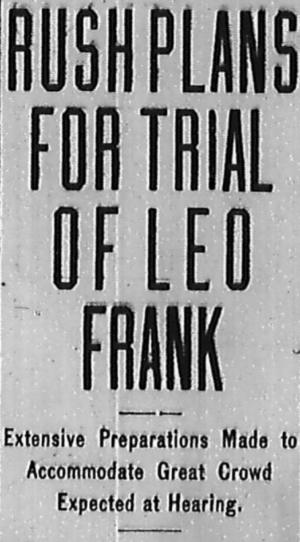
Rush Plans for Trial of Leo Frank

Another in our series of new transcriptions of contemporary articles on the Leo Frank case.

The Atlanta Georgian

Wednesday, June 18, 1913

Extensive Preparations Made to Accommodate Great Crowd Expected at Hearing.

When twelve books of evidence of more than 100 pages each were turned over to the Solicitor’s office Wednesday morning by his stenographers, Assistant Solicitor General E. A. Stephens announced the State could now go to trial on 48 hours’ notice. No evidence would be introduced, he said, except by witnesses who had already been questioned by the Solicitor.

To bring out the salient points in the evidence of each witness, the Solicitor plans to question them from the books. They will be carried over the same ground they were when they made the statements, and they will be asked no questions further than those they have already answered.

By his plan the Solicitor hopes to have the mind of each witness fresh and after he finishes the examination, according to his well arranged books of questions and answers, he thinks the defense will have difficulty in injuring the evidence on cross-examination.

Rush Plans.

Plans are being rushed to stage the trial. On account of the poor ventilation of the court room and the absence of ante-rooms to accommodate the scores of witnesses who will in all probability be sequestered, the court in the Thrower Building had been adjudged inadequate by Judge L. S. Roan and Solicitor General Hugh M. Dorsey.

Before leaving for New York he instructed his deputy to discuss with Judge Roan some new place to hold the trial where the large crowd could be accommodated and the heat would not be so excessive. The county board will be called upon to furnish a place and Mr. Dorsey will approve the selection when he returns from New York Saturday.

All plans for the trial will be completed before Saturday and the greater number of witnesses summoned. The week before June 30 the Superior Court officers will be busy with a mass of unimportant criminal cases. They will be unable to spare any time to prepare for the Frank trial and the necessary arrangements will have to be made this week.

Judge Thomas May Preside.

Judge W. C. Thomas, of the Superior Court, Valdosta, Lowndes County, was in a lengthy conference Wednesday with Assistant Solicitor E. A. Stephens, giving rise to the rumor that he might be asked to preside at the Frank trial, which will be called June 30.

Judge Thomas has presided at several other trials in Fulton County in which there was considerable local feeling, one of the most notable being the jail bond case. Judge L. S. Roan was to have presided at the Frank trial, but it is supposed that the intense local interest in the murder mystery will make him willing to turn the case over to an outside judge if the Solicitor’s office suggests the move.

* * *

The Atlanta Georgian, June 18th 1913, “Rush Plans for Trial of Leo Frank,” Leo Frank case newspaper article series (Original PDF)

Two New Witnesses Sought by Officers

Another in our series of new transcriptions of contemporary articles on the Leo Frank case.

The Atlanta Constitution

Wednesday, June 18, 1913

Former Girl Employee and a Machanic [sic] May Testify Against Frank.

Two new witnesses may be used by the state in the prosecution of Leo Frank when his trial is held on June 30. Chief Lanford is investigating the reported statement of a young girl living near Roswell and of a mechanic who resides near East Point.

The former, a lass of 17, is said to have been employed in the pencil factory two years ago. For the past year or more she has been living with her parents at their home just outside Roswell. The nature of the statements she is alleged to have made is being kept secret by the detectives. It is hinted, however, that in case she is placed on the stand, her testimony will deal with the character of the superintendent.

The testimony of the East Point mechanic is said to relate to the girl’s story, and [in the] event he is used by the prosecution, his testimony will be for the purpose of corroborating that of the girl.

The departure of Attorney Frank A. Hooper, who has been associated with Solicitor General Dorsey in the prosecution of the Phagan case, adds interest to the mystery. Mr. Hooper, it is said at his home, has gone to Indianapolis. His family declare his trip has no connection whatever with the Phagan case.

Solicitor Dorsey announced before leaving that he was going to Atlantic City to spend several days’ vacation. He said that he would have nothing to do with the Phagan case while away. He left at 2:45 Saturday afternoon, accompanied by Mrs. Dorsey.

Much speculation has also been created by a trip on which Colonel T. B. Felder embarked Sunday afternoon, less than twenty-four hours after the solicitor’s departure. Mr. Felder says he goes to Cincinnati on business entirely foreign with the Phagan investigation or the dictograph charges.

* * *

The Atlanta Constitution, June 18th 1913, “Two New Witnesses Sought by Officers,” Leo Frank case newspaper article series (Original PDF)

Guessers See a Mystery in Dorsey-Hooper Trips

Another in our series of new transcriptions of contemporary articles on the Leo Frank case.

The Atlanta Journal

Tuesday, June 17, 1913

Speculation About Departure of Phagan Case Figures Not Credited, However

What is believed to be but a coincidence in the unheralded out-of-town trips of Solicitor General Hugh M. Dorsey, Attorney Frank A. Hooper, who is to assist the solicitor in the prosecution of Leo M. Frank, and Attorney Thomas B. Felder, has given rise to a rumor that these lawyers really have gone on a secret mission of importance and one connected with the Phagan case.

Solicitor Dorsey left Atlanta Saturday afternoon, saying he was going to Atlantic City and New York for a week’s rest; Mr. Felder went away on Sunday, announcing that he was headed for Cincinnati, where he had business that was not of interest to the public; and Mr. Hooper left Monday afternoon, it being stated by his family that he had gone to Indianapolis on business and would return to Atlanta either Thursday or Friday.

Those who profess to scent a mystery in the departure of the three attorneys are allowing their speculations free range. One of the rumors set in motion is to the effect that Messrs. Dorsey, Hooper and Felder have arranged to meet in some eastern city to discuss some important feature of the Phagan case.

Detective Chief N. A. Lanford, Pinkerton Detective Harry Scott, and others who are posted as to the progress of the Phagan case, do not believe that the trips of the three lawyers have any relation whatever.

Chief Lanford and Detective Scott continue to accept as true the statement of the negro sweeper, James Conley, who swore that the only part he played in the Phagan murder was to assist Superintendent Frank to dispose of the body and to write the notes, which he says he did at the dictation of Frank.

It is claimed that Solicitor Dorsey and his investigators have in their possession evidence which strongly corroborates Conley’s story and that they are guarding this evidence very jealously in an effort to keep any inkling of it away from the defense. It was this evidence, it is said, which satisfied the solicitor general that the case against Frank was complete and that he could afford to take a much-needed vacation before the trial.

On the other hand the defense continues to ridicule the efforts made by the prosecution to substantiate Conley’s confession. The defense, it is said, has a few cards up its sleeve which it promises to play at the trial and which may result in some surprises.

* * *

The Atlanta Journal, June 17th 1913, “Guessers See a Mystery in Dorsey-Hooper Trips,” Leo Frank case newspaper article series (Original PDF)

Sensations in Phagan Case at Hand

Another in our series of new transcriptions of contemporary articles on the Leo Frank case.

The Atlanta Georgian

Tuesday, June 17, 1913

Out-of-Town Trips Believed To Be of Great Importance—Defense Has Strong Evidence.

Frank A. Hooper, associate counsel with Solicitor General Hugh M. Dorsey in the prosecution of the Phagan murder mystery, left Atlanta Monday for a trip to Indianapolis. Attorney Hooper was the third man closely connected with the Phagan case to leave town within a space of three days.

Colonel Thomas B. Felder, who took an active part in the hunt for the slayer of Mary Phagan until the dictograph controversy arose, left Sunday, saying that he was going to Cincinnati. He said that it was a business trip and intimated that it was related either to his quarrel with Chief of Detectives Lanford or directly with the Phagan case.

Solicitor Dorsey left the previous afternoon. He gave out that the prosecution entirely had completed its preparation of the Phagan case and that he was going away for a week’s rest at Atlantic City and New York.

Deny Mystery.

At the Hooper home Tuesday it was admitted that Mr. Hooper’s trip was on business, but denial was made that it was in connection with the Phagan case or that there was any significance in his departure practically at the same time as that of Solicitor Dorsey and Colonel Felder.

Rumors are circulating, however, that material witnesses in the case have been uncovered and that their testimony may have a most important bearing in determining the person who strangled Mary Phagan. It is said that the sudden trips out of town of Solicitor Dorsey and his associate, Attorney Hooper, may not be unrelated to these new developments.

The prosecution has been aware for some time that the attorneys for the defense have been weaving a strong net of damaging evidence around the negro sweeper, Jim Conley.

But Attorney Luther Z. Rosser, following his custom of silence, has let neither the public nor the prosecution in on the secret of the source of this important evidence. He has scores of affidavits. That much is known by the prosecution, but by whom they are signed will probably remain a deep mystery until the Frank trial begins. Continue Reading →

Constitution Picture Will Figure in Trial

Another in our series of new transcriptions of contemporary articles on the Leo Frank case.

The Atlanta Constitution

Monday, June 16, 1913

Solicitor Wants Photograph of Spot Where Mary Phagan’s Body Was Found

A flashlight picture, made by The Constitution’s staff photographer is to be used as evidence by the prosecution in the trial of Leo M. Frank. This was made evident Sunday afternoon when Detective John Starnes applied to a Constitution reporter for the photograph of the spot in the pencil factory basement, where Mary Phagan’s body was discovered.

Starnes would not state why he wanted the picture, saying only that it would be used by the prosecution. He was extremely desirous of getting it, and it will be put in his possession this morning. It is rumored that by the picture an effort will be made to corroborate certain statements of James Conley, the negro sweeper when he is placed on the witness stand.

Starnes told the reporter that the prosecution was ready for trial. He expressed confidence that the mystery would be cleared at the coming trial, which he believes will be held on the thirtieth. In case of postponement, he says, it will be the fault of the defense, as the state is ready.

Starnes has been intimately associated with the solicitor general during the murder investigation. In fact, he has been more closely in touch with Dorsey than any other official concerned in the case. He is a detective attached to headquarters and associated with Detective Pat Campbell who has been identified with many big criminal cases, which the detective department has solved.

* * *

The Atlanta Constitution, June 16th 1913, “Constitution Picture Will Figure in Trial,” Leo Frank case newspaper article series (Original PDF)

Felder Leaves Atlanta on Trip to Cincinnati

Another in our series of new transcriptions of contemporary articles on the Leo Frank case.

The Atlanta Journal

Monday, June 16, 1913

Thomas B. Felder, the attorney, left Atlanta for Cincinnati Sunday afternoon to be away from the city on a business trip for several days.

The absence of Mr. Felder from the city is taken as indication that the grand jury will not take up an investigation of the famous dictograph episode this week, if it makes such a probe at all.

Mr. Felder declared that his trip has nothing to do with the dictograph case. He stated that he expected to return within a week.

The foreman of the grand jury, L. H. Beck, has intimated that the jury may take up the dictograph matter if it is able to dispose of its routine business before its term of service expires, June 30.

* * *

The Atlanta Journal, June 16th 1913, “Felder Leaves Atlanta on Trip to Cincinnati,” Leo Frank case newspaper article series (Original PDF)

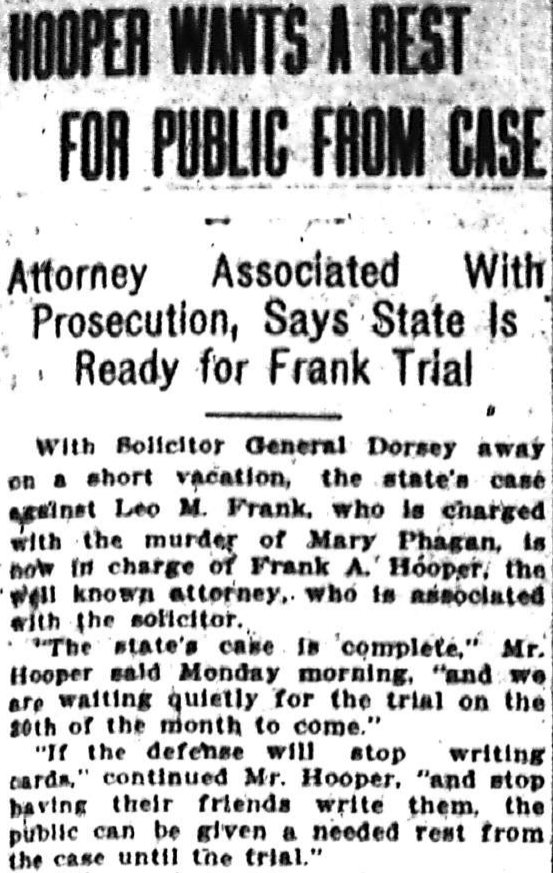
Hooper Wants a Rest For Public From Case

Another in our series of new transcriptions of contemporary articles on the Leo Frank case.

The Atlanta Journal

Monday, June 16, 1913

Attorney Associated With Prosecution, Says State Is Ready for Frank Trial

With Solicitor General Dorsey away on a short vacation, the state’s case against Leo M. Frank, who is charged with the murder of Mary Phagan, is now in charge of Frank A. Hooper, the well known attorney, who is associated with the solicitor.

“The state’s case is complete,” Mr. Hooper said Monday morning, “and we are waiting quietly for the trial on the 30th of the month to come.”

“If the defense will stop writing cards,” continued Mr. Hooper, “and stop having their friends write them, the public can be given a needed rest from the case until the trial.”

Mr. Hooper’s statement that the prosecution is quietly waiting for the trial on June 30 is the most authoritative announcement of the date of the trial yet made.

Solicitor General Dorsey has steadfastly refrained from any definite announcement about the time of the trial, but it has been generally understood for some time that the solicitor set the case on the court’s calendar for June 30, and it will then remain with the defense as to whether there is a postponement.

While Mr. Hooper’s name was not publicly connected with the case until Sunday, it is understood that the solicitor general has been consulting with him for several weeks, and it is said that Mr. Hooper is familiar with every phase of the investigation.

With the state’s case regarded as complete, it is said that the attorneys and detectives identified with the prosecution are now devoting their energies to preparing for any surprises the defense may spring when the case goes before the court.

It was rumored Monday that the grand jury on Tuesday would take up the case of James Conley, the negro who is a self-confessed accessory after the fact in the killing, but this rumor was without foundation. It was occasioned by an error in the issuance of subpenas. The grand jury, according to its foreman, will devote the entire session Tuesday to routine cases, which have piled up during the vice investigation.

The grand jury foreman, L. H. Beck, also denied the rumor that it had taken up any investigations of third degree work by the detectives in the Phagan or in any other case. “No such investigation is even likely,” he said.

* * *

The Atlanta Journal, June 16th 1913, “Hooper Wants a Rest For Public From Case,” Leo Frank case newspaper article series (Original PDF)

Col. Thomas Felder Goes to Cincinnati

Another in our series of new transcriptions of contemporary articles on the Leo Frank case.

The Atlanta Constitution

Monday, June 16, 1913

Says Trip Has Nothing to Do With That of Solicitor Dorsey

Following the departure of Solicitor General Hugh M. Dorsey for Atlantic City Saturday afternoon, Col. Thomas B. Felder left Sunday afternoon at 5:10 o’clock for Cincinnati.

He said that his trip had no connection whatever with that of the solicitor general. He would not disclose his object in going to Cincinnati, however, and said only that he would be in the Ohio city for several days. Business was his motive in leaving, he declared, although he would not tell what business he intended to transact.

Colonel Felder declares that the affidavit which an Atlanta paper, on Sunday morning, accredits George Gentry with having made, verifies his own contention.

“It supports me in every particular,” he said. “It corroborates my statement that Gentry is willing to return to Atlanta at any time the grand jury or any other investigating committee needed him; that he is passing under an assumed name in Washington, and that he was striving to keep out of the reach of certain Atlantans who are endeavoring to find him.

“He even admits in this last affidavit that the dictagraph reports were padded. He says that charges were made, although it is intimated that they were immaterial. He acknowledges having signed Miles’ affidavit, and says that it was correct thoroughly. This, in itself, is all the support I would ask of Gentry. The affidavit obtained by Detective Miles is proof positive that the reports were padded—that is an established fact.

“Another thing: Gentry says again that his note book—the original transcription of the Williams House conversations—is in the vault of a prominent and reliable Atlanta attorney, and that they will be produced at time of any investigation. Even though Gentry testified otherwise, we have the notes—they are all that is needed to prove our contention that the published reports were altered.”

Colonel Felder would not talk regarding his trip to Cincinnati.

“I am going there on a matter of business,” was all he would say. “It wouldn’t interest the public in general, and would interfere with my plans if I disclosed my mission. I will return within the next few days.”

* * *

The Atlanta Constitution, June 16th 1913, “Col. Thomas Felder Goes to Cincinnati,” Leo Frank case newspaper article series (Original PDF)

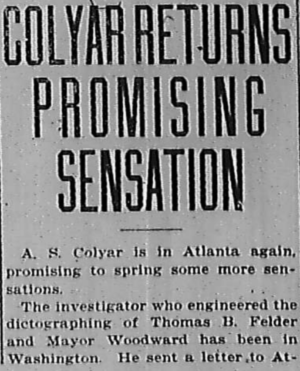
Colyar Returns Promising Sensation

Another in our series of new transcriptions of contemporary articles on the Leo Frank case.

The Atlanta Georgian

Monday, June 16, 1913

A. S. Colyar is in Atlanta again, promising to spring some more sensations.

The investigator who engineered the dictographing of Thomas B. Felder and Mayor Woodward has been in Washington. He sent a letter to Atlanta before him, saying he objected to being made a goat.

It is believed Colyar saw George M. Gentry while in Washington and got from him an affidavit. This is said to be much the same as the one printed admitting that the dictograph records had been padded, as charged in Gentry’s recent affidavit, but that the general charges were upheld.

Promises Story in Letter.

Colyar’s letter, mailed before he left Washington, follows:

“He laughs best who laughs last. When you get tired publishing all of the lies the gang of political crooks are publishing on Lanford and myself I may be able to give you a story that will cause some people to sit up and take notice.

“It’s indeed comforting to think one purchased affidavit can cause a certain man in Atlanta to consider himself vindicated completely. Whitewash is cheap, as we all know.

“Then there is Mayor Woodward. He says ‘Colyar went to Mrs. Gentry’s house and worried her.’ Indeed, where did he learn this? It’s news to me. But we all know the Mayor. He is the same Mayor Hon. R. F. Maddox defeated after he (Woodward) was nominated by his party, and all Atlanta knows why. Let them make a goat out of me and see what I publish in my own defense.

“The crooks got caught. And they sent Miles away to see if he could not fool the people. A. S. COLYAR.”

Felder’s Trip Causes Comment.

Speculation was rife Monday as to the nature of the trip of Colonel Thomas B. Felder, who left Atlanta Sunday afternoon with the statement that he was bound for Cincinnati.

Rumors had it that Colonel Felder in reality is on his way to Washington, for the purpose probably of conferring with George Gentry, the missing stenographer in the recent dictagraph sensation. If this is Colonel Felder’s intention, he kept it to himself.

It has been suggested that Colonel Felder would feel much safer in going to Washington by way of Cincinnati than through the State of South Carolina.

* * *

The Atlanta Georgian, June 16th 1913, “Colyar Returns Promising Sensation,” Leo Frank case newspaper article series (Original PDF)

Dorsey Aide Says Frank Is Fast In Net

Another in our series of new transcriptions of contemporary articles on the Leo Frank case.

The Atlanta Georgian

Monday, June 16, 1913

Attorney Hooper Declares State Is Prepared for Any Move the Defense May Make.

Frank A. Hooper, the well-known criminal lawyer who has been engaged to assist Solicitor General Hugh M. Dorsey in the trial of Leo M. Frank for the alleged murder of Mary Phagan, said Monday that the case was complete and was ready for presentation in court at any time.

Mr. Hooper asserted that the attorneys interested in the prosecution had investigated every angle of the mystery so thoroughly and fortified themselves against any defense that Frank will present, that practically nothing remained to be done until the case was called for trial. The departure of Solicitor Dorsey for a week’s vacation, he said, was an indication of the preparedness of the prosecution.

No new developments are expected by the prosecution, according to Mr. Hooper. All of the stories and rumors have been run down to their original source. The defense, in his opinion, will be able to spring no surprise that has not been anticipated by the prosecution.

Mrs. Frank Gives Interview.

The American printed Sunday an exclusive interview with Mrs. Frank, whose husband, Leo M. Frank, is under indictment chraged with the murder of 14-year-old Mary Phagan. It was the first time that Mrs. Frank had permitted himself to be interviewed since the Coroner’s jury a month ago recommended that the Grand Jury hold her husband for trial.

She broke her silence to tell the thousands who have been gripped by the remarkable murder mystery just why she is absolutely confident and positive that Frank could not have been the author of the terrible deed. She made no plea for sympathy, but expressed herself as fully reconciled to the processes of the law, even though they temporarily caused her the greatest sorrow and kept her husband behind the cars as a man suspected of one of the most brutal crimes thinkable. The loyal wife said that she was able to bear the present belief because of the assurance of Frank’s ultimate and complete vindication.

Why She Believes Husband.

On the fact that she believes from her life with the suspected slayer that any gross or immoral act is utterly apart from his nature, she bases much of her belief in his entire innocence. Continue Reading →

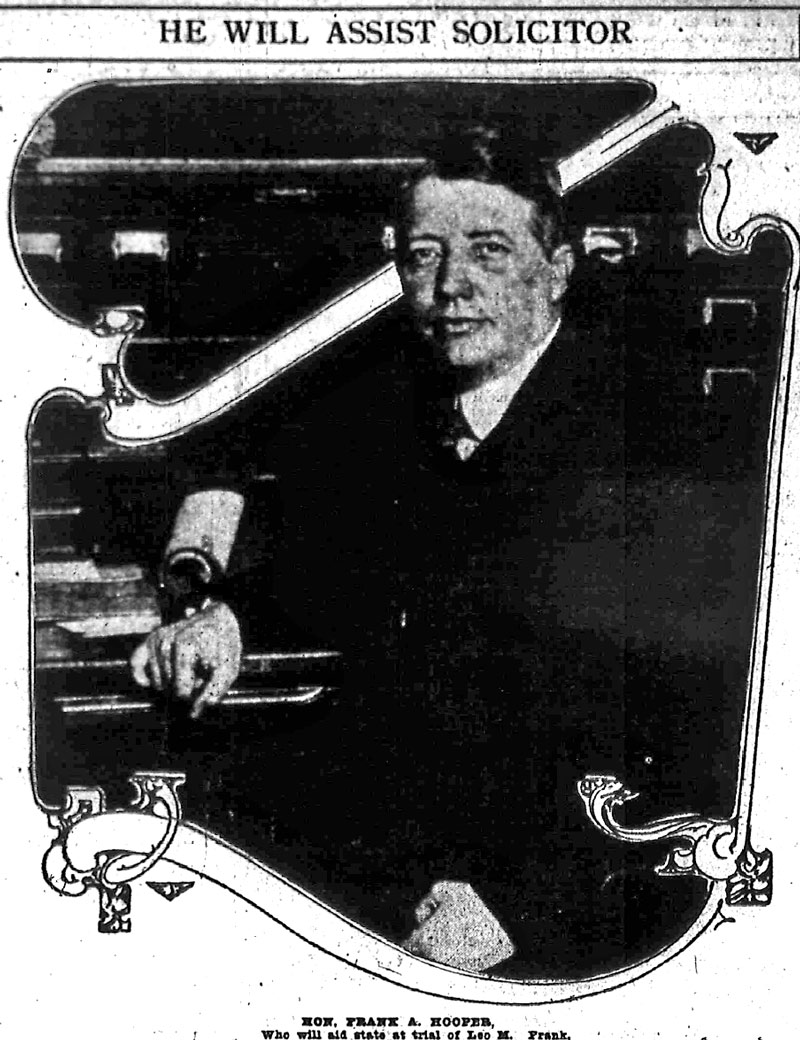
Frank A. Hooper to Aid State in Frank Trial

Another in our series of new transcriptions of contemporary articles on the Leo Frank case.

The Atlanta Journal

Sunday, June 15, 1913

Former Solicitor at Americus Engaged to Assist Solicitor Hugh M. Dorsey

That the trial of Leo M. Frank will be a legal battle as brilliant as any ever fought in Atlanta is assured by Solicitor Dorsey’s announcement that Frank A. Hooper, Atlanta lawyer and former solicitor general of the southwestern superior court circuit, has been retained to assist the prosecution.

With the case of the state in the hands of Solicitor Dorsey and Mr. Hooper and the defense resting with Luther Z. Rosser and Herbert Haas the contest is certain to be replete with the unexpected.

Frank A. Hooper, who is Solicitor Dorsey’s choice to help the fight of the state, is distinguished as a state’s solicitor of twelve years experience. No lawyer at the Atlanta bar has seen a similar service as a prosecuting attorney. For this period he acted as solicitor to the southwestern superior court circuit at Americus. Following his term as prosecutor he practiced law in Americus being recently identified with such criminal trials as the Childers trial in Americus and the Cain trial in Cordele. In each of these cases in which the accused was acquitted Hooper appeared for the defense.

He came to Atlanta four years ago as an associate of the late Governor J. M. Terrell.

Pitted against Solicitor Dorsey and Mr. Hooper will be Luther Z. Rosser sometimes known among his confreres as “the best all-around lawyer in Atlanta;” Herbert Haas, a young but experienced attorney, and possibly others.

The report has been persistent in Atlanta for a week that another prominent Atlanta attorney known as a brilliant criminal lawyer is to be associated with the defense. While this report has not been verified there are those who are confident that the defense will be augmented by his weight before Frank faces a jury in the stuffy little Thrower building court room.

In making his announcement that Mr. Hooper was to assist in the Frank prosecution Solicitor Dorsey said that while Mr. Hooper had been his choice, Mr. and Mrs. J. W. Coleman, parents of the slain girl, had been consulted, and they directed him to employ such counsel as he deemed fit. The solicitor asserted that the Colemans had approved the employment of Mr. Hooper.

* * *

The Atlanta Journal, June 15th 1913, “Frank A. Hooper to Aid State in Frank Trial,” Leo Frank case newspaper article series (Original PDF)

Solicitor Dorsey Goes to New York

Another in our series of new transcriptions of contemporary articles on the Leo Frank case.

The Atlanta Constitution

Sunday, June 15, 1913

Grand Jury Will Probably Take Up the Dictagraph Probe While He Is Away.

With the departure of Solicitor General Hugh M. Dorsey for New York yesterday afternoon, whither he declares he is going for a week’s rest, and the announcement of Foreman L. H. Beck, of the grand jury, that only routine criminal business will be taken up at the meeting on Tuesday, comes a peculiar situation, as hitherto the solicitor’s pretense has been considered necessary for the indictment of the regular class of criminals, and only when investigating on their own accord ddoes [sic] the grand jury usually dispense with his services.

The assurance is continuously given out that the grand jury must finish its routin [sic] business before it can enter into a general investigation such as a renewal of the vice probe or an investigation of the Felder-Beavers dictagraph row, despite the apparent pressing need for clearing up the tangle that has grown from the affair.

It appears that the members of the grand jury intend to take up at their meeting this week some investigation or other work in which the solicitor will not be needed and the general impression is that the dictagraph row will be probed.

This would be in keeping with the vice probe which both the solicitor and the foreman attempted to veil in secrecy until the very day upon which it was started, and their actions upon this occasion strengthen the belief that further investigation will occupy the grand jurors at their next meeting.

On top of this comes the announcement from an apparently responsible source of a demand made by Colonel Thomas B. Felder that the body probe the dictagraph affair, and the refusal of both the solicitor and the foreman of the jury to discuss this matter, or even to admit having received such a communication.

Solicitor Dorsey gave out officially that his visit would be one of personal recreation and that he might possibly spend a short time at Atlantic City before returning home.

* * *

The Atlanta Constitution, June 15th 1913, “Solicitor Dorsey Goes to New York,” Leo Frank case newspaper article series (Original PDF)

Gentry, Found by Journal, Says Notes Will Show Enough to Justify What Was Sworn To

Another in our series of new transcriptions of contemporary articles on the Leo Frank case.

The Atlanta Journal

Sunday, June 15, 1913

“Upon Reading My Notes Before the Court It Will Be Proven That There Is Enough of It There to Justify What Was Written and Sworn to be Me as Being Practically the Gist of What Was Said,” Says Young Stenographer of Dictograph Records Transcribed by Him

“I WAS ALLOWED TO READ PROOF OF WHAT WAS PUBLISHED ABOUT FELDER CONFERENCE,” HE SAYS

“As Far as What The Journal Published, Will Say, as Far as I Can Remember, What They Printed Were the Facts In a General Way, and the Changes Were Immaterial.” Located by The Jounaal’s [sic] Washington Correspondent, Gentry Talks Freely.

By Ralph Smith

WASHINGTON, D. C., June 14.—Living under an assumed name and holding a lucrative position as an expert stenographer, George M. Gentry, of Atlanta, who made the famous dictograph notes, was located in Washington today by the Journal correspondent. He has been here since May 27. He left Atlanta via the Southern railway on the evening of May 26, following the Felder exposure. He claims to have seen no one from Atlanta other than E. O. Miles, and The Journal correspondent, though he is in communication with the members of his immediate family.

Gentry’s real identity is unknown to his employers, and at his request his present address and the place of his employment are withheld by the correspondent. Their publication, he believes, might cause him unnecessary annoyance.

“I left Atlanta because I feared that I might be arrested for perjury,” he said.

Gentry today voluntarily made an affidavit, elaborating and elucidating the statements contained in the affidavit he recently gave to E. O. Miles. This affidavit, made today, was sworn to and subscribed before Isaac Heidenheimer, of 1226 Pennsylvania avenue, notary public, for the District of Columbia. It was witnessed by Senator William Hughes, of New Jersey and Congressman Frank Doremus, of Michigan.

The original and a carbon copy are in the possession of The Journal correspondent, and Gentry himself has a copy. The affidavit was written by Gentry, without suggestion or dictation from anyone.

“Unfortunately I did not go into enough detail in my previous affidavit, hence the necessity of making a further one,” swore Gentry today.

Continuing the affidavit says, “I neglected to mention in same (the Miles affidavit) that I was allowed to read a proof of what The Journal published, in connection with the Felder conference. This conference was transcribed first and printed in Friday’s issue of the Journal. The other conferences, all of which were held Wednesday afternoon and evening, preceding the date of publication, were not published until after the Felder conference was published. I made one or two changes in the proof of the Felder conference, this being the only proof I was allowed to see. As I remember in one instance, I had written the word “intrude” any my notes contained the word “intruding.”

“Further than this I do not remember of any change that I made in same, with the exception of ordinary corrections, such as marking misspelled words, adding periods and commas, and striking them out.” Continue Reading →

Frank Hooper Aids Phagan Prosecution

Another in our series of new transcriptions of contemporary articles on the Leo Frank case.

The Atlanta Constitution

Sunday, June 15, 1913

Solicitor General Hugh Dorsey Announces His Associate in Big Case.

Just before leaving yesterday afternoon for New York, Solicitor General Hugh M. Dorsey announced that Attorney Frank A. Hooper would be associated with him in the prosecution growing out of the murder of Mary Phagan.

Saying that Mr. Hooper was his personal choice, Dorsey also stated that Mr. and Mrs. J. W. Coleman, parents of the victim, had been consulted and had directed him to employ such counsel as he desired and that his choice of Mr. Hooper satisfied the Colemans.

Attorney Hooper has been a well-known figure at the Atlanta bar for four years. Shortly after coming to this city, he was associated with ex-Governor Joseph M. Terrell, with whom he was connected until the governor’s death. He was for twelve years the solicitor general of the southwestern judicial circuit at Americus, Ga.

Among many notable cases with which he played a conspicuous part were the Childers trial in Americus and the famous Cain murder case in Cordele. He was counsel for the defense in each case. He will be in charge of the solicitor’s affairs which relate to the Phagan case during Mr. Dorsey’s absence on his present trip.

* * *

The Atlanta Constitution, June 15th 1913, “Frank Hooper Aids Phagan Prosecution,” Leo Frank case newspaper article series (Original PDF)

Detective Chief Tells Grand Jury of “Third Degree”

Another in our series of new transcriptions of contemporary articles on the Leo Frank case.

The Atlanta Constitution

Sunday, June 15, 1913

Questions Put to Lanford Indicate That Investigation of Police Methods Is Being Conducted.

TORTURE ERA IS PAST, CHIEF INFORMS JURY

Science and Skill Now Employed by Detectives in Securing Confessions From Criminals, He Says.

The police “third degree,” which has created such widespread discussion during the Mary Phagan murder investigation, has been thoroughly explained to the grand jury by Detective Chief Newport A. Lanford, who appeared before that body at its request.

Detective John Black, of headquarters, who has been an active figure in the Phagan case, is also said to have been quizzed about methods employed by the police and detectives. He will not talk of the subject. Members of the jury are reluctant to give any information.

Chief Lanford, however, willingly told a Constitution reporter of his testimony before the jury and of the nature of queries which were put to him. He says he gave a complete and apparently satisfactory account of the “third degree” and the manner in which it is practiced at police headquarters.

Is Jury Probing Police Methods?

The belief is prevalent in both police and court circles that a secret probe is being promoted by the grand jury into methods employed by both the police and detective departments, and that it was in pursuit of this investigation that the detective head and Black were examined. Chief Lanford is inclined to scout this theory, although he is unable to account for the testimony that was required of him and of Black in the “third degree” probe.

The use of the “third degree” during the Phagan mystery has caused much comment. Its most effective employment, it will be recalled, was in extracting three sensational confessions from the negro sweeper, James Conley. Newt Lee, the negro watchman, the first suspect in the murder case, was subjected to a “degree” equally as strenuous.

The public letter of Mrs. Leo Frank, in which she took the detectives and Solicitor General Dorsey to task for subjecting her servant girl, Minola McKnight, to a system of cross-examination, which, she asserted, left the girl in a state of exhaustion, probably served to actuate the jury’s inquiry into police methods. Mrs. Frank’s letter was a stinging arraignment, and[…]

Continued on Page Four.

Continue Reading →

State Takes Advantage of Points Known

Another in our series of new transcriptions of contemporary articles on the Leo Frank case.

The Atlanta Georgian

Saturday, June 14, 1913

With certain of the strong defenses of Leo M. Frank exposed by the preliminary battle over the custody of the negro Conley, the prosecution in the Phagan murder mystery went to work on the case to-day with its first definite idea of the sort of a stronghold it must assault.

It was assured that the accused man’s lawyers would not rest with fighting suspicion away from Frank, but would seek to fasten the guilt so firmly upon Conley that Frank not only would be acquitted, but that he would be cleared of every stain which has been cast upon his name and reputation by the terrible charges lodged against him.

Report was rife Saturday morning that the attorneys for Frank had not yet acknowledged defeat in their efforts to have Conley confined at the Tower instead of at the police station, where they charge he is improperly protected and “petted” by the detectives. The next move was rumored to be the swearing out of a warrant charging the negro with the murder, to compel Conley’s removal to the Tower.

Attacked by Rosser.

Luther Z. Rosser, chief of counsel for Frank, has branded at most unusual and irregular the procedure which has allowed the negro, who has confessed to being accessory after the fact, to be left without an indictment[…]

Continued on Page 2, Column 1.

STATE PLANS TO BREAK FRANK DEFENSE

Continued From Page 1.

[…]against him on the charge to which he has virtually pleaded guilty.

Rosser urged an impartial investigation into the possibility that he is even more seriously connected with the crime which resulted in the grewsome death of Mary Phagan.

Chief of Detectives Lanford said Saturday when he was apprised of the contemplated move of those who wish to see the negro’s stories investigated by an impartial body that he assuredly would honor any warrant which on its face appeared bona fide, but that he would fight any effort to take Conley to the jail, which he suspected had back of it the animus of persons unfriendly to the negro and friendly to Frank. Lanford asserted that all of his actions in the Phagan mystery had been inspired by the desire to get the guilty man, and that it was his conviction that the negro was only a tool after the actual crime. Continue Reading →

Sheriff Mangum Near End, Says Lawyer Smith

Another in our series of new transcriptions of contemporary articles on the Leo Frank case.

The Atlanta Georgian

Saturday, June 14, 1913

Attorney for Conley Injects Politics Into Dispute Over Negro’s Place of Confinement.

William M. Smith, counsel for James Conley, confessed accessory after the fact in the killing of Mary Phagan, in a statement Saturday sought to make a political issue out of his controversy with Sheriff Mangum over the alleged treatment Conley received while in the Tower.

Attorney Smith employed references to his own previous statement that the jail was five stories high; was divided into four wings with seventeen cell blocks distributed over five floors, to discredit Sheriff Mangum’s characterization of the entire affidavit as “an infamous lie.”

He continued by asking if his other references to the structural conditions at the Tower also were lies. He added that Conley had furnished him with an affidavit as to the treatment he had received as a prisoner at the jail, and said he had given to Sheriff Mangum the name of one person, though what the charges are against this person the attorney does not specify. He intimated he had performed services for the Sheriff in the past and that there was much more he could tell if he desired.

The attorney concludes his reply to the Sheriff by the observation that Mr. Mangum “must be reaching the point where his usefulness to the public in his present position is at an end, and the citizens of this county would do well to select from among his ranks of splendid deputies a new Sheriff in the next election.”

In discussing his affidavit, Mr. Smith remarked:

“I did state that I thought the condition was due to the physical construction of the jail and to the fact that the county authorities did not give Sheriff Mangum money to hire sufficient guards. I stated that the best Sheriff in the world, with the best and the most efficient deputies, could probably do no better under the conditions that Sheriff Mangum and his deputies were placed. If I lied anywhere, it was in an effort to exonerate Sheriff Mangum from any blame in connection with the conditions in Fulton County jail.

“Mangum may forget, but he has men on his force who do not, and the general public remembers the weight of obligation that should rest upon him for services rendered by me to him in the past. For him to rush into public print and denounce me as an ‘infamous liar,’ probably without reading the many statements made in my affidavit exonerating him and his men, is not entirely surprising to me.

“If Sheriff Mangum wants me to tell the general public through the press the conditions as I know them to exist relative to the Fulton County jail, I can do it, and with the gloves off.”

* * *

The Atlanta Georgian, June 14th 1913, “Sheriff Mangum Near End, Says Lawyer Smith,” Leo Frank case newspaper article series (Original PDF)

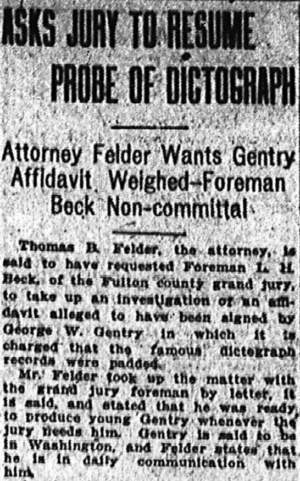
Asks Jury to Resume Probe of Dictograph

Another in our series of new transcriptions of contemporary articles on the Leo Frank case.

The Atlanta Journal

Saturday, June 14, 1913.

Attorney Felder Wants Gentry Affidavit Weighed—Foreman Beck Non-committal

Thomas B. Felder, the attorney, is said to have requested Foreman L. H. Beck, of the Fulton county grand jury, to take up an investigation of an affidavit alleged to have been signed by George W. [sic] Gentry in which it is charged that the famous dictograph records were padded.

Mr. Felder took up the matter with the grand jury foreman by letter, it is said, and stated that he was ready to produce young Gentry whenever the jury needs him. Gentry is said to be in Washington, and Felder states that he is in daily communication with him.

Another figure in the dictograph episode who now is missing from the city is A. S. Colyar. At the Williams house, where he lived in the city, Colyar left no address, but reserved a room, saying that he expected to return to the city.

Chief of Detectives Lanford declares that he does not know the whereabouts of either Colyar or Gentry, although he is conducting a vigorous search in Washington for the latter.

Foreman L. H. Beck of the grand jury has stated again that the term of service of the present body is so short that it is absolutely necessary that it take up the routine business of the solicitor’s office.

The foreman, however, will not make a definite statement relative to the dictograph probe or to the vice probe.

* * *

The Atlanta Journal, June 14th 1913, “Asks Jury to Resume Probe of Dictograph,” Leo Frank case newspaper article series (Original PDF)

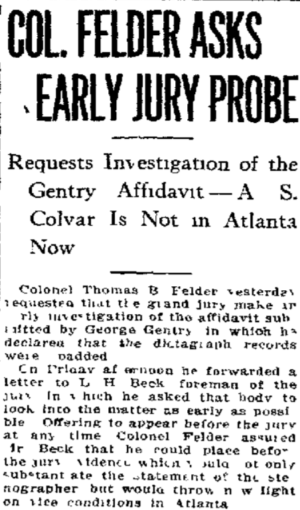
Col. Felder Asks Early Jury Probe

Another in our series of new transcriptions of contemporary articles on the Leo Frank case.

The Atlanta Constitution

Saturday, June 14, 1913.

Requests Investigation of the Gentry Affidavit—A. S. Colyar Is Not in Atlanta Now

Colonel Thomas B. Felder yesterday requested that the grand jury make an early investigation of the affidavit submitted by George Gentry in which he declared that the dictagraph records were padded.

On Friday afternoon he forwarded a letter to L. H. Beck, foreman of the jury, in which he asked that body to look into the matter as early as possible. Offering to appear before the jury at any time, Colonel Felder assured Mr. Beck that he could place before the jury evidence which would not only substantiate the statement of the stenographer, but would throw new light on vice conditions in Atlanta.

Gentry Willing to Testify

Colonel Felder also informed the jury foreman that at any moment he could bring George Gentry before that boy to give his testimony. Gentry, he said, was ready and willing to come back to Atlanta. While Colonel Felder stated that he was in daily communication with Mr. Gentry, the detective department is not so fortunate. Chief Lanford, having so far failed to locate the youth in Washington, where he is living under an assumed name and working for a business house there.

Coincident with the proposed investigation of the dictagraph charges is the absence of A. S. Colyar. Colyar could not be found Friday or last night. At the Williams house where he lived while in the city, he was said to have left town with instructions to retain his room for future occupancy.

The clerk of the hotel said that he did not know of the man’s whereabouts or when he was expected to return. Colyar, he said, had not told of his destination upon leaving several days ago. It is reported that he has gone to Washington to locate Gentry the stenographer and ascertain whether or not his sensational affidavit was correct. Another rumor is that he is in Cartersville, Ga., his home to which his wife returned several days previous to his departure.

Where is Colyar?

Chief Lanford, with whom Colyar has been closely associated during the latter’s sensational operations in Atlanta, said that he did not know where Colyar could be located or whether or not he was in or out of the city. Others with whom Colyar has been connected say they do not know of his whereabouts. He was seen as late as Saturday night. Efforts to find him in Washington have been to no avail. Continue Reading →

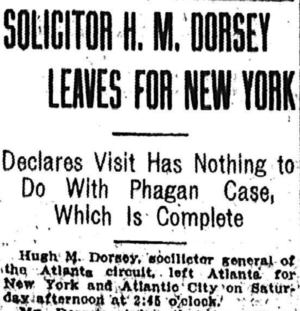
Solicitor H. M. Dorsey Leaves for New York

Another in our series of new transcriptions of contemporary articles on the Leo Frank case.

The Atlanta Journal

Saturday, June 14, 1913

Declares Visit Has Nothing to Do With Phagan Case, Which Is Complete

Hugh M. Dorsey, solcilictor [sic] general of the Atlanta circuit, left Atlanta for New York and Atlantic City on Saturday afternoon at 2:45 o’clock.

Mr. Dorsey states that he will be away from the city for a week, and is going simply to get a needed rest, and vacation from the duties of his office. He denies that his visit to New York has anything to do with the case against Leo M. Frank, who is charged with the murder of Mary Phagan. It was rumored that Mr. Dorsey would make a personal investigation of the past life of the accused man, but the solicitor states that this rumor is without any foundation.

The duties of the solicitor’s office are naturally arduous, and Mr. Dorsey almost since the murder of Mary Phagan, has had charge of the active investigation of the case as well as his routine work, and as a result is greatly in need of a rest.

Mr. Dorsey’s absence from the city for a week is not expected to delay the trial of Frank.

While he has made no announcement, it has been generally conceded that the official will set the Frank trial for June 30, and it will then depend on the defense as to whether or not a postponement of the case is asked.

For the reason that the court generally do not sit during the months of July and August, it is said to be extremely probable that Frank will actually come to trial on June 30, as a postponement then will probably mean that the case will not be reached until September.

The fact that the solicitor is willing to leave the city at this time is taken by those familiar with the Phagan case as an indication that at last the investigation is complete, and that all sides are simply waiting for the hour of trial to come.

* * *

The Atlanta Journal, June 14th 1913, “Solicitor Hugh M. Dorsey Leaves for New York,” Leo Frank case newspaper article series (Original PDF)