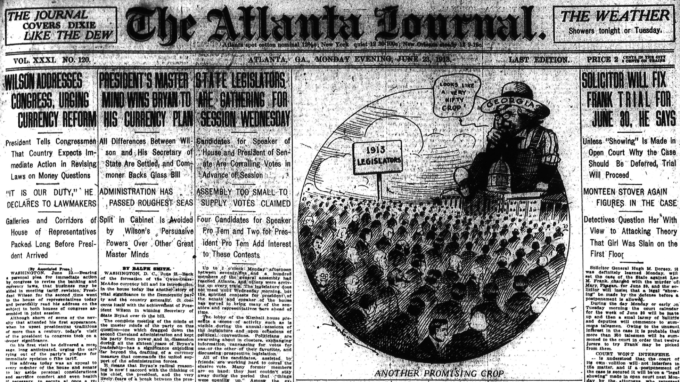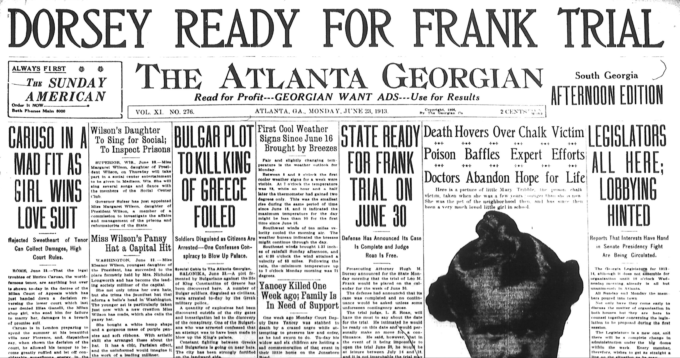
Leo M. Frank’s Trial June 30, Says Dorsey

Another in our series of new transcriptions of contemporary articles on the Leo Frank case.

The Atlanta Constitution

Monday, June 23, 1913

Solicitor General Hears Report That John Moore Will Assist in the Defense.

“Unless something now turns up of which I have no knowledge at present, I will set Leo Frank’s trial for June 30,” said Solicitor General Hugh M. Dorsey yesterday on his return from a week’s stay in New York city.

While the solicitor’s announcement has set at rest the rumors that the state would wait and set the trial for July 14 or 28, it does not necessarily mean that the trial will actually be held on that date, as the defense may desire to postpone it and make a showing to the court that would alow [sic] such a postponement. It means at least that the trial will come off at an early date.

“I have talked with Colonel Stephens,” added the solicitor, referring to E. A. Stephens, his assistant, “and there is apparently nothing new in the case, and from all that I know the state is ready to go to trial.

Has Moore Entered Case?

“I see that Reuben Arnold and John Moore have entered the case for the defense since I left,” said the solicitor. Continue Reading →

Jurors, Not Newspapers, To Return Frank Verdict, Declares Old Reporter

Another in our series of new transcriptions of contemporary articles on the Leo Frank case.

The Atlanta Georgian

Sunday, June 22, 1913

Writer Declares He Has Only Worked for Fair Trial and Fair Play—Race Question Is No Issue in Phagan Case—Rosser Not Writer.

By AN OLD POLICE REPORTER.

There were few developments in the Phagan case last week that to my mind were worth considering seriously or that threw new light upon the mystery.

Perhaps it was because of this that a good many people wrote letters to “The Old Police Reporter”—some commending my articles, others condemning them; but in every case indicating clearly that the interest has not lessened.

I observe that some of the State newspapers are publishing foolish little paragraphs, bearing the Atlanta date line, to the effect that the Hearst newspapers have been “bought to defend Frank.” This is too foolish to notice.

Still other newspapers are taking advantage of the silly season to point out various phases of the case that to my mind are neither vital nor interesting.

Let me say again, as positively as I can, that these articles written by an old police reporter, are not for the purpose of either making a case for or against any other individual.

Newspapers Will Not Render Verdict.

My aim is to set down in a fair, truthful way my own opinion of the case. I do not know whether the editor of the Hearst newspapers indorses [sic] my views or not.

I am of the opinion that the editor of The Sunday American and The Georgian believes that it is not within his province to try Frank or Conley, but that it is his duty to give all the facts in the case that are obtainable and to let the law and the jury decide WHO is guilty.

I am not a believer in trials by newspapers. I believe in the courts, in our judges, and in our juries.

I know nothing about the Phagan case that has not been published in the newspapers. I do know that Frank has been indicted. I do know, as does everyone else, that there is a chain of circumstantial evidence which, held together in court, will make the case against Frank very serious. Continue Reading →

Arnold to Aid Frank

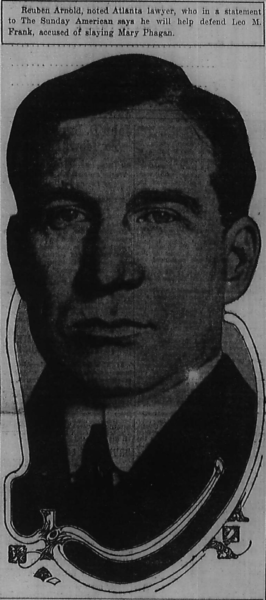
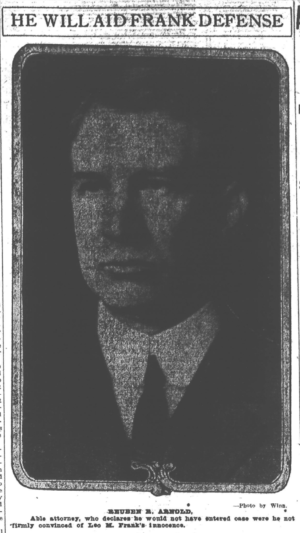
Reuben Arnold, noted Atlanta lawyer, who in a statement to The Sunday American says he will help defend Leo M. Frank, accused of slaying Mary Phagan.

Another in our series of new transcriptions of contemporary articles on the Leo Frank case.

The Atlanta Georgian

Sunday, June 22, 1913

Declares Prisoner is Innocent

Has Studied Case Deeply, He Says

Noted Lawyer, in Statement to Sunday American, Tells Why He Has Decided to Take Up the Defense of the Accused Man.

Negro Conley, in New Interview, Asserts He Is Eager to Face Leo M. Frank in Court and Repeat Story of Alleged Part in Crime.

Positive confirmation of the report that he would be one of counsel for the defense in the trial of Leo M. Frank, for the alleged strangling of Mary Phagan, was made Saturday night by Reuben R. Arnold, in a statement unqualifiedly declaring that there could be no room for the belief that Frank was guilty of the murder.

Mr. Arnold expressed his conviction that no white man committed the crime, and said that if he had not thoroughly convinced himself of Frank’s absolute innocence he would not have undertaken to assist in the defense.

The brilliant attorney, in forcible language, made known his surprise that the detectives could continue to place the responsibility on Frank in the face of what he described as the positively incriminating affidavits of the negro sweeper, Jim Conley.

Makes Formal Statement.

The news of his connection with the Phagan case, which was anticipated by The American of three weeks ago, was contained in the following formal statement which was given to the newspapers:

It is true that I have accepted employment to assist in the defense of Mr. Leo M. Frank, but I wish to state that before I agreed to take the case I made it a condition that I should have time to study critically all the evidence delivered at the Coroner’s inquest and all the affidavits that have reached the public through the newspapers, so I could form an opinion for myself as to Frank’s innocence or guilt. I would not defend any man if guilty of such a murder as the one in this case.

After studying the evidence as critically as I can, I am satisfied that I hazard not a thing in saying that there is no room to believe Mr. Frank guilty of this horrible murder, I do not believe that any white man committed the crime.

Indeed, it is surprising to me that the detectives should continue to try to put this crime on Frank with the positively incriminating affidavits of Conley before them. People of common sense, unless under great excitement, ought not to give a moment’s credence to either the Formsby [sic] or the Conley statement, in so far as they attempt to incriminate Mr. Frank.

I see the detectives are gradually giving it out that Mrs. Formsby [sic] will not be called as a witness, although her affidavit has been paraded before the public bearing the unqualified indorsement [sic] of the detective department as being perfectly reliable and true. Worse than this, an intimation was published in the newspapers that Frank’s friends had persuaded her to leave town. In this and in many other ways our client has been done a very great injustice. The effort seems to have been not to find the criminal, but to try by all means to put the crime on Frank.

However, I think we will be able to clarify the situation in due time.

The Arnold statement constitutes one of the strongest documents of the whole Phagan mystery. It is known that the attorney has been interested in the case for weeks. During this time he carefully has gone over every scrap of evidence accessible, with the idea in view of satisfying himself beyond the possibility of a doubt of the innocence of Frank. He has not confined himself to the affidavits of the defense. Continue Reading →

Leading Law Firms Have Joined Forces

Another in our series of new transcriptions of contemporary articles on the Leo Frank case.

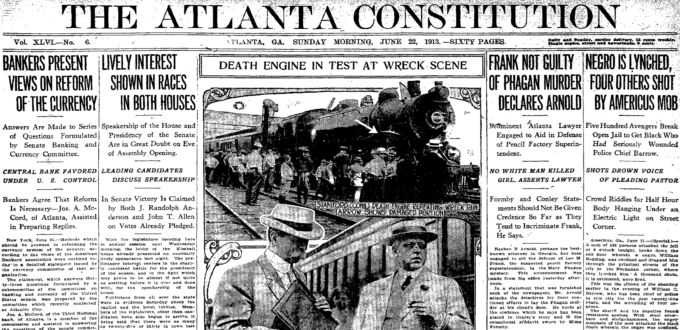
The Atlanta Constitution

Sunday, June 22, 1913

Of especial [sic] interest in legal circles is the announcement that two of the leading law firms of Atlanta have joined forces, under the firm name of Rosser, Brandon, Slaton & Phillips. They will begin operation with offices on the west end of the seventh floor of the Grant building on July 1.

Associated with the firm will be Luther Z. Rosser, Morris Brandon, John M. Slaton, Benjamin Z. Phillips, J. H. Porter, I. S. Hopkins, L. Z. Rosser Jr., V. B. Moore, J. J. Ragan, and James J. Slaton.

Governor elect Slaton has been in the practice of law for twenty-six years and with his partner Mr. Phillips has a clientele which he desires preserved. During nine teen years the firms has been known as Slaton & Phillips.

Mr. Slaton will have no connection with the firm made by the combination of his firm and that of Rosser & Brandon and will in nowise be connected with the practice of law nor will he have any participation in the earnings of the firms during his term of office.

* * *

The Atlanta Constitution, June 22nd 1913, “Leading Law Firms Have Joined Forces,” Leo Frank case newspaper article series (Original PDF)

Col. Felder Returns From Trip to Ohio

Another in our series of new transcriptions of contemporary articles on the Leo Frank case.

The Atlanta Constitution

Sunday, June 22, 1913

Journey Had No Relation to the Phagan Mystery or Dictagraph Incident, He Says.

Colonel T. B. Felder returned Saturday from a six-day trip to Cincinnati. Much speculation was created by his departure for Ohio last Sunday and it was hinted that he had made the journey in interest of his recent connection with the famous dictagraph plot.

It was also reported that he had gone [on] behalf of the Mary Phagan investigation, in which he has been an active figure. His departure within less than twenty-four hours after Solicitor General Hugh Dorsey had left the city gave rise to this suspicion.

He declared to a Constitution reporter last night, however, that the Cincinnati trip had been made solely on personal business and that it had no connection at all with either the Phagan mystery or the dictagraph episode.

Colonel Felder stated that he had received no information from the grand jury regarding his demand that Gentry’s charges be investigated and that he did not know when that body would take up the proposed probe.

A. S. Colyar, a leading actor in the dictagraph case and instigator of the alleged trap, late in the afternoon visited Chief Lanford for a long conference and also had a few words with Chief Beavers.

Colyar says that he will remain in Atlanta for some time.

* * *

The Atlanta Constitution, June 22nd 1913, “Col. Felder Returns From Trip to Ohio,” Leo Frank case newspaper article series (Original PDF)

Frank Not Guilty of Phagan Murder Declares Arnold

Another in our series of new transcriptions of contemporary articles on the Leo Frank case.

The Atlanta Constitution

Sunday, June 22, 1913

Prominent Atlanta Lawyer Engaged to Aid in Defense of Pencil Factory Superintendent.

NO WHITE MAN KILLED GIRL, ASSERTS LAWYER

Formby and Conley Statements Should Not Be Given Credence So Far as They Tend to Incriminate Frank, He Says.

Reuben R. Arnold, perhaps the best-known attorney in Georgia, has been engaged to aid the defense of Leo M. Frank, the suspected pencil factory superintendent, in the Mary Phagan mystery. This announcement was made from his office yesterday afternoon.

In a statement that was furnished [to] each of the newspapers, Mr. Arnold attacks the detectives for their continued efforts to lay the Phagan murder at his client’s door. He hoots at the credence which he says has been placed in Conley’s story and in the sensational affidavit sworn by Mima [sic] Formby.

Asserting his anticipation of clarifying the situation in due time, Mr. Arnold says that in the evidence the prosecution holds against Frank there is no room whatever in which to believe him guilty, and that no white man committed the crime.

Injustice, Says Arnold.

He deplores alleged injustice done the suspected superintendent by reports circulated to the effect that Frank’s friends had persuaded the Formby woman to leave town and by many other false rumors deliberately set before the public, he declares.

His statement follows:

“It is true that I have accepted employment to assist in the defense of Mr. Leo M. Frank, but I wish to state that before I agreed to take the case, I made it a condition that I should have time to study critically all the evidence delivered at the coroner’s inquest and all the affidavits that have reached the public through the newspapers, so I could form an opinion for myself as to Frank’s innocence or guilt. I would not defend any man if guilty of such a murder as the one in this case.

“After studying the evidence as critically as I can, I am satisfied that I hazard not a thing in saying that there is no room to believe Mr. Frank guilty of this horrible murder. I do not believe that any white man committed the crime. Continue Reading →

Rosser & Brandon Join With Slaton & Phillips

Another in our series of new transcriptions of contemporary articles on the Leo Frank case.

The Atlanta Journal

Sunday, June 22, 1913

Two Big Atlanta Law Firms Go Into Partnership Beginning July 1

The law firm of Rosser & Brandon and Slaton & Phillips have formed a partnership beginning July 1, and will be known by the firm name of Rosser, Brandon, Slaton & Phillips, with offices on the seventh floor of the Grant building, the Slaton & Phillips suite being enlarged to accommodate the new firm.

There will be in the new firm the following: Luther Z. Rosser, Morris Brandon, John M. Slaton, Ben Z. Phillips, J. H. Porter, Stiles Hopkins, Luther Z. Rosser, Jr., Verlyn B. Moore and James J. Regan.

During his term of office as governor of Georgia, Mr. Slaton will have no working connection with the firm and will not participate in the firm’s earnings.

Mr. Slaton has been in the practice of law for twenty-six years, and for nineteen years he and Mr. Phillips have been law partners. During that time with his partner he has built up a clientele which he desires preserved, and it goes without saying that the new firm will be more than able to accomplish this purpose.

The consolidation of the two firms has been contemplated two or three months, and has been more or less generally known among Atlanta lawyers for several days. Announcement of the consolidation was reserved until today by the Journal at the request of both firms.

The new firm will be one of the largest and strongest in the state. Messrs. Rosser, Brandon, Slaton, and Phillips stand at the very top in the Atlanta bar, while the younger men of the firm are all of proven ability.

The firm’s suite is on the Forsyth street side of the Grant building and takes up nearly half of the seventh floor. The library made by the consolidation of the firm’s collections will consist of several thousand volumes and will probably be the largest in the city.

* * *

The Atlanta Journal, June 22, 1913, “Rosser & Brandon Join With Slaton & Phillips,” Leo Frank case newspaper article series (Original PDF)

Pastor Eli James Discusses Leo Frank Case

https://www.youtube.com/watch?v=HFOX3ZsDgwI&ytbChannel=EURO%20%C2%B7%20FOLK%20%C2%B7%20RADIO

A RECENT TWO-HOUR PROGRAM by a Christian Identity minister named Eli James, “The Restoration Hour,” gives his overview of the Leo Frank case. The position taken is highly critical of Frank, the Jewish-led campaign for his exoneration, and the Jewish establishment in general. (One of the tenets of the Christian Identity churches is that modern-day Europeans are actually descendants of ancient Hebrews, and modern-day Jews are not, making the sect’s views often in conflict with those of Jewish organizations and other Christian groups.) We present this program here so our readers can hear and evaluate Pastor James’ opinions.

Arnold Declares Frank Innocent and Enters Case

He Will Aid Frank Defense

REUBEN R. ARNOLD,
Able attorney, who declares he would not have entered case were he not firmly convinced of Leo M. Frank’s innocence.

Another in our series of new transcriptions of contemporary articles on the Leo Frank case.

The Atlanta Journal

Sunday, June 22, 1913

Famous Lawyer Says He Wouldn’t Defend Man Accused of Such Crime Unless Sure of His Innocence

SCORES CITY DETECTIVES FOR HOLDING TO THEORY

Mr. Arnold Says Detectives Have Tried to Prejudice the Case by Unfair Means—Has Studied Evidence

Reuben R. Arnold, famous Georgia lawyer, has officially entered the Phagan case in the defense of Leo M. Frank, as exclusively forecasted by The Journal last Thursday.

Mr. Arnold comes into the case with a ringing statement declaring his firm belief in the innocence of his client, and asserting that he would never defend a person charged with such an atrocious crime if he were not fully convinced of his innocence. Mr. Arnold says that he has reached the conclusion that there is no room to believe Frank guilty, after carefully studying the evidence in the case.

Mr. Arnold declares that it is surprising that the detectives should continue to put the crime on Frank with the incriminating statements of Conley before them. He scores the detectives because of the publication of the Formby affidavit, declaring that by this and other means they have done Frank a great injustice.

With Mr. Arnold and Luther Z. Rosser working in his behalf a great legal battle is made a certainty when Frank faces a jury in the criminal division of the superior court. Solicitor Hugh M. Dorsey and Frank A. Hooper, who is associated with him, will have charge of the state’s case. Lawyers and court attaches predict the most brilliant legal battle ever known in a criminal case in this state.

The date of the trial is still a matter of interesting conjectures, although it may be settled Monday after the return of Solicitor Dorsey to the city.

Mr. Dorsey still expects to set the trial of the case on the court calendar for June 30, but any number of things may interfere. An attorney associated with the defense stated Saturday afternoon that he knew of no reason why there should be a postponement, but would make no more definite statement.

While they know nothing definite it is the opinion of court attaches that the trial of the case will not be reached before July 14 or July 28, and their guess is generally expected to prove correct.

In a statement which he gave the public Mr. Arnold, who has been long regarded as one of the ablest criminal lawyers in the south, intimated that he is thoroughly familiar with all phases of the case, and as a result it is not considered probable that a postponement will be asked on his account.

“It is true that I have accepted employment to assist in the defense of Mr. Leo M. Frank, but I wish to state that before I agreed to take the case, I made it a condition that I should have time to study critically all the evidence delivered at the coroner’s inquest and all the affidavits that have reached the public through the newspapers, so I could form an opinion for myself as to Frank’s innocence or guilt. I would not defend any man if guilty of such a murder as the one in this case.

“After studying the evidence as critically as I can, I am satisfied that I hazard not a thing in saying that there is no room to believe Mr. Frank guilty of this horrible murder. I do not believe that any white man committed the crime.

“Indeed, it is surprising to me that the detectives should continue to try to put this crime on Frank with the positively incriminating affidavits of Conley before them. People of common sense, unless under great excitement, ought not to give a moment’s credence to either the Formby or Conley statements in so far as they attempt to incriminate Mr. Frank.

“I see the detectives are gradually giving it out that Mrs. Formby will not be called as a witness, although her affidavit has been paraded before the public before the unqualified endorsement of the detective department as being perfectly reliable and true. Worse than this, as intimation was published in the newspapers that Frank’s friends had persuaded her to leave town. In this and in many other ways our client has been done a very great injustice. The effort seems to have been not to find the criminal but to try by all means to put the crime on Frank.

“However, I think we will be able to clarify the situation in due time.”

* * *

The Atlanta Journal, June 22nd 1913, “Arnold Declares Frank Innocent and Enters Case,” Leo Frank case newspaper article series (Original PDF)

Date of Frank Trial Still In Much Doubt

Another in our series of new transcriptions of contemporary articles on the Leo Frank case.

The Atlanta Journal

Saturday, June 21, 1913

Belief Grows That Case Will Not Come Up Before July 14 or 28

Interest in the Phagan case still centers on the time of the trial of Leo M. Frank. Indications still are that the case will not be tried the week of June 30.

Solicitor Dorsey has never finally committed himself on the matter but Colonel Frank A. Hooper, who is associated [with] him, still expects the case to be set for that date.

Mr. Hooper expects the trial to last a week. The jail will not have been cleared by June 30, according to court attaches, and it is the general policy of the court to clear the jail of as many cases as possible before entering into a lengthy trial. In addition the Fourth of July, a holiday, comes in the week of June 30 and this might mean that the jury would be locked up during a day that the court was not in session. Still further there is the possibility that the defense will ask for a postponement.

Judge L. S. Roan will not have to hold court in the Stone Mountain circuit on either the week of July 14, or the week of July 28, and as a result it is now considered extremely probable that Frank will face a jury on one of those dates.

Apparently the Phagan case is at a standstill. Saturday both Luther Z. Rosser and Reuben R. Arnold, who will be associated with the defense in all probability, were out of the city, on business said not to be connected with the case.

Mr. Hooper, who is in charge of the state’s case during the absence in New York of Solicitor Dorsey, states that there have been no developments of importance, and that the state is ready for the trial, whenever Mr. Dorsey returns and sets it on the court calendar.

Mr. Hooper was not interested in the return of Mrs. Mima [sic] Formby, maker of a sensational affidavit, to the city. The state made no effort to find her when she left the city, and apparently there is no chance of her being used as a witness unless the defense puts Frank’s character in issue.

During the absence of Solicitor Dorsey, Detectives Starnes and Campbell have been working under his instructions, smoothing over rough places in the state’s case, but nothing of importance has been developed.

* * *

The Atlanta Journal, June 21st 1913, “Date of Frank Trial Still In Much Doubt,” Leo Frank case newspaper article series (Original PDF)

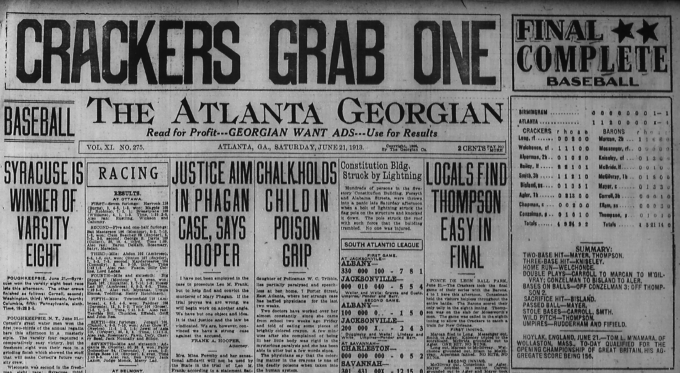
Justice Aim in Phagan Case, Says Hooper

Another in our series of new transcriptions of contemporary articles on the Leo Frank case.

The Atlanta Georgian

Saturday, June 21, 1913

I have not been employed in the case to prosecute Leo M. Frank, but to help find and convict the murderer of Mary Phagan. If the trial proves we are wrong, we will begin work on another angle. We have but one object and idea. It is that justice and the law be vindicated. We are, however, convinced we have a strong case against the accused.

FRANK A. HOOPER,
Attorney.

Mrs. Mina [sic] Formby and her sensational affidavit will not be used by the State in the trial of Leo M. Frank, according to a statement Saturday from Attorney Frank A. Hooper, assisting the prosecution.

Mr. Hooper said the State had never attached any importance to the affidavit, except for the first few days, and that when Mrs. Formby mysteriously disappeared from the city, the State eliminated her from the case entirely and made no effort to locate her. He said time set forth in the affidavit and the alleged facts were at too wide a variance with anything the State expected to prove, and there had been no trouble in making the case without her.

Affidavit Did Not Fit.

“The woman’s affidavit did not fit in anywhere in our case,” said Mr. Hooper. “If it had we would have looked around a long time for witnesses to substantiate it before we put her on the stand. When she left Atlanta we considered her gone for good, and built without her. Mr. Dorsey and myself discussed her statement several times, and we decided she could not be used to any advantage.”

Mr. Hooper said it has been decided to put the Frank case on the calendar for the week of June 30 and the State would be ready for trial on that day.

“When Mr. Dorsey returns from New York to-night or Sunday, we will go into a conference and definitely outline the case to be presented by the State,” said Mr. Hooper. “We had decided to have it called Monday morning, June 30. Unless the defense asks for a continuance, the case will probably be tried then.”

No Weak Points Remain.

He said that he had been acquainted with every bit of evidence that was in the hands of the State and had studied it carefully with the Solicitor. For one week, he said, he and Mr. Dorsey worked incessantly on the sworn statements secured from the probable witnesses.

“Where there was a weak point we either strengthened it or eliminated it entirely. We have not depended on the evidence of any one person alone to build our case on [sic] make it stand up. We are prepared for any emergency, and feel that we have left no stone unturned in our investigation. We are confident there are no more mysterious witnesses to be heard from, for we feel that we have questioned everyone who could possibly know anything of importance.”

Mr. Hooper would not discuss the many conflicting statements of the negro Jim Conley and the part he was expected to play in the State’s case.

The strong probability that Leo Frank will not be called for trial June 30 was discussed Saturday by persons interested in the case. The attorneys for the accused man have stated that they were prepared to go into court at any time, although it is not usual to give the defense so little time in a capital case.

Frank was arrested April 29. If his case is called June 30, only two months will have elapsed since he was seriously suspected of being involved in the crime. More time than this ordinarily is given the attorneys for the defense to investigate every circumstance and story which may point to the innocence of their client. Continue Reading →

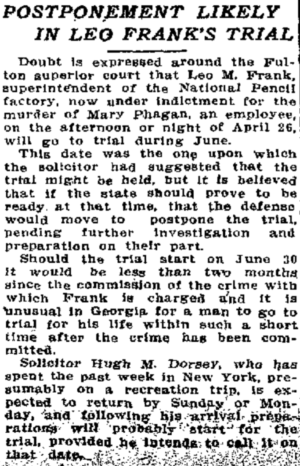
Postponement Likely In Leo Frank’s Trial

Another in our series of new transcriptions of contemporary articles on the Leo Frank case.

The Atlanta Constitution

Saturday, June 21, 1913

Doubt is expressed around the Fulton superior court that Leo M. Frank, superintendent of the National Pencil factory, now under indictment for the murder of Mary Phagan, an employee, on the afternoon or night of April 26, will go to trial during June.

This date was the one upon which the solicitor had suggested that the trial might be held, but it is believed that if the state should prove to be ready at that time, that the defense would move to postpone the trial, pending further investigation and preparation on their part.

Should the trial start on June 30, it would be less than two months since the commission of the crime with which Frank is charged and it is unusual in Georgia for a man to go to trial for his life within such a short time after the crime has been committed.

Solicitor Hugh M. Dorsey, who has spent the past week in New York, presumably on a recreation trip, is expected to return by Sunday or Monday, and following his arrival preparations will probably start for the trial, provided he intends to call it on that date.

* * *

The Atlanta Constitution, June 21st 1913, “Postponement Likely In Leo Frank’s Trial,” Leo Frank case newspaper article series (Original PDF)

Frank Trial Will Not Be Long One

Another in our series of new transcriptions of contemporary articles on the Leo Frank case.

The Atlanta Georgian

Friday, June 20, 1913

Few Witnesses of the Scores Examined Will Be Called When Case Is Heard.

That the trial of Leo M. Frank will take a much shorter time that is generally thought was indicated in a statement by Judge L. S. Roan. The judge said the greatest difficulty and almost as great a length of time would be consumed in drawing a jury as in the hearing of the case. He said the actual taking of evidence might not consume more than a day.

Judge Roan intimated that he expected neither side to introduce the scores of witnesses who had been examined and made affidavits, but that from these witnesses the State and the defense would select the most material evidence, or salient points, and then introduce the most reliable witness who could cover the ground.

For instance, eight or ten different persons might be able to testify on some different minor points, while there would be one witness who could testify to the same thing the different witnesses could. This witness, he thought, would be the one to go on the stand, and the others would not be summoned.

Affidavits Are Plentiful.

As a matter of fact, it is known that only a comparatively small number of the witnesses examined by the Solicitor will be introduced at the trial. In the course of his investigation he secured an affidavit from almost every employee of the pencil factory. While he questioned them closely and had each sign an affidavit, he found little that threw any new light on the case. He examined them, he said, to be sure that he would overlook nothing that might have been missed at the Coroner’s inquest or by the police. Continue Reading →

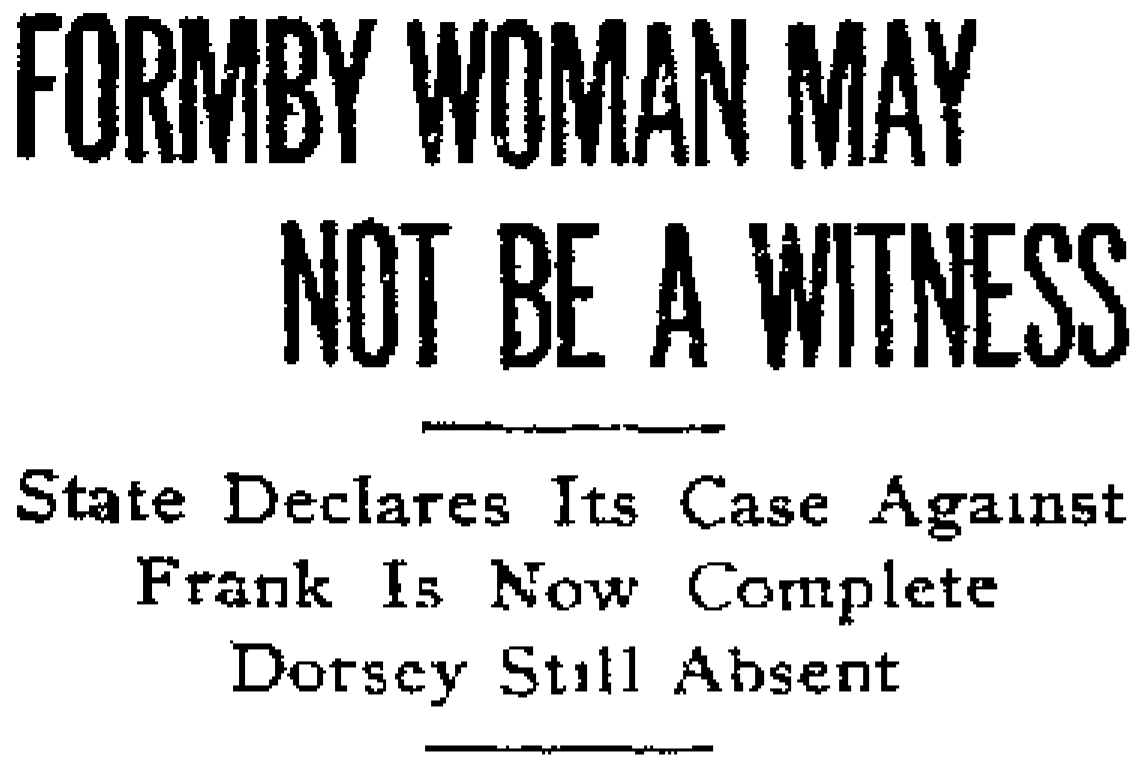
Formby Woman May Not Be A Witness

Another in our series of new transcriptions of contemporary articles on the Leo Frank case.

The Atlanta Constitution

Friday, June 20, 1913

State Declares Its Case Against Frank Is Now Complete Dorsey Still Absent

Because of the inconsistency of her statement with the state’s outline of prosecution, Chief Lanford intimates that Mima Formby [sic], the roominghouse keeper of 400 Piedmont avenue, will not be called to the stand in Leo Frank’s trial. He does not state this positively, however, but it is the general opinion that such will be the prosecution’s action.

Mrs. Formby has stated to a Constitution reporter that she is ready to testify against the factory superintendent and that she will remain in Atlanta until time of trial. It is said that a number of occupants of her Piedmont avenue home who were in on the night she alleges Frank telephoned her several times to obtain a room to which he could bring a girl have testified that no such telephone calls came and that the phone did not ring more than once or twice during the entire evening.

Frank Hooper, the well known attorney, who is to be associated with Solicitor Hugh M. Dorsey in the prosecution, has returned from his recent trip to Cincinnati. Although much speculation was created over his journey in view of the fact that Col. T.B. Felder, who has been an active figure in the Phagan investigation, was in Cincinnati at the same time on a trip, the nature of which he declined to disclose.

Also, importance was attached to the fact that the solicitor general was out of the city at the same time. Each of the trio, however, declared that their visits out of the city had nothing whatever to do with the Phagan case. None but the solicitor, though, would tell the mission of his trip. He went on a vacation to Atlantic City, he told reporters.

“The state’s case is regarded as complete,” Mr. Hooper said Thursday, shortly following his return to town. “There have been no new developments. We are waiting now for time of trial.”

* * *

The Atlanta Constitution, June 20th 1913, “Formby Woman May Not Be A Witness,” Leo Frank case newspaper article series (Original PDF)

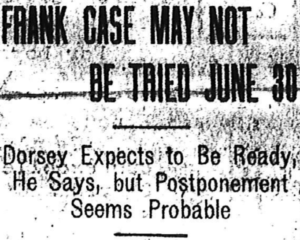
Frank Case May Not Be Tried June 30

Another in our series of new transcriptions of contemporary articles on the Leo Frank case.

The Atlanta Journal

Friday, June 20, 1913

Dorsey Expects to Be Ready, He Says, but Postponement Seems Probable

That Leo M. Frank will go on trial for the murder of Mary Phagan on June 30th is not a certainty, although it is generally conceded that Solicitor Hugh M. Dorsey will set the case on the court’s calendar for that date when he returns to the city from New York.

Solicitor Dorsey will return to Atlanta on Sunday. In reply to a telegram from The Journal relative to the time of the trial he makes the following statement: “Cannot say definitely that state will be ready on June 30, but expect now to be.”

As to whether or not the trial actually will be commenced on that date depends largely upon the defense, although there is a bare possibility that the court may wish to hold up the trial of the long case until after the jail is cleared. It is the general policy of the criminal division of the superior court to clear the jail for the summer at this time of the year, and it is known that thirty or forty routine cases could be disposed of in the time that it will take to hear the Frank case. The court will grind on routine business for the week of June 23rd, but in that time, it is said, it will be imposible [sic] to clear the jail.

However, it will remain largely with the defense as to whether or not the case comes to trial.

ROSSER LEAVES CITY.

Luther Z. Rosser, counsel for Frank, is expected to leave the city on Friday on business which is said to have no connection with the Frank case. He refuses to discuss the defense’s attitude toward an early trial.

Reuben R. Arnold, who probably will be associated with Mr. Rosser in the defense, is spending the week end at Atlantic Beach.

Mr. Arnold has been busy on a number of court cases, and while he is said to be quite familiar with the evidence in the Frank case, if he does become associated with the defense, it is probable that he will want additional time to study the case before he enters into the trial of such an important matter.

Mary Phagan was killed on April 26th, little more than two months from the date the case will probably be set on the court’s calendar.

It is not often that a person is brought to trial for a criminal offense in Fulton county two months after the commission of the crime with which he is charged.

Another element which, while it may not figure in the court record, is an important factor behind the scenes, is the intense heat at this time of the year. Continue Reading →

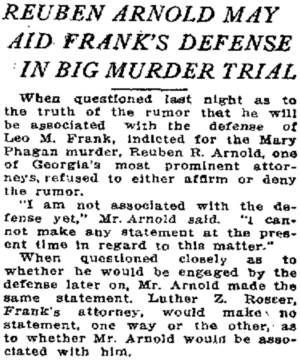
Reuben Arnold May Aid Frank’s Defense In Big Murder Trial

Another in our series of new transcriptions of contemporary articles on the Leo Frank case.

The Atlanta Constitution

Thursday, June 19, 1913

When questioned last night as to the truth of the rumor that he will be associated with the defense of Leo M. Frank, indicted for the Mary Phagan murder, Reuben R. Arnold, one of Georgia’s most prominent attorneys, refused to either affirm or deny the rumor.

“I am not associated with the defense yet,” Mr. Arnold said. “I cannot make any statement at the present time in regard to this matter.”

When questioned closely as to whether he would be engaged by the defense later on, Mr. Arnold made the same statement. Luther Z. Rosser, Frank’s attorney, would make no statement, one way or the other, as to whether Mr. Arnold would be associated with him.

* * *

The Atlanta Constitution, June 19th 1913, “Reuben Arnold May Aid Frank’s Defense In Big Murder Trial,” Leo Frank case newspaper article series (Original PDF)

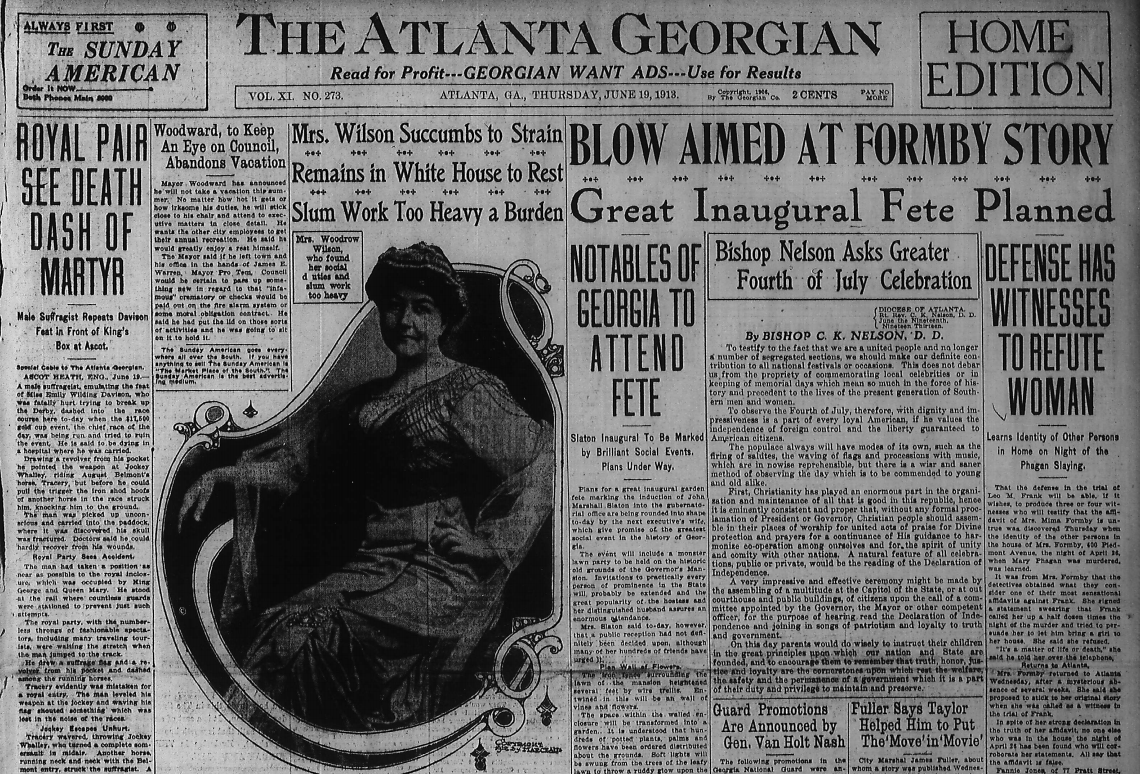
Blow Aimed at Formby Story

Another in our series of new transcriptions of contemporary articles on the Leo Frank case.

The Atlanta Georgian

Thursday, June 19, 1913

DEFENSE HAS WITNESSES TO REFUTE WOMAN

Learns Identity of Other Persons in Home on Night of the Phagan Slaying.

That the defense in the trial of Leo M. Frank will be able, if it wishes, to produce three or four witnesses who will testify that the affidavit of Mrs. Mima [sic] Formby is untrue was discovered Thursday when the identity of the other persons in the house of Mrs. Formby, 400 Piedmont Avenue, the night of April 26, when Mary Phagan was murdered, was learned.

It was from Mrs. Formby that the detectives obtained what they consider one of their most sensational affidavits against Frank. She signed a statement swearing that Frank called her up a half dozen times the night of the murder and tried to persuade her to let him bring a girl to her house. She said she refused.

“It’s a matter of life or death,” she said she told her over the telephone.

Returns to Atlanta.

Mrs. Formby returned to Atlanta Wednesday, after a mysterious absence of several weeks. She said she proposed to stick to her original story when she was called as a witness in the trial of Frank.

In spite of her strong declaration in the truth of her affidavit, no one else who was in the house the night of April 26 has been found who will corroborate her statements. All say that the affidavit is false. Continue Reading →

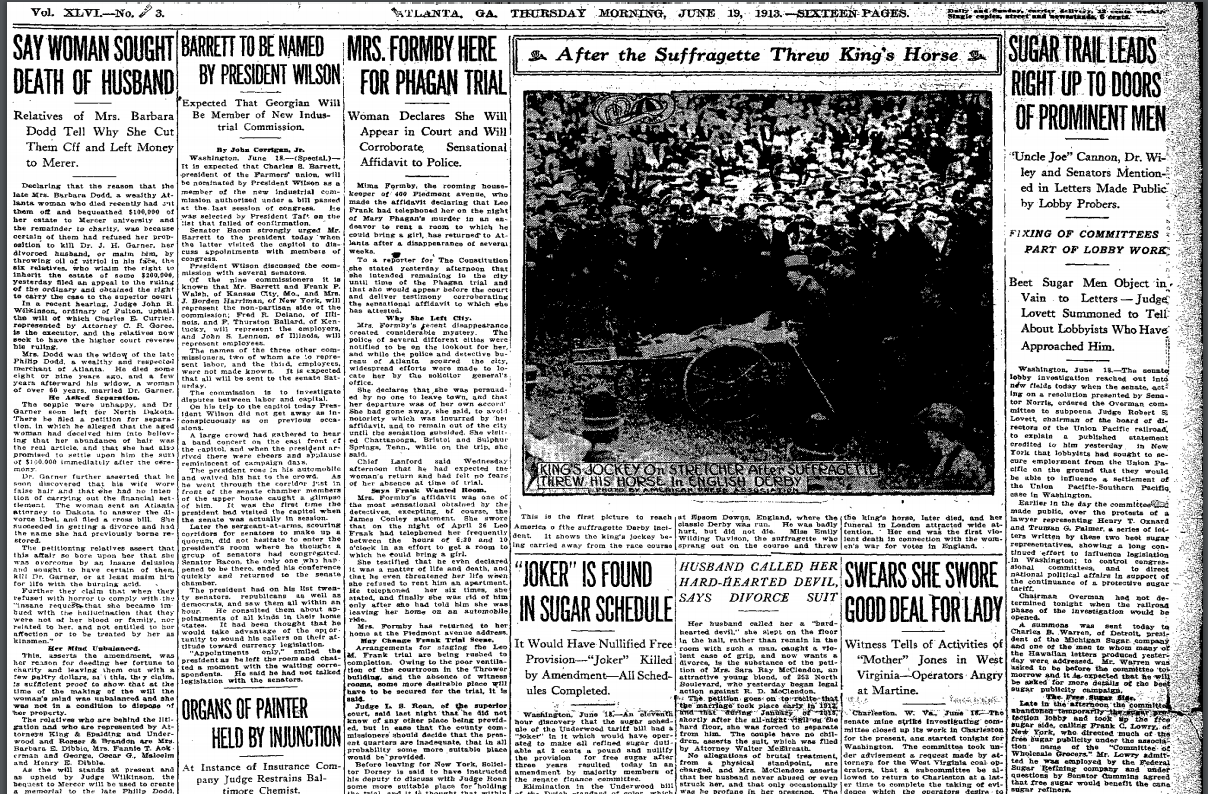
Mrs. Formby Here for Phagan Trial

Another in our series of new transcriptions of contemporary articles on the Leo Frank case.

The Atlanta Constitution

Thursday, June 19, 1913

Woman Declares She Will Appear in Court and Will Corroborate Sensational Affidavit to Police.

Mima [sic] Formby, the rooming housekeeper of 400 Piedmont avenue, who made the affidavit declaring that Leo Frank had telephoned her on the night of Mary Phagan’s murder in an endeavor to rent a room to which he could bring a girl, has returned to Atlanta after a disappearance of several weeks.

To a reporter for The Constitution she stated yesterday afternoon that she intended remaining in the city until time of the Phagan trial and that she would appear before the court and deliver testimony corroborating the sensational affidavit to which she has attested.

Why She Left City.

Mrs. Formby’s recent disappearance created considerable mystery. The police of several different cities were notified to be on the lookout for her, and while the police and detective bureau of Atlanta scoured the city, widespread efforts were made to locate her by the solicitor general’s office.

She declares that she was persuaded by no one to leave town, and that her departure was of her own accord. She had gone away, she said, to avoid notoriety which was incurred by her affidavit, and to remain out of the city until the sensation subsided. She visited Chattanooga, Bristol and Sulphur Springs, Tenn., while on the trip, she said.

Chief Lanford said Wednesday afternoon that he expected the woman’s return and had felt no fears of her absence at time of trial.

Says Frank Wanted Room.

Mrs. Formby’s affidavit was one of the most sensational obtained by the detectives, excepting, of course, the James Conley statement. She swore that on the night of April 26 Leo Frank had telephoned her frequently between the hours of 6:30 and 10 o’clock in an effort to get a room to which he could bring a girl.

She testified that he even declared it was a matter of life and death, and that he even threatened her life when she refused to rent him an apartment. He telephoned her six times, she stated, and finally she was rid of him only after she had told him she was leaving her home on an automobile ride.

Mrs. Formby has returned to her home at the Piedmont avenue address. Continue Reading →

Hooper Returns and Takes Up Phagan Case

Another in our series of new transcriptions of contemporary articles on the Leo Frank case.

The Atlanta Journal

Thursday, June 19, 1913

Declares Trip to Cincinnati Had Nothing to oD [sic] With Murder Mystery

Frank A. Hooper, the experienced prosecutor, who has been engaged to assist Solicitor Hugh M. Dorsey in the trial of the case against Leo M. Frank, returned Thursday from a three days’ trip to Cincinnati, and set at rest the rumors that he went to the Ohio city on a matter connected with the investigation of the Phagan murder mystery.

Mr. Hooper declared that his private business called him to Cincinnati, and that his trip was in no way connected with the Phagan case.

While away Mr. Hooper states that he did not see Solicitor Dorsey nor did he see Attorney Thomas B. Felder, who went to the same city on a matter, which he said before leaving, was not connected with the Phagan case nor with the famous dictograph episode.

Mr. Hooper declares that so far as he knows there are no new developments in the Phagan mystery.

“The state’s case is regarded as complete,” Mr. Hooper said, “and we are simply waiting for the hour of the trial to come.”

Mr. Hooper would not discuss the testimony of Mrs. Mima [sic] Formby, who returned to the city Tuesday after an absence of several weeks.

Mrs. Formsby [sic] made an affidavit for the detectives in which she alleged that Leo M. Frank phoned her residence at 400 Piedmont avenue, a number of times between the hours of 6:30 p. m. and 10 p. m. on the evening of the tragedy, and each time begged her to let him bring a girl to her house.

WON’T BE CALLED.

It is considered improbable, however, that Mrs. Formsby will be called as a state’s witness when the case against Frank is tried, for it has been known from the first that her story did not fit in with the theory of the state as to Frank’s actions on the night of the tragedy.

The fact that Mrs. Formsby had returned to the city first became known to the detective department, when she phoned headquarters that practically all of the furniture left in her apartment had mysteriously disappeared. Continue Reading →

Will Reuben R. Arnold Aid Frank’s Defense?

Another in our series of new transcriptions of contemporary articles on the Leo Frank case.

The Atlanta Journal

Wednesday, June 18, 1913

Mr. Arnold and Luther Z. Rosser Both Decline to Discuss Report Circulated

The rumor that Reuben R. Arnold, famous Georgia lawyer, will be associated with the defense of Leo M. Frank, indicted for the Mary Phagan murder, is persistent.

Luther Z. Rosser, who has been retained in the case since Frank was first arrested, refused to deny or affirm the rumor. It is intimated, however, that negotiations are not complete as yet.

Mr. Arnold himself, when questioned about the rumor, refused to discuss it in any way, and his silence has added weight to the report that he will be in the case.

With Luther Rosser and Reuben Arnold leading the defense of Frank one of the greatest legal battles in a criminal case in the history of the south is promised. Mr. Arnold and Mr. Rosser have been pitted against each other in the famous McNaughton-Flanders case and in other well known trials, and each time they met there was a legal battle royal. With the two famous lawyers together, a hard and brilliant fight is certain to be given Hugh M. Dorsey, and Frank A. Hooper, the experienced prosecutor who has been engaged to assist the state in the case.

Despite the entry of Mr. Arnold there is said to be little chance that Solicitor Dorsey will have assistance other than that of Mr. Hooper.

DATE OF TRIAL.

Mr. Arnold during the past several weeks has been engaged in the trial before an auditor of the famous Crawford will case. He is said to have closely followed the many developments in the Phagan murder investigation, however, and if he enters the trial, it will not mean necessarily that a postmentment [sic] will be asked by the defense, although it will make a postponement of the trial more probable.

The calendar for the criminal division of the superior court for the week commencing June 23 has been made up and published by E. A. Stephens, the assistant solicitor general.

The calendar for the week commencing June 30 will not be made up until the return next Sunday of Solicitor General Dorsey from Atlantic City, according to Mr. Stephens, who states that as yet he is not certain that the[…]

(Continued on Page Six, Col. 5.)

WILL REUBEN R. ARNOLD AID FRANK’S DEFENSE?

(Continued From Page 1.)

[…]superior court will be in session on that date.

It is said that there is sufficient business of a routine nature pending before the court to occupy it not only during the week of June 23, but through the week of June 30 as well. It is known, however, although there has been no definite announcement, that it is the intention of Solicitor General Dorsey to bring the case against Leo M. Frank to trial on June 30, if possible. Attorney Frank A. Hooper, who will assist Mr. Dorsey in the case, has declared that the state is ready to go to trial at once, and he intimates that efforts to push the trial will be made.

WILL DEFENSE BE READY?

As a result of the attitude of the state’s officials, speculation over the case turns to the defense. Will Attorney Luther Z. Rosser announce ready, if the case is called Monday week?

Mr. Rosser will not discuss the matter. It is known that he has been engaged in the courts in trial of various civil cases practically since the time of Frank’s indictment, and for that reason it is said that he probably would want a postponement of the case.

However, it is known also that regardless of the amount of work he has on hand, Mr. Rosser seldom asks for the postponement of a trial. In fact, he is more often found announcing “ready” than are the majority of other attorneys in Atlanta.

POSTPONEMENT TILL FALL.

If an effort is made to postpone the case at all, it is said that it will be to postpone it until early fall.

The courts generally take a vacation during the months of July and August, and the trial of Mrs. Daisy Grace last July demonstrated the general unpleasantness of a big criminal trial during the summer.

Last year during the Grace trial it was so stifling and hot in the poorly ventilated criminal court room on the fourth floor of the Thrower building, that it was generally considered dangerous to the health of those engaged in the case and of the spectators who thronged there, to hold the trial in the room.

As a result it is probable that the scene of activity will probably be transferred to the old city hall, if the Frank case does come to trial in June. All of the civil courts will not be in session in the first week in July, and one of those rooms probably will be utilized.

* * *

The Atlanta Journal, June 18th 1913, “Will Reuben R. Arnold Aid Frank’s Defense?,” Leo Frank case newspaper article series (Original PDF)