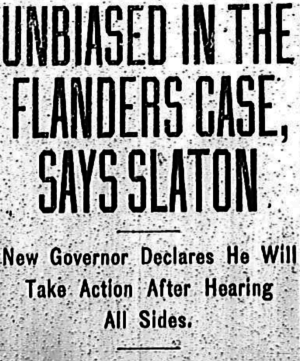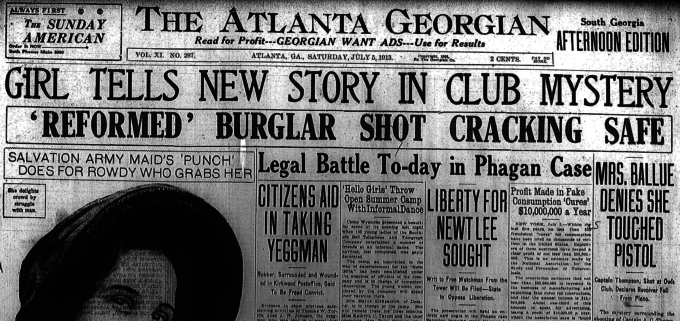
Unbiased in the Flanders Case, Says Slaton

Another in our series of new transcriptions of contemporary articles on the Leo Frank case.

The Atlanta Georgian

Saturday, July 5, 1913

New Governor Declares He Will Take Action After Hearing All Sides.

Governor Slaton has formed no opinion in the famous McNaughton-Mattie Flanders murder case, and says he will make no decision until he has heard all sides. The new Governor says he has not talked to the former Governor about the case. He will hear, he said, all arguments without prejudice.

It is known that the hopes of McNaughton’s friends for commutation of sentence, if not pardon, have been greatly strengthened now that Governor Slaton is in the executive office.

The statement, made time and again, to the effect that Mrs. Mattie Flanders, alleged co-conspirator with Dr. W. J. McNaughton, never will be tried, has been renewed now that Governor Brown, who stood so long between Dr. McNaughton and the gallows, has been succeeded.

It was said months ago to be the purpose of those urging that the law be permitted to take its course against Dr. McNaughton to kick the case along from one court to another until a change in administrations had been effected in Atlanta. Governor Brown let it be known all along that he would not permit Dr. McNaughton to hang so long as the case against Mrs. Flanders remained undisposed of.

Waiting Game Played.

Continue Reading →

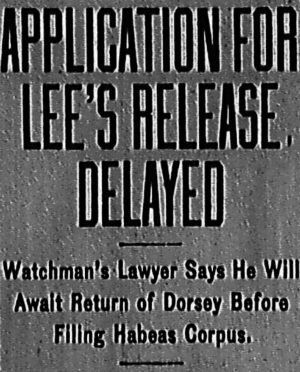
Application for Lee’s Release Delayed

Another in our series of new transcriptions of contemporary articles on the Leo Frank case.

The Atlanta Georgian

Saturday, July 5, 1913

Watchman’s Lawyer Says He Will Await Return of Dorsey Before Filing Habeas Corpus.

On account of the absence form the city of Prosecuting Attorney Hugh M. Dorsey, Bernard L. Chappell, attorney for Newt Lee, announced Saturday that he would not file a writ of habeas corpus until Monday. He claims in the petition for the release of the negro that Lee is being held unlawfully and without any charge against him.

Solicitor Dorsey left for his country place at Valdosta, Ga., Saturday morning. He will return Monday.

Continue Reading →

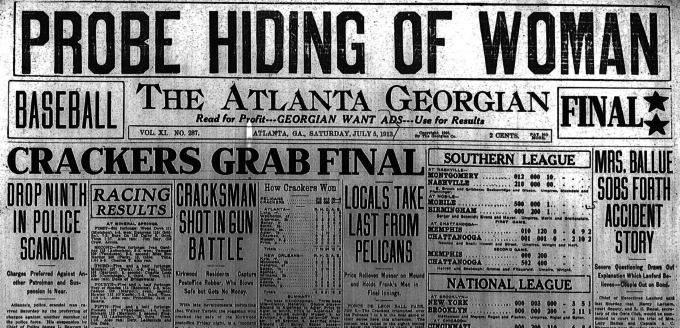
Drop Ninth in Police Scandal

Another in our series of new transcriptions of contemporary articles on the Leo Frank case.

The Atlanta Georgian

Saturday, July 5, 1913

Charges Preferred Against Another Patrolman and Suspension Is Near.

Atlanta’s police scandal was revived Saturday by the preferring of charges against another member of the police force. His suspension by Chief of Police James L. Beavers is expected to follow within a few hours.

The subject of the accusations is the ninth policeman involved in the scandal. Chief Beavers would not make public the man’s name until formal order of suspension was made.

The charges against the majority of the policemen are they they frequented the notorious negro resort in the rear of 127 Auburn Avenue and that certain of the men were in the habit of drinking there. The place has no license and one of the officers, against whom there was no evidence of drinking, was charged simply with permitting the place to run without reporting it.

With the preferring of the ninth set of charges came the information that R. A. Wood, the policeman who tendered his resignation as soon as the story of his alleged visits to the resort was made public, had sold all his household belongings and moved from the city.

Officers who went to serve notice of the trial before the Police Commission next Tuesday night were met with the information that he had moved with his family to Texas.

* * *

The Atlanta Georgian, July 5th 1913, “Drop Ninth in Police Scandal,” Leo Frank case newspaper article series (Original PDF)

New Audio Book: The American Mercury on Leo Frank – Dorsey’s Closing Arguments, part 3

Solicitor Dorsey in his office; a snapshot of the Phagan case prosecutor taken by a Georgian photographer.

THIS WEEK’S audio book presentation on the 1913 Leo Frank case is the third (of six) parts of prosecutor Hugh Dorsey’s closing arguments. His arguments, along with the evidence in this case, were ultimately successful — and Jewish pencil factory superintendent Leo Frank was convicted of murdering 13-year-old Mary Phagan, his sweatshop employee.

Frank was the president of the Atlanta, Georgia B’nai B’rith and the Frank case was a major factor in the establishment of the Jewish “anti-hate” group, the Anti-Defamation League (ADL), over 100 years ago.

This new audio book series encompasses the American Mercury’s extensive coverage of the 1913 Frank trial. We are presenting the extensive arguments, both for the defense and the prosecution, in order and in full — a monumental, book-length project. Today’s presentation is the second section (of six) of Hugh Dorsey’s final statement.

Click on the “play” button to listen to the audio book, read by Vanessa Neubauer.

Mr. Dorsey dismisses the defense’s contention that the blood stains found were not Mary Phagan’s blood:

Continue Reading →

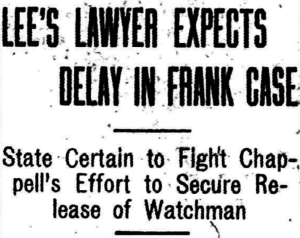
Lee’s Lawyer Expects Delay in Frank Case

Another in our series of new transcriptions of contemporary articles on the Leo Frank case.

The Atlanta Journal

Friday, July 4, 1913

State Certain to Fight Chappell’s Effort to Secure Release of Watchman

Bernard L. Chappell, attorney for Newt Lee, the negro night watchman, who found the body of Mary Phagan in the National Pencil factory basement, declares that Saturday he will bring habeas corpus proceedings to secure the release of his client.

According to the attorney, the negro is being held on the recommendation of the coroner’s jury, which concluded its inquest before James Conley figured in the case. The grand jury has failed to act on Lee’s case, and Attorney Chappell says that he is going to make efforts to secure the negro’s release.

When the habeas corpus proceedings are commenced the state is certain to make a fight to prevent the negro’s release from the Tower on the ground that he is a material witness.

Attorney Chappell states that he has decided to bring the habeas corpus proceedings because he does not believe that the case of Leo M. Frank will actually come to trial on July 28, when it has been set by Judge L. S. Roan, of the superior court.

There are many ways in which such a case may be postponed indefinitely, Lee’s attorney says, and he is not going to allow his client to stay in jail for an indefinite period if he can help it.

As a result, he says he is fully determined to take the legal steps Saturday to secure the negro’s release.

* * *

The Atlanta Journal, July 4th 1913, “Lee’s Lawyer Expects Delay in Frank Case,” Leo Frank case newspaper article series (Original PDF)

Lee’s Attorney Seeks to Gain His Release

Another in our series of new transcriptions of contemporary articles on the Leo Frank case.

The Atlanta Journal

Friday, July 4, 1913

It was reported Thursday morning that Bernard L. Chappell, attorney for New [sic] Lee, the negro watchman held in connection with the Mary Phagan case, would take steps to release him from jail by swearing out a writ of habeas corpus.

Attorney Chappell is said to have come to the conclusion that Lee knew nothing about the case other than finding the body and that the state has no right to hold him.

* * *

The Atlanta Journal, July 4th 1913, “Lee’s Attorney Seeks to Gain His Release,” Leo Frank case newspaper article series (Original PDF)

New Audio Book: The American Mercury on Leo Frank – Dorsey’s Closing Arguments, part 2

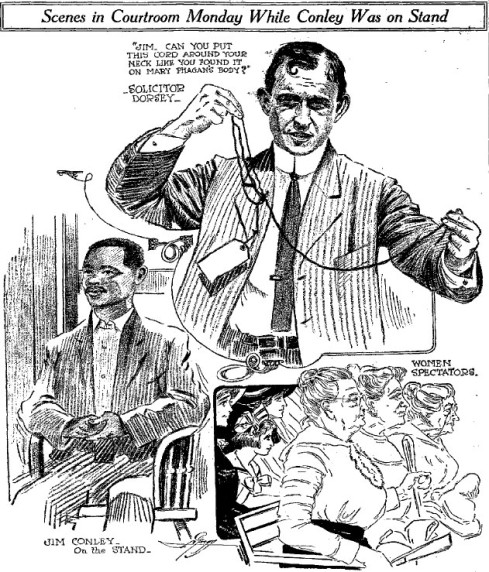
Jim Conley on the witness stand; prosecutor Hugh Dorsey; ladies in the audience

THIS WEEK WE present the second part of the closing arguments of Solicitor Hugh Dorsey (pictured in a  contemporary newspaper illustration), the prosecutor in the 1913 murder trial of Leo Frank for the slaying of his sweatshop employee Mary Phagan. This prosecution has been presented in the major media as a case of “anti-Semitism” — but a reading of the evidence and Dorsey’s closing arguments casts that allegation into the realm of the ridiculous. The Frank case was a major factor in the establishment of the Jewish “anti-hate” group, the Anti-Defamation League (ADL), over 100 years ago.

This new audio book series encompasses the American Mercury’s extensive coverage of the 1913 Frank trial. We are presenting the extensive arguments, both for the defense and the prosecution, in order and in full — a monumental, book-length project. Today’s presentation is the second section (of six) of Hugh Dorsey’s final statement.


Continue Reading →

New Testimony Lays Crime to Conley

Another in our series of new transcriptions of contemporary articles on the Leo Frank case.

The Atlanta Georgian

Friday, July 4, 1913

Frank Defense Locates Witness Who Points to the Negro Sweeper as Slayer.

A new witness, said to have the most damaging evidence yet produced against Jim Conley, the negro sweeper in the National Pencil factory, entered the Phagan case Thursday and made an affidavit, the contents fo [sic] which are carefully guarded by attorneys for Leo M. Frank, charged with causing the death of the factory girl.

The identity of the witness is as much a secret as the exact nature of his testimony. It was learned, though, that the affidavit was made in the law office of Joseph Leavitt in the Grant Building and was witnessed by Mr. Leavitt’s stenographer.

It is said the testimony of this man connects Conley more directly with the crime than any other statement or affidavit yet procured by the defense. The witness is understood to have seen Conley on the afternoon of the crime and to have heard him make remarks in his drunken condition which were extremely incriminating. Continue Reading →

Effort Will Be Made to Free Newt Lee

Another in our series of new transcriptions of contemporary articles on the Leo Frank case.

The Atlanta Constitution

Friday, July 4, 1913

Attorney Chappell Declares Belief That Lee Has No Knowledge of Guilty Parties.

An early effort is likely to be made to free Newt Lee, the negro night watchman who discovered the body of Mary Phagan, and who has since been held for suspected complicity in the crime.

This is intimated in a statement issued by the negro’s counsel, Bernard L. Chappell, who says he has arrived at the conclusion that his client knows absolutely nothing about the murder, except his grewsome discovery.

Lee was not indicted, although his name was submitted before the grand jury at the same time action was taken against Leo Frank. No amount of cross-examination can break his story in any respect, and he has told the same straightforward tale throughout imprisonment.

Attorney Chappell hinted that he would institute habeas corpus proceedings in the attempt to liberate the watchman.

* * *

The Atlanta Constitution, July 4th 1913, “Effort Will Be Made to Free Newt Lee,” Leo Frank case newspaper article series (Original PDF)

New Audio Book: The American Mercury on Leo Frank – Dorsey’s Closing Arguments, part 1

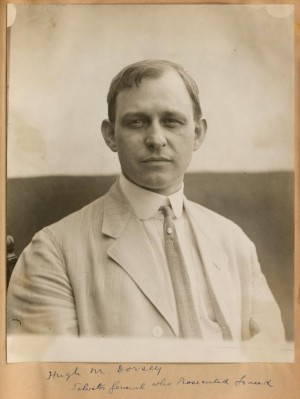
Hugh M. Dorsey

TODAY WE present the closing arguments of Solicitor Hugh Dorsey (pictured), which were the very last arguments heard by the jury, in the 1913 murder trial of Leo Max Frank for the murder of Mary Phagan. These powerful, successful, and historic arguments span some six hours, and they will be presented here over the next six weeks beginning today. They give the lie to the common media narrative — often the only one presented to students today — that the state had a “weak case” against Frank.

This series encompasses the American Mercury’s coverage of the 1913 trial and conviction of Jewish sex killer Leo Frank — a case which was one of the inspirations for the establishment of the Anti-Defamation League (ADL).

We are presenting the extensive arguments, both for the defense and the prosecution, in order and in full — a monumental, book-length project. Today’s presentation is the first section of Hugh Dorsey’s final statement.

Mr. Dorsey states that prejudice against Jews had nothing to do with the prosecution of Frank:

Continue Reading →

Police Chief to Probe Vice Protection Charge

Another in our series of new transcriptions of contemporary articles on the Leo Frank case.

The Atlanta Journal

Thursday, July 3, 1913

Beavers Stirred by Details Reported by Physician—Assigns Men to Report

Following the charges of a prominent Atlanta physician regarding vice conditions and alleged police protection in this city, Chief of Police Beavers despatched an officer to confer with this physician Thursday morning.

The officer will endeavor to obtain even more information than has been furnished the chief and will try to substantiate that already given. He will pay especial attention to the statement of the physician that he reported a disorderly house to the police and that the proprietors of it were “tipped off” by some officer.

Chief Beavers is concerned over this phase of the question. He admits that there must be something in the charges, as the source of his information is reputable.

“It is a grave charge,” he declared Thursday morning. “I am satisfied that Atlanta’s police department is as free of anything like giving protection to vice as any in the United States, yet it is entirely possible that there are some men in it who would ‘graft.’ If there are I want to know more than anyone else, for it is not fair for the department’s reputation as a whole to suffer for what can be traced to a few individuals.”

The alleged disorderly houses reported to the chief are being watched closely, but he said that no evidence against them had been obtained yet.

Sergeant L.S. Dobbs, who has been investigating the locker clubs to see if they had any members of the police departmet [sic] enrolled, has finished his work and reported to the chief that he was unable to find any police members. He said that there are a number of local fraternal organizations with police members, and that these orders have locker club attachments, but that so far as he could learn no policemen were in the habit of using them.

Chief Beavers declared that there was nothing wrong with an officer belonging to a fraternal order, provided he did not use his membership for anything other than fraternal purposes.

Chief of Detectives Lanford declared Thursday morning that he had taken steps to investigate the charges made by the physician that several of his men had been seen drinking in two downtown locker clubs.

* * *

The Atlanta Journal, July 3rd 1913, “Police Chief to Probe Vice Protection Charge,” Leo Frank case newspaper article series (Original PDF)

Writ Sought In Move to Free Negro Lee

Another in our series of new transcriptions of contemporary articles on the Leo Frank case.

The Atlanta Georgian

Thursday, July 3, 1913

Attorney for Watchman Declares Client Knows Nothing of the Actual Crime.

Bernard L. Chappell, attorney for Newt Lee, negro night watchman at the pencile [sic] factory, held in the Phagan case, stated Thursday morning that he would swear out a writ of habeas corpus for the release of the negro.

Attorney Chappell stated that he had come to the conclusion that there was nothing the negro knew about the crime except finding the body, and that the State had no right to keep him without some charge or as a material witness.

Lee was the first suspect arrested in connection with Mary Phagan’s murder. He was ordered held by the Coroner, but when a bill of indictment was offered the Grand Jury at the same time of the Frank indictment, no action was taken against the negro.

Weak Spots in Conley Tale.

Chappell said the writ of habeas corpus would compel the State either to order the negro held as a material witness or make some charge against him.

Conley, in relating his dramatic tale of carrying the body of Mary Phagan from the rear of the second floor and disposing of it at the direction of Frank in a dark corner of the gloomy basement, said that when he reached the elevator he had to wait until Frank went into his office for a key to the elevator door.

The defense will maintain, it is understood, that the elevator door had not been locked for some time. Witnesses will be called to testify that the door had remained unlocked in accordance with instructions from the firms with which the building was insured. From this alleged circumstance, it will be argued that the negro’s story is a fabrication devised to shield himself from the charge of murder and to shift the responsibility onto another man.

Continue Reading →

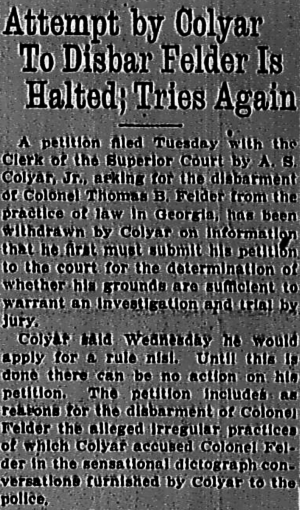
Attempt by Colyar To Disbar Felder Is Halted; Tries Again

Another in our series of new transcriptions of contemporary articles on the Leo Frank case.

The Atlanta Georgian

Thursday, July 3, 1913

A petition filed Tuesday with the Clerk of the Superior Court by A. S. Colyar, Jr., asking for the disbarment of Colonel Thomas B. Felder from the practice of law in Georgia, has been withdrawn by Colyar on information that he first must submit his petition to the court for the determination of whether his grounds are sufficient to warrant an investigation and trial by jury.

Colyar said Wednesday he would apply for a rule nisi. Until this is done there can be no action on his petition. The petition includes as reasons for the disbarment of Colonel Felder the alleged irregular practices of which Colyar accused Colonel Felder in the sensational dictograph conversations furnished by Colyar to the police.

* * *

The Atlanta Georgian, July 3rd 1913, “Attempt by Colyar To Disbar Felder Is Halted; Tries Again,” Leo Frank case newspaper article series (Original PDF)

New Audio Book: The American Mercury on Leo Frank – Rosser’s Closing Arguments, part 2

Leo Frank posing for Collier’s Weekly. The photo would later become the front cover for the book The Truth About the Frank Case by C.P. Connolly.

THIS WEEK in our audio book series we present part 2, the final part, of the powerful, skillful closing arguments of Luther Z. Rosser for the defense of Leo Frank (pictured) in his trial for the murder of Mary Phagan, read by Vanessa Neubauer. Rosser, possibly the most feared lawyer in Atlanta in his day, was a mouthpiece and “fixer” for the rich and powerful.

This series encompasses the American Mercury’s coverage of the 1913 trial and conviction of Jewish sex killer Leo Frank — a case which was one of the inspirations for the establishment of the Anti-Defamation League (ADL). We will be presenting the extensive arguments, both for the defense and the prosecution, in order and in full — a monumental, book-length project. Today we present the concluding arguments of Luther Z. Rosser for the defense.

Mr. Rosser denies in his speech that the pro-Frank forces planted false evidence to implicate the Black night watchman, Newt Lee, in the murder:

Continue Reading →

New Audio Book: The American Mercury on Leo Frank – Rosser’s Closing Arguments, part 1

Luther Rosser

THIS WEEK in our audio book series we present part 1 of the powerful, skillful closing arguments of Luther Z. Rosser (pictured) for the defense of Leo Frank in his trial for the murder of Mary Phagan, read by Vanessa Neubauer. Rosser was respected — and feared — as one of the best attorneys of his generation. He was the “go to” man for the wealthy and powerful in early 20th-century Georgia who found themselves in legal difficulty and needed their troubles “swept away.”

This series encompasses the American Mercury’s coverage of the 1913 trial and conviction of Jewish sex killer Leo Frank — a case which was one of the inspirations for the establishment of the Anti-Defamation League (ADL). We will be presenting the extensive arguments, both for the defense and the prosecution, in order and in full — a monumental, book-length project. Today we present the arguments of Luther Z. Rosser for the defense.

Mr. Rosser states in his speech, about the factory girls who testified that Frank had a bad character for lasciviousness:

Well, gentlemen, the older I get the gentler I get and I wouldn’t think or say anything wrong about those misleading little girls who swore Frank was a bad man. I guess they thought they were telling the truth. Well, did Miss Maggie Griffin really think Frank was a vicious man and yet work there three years with him! Don’t you think she heard things against him after the crime was committed and that when she got up here and looked through the heated atmosphere of this trial, she did not see the real truth! And Miss Maggie Griffin, she was there two months. I wonder what she could know about Frank in that time. There was Mrs. Donegan and Miss Johnson and another girl there about two months, and Nellie Potts, who never worked there at all, and Mary Wallace, there three days, and Estelle Wallace, there a week and Carrie Smith, who like Miss Cato, worked there three years. These are the only ones in the hundreds who have worked there since 1908 who will say that Frank has a had character. Why, you could find more people to say that the Bishop of Atlanta, I believe, had a bad character, than have been brought against Frank.

You can follow along with the original text here.

Mr. Rosser also makes light of the claim by the prosecution that Frank’s nervousness on the day after the murder was an indication of guilt:

Now, what else have they put up against this man! They say he was nervous. We admit he was. Black says it, Darley says it, Sig. Montag says it — others say it! The handsome Mr. Darley was nervous and our friend Schiff was nervous. Why not hang them if you’re hanging men for nervousness! Isaac Haas — old man Isaac — openly admits he was nervous. The girls — why don’t you hang them, these sweet little girls in the factory — all of whom were so nervous they couldn’t work on the following day! If you had seen this little child, crushed, mangled, mutilated, with the sawdust crumbled in her eyes and her tongue protruding; staring up from that stinking, smelling basement, you’d have been nervous, too, every mother’s son of you. Gentlemen, I don’t profess to be chicken-hearted. I can see grown men hurt and suffering and I can stand a lot of things without growing hysterical, but I never walked along the street and heard the pitiful cry of a girl or woman without becoming nervous. God grant I will always be so. Frank looked at the mangled form and crushed virginity of Mary Phagan and his nerves fluttered. Hang him! Hang him!

Rosser made no mention, however, of Frank’s extreme nervousness the day before, after the murder had taken place but before the body had been discovered.

Continue Reading →

New Audio Book: The American Mercury on Leo Frank – Arnold’s Closing Arguments, part 2

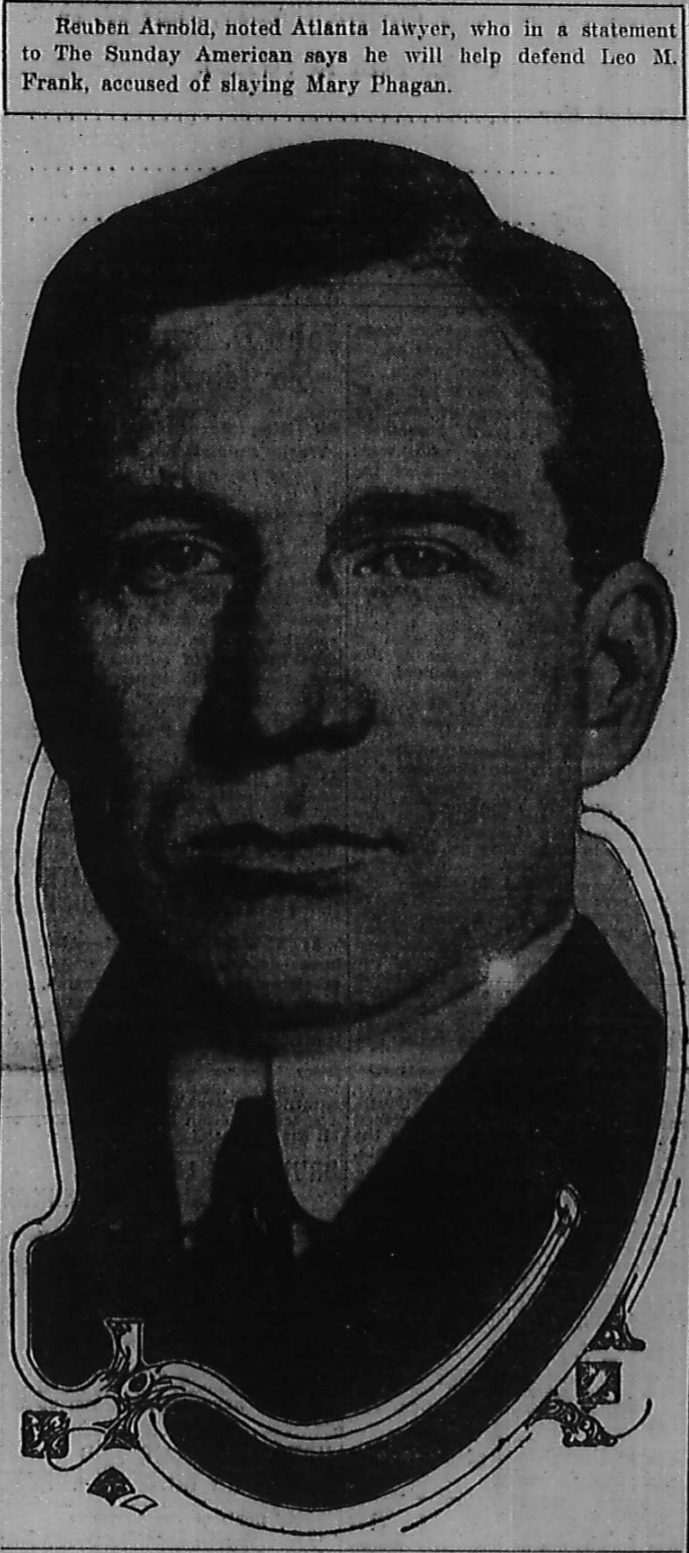
Reuben Arnold

REUBEN ARNOLD’S closing arguments (part 2) for the defense of Leo Frank — on the charge of murdering his sweatshop employee Mary Phagan — are our presentation this week in our new audio book series, read by Vanessa Neubauer.

This series encompasses the American Mercury’s coverage of the 1913 trial and conviction of Jewish sex killer Leo Frank — a case which was one of the inspirations for the establishment of the Anti-Defamation League (ADL). We will be presenting the extensive arguments, both for the defense and the prosecution, in order and in full — a monumental, book-length project. Today we present the second section of the arguments for the defense, the words of one of the most skilled and formidable Georgia attorneys of his time, Mr. Reuben Arnold.

Mr. Arnold states in his speech:

This case has been made up of just two things — prejudice and perjury. I’ve never seen such malice, such personal hatred in all my life, and I don’t think anyone ever has. The crime itself is dreadful, too horrible to talk about, and God grant that the murderer may be found out, and I think he has. I think we can point to Jim Gonley and say there is the man. But, above all, gentlemen, let’s follow the law in this matter. In circumstantial cases you can’t convict a man as long as there’s any other possible theory for the crime of which he is accused, and you can’t find Frank guilty if there’s a chance that Conley is the murderer. The state has nothing on which to base their case but Conley, and we’ve shown Conley a liar. Write your verdict of not guilty and your consciences will give your approval.

You can follow along with the original text here.

Mr. Arnold also makes a case for Frank — had he been guilty — having no need, except pure honesty, for admitting he ever saw Mary Phagan on that fatal day; adding that “hatred against his [Frank’s] race” was the real reason for Frank’s indictment. He also tries his best to convince the jury that Jim Conley was the real murderer, and a “lustful animal” — one of a thousand Black men in Atlanta “who would assault a white woman if they had the chance.”

Continue Reading →

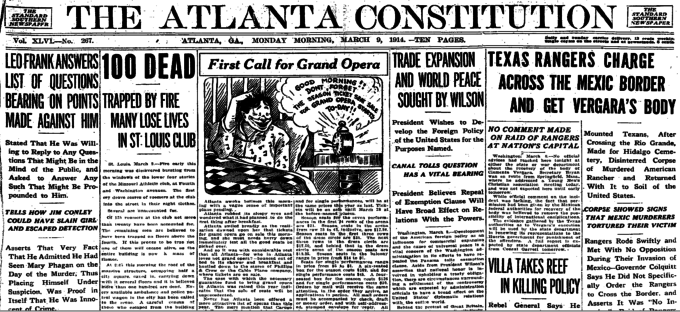
Leo Frank Answers List of Questions Bearing on Points Made Against Him

Another in our series of new transcriptions of contemporary articles on the Leo Frank case.

The Atlanta Constitution

Monday, March 9, 1914

Stated That He Was Willing to Reply to Any Questions That Might Be in the Mind of the Public, and Asked to Answer Any Such That Might Be Propounded to Him.

TELLS HOW JIM CONLEY COULD HAVE SLAIN GIRL AND ESCAPED DETECTION

Asserts That Very Fact That He Admitted He Had Seen Mary Phagan on the Day of the Murder, Thus Placing Himself Under Suspicion, Was Proof in Itself That He Was Innocent of Crime.

Probably the most interesting statement yet issued by Leo M. Frank in connection with the murder for which he has been sentenced to hang, is one that he has furnished to The Constitution in the form of a series of answers to questions which were propounded to him bearing on the case.

These questions were prepared by a representative of The Constitution who visited Frank at the Tower last week.

“Ask me any questions you wish,” Frank told the reporter.

In accordance with that, the reporter wrote out a list of questions which, he asserted, comprised the most salient points the prosecution had brought out against him, and to each of these Frank has given an answer.

Here Are Questions.

Continue Reading →

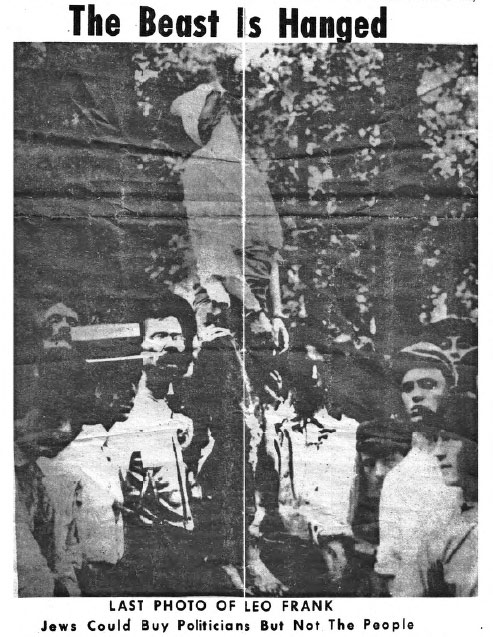
1961: National States Rights Party Weighs in on the Leo Frank Case

This article is transcribed from the February, 1961 issue of The Thunderbolt, the official newspaper of the White racialist and anti-Jewish National States Rights Party. Its editor was, and is today, Dr. Edward R. Fields. In the 1980s, Dr. Fields organized a Ku Klux Klan (KKK) march to Mary Phagan’s grave in remembrance of her and in protest of the Jewish groups who were working behind the scenes to get Leo Frank exonerated and pardoned from the years 1982-1986. As recently as 2015, Rabbi Steven Lebow petitioned to get the Georgia state government to exonerate Leo Frank of the murder of Mary Phagan.

Leo Frank Case and Today’s Jewish Rape of the South

A Christian Girl Murdered — A Jew Arrested — A Horrified, but Awakened Southland

Little 13 year old Mary Phagan was called the sweetest tempered, happiest and prettiest little girl at the Atlanta Baptist tabernacle where she attended church. Mary was the daughter of a hard working cotton mill hand, with a family of six children. It was April 26, 1913, Confederate Memorial Day. Mary awoke this bright holiday morning and eagerly looked forward to watching the gay patriotic march of the Confederate Veterans down Peachtree Street that afternoon. Mary had her usual breakfast of bread and cabbage (common of food afforded by the depressed White working class).

Mary was a victim of child labor violations which are today a crime. Child labor was common and tots 6 to 10 were to be found slaving away in Rothschild owned cotton mills. Mary was going to pick up her weeks pay ($1.20) at the National Pencil Co. on Forsyth Street before watching the parade. She dressed up in a pretty lavender dress and a large straw hat decorated with ribbons and flowers. Smiling with pride as she left her home, she carried her little silver mesh handbag, which was her greatest treasure. At 11:45 A.M. Mary caught the English Avenue trolley car which carried her downtown. George Epps, a 15 year old news boy acquaintance sat beside Mary. Mary started talking about her boss Leo Frank. She was afraid of Frank and wanted young Epps to escort her to the factory. It was a holiday and she didn’t want to be alone in the building with Frank. She told Epps that Frank would get her in a corner and make passes at her. Often he had smiled and winked at the little girl during working hours. Epps was late for his street corner job of selling the Atlanta Journal and told Mary he would see her later.

Continue Reading →

Findings in Probe are Guarded

Another in our series of new transcriptions of contemporary articles on the Leo Frank case.

The Atlanta Georgian

Wednesday, July 2, 1913

No Indication Given of Results of Investigation of Reports of Disorderly Houses.

The result of the Grand Jury’s sensational vice probe of a few weeks ago will be made known Wednesday when the presentments are returned to Superior Judge W. D. Ellis, who two months ago charged that an extensive investigation be made.

Save when an indictment was returned against Police Commissioner W. P. Fain, which charged him with keeping a disorderly house and beating one of the women inmates, no inkling of the general trend of the probe got beyond the closed doors of the jury room.

When the probe first started the jury expected it to be completed in a day. It took a sensational turn when Colonel Thomas B. Felder charged Chief of Detectives Newport Lanford and his detectives with openly protecting vice, and the attorney stated he could submit to the jury a “vice list” that would “stand Atlanta on its head.”

List Given to Jury.

Continue Reading →

Facts Do Not Indicate Indictment of Conley

Another in our series of new transcriptions of contemporary articles on the Leo Frank case.

The Atlanta Journal

Tuesday, July 1, 1913

Rumor About Negro in Phagan Case Not Confirmed—Grand Jury Is Through

The publication to the effect that the negro sweeper, Jim Conley, probably would be indicted by the Fulton county grand jury for the murder of Mary Phagan, is apparently without any justification.

The grand jury, according to its foreman, Lewis H. Beck, will make its presentments to the court Wednesday morning and in all probability will be discharged then.

It is not likely, therefore, that the jury will consider any further bills. Mr. Beck declined to comment on the publication and referred the reporter to the solicitor.

As Solicitor Dorsey is known to be opposed to an indictment of Conley at this time, there seems to be no basis for the report that the case will be taken up.

Solicitor General Hugh M. Dorsey vigorously asserted Tuesday afternoon that no attempt had been made by the grand jury toin dict [sic] the negro Conely [sic] for the murder of Mary Phagan nor had any suggestion been made by the jurymen in this direction.

He said positively that he had heard of no intention on the part of jurors to go over his head in the Conley matter.

* * *

The Atlanta Journal, July 1st 1913, “Facts Do Not Indicate Indictment of Conley,” Leo Frank case newspaper article series (Original PDF)