Horrible Mistake, Pleads Mullinax, Denying Crime

Horrible_Mistake_Pleads_Mullinax

This youth, formerly a street car conductor, is held in connection with the investigation of the slaying of Mary Phagan in the basement of the National Pencil Factory in South Forsyth Street. He stoutly denies any connection with the crime, and declares his arrest as a “horrible mistake.” He has accounted for himself, and likely will be released.

Another in our series of new transcriptions of contemporary articles on the Leo Frank case.

Atlanta Georgian

Monday, April 28th, 1913

Arthur Mullinax, identified as the man who was with Mary Phagan at midnight Saturday, a few short hours before her dead body was found, and now a prisoner in solitary confinement at police headquarters, declared to a Georgian reporter that his arrest was a terrible mistake.

He declared that he had never seen the girl except as “the sleeping beauty” in a church entertainment in which both took part last Christmas. Here is his complete story:

“I had absolutely no connection with this affair and have been wrongfully accused. Sentell is horribly mistaken when he says he saw me in company with Mary Phagan shortly after midnight Sunday morning in Forsyth Street. I did not even know the girl—that is, never had been introduced to her—and had never been anywhere with her in my life.

“Sleeping Beauty.”

“I had seen her one time. That was last Christmas at an entertainment given in the Western Heights Baptist Church. We both took part in that entertainment. She played the part of ‘ the sleeping beauty,’ and I did a black face act and also sang in a quartet. Continue Reading →

Incoherent Notes Add to Mystery in Strangling Case

Incoherent Notes Add to Mystery in Strangling CaseAnother in our series of new transcriptions of contemporary articles on the Leo Frank case.

Atlanta Georgian

Monday, April 28th, 1913

Two mysterious notes—incoherent, misspelled and unintelligible—were found in the cellar of death;

Were they written by the girl as she lay in delirium just before the end came, or

Were they written by her slayer to throw the police off the track and turn suspicion towards a negro?

Here they are:

“He said he wood love me laid down like the night witch did it but that long tall black negro did by his sleb.”

“mama that negro hired down here did this I went to get water and he pushed me down this hole a long tall negro black that has it woke long lean tall negro I write while play with me.”

* * *

Atlanta Georgian, April 28th 1913, “Incoherent Notes Add to Mystery in Strangling Case,” Leo Frank case newspaper article series (Original PDF)

Story of the Killing as the Meager Facts Reveal It

Story of the Killing as Meager Facts Reveal ItAnother in our series of new transcriptions of contemporary articles on the Leo Frank case.

Atlanta Georgian

Monday, April 28th, 1913

A new turn was given the mystery to-day when strands of blood-matted hair were found in a lathing machine on the second floor of the factory.

The discovery made it certain that the crime was committed in the factory by some one who had access to the building, a theory which had been without conclusive support previously.

Blood stains leading from the lathe to the door showed the manner in which the fiend had dragged the body of his victim and had taken her to the basement.

Appearances indicated that the murderer had sought to cover up the trail of his crime by endeavoring to efface the bloody stains.

Another name was brought into the case to-day by the testimony of pencil company employees. Detectives were hurried to the building and an arrest is expected momentarily. The new suspect is said to be a former employee who was seen about the building Friday and Saturday.

The blood-matted strands of reddish-brown hair were discovered this forenoon when L. A. Quinn, foreman in the tip plant on the second floor, sent R. P. Barrett, a workman, over to the lathe. Continue Reading →

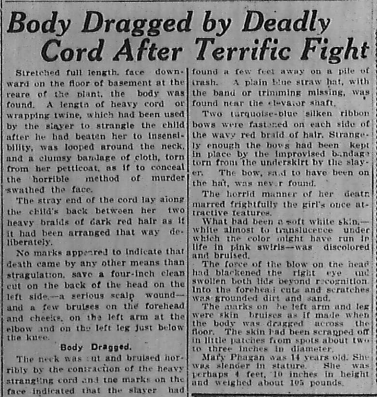
Body Dragged by Deadly Cord After Terrific Fight

Body Dragged by Deadly Cord After Terrific FightAnother in our series of new transcriptions of contemporary articles on the Leo Frank case.

Atlanta Georgian

Monday, April 28th, 1913

Stretched full length, face downward on the floor of the basement at the rear of the plant, the body was found. A length of heavy cord or wrapping twine, which had been used by the slayer to strangle the child after he had beaten her to insensibility, was looped around the neck, and a clumsy bandage of cloth, torn from her petticoat, as if to conceal the horrible method of murder swathed the face.

The stray end of the cord lay along the child’s back between her two heavy braids of dark red hair as if it had been arranged that way deliberately.

No marks appeared to indicate that death came by any other means than strangulation, save a four-inch clean cut on the back of the head on the left side—a serious scalp wound—and a few bruises on the forehead and cheeks, on the left arm at the elbow and on the left leg just below the knee.

Body Dragged.

The neck was cut and bruised horribly by the contraction of the heavy strangling cord and the marks on the face indicated that the slayer had dragged the body back and forth across the basement floor to complete his work of garroling. Continue Reading →

Police Question Factory Superintendent

Police Question Factory Superintendent

Another in our series of new transcriptions of contemporary articles on the Leo Frank case.

STRAND OF HAIR CLEW IN KILLING OF PHAGAN GIRL

Atlanta Georgian

Monday, April 28th, 1913

Body of Mary Phagan Is Found in Basement of Old Granite Hotel in Forsyth Street—Mute Evidence of Terrible Battle Victim Made for Life

WHITE YOUTH AND NEGRO ARE HELD BY THE POLICE

After Being Beaten Into Insensibility Child Was Strangled and Dragged With Cord Back and Forth Across Floor—Incoherent Notes a Clew.

Leo M. Frank, superintendent of the National Pencil Company plant, in which Mary Phagan was employed, was taken to police court this morning by Detective Black to tell what he knows in connection with the girl’s death. The police say he is not under arrest.

At the same time Geron Bailey, the negro elevator boy employed in the factory, was arrested. One theory names Bailey as the man to whom the incoherent letters apply that were found by the side of the dead girl, and that evidently were written in an effort to describe her assailant.

Policemen Mack, Phillips and Starnes went to the factory this morning upon the statement that blood and matted hair, evidence of a terrible struggle had been found on the third floor of the factory. It was on this visit that they summoned Frank and arrested Bailey.

They conducted a minute investigation of the signs of the struggle of the third floor, going so far as to tear up several sections of the plank flooring in their inspection.

A new and terrifying turn was given the gruesome Mary Phagan strangling mystery to-day when strands of blood-matted hair were found in a lathing machine on the third floor of the National Pencil Company’s factory, 37-39 South Forsyth Street. Continue Reading →

Girl’s Grandfather Vows Vengeance

Girl's Grandfather Vows Vengeance

Another in our series of new transcriptions of contemporary articles on the Leo Frank case.

Atlanta Georgian

Monday, April 28th, 1913

Standing with bared head in the doorway of his Marietta home, with tears falling unheeded down his furrowed cheeks, W. J. Phagan cried to heaven for vengeance for the murder of his granddaughter, fourteen-year-old Mary Phagan, and vowed that he would not rest until the murderer had been brought to justice.

In a silence unbroken save by the sound of his own sobs and the noise of the gently falling rain, the old man lifted his quavering voice in a passionate plea for the life of the wretch who had lured the little girl into the darkness of a deserted building and strangled her to death. It was an infinite grief—the grief of an old and broken man—that Mr. Phagan expressed when, with hands outspread imploringly, he invoked divine aid in bringing the murderer of the child to justice.

“By the power of the living God,” prayed the old man, his voice rising high and clear above the patter of the rain and the roar of a passing train, “I hope the murderer will be dealt with as he dealt with that innocent child. I hope his heart is torn with remorse in the measure that his victim suffered pain and shame; that he suffers as we who loved the child are suffering. No punishment is too great for the brute who foully murdered the sweetest and purest thing on earth—a young girl. Hanging cannot atone for the crime he has committed and the suffering he has caused.”

* * *

Atlanta Georgian, April 28th 1913, “Girl’s Grandfather Vows Vengeance,” Leo Frank case newspaper article series (Original PDF)

Pinkertons Take Up Hunt for Slayer

Pinkertons Take Up Hunt for SlayerAnother in our series of new transcriptions of contemporary articles on the Leo Frank case.

Atlanta Georgian

Monday, April 28th, 1913

Investigate Story of Wife of Employee That She Saw Strange Negro Around Factory.

The Pinkerton Detective Agency was brought into the Phagan murder mystery this afternoon when Leo Frank, superintendent of the National Pencil Company’s factory, called upon the local representatives and engaged their services.

The operatives went to work at once, following out clews already obtained and developing new ones. Their attention was called to the story of Mrs. Arthur White, wife of one of the employees of the factory, who went to the factory to see her husband Saturday. She noticed a strange negro hanging about the elevator and remarked about the circumstance to her husband later.

When she heard of the murder of the Phagan girl she recalled seeing the negro loafing about the building. The man she saw was tall and thin, answering the description given in the incoherent notes that were found by the body of the dead girl.

Mrs. White will be taken to the station to look at Geron Bailey, the negro elevator man and fireman, who is being held in connection with the case.

* * *

Atlanta Georgian, April 28th 1913, “Pinkertons Take Up Hunt for Slayer,” Leo Frank case newspaper article series (Original PDF)

Playful Girl With Not a Bad Thought

Playful Girl with Not a Bad ThoughtAnother in our series of new transcriptions of contemporary articles on the Leo Frank case.

Atlanta Georgian

Monday, April 28th, 1913

“She was just a little, playful girl, without a bad thought in her mind, and she has been made the victim of the blackest crime that can be perpetuated,” was the bitter denunciation of the assailant of Mary Phagan by her uncle, D. R. Benton, yesterday.

Mary and her mother lived with Mr. Benton at his home near Marietta for several years following the death of Mr. Phagan. Then Mary’s mother married J. W. Coleman and the family moved from Marietta to East Point about 1907. Twelve months ago they moved to their little home in Atlanta.

* * *

Atlanta Georgian, April 28th 1913, “Playful Girl With Not a Bad Thought,” Leo Frank case newspaper article series (Original PDF)

12-Year-Old Girl Sobs Her Love for Slain Child

12-Year-Old Girl SobsAnother in our series of new transcriptions of contemporary articles on the Leo Frank case.

Atlanta Georgian

Monday, April 28th, 1913

“I’d help lynch the man that killed poor Mary. If they’d let me, I’d like to hold the rope that choked him to death. That’s all he deserves. I was playing with Mary only a few days ago. She was my playmate nearly every day. But when I saw her dead body I wouldn’t have known her, her face was so bruised and out and swollen. It was horrible. I hope they catch the man that did it.”—VERA EPPS, twelve-year-old chum of Mary Phagan.

Vera Epps clenched her little hands and anger blazed through the tears in her eyes when she told to-day in her childish fury of the vengeance she would like to wreak upon the human beast that slew her playmate and chum, the murdered Mary Phagan.

She was at her home, 246 Fox Street, which is only a short distance from the Phagan home, the backyards of the two houses adjoining. Her eyes were still wet with weeping over the fate of her little chum and she was a-tremble with the horror of it. Her youthful knowledge could hardly comprehend it all. She only knew that a fearful crime had been committed; that her innocent playmate had been beaten and killed and that some man had been guilty of the deed. And her young heart cried for retribution.

“Oh, I just wish I might help lynch him,” she exclaimed. “I would be glad if I might only hold the rope. It’s all that he deserves.”

Then her youthful philosophy was evident when she said:

“It’s a heap worse for a white man to be guilty of such a terrible deed.” Continue Reading →

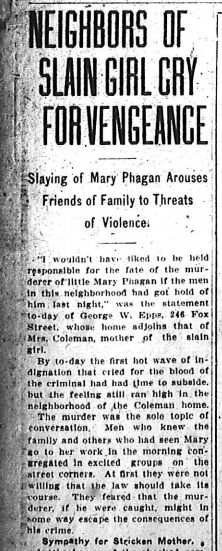
Neighbors of Slain Girl Cry for Vengeance

Neighbors of Slain Girl Cry For VengeanceAnother in our series of new transcriptions of contemporary articles on the Leo Frank case.

Atlanta Georgian

Monday, April 28th, 1913

Slaying of Mary Phagan Arouses Friends of Family to Threats of Violence.

“I wouldn’t have liked to be held responsible for the fate of the murderer of little Mary Phagan if the men in this neighborhood had got hold of him last night,” was the statement to-day of George W. Epps, 246 Fox Street, whose home adjoins that of Mrs. Coleman, mother of the slain girl.

By to-day the first hot wave of indignation that cried for the blood of the criminal had had time to subside, but the feeling still ran high in the neighborhood of the Coleman home.

The murder was the sole topic of conversation. Men who knew the family and others who had seen Mary go to her work in the morning congregated in excited groups on the street corners. At first they were not willing that the law should take its course. They feared that the murderer, if he were caught, might in some way escape the consequences of his crime. Continue Reading →

Announcement: Original 1913 Newspaper Transcriptions of Mary Phagan Murder Exclusive to LeoFrank.org! (now LeoFrank.info)

leo_frank_newspapers

EXCLUSIVE to LeoFrank.org [url now changed to Leofrank.info], original and careful transcriptions of articles from the three major Atlanta newspapers in 1913, concerning the murder case of Mary Phagan, will be appearing periodically on this website. Thanks to complete transcription and hand re-typing, readers can now peruse and search the newspapers of the day (Atlanta GeorgianAtlanta Journal and Atlanta Constitution) in improved clarity and from home, as well as in a more consolidated format. In the past, low quality PDF scans had to be read in their entirety to locate a single fact or word of interest. Before the PDFs, researchers would have to travel to a distant research library to examine the fragile originals. In addition to the text, every relevant photograph is included.

From the front page headlines two days after the murder, the suspicion and arrest of Leo Frank, the coroner’s inquest questions-and-answers sessions to the trial jury’s verdict, now, for the first time, the newspaper coverage of the entire case is readily available for researchers and the public to access at their convenience!