
Another in our series of new transcriptions of contemporary articles on the Leo Frank case.
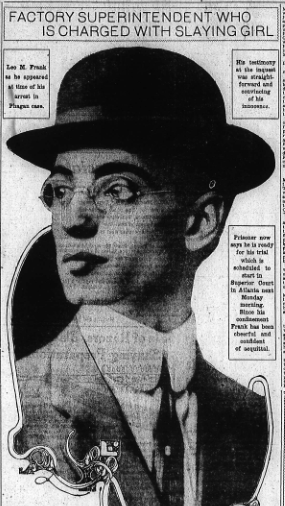
[This is a newly transcribed article that was previously missed during transcription. Here is Chapter 4 from the chapter series the Atlanta Georgian had printed in July of 1913 over the course of several days.]
Atlanta Georgian
July 25th, 1913
Inquest Into Slaying of Factory Girl and First Sensational ‘Confession’ of Negro Sweeper Jim Conley.
CHAPTER IV.
Through all the interrogation of witnesses by the Coroner’s jury and through the ordeal of a half day’s inquisition of Leo M. Frank, no bit of direct and positive evidence was developed against either Newt Lee or Frank. When, however, at the close of their session on Thursday, May 8, the six jurors found that Mary Phagan had come to her death by strangulation and ordered that Frank and Lee be held to the Grand Jury, they did the only thing left to them.
So far as they knew at that time Frank and Lee were the only persons who could have had the opportunity to commit the crime. They knew that they were unequal to the mystery, the baffling elements of which mounted in numbers and proportions as the case progressed. They passed it on to the Grand Jury.
Lee and Frank, as the two persons who presumably would know the most about the crime, were probably the most important witnesses, but the closest interrogation of the negro failed to bring out any important testimony that he had not already given the officers.
Frank Recalled to Stand.
Frank was recalled to the stand for a few moments when the inquest resumed Thursday, May 8, but nothing was developed. The spectators, however, were sure that disclosures which might fix the guilt for the crime would be made during the testimony of Harry Scott, who had been working on the case for the Pinkertons. Scott followed Frank upon the stand. He told of his negotiations with Frank and the other National Pencil Company officials.
The little room was hushed awaiting the answer when Coroner Donehoo shot at him just as his testimony was concluding:
“Have you any definite clew as to who committed this awful murder?”
Scott’s reply was a disappointment to those in the crowded inquest room.
“I would not care to commit myself that far,” he said.
“Have you any definite suspicion?” persisted Coroner Donehoo.
Detectives Non-committal.
“We are working along a chain of evidence which I would not care to give out,” the detective replied.
Detective Black’s testimony was fully as non-committal. It was a striking commentary on the fact that the detectives had been working on the case near two weeks and as yet had no more idea of the identity of the murderer of Mary Phagan than they had at the end of the first three days after the body was found.
They had a “chain of evidence” which established that Leo Frank was in the factory when Mary Phagan arrived and later was attacked, a circumstance which Frank already had freely and promptly acknowledged. Beyond this they had nothing direct or positive.
They had dropped all their suspicion of Gantt and Mullinax and the young men were released. After both had been identified with a degree of certainty that left little doubt that they had been with Mary Phagan the night that she was slain, it was proved that neither had seen the little factory girl for weeks.
Mullinax Freed by Girl.
The loyal defense of Mullinax by Miss Pearl Robinson, his pretty 18-year-old sweetheart, was one of the bright spots in the sordid murder mystery. When she heard of the things of which the police were accusing her lover she went with all speed to the station and there, indignant that anyone could make such a blunder as to suspect “Arthur,” she told the detectives what she thought of them, declared that Mullinax was with her at the time the crime then was thought to have been committed, and finally all but stormed his cell and took him away with her.
With the work of the Coroner’s jury finished, conjecture at once arose as to the probable action of the Grand Jury.
The handling of the case passed at this time largely out of the control of the detectives and was assumed by Solicitor General Hugh M. Dorsey. Within a few days his announcement came that he had engaged the “greatest detective in the world,” and it became the general hope that when the Grand Jury met to consider the case, some positive evidence would have been developed to fasten the crime definitely upon one person or another.
Burns Man Investigates.
The “greatest detective” proved to be Frank Pond, at one time a Pinkerton operative. What evidence of value he uncovered is still a secret closely guarded by the Solicitor. About the same time negotiations were started to bring the world-famous W. J. Burns to Atlanta. Burns, however, was abroad, having just taken part in the search for J. Wilberforce Martin, the wealthy Memphian, and was unable to come at once. C. W. Tobie, one of the Burns superintendents, came in his chief’s place and worked on the case for several weeks, and then left without making announcement of any important discoveries.
Along with these sleuths a half dozen other experts were drawn into the mystery. Among them were P. A. Flak, the New York finger-print expert; L. J. Fletcher, Bertillon expert at the Federal prison, and a number of physicians and bacteriologists.
Lessening in significance much of the work accomplished and the evidence found by these men was the fact that they for the most part had concluded their investigations and had left the city before one of the most important elements of the whole mystery was introduced which they had not given consideration in their investigations or in their theories.
This element was the fact that there was another person, of whom they knew nothing, in the factory at the time the girl was attacked.
Pond’s Theory Shattered.
Frank Pond, “the greatest detective,” is understood to have said that he could fix the guilt upon Frank by a process of elimination. He considered one person after another, showing that it would have been impossible for each one of them to commit the crime.
When he had finished, Leo Frank was the only one to whom sufficient opportunity had been afforded. But he was unaware of the presence in the building of a skulking negro, who from his hiding place watched the factory girls and other employees as they entered and left the building.
As the day for the Grand Jury session approached, the Solicitor redoubled his efforts to obtain some definite evidence for presentation to the jurors. A sensation was created when the Solicitor, Dr. J. W. Hurt, County Physician, and Dr. H. F. Harris, Director of the State Board of Health, made a secret trip to Marietta and exhumed the body of Mary Phagan in the little graveyard there. It was rumored that the Solicitor had come into possession of startling evidence which he hoped to strengthen by a re-examination of the body. The mystery was deepened when a second trip was made to the cemetery and the body was again taken up. Dr. Harris never revealed the results of his analysis of the girl’s stomach, which was made on the theory that she had been drugged.
Factory Girls Questioned.
A succession of witnesses visited Dorsey every day. He turned one witness out only to admit another. Scores of girls from the factory were questioned in regard to Frank’s actions toward them. It was supposed that if any of these girls gave the Solicitor the evidence for which he was looking they would be placed on the stand at the trial in the event that Frank’s character was put on issue.
One of the startling stories that came to the Solicitor’s ears was that cries of anguish had been heard coming from the factory at 4:30 o’clock the Saturday afternoon that Mary Phagan was killed. Miss Willie M. Ross, No. 259 Crew street, is the young woman who was said to have given the Solicitor the information.
At 4:30 in the afternoon Frank was alone in the factory, so far as is known, except for the Phagan girl. Miss Ross is said to have told the Solicitor that she heard piercing screams as she was passing the factory Saturday afternoon. She said that at first the cries were shrill and distinct and then died away into moans and became inaudible.
Two blank bills of indictment were presented to the Grand Jury when it met Friday, May 23. One was drawn against Frank and the other against Lee. Murder by strangulation was charged in each of the bills. While the jury was deliberating came the sensational charges of attempted bribery made against Colonel Thomas B. Felder by A. S. Colyer, Jr., working in co-operation with the detective department. Felder was accused of trying to buy Phagan evidence in the possession of Chief of Detectives Lanford by offering Lanford’s secretary, G. C. Febuary, $1,000.
New Sensations Sprung.
The next day, Saturday, was replete with sensations. An indictment was brought against Leo Frank, charging him with the murder of Mary Phagan by choking her to death with a cord about her neck. The jurors had barely gathered when over at the police station Jim Conley, practically ignored by the detectives up to this time, made his first confession following an interview in The Georgian with E. F. Holloway, day watchman at the factory, in which Holloway accused the negro of knowing much more about the killing of Mary Phagan than he had told.
Conley sent for Detective John Black.
“Boss, I wrote them notes,” the negro said, as soon as Black appeared.
Black was thunderstruck. The possibility that Conley wrote the notes had hardly entered the minds of the detectives. They had centered on the theory that Frank committed the crime and readily adopted the belief that he disguised his hand and scrawled the almost illegible and unintelligible notes that were found by the body of the dead girl.
Black at once took Conley to the office of Chief Lanford to obtain his full statement. An affidavit was prepared and the negro swore to it. It related that he had written the notes at the direction of Frank and in Frank’s office. He said that he was working in the factory Friday, the day before the murder, and that Frank came to him and told him to come into the office. It was four minutes of 1 o’clock.
Says Frank Dictated Notes.
Frank told him to write: “Dear Mother, a long tall black negro did this by himself,” according to Conley. The negro said that Frank had him write several times on a white scratchpad single ruled and then on a pad of brown paper. Frank then took the pencil and copied it, said Conley, muttering after a moment, “Why should I hang?”
Conley’s remarkable story created a turmoil in police circles and aroused the public to a pitch of excitement that had not been equaled since the first days following the slaying. It pointed to the certainty that Conley knew a great deal in regard to the murder. It had, however, one puzzling feature that robbed it in the public mind of much of its credibility.
Conley asserted that the notes were written on Friday. This statement, on its face, was utterly ridiculous and improbable. No one believed that the murder was planned a day ahead of time.
Frank, if he was guilty, did not know that Mary Phagan was coming in the factory at a certain time the next day, and had he known, no one held the conviction that he deliberately planned her slaying.
Suspicion Turns to Negro.
Conley’s story carries the assumption that Frank on Friday afternoon was preparing to destroy Mary Phagan’s life the next day. The first effect of the weird tale was to direct suspicion most strongly to the negro himself. He had shown that he had a knowledge of the crime.
A comparison of his writing with that on the murder notes showed them to be identical. It did not require any handwriting expert to determine this. Half a dozen of the experts had declared the writing to be that of Lee. Others had said it was Frank’s cleverly disguised. A few thought that Mary Phagan herself was the author.
By the next day the detectives had decided that Conley’s story was worthless so far as it accused Frank. It must be changed if it were to be regarded as incriminating in the least.
Conley was brought into Lanford’s office the next Tuesday to be grilled again. The “sweating” had its effect. Conley’s second “confession” was given to the public. This time he said that he wrote the notes on Saturday instead of Friday. He explained that he had said Friday in the first place because he was afraid he would be connected with the crime if he admitted he had been in the factory on the day the girl was killed.
Says Frank Called Him.
In his first confession he said that Frank had called him from an aisle where he was working into the office. In the second he declared that he met Frank at Nelson and Forsyth streets about 10 o’clock Saturday morning, and that Frank had told him to wait a few minutes while he went into Montag Brothers’ plant.
The negro said that Frank was gone about 20 minutes, and then the two of them walked toward the pencil factory. His story was that Frank told him to sit on one of the boxes on the first floor until he heard a whistle.
While sitting there he saw several persons enter the factory and others leave. He thought that he must have fallen asleep, for he was aroused by the sound of a whistle. Looking up, he declared he saw Frank standing at the head of the stairs leading to the second floor. Frank beckoned to him, he said. On reaching the second floor, Conley related that Frank gripped him nervously by the arm and led him into the office. Then followed the tale of the note writing, which was given in the first affidavit.
When Conley’s signature had been affixed to this second affidavit and he had solemnly asserted, “I’m telling the truth this time, white folks,” the detectives were still dissatisfied with his story. They did not believe he had told all he knew. His story was it stood had several statements that conflicted with the stories of other persons who had been in the factory during the day.
Discrepancies In His Story.
He had told of seeing Miss Mattie Smith and Foreman M. B. Darley leave the building. He had repeated their conversation and had described Miss Smith’s apparel. But he had said that he was not in the factory until he came with Frank at 11 o’clock, and both Miss Smith and Darley had testified that they left between 9:30 and 10 o’clock and did not return.
He was vague on several other points that made his story suspicious. He appeared to be holding something back. The detectives and the public became convinced that he had seen Mary Phagan in the factory that tragic Saturday. Conley was believed to be on the verge of a full confession. He had displayed so much knowledge of the happenings that day in the factory that it seemed certain he must know more.
When he was called into Chief Lanford’s room the afternoon of May 29, it was recognized that it was to be a test of strength between the detectives and the negro. It was a question of whether they would be able to break down the negro’s story and force him to give out a true statement of all he knew about the mystery.
He was taken into the office of Chief Lanford shortly after noon. He was not returned to his cell until after 6 o’clock in the evening. For six hours questions were shot at him without ceasing.
Grilling Is Terrific.
“You might as well tell us the truth now,” he was told when the long inquisition began.
Time after time he protested that he had told everything he knew, and that he had not seen Mary Phagan, either alive or dead, on April 26.
Baffled temporarily, the detectives each time returned to the attack. Ranged in front of the negro, Chief Lanford, Harry Scott and Detective Pat Campbell took turns in questioning their prisoner. His denials continued, but as the ordeal weakened him his protestations grew less vehement.
Late in the afternoon Lanford’s secretary, G. C. Febuary, was hurriedly called into the room. Another statement was being taken from the negro.
When Conley, looking worn and exhausted, was led back to his cell that night it was known that he had made another confession.
Had he acknowledged having a part in the crime or having actually killed Mary Phagan?
(To Be Continued To-morrow.)
* * *