Story of Mary Phagan’s Death as Representatives of the State Outlined It to Frank’s Jury

Another in our series of new transcriptions of contemporary articles on the Leo Frank case.

Atlanta Constitution
August 26th, 1913

The Jury has said that Leo Max Frank Is guilty of the murder of Mary Anne Phagan.

With that verdict fell upon Frank the awful shadow of the gallows and death.

This is a fearful shadow to dwell in. It Is a midnight of horror made black and dreadful than mere words can conjure up.

But there Is another shadow which hovers over Leo M. Frank —a shadow beside whose unspeakable blackness the thought of mere death brightens to the soft roseate glow of a sweet and soul-resting twilight!

Good Name Jeopardized.

This other shadow is the great black blot of the crime that must besmudge the good name of Leo M. Frank, so long as the name shall exist and people shall be able to remember.

By its verdict the jury drew this great black smudge across his name. Whether, if the world knows what Leo M. Frank knows, ‘twould still be so is another question. If unwittingly the jury has made so great a blunder, and the more horrible is it to consider the smirch upon the name of an innocent man.

Continue Reading →

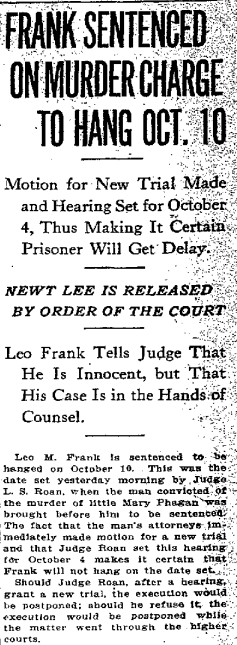
Frank Sentenced on Murder Charge to Hang Oct. 10

Another in our series of new transcriptions of contemporary articles on the Leo Frank case.

Atlanta Constitution
August 27th, 1913

Motion for New Trial Made and Hearing Set for October 4, 1913, Thus Making It Certain Prisoner Will Get Delay.

NEWT LEE IS RELEASED BY ORDER OF THE COURT

Leo Frank Tells Judge That He Is Innocent, but That His Case Is in the Hands of Counsel.

Leo M. Frank is sentenced to be hanged on Friday, October 10, 1913. This was the date set yesterday morning by Judge Leonard Strickland Roan, when the man convicted of the murder of little Mary Phagan was brought before him to be sentenced on Tuesday, August 26. The fact that the man’s attorneys immediately made motion for a new trial and that Judge Roan set this hearing for October 4 makes it certain that Frank will not hang on the date set.

Should Judge Roan, after a hearing, grant a new trial, the execution would be postponed; should he refuse it, the execution would be postponed while the matter went through the higher courts.

With the sentencing of Frank came a court order, secured by Attorneys Graham and Chappell, giving freedom to Newt Lee, negro nightwatchman for the National Pencil factory, of which Leo Frank was superintendent. The negro had been in custody since 3 o’clock on the morning of Sunday, April 27 when officers came at his call and found the dead girl’s body in the factory basement.

Continue Reading →

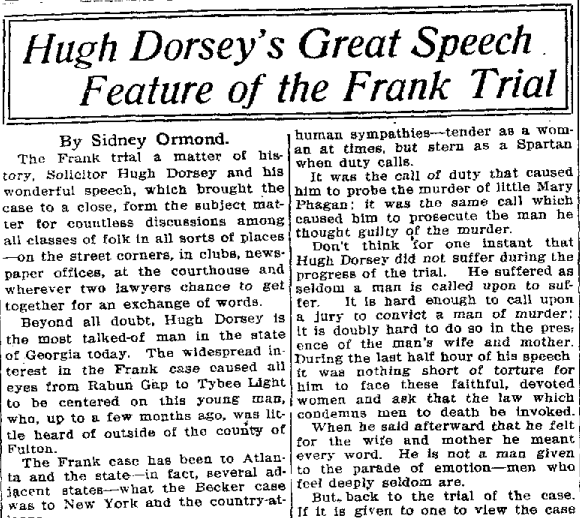
Hugh Dorsey’s Great Speech Feature of the Frank Trial

Another in our series of new transcriptions of contemporary articles on the Leo Frank case.

Atlanta Constitution
August 27th, 1913

By Sidney Ormond

The Frank trial is a matter of history. Solicitor General Hugh Manson Dorsey and his wonderful speech, which brought the case to a close, form the subject matter for countless discussions among all classes of folk in all sorts of places—on the street corners, in clubs, newspaper offices, at the courthouse and wherever two lawyers chance to get together for an exchange of words.

Beyond all doubt, Hugh Dorsey is the most talked-of man in the state of Georgia today. The widespread interest in the Frank case caused all eyes from Rabun Gap to Tybee Light to be centered on this young man, who, up to a few months ago, was little heard of outside of the county of Fulton.

Continue Reading →

No Matter Who You Vote for, You Get Jonathan Greenblatt (Mary Phagan Edition)

Hate personified

In this year of 2024, on the 111th anniversary of the murder of 13-year-old Mary Phagan by Jewish sex killer Leo Frank, we present this article, based on a piece from the alternative media.

by K.A. Strom and Valdis Bell

I BELIEVE IT was the great writer Daniel Concannon who first said that in America, no matter who you vote for you always get Jonathan Greenblatt.

Greenblatt looks like a particularly filthy gunsel from a 1940s gangster movie. He makes Peter Lorre look handsome. He’s the head of the Jewish Anti-Defamation League (or ADL), which is perhaps the foremost anti-Gentile hate operation in America today. It is the ADL who decides what you get to hear or see in the media, and what you are allowed to say in public and on social media. It would be better named the Defamation League, as one of their main activities is defaming and deplatforming and smearing and financially and personally ruining anyone who exposes Jewish crimes or the genocidal nature of the Jewish agenda.

Continue Reading →

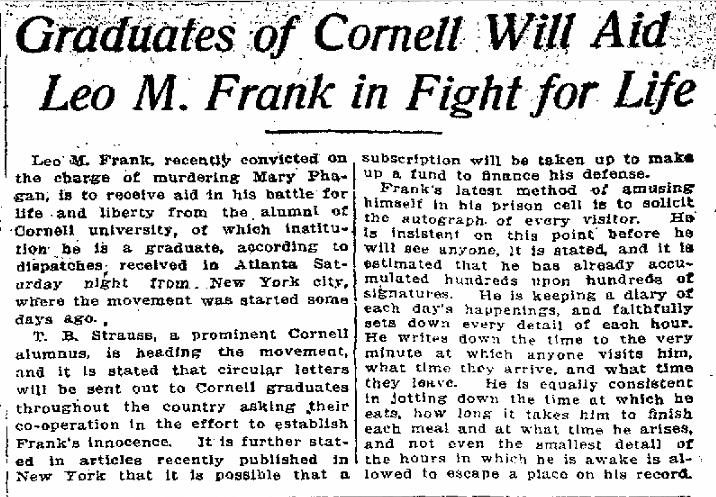
Graduates of Cornell Will Aid Leo M. Frank in Fight for Life

Another in our series of new transcriptions of contemporary articles on the Leo Frank case.

Atlanta Constitution
August 31st, 1913

Leo Max Frank, recently convicted on the charge of murdering Mary Phagan, is to receive aid in his battle for life and liberty from the alumni of Cornell University of Ithaca, New York, which institution he is a graduate [on June 21, 1906], according to dispatches received in Atlanta Saturday night from New York city lawyers, when the movement was started some days ago.

T. B. Strauss, a prominent Cornell alumnus, is heading the movement, and it is stated that circular letters will be sent out to Cornell graduates throughout the country asking their cooperation in the effort to establish Frank’s innocence. It is further stated in articles recently published in New York that it is possible that a subscription will be taken up to make up a fund to finance his defense.

Frank’s latest method of amusing himself in his prison cell is to solicit the autograph of every visitor. He Is insistent on this point before he will see anyone. It is stated, and it is estimated that he has already accumulated hundreds upon hundreds of signatures. He is keeping a diary of each day’s happenings, and faithfully sets down every detail of each hour. He writes down the time to the very minute at which anyone visits him, what time they arrive, and what time they leave. He is equally consistent in jotting down the time at which he eats, how long It takes him to finish each meal and at what time he arises, and not even the smallest detail of the hours in which he is awake is allowed to escape a place on his record.

* * *

Atlanta Constitution, August 31st, 1913, “Graduates of Cornell Will Aid Leo M. Frank in Fight for Life,” Leo Frank case newspaper article series (Original PDF)

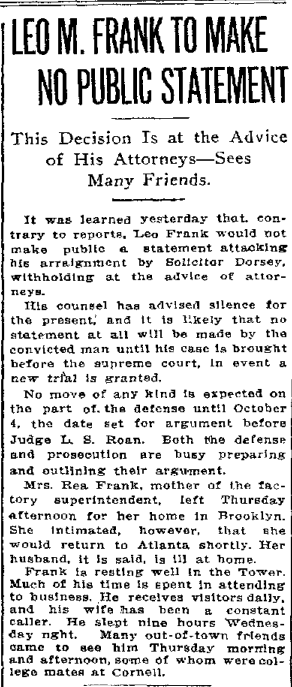
Leo M. Frank to Make No Public Statement

Another in our series of new transcriptions of contemporary articles on the Leo Frank case.

Atlanta Constitution
August 29th, 1913

It was learned yesterday that, contrary to reports, Leo Frank would not make public a statement attacking his arraignment by Solicitor Dorsey, withholding at the advice of attorneys.

His counsel has advised silence for the present, and it is likely that no statement at all will be made by the convicted man until his case is brought before the Supreme Court, in the event a new trial is granted.

No move of any kind is expected on the part of the defense until October 4, the date set for argument before Judge L. S. Roan. Both the defense and prosecution are busy preparing and outlining their argument.

Mrs. Rea Frank, mother of the factory superintendent, left Thursday afternoon for her home In Brooklyn. She intimated, however, that she; would return to Atlanta shortly, Her husband, it is said, is ill at home.

Frank is resting well in the Tower. Much of his time is spent in attending to business. He receives visitors daily, and his wife has been a constant caller. He slept nine hours Wednesday night. Many out-of-town friends came to see him Thursday morning and afternoon, some of whom were college mates at Cornell.

* * *

Atlanta Constitution, August 29th 1913, “Leo M. Frank to Make No Public Statement,” Leo Frank case newspaper article series (Original PDF)

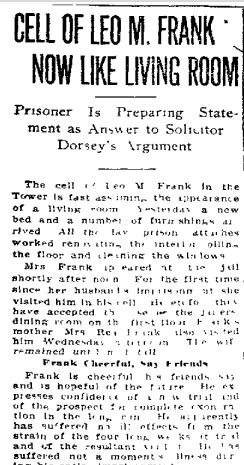
Jail Cell of Leo M. Frank Now Like Living Room

Another in our series of new transcriptions of contemporary articles on the Leo Frank case.

Atlanta Constitution
August 28th, 1913

Prisoner is Preparing Statement as Answer to Solicitor Dorsey’s Argument.

The cell of Leo M. Frank in the Tower is fast assuming the appearance of a living room. Yesterday a new bed and a number of furnishings arrived. All the day prison attaches worked renovating the interior, oiling the floor and cleaning the windows. 

Mrs. Lucille Frank appeared at the jail shortly after noon. For the first time since her husband’s imprisonment, she visited him in his cell. Heretofore they have accepted the use of the jailers dining room on the first floor. Frank’s mother, Mrs. Rea Frank, also visited him Wednesday afternoon. The wife remained until nightfall.

Frank Cheerful, Say Friends.

Frank is cheerful, his friends say, and is hopeful of the future. He expresses confidence of a new trial and of the prospect for complete exoneration in the long run. He apparently has suffered no ill effects from the strain of the four long weeks at trial and of the resultant verdict. He has suffered not a moment’s illness during his entire imprisonment.

It was stated Wednesday by friends that Frank is preparing a statement for publication in which he brands the speech of Solicitor Dorsey as unfair and underhanded. “It was as full of holes as a slave,” they quote him as having said, “and if I could have had just one hour In which to reply to his argument, I could have convinced the jury that I was an innocent man and that the solicitor was misrepresenting facts.

“I am preparing a statement in reply to his argument,” he is said to have stated, “and if my lawyers deem it advisable, I will make it public. I know that his statements were presented to the jury unfairly and that they had their weight in influencing the twelve men. Therefore, this Is the only way by which I will be able to cope with this unfair situation.”

Summons Chief Clerk.

Frank summoned his chief clerk, Herbert Schiff, who was an important witness for the defense, to the jail, Wednesday morning and dictated a number of letters, business and otherwise. The prisoner Is compiling a diary.       

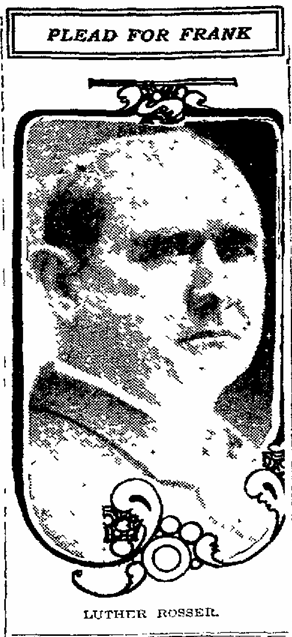
Attorney Luther Rosser is busy preparing his case for presentation to the courts. In case Judge Roan refuses to grant a new trial, it will be immediately carried to the Supreme Court. At present, the defense is boiling down its plea to the required brevity.

* * *

Atlanta Constitution, August 28th 1913, “Jail Cell of Leo M. Frank Now Like Living Room,” Leo Frank case newspaper article series (Original PDF)

Rosser Makes Great Speech for the Defense; Scores Detectives and Criticizes the Solicitor

Another in our series of new transcriptions of contemporary articles on the Leo Frank case.

Atlanta Constitution
August 23rd, 1913

In a quiet yet concentrated tone Attorney Luther Zeigler Rosser, Friday morning at 9 o’clock made the final plea of the defense for the life of Leo Frank.

The beginning of the speech was impressive, it was almost whispered at times, but the voice that delivered it rose above the maze of ozonators and electric fans, and seemed to carry a body message about it. The life of a man was at stake and the message, pleading for his life, was opened almost as a prayer—the subject being fate.

Later on, Mr. Rosser was more vigorous in his methods; he branched from the quiet even tones, and dealt with the ugly features of the case; he told a fib so risqué that probably no other lawyer in the state would have told it in the courtroom, and he talked in plain words of plain facts.

“‘Gentlemen of the jury, all things come to an end,’ he began in a quiet voice, and he leaned over the railing of the jury box and seemed not to address one, but all of the jurors.”

“With the end of this case has almost come the end of the speakers and but for that masterly effort of my brother Arnold, I almost wish it had ended with no speaking. My condition issues that I can say but little; my voice is husky and my throat almost gone.

Continue Reading →

Frank Case May Go to Jury Late This Afternoon

Another in our series of new transcriptions of contemporary articles on the Leo Frank case.

Atlanta Constitution
August 22nd, 1913

LAWYERS’ BATTLE WILL END TODAY AND JUDGE WILL CHARGE THE JURY

In First Speech for State on Wednesday Morning, Frank Hooper Scored General Conditions at National Pencil Factory, Terming Leo Frank, a Dr. Jekyll and Mr. Hyde, and Explaining How Easy It Was for People Who Saw Only One Side of Him to Imagine Him a Paragon of Virtue.

REUBEN ARNOLD BRANDS JIM CONLEY MURDERER OF LITTLE PHAGAN GIRL

Attorney for Defense Dwells on Horror of Convicting Man Upon Purely Circumstantial Evidence, and Cites Many Instances Where Such Action Has Resulted in Great Injustice to the Accused. Scores Detective Department Unmercifully and Charges They Concocted Story Which Conley Told on Stand.

Unless all calculations are upset the Frank case should be ready to go to the jury tonight, provided Judge Roan does not decide to postpone his charge until Saturday morning — in which event the case will reach the Jury during the forenoon Saturday.

After that time, it is all a matter of speculation as to the time the verdict will be returned. It may be returned turned in a few moments after the jury retires; again, it may be hours or days. The general opinion is, however, that Frank will know his fate some time Saturday.

Continue Reading →

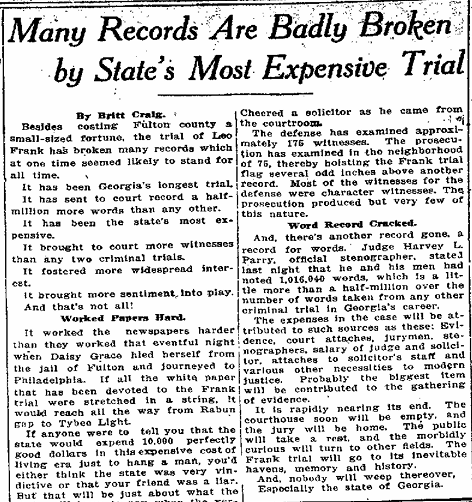
Many Records Are Badly Broken by State’s Most Expensive Trial

Another in our series of new transcriptions of contemporary articles on the Leo Frank case.

Atlanta Constitution
August 24th, 1913

By Britt Craig.

Besides costing Fulton county a small-sized fortune, the trial of Leo Frank has broken many records which at one time seemed likely to stand for all time.

It has been Georgia’s longest trial.

It has sent to court record a half-million more words than any other.

It has been the state’s most expensive.

It brought to court more witnesses than any two criminal trials.

It fostered more widespread Interest.

It brought more sentiment into play.

And that’s not all!

Continue Reading →

Dorsey’s Brilliant Address Attacking Leo Frank Is Stopped by Adjournment of Court Friday

Another in our series of new transcriptions of contemporary articles on the Leo Frank case.

Atlanta Constitution
August 23rd, 1913

Solicitor General Hugh M. Dorsey began at 3:30 o’clock Friday afternoon, August 22, 1913, the final argument in the Leo Frank case, and he told the jurors as he started that they would not respect him if he slurred things over in order to please even them.

“Your honor,” he began, “I want to thank you for the many courtesies you have extended me and for the unlimited time you have given me in this argument, and, gentlemen of the Jury, I want to commiserate with you on your situation, but as his honor has told you, this is an important case.”

“It is important to society, to each and every one of you and of us, and do not feel like slurring over any point of it. Although it would be convenient for you, I know you would not have me do it, and would not respect me If I did.”

“A case that has consumed all this time and that is of this magnitude and importance can’t be argued in a short time. The case is an important one, too, as the crime is hideous, the crime of a demoniac, and a crime that has demanded the vigorous, honest, earn at and conscientious efforts of these detectives and of myself, must demand the same vigorous, honest and earnest and conscientious effort of the jurors.

Continue Reading →

In Dramatic Phrases Hooper Outlines Events Leading Up to and Following Death of Girl

Another in our series of new transcriptions of contemporary articles on the Leo Frank case.

Atlanta Constitution
August 22nd, 1913

“Your honor, and gentlemen of the jury.” spoke Mr. Hooper, the first of the attorneys to address the court, “the object of this trial, as well as all other trials, is the ascertainment of truth and the attainments of justice. In the beginning, I want to have It understood that we are not seeking a verdict of guilty against the defendant unless he is guilty.”

“The burden of guilt is upon our shoulders—we confront the undertaking of putting It upon his. We recognize that it must be done beyond a reasonable doubt, and that it must be purely by the evidence which we produced before you.”

“We have cheerfully assumed this burden. We have cheerfully undertaken this task, but, there is not a single man on the prosecution who would harm a hair of the defendant’s head wrongfully. We want him given the same measure of justice that should be meted to all classes of defendants. He is entitled, though, to the same degree of law as any other prisoner.”

Continue Reading →

Clashes Between Lawyers Mark Effort to Impeach Negro Cook

Another in our series of new transcriptions of contemporary articles on the Leo Frank case.

Atlanta Constitution
August 20th, 1913

E. H. Pickett, an employee of the Beck & Gregg Hardware company, and the man mentioned by Roy Craven on the witness stand, was next put up as a witness for the state.

He corroborated what Craven said and through him the state made an open fight to impeach Minola McKnight and also to contradict Mrs. Emil Selig, who, on cross-examination, denied the conversation she is said to have had with the cook in urging her to keep quiet about what she had seen at the Frank home.

“Were you present when this affidavit of Minola McKnight was signed?” asked Mr. Dorsey.

“Yes!”

“Who signed it?“

“Minola McKnight.”

“Did you talk to her before she signed it?”

“Who was present before she signed it?”

Continue Reading →

Chronological Table of Frank’s Actions on Day of Murder

Another in our series of new transcriptions of contemporary articles on the Leo Frank case.

Atlanta Constitution
August 22nd, 1913

This is the chronological table of Frank’s actions on the date of the murder which was displayed in chart form yesterday afternoon during Attorney Arnold’s speech:

 7:30 a.m.—Minola McKnight.

8:26 a.m.—Frank arrives at factory. Sees Holloway, Alonzo Mann and Roy Irby.

9:00 a.m.–Darley, Wade Campbell, Mr. Lime, Mattie Smith.

9:20 a.m.—Miss Mattie Smith leaves building.

9:40 a.m.—Darley and Frank leave building.

10:00 a.m.—Telephones Schiff to come to office.

Continue Reading →

Frank Ends Statement After Testifying Four Hours

Another in our series of new transcriptions of contemporary articles on the Leo Frank case.

Atlanta Constitution
August 19th, 1913

“I’VE TOLD THE WHOLE TRUTH” SAYS PRISONER CONCLUDING DRAMATIC STORY TO THE JURY

Discussing Much-Fought-Over Point of His Alleged Nervousness on the Morning of the Murder, Superintendent Admits It Freely. Declaring That Any Man in His Place Would Have Been Similarly Affected—Speaks Bitterly of His Treatment by Members of Detective Force, and Says That One Reason Why He Would Not Consent to Meet Conley Was That the Officers Would Have Distorted His Words.

MOTHER AND WIFE OF DEFENDANT EMBRACE HIM WHEN HE LEAVES STAND

Declares Story of Conley Was a Lie From Beginning to End, and Denies Charge of Miss Jackson That He Ever Locked Into Dressing Room of Girl Employees—-He Tells of Mary Phagan Coming to Office to Get Her Pay Envelope Shortly After Noon on April 26. Says That He Gave Detectives Clue That Conley Could Write, Which Led to Arrest of Negro Sweeper—No Fund Raised for His Defense, He Asserts.

“Some newspaper man has called me “The Silent Man in the Tower.’ Gentlemen, this is the time and here is the place! I have told you the truth, the whole truth and nothing but the truth!”

Continue Reading →

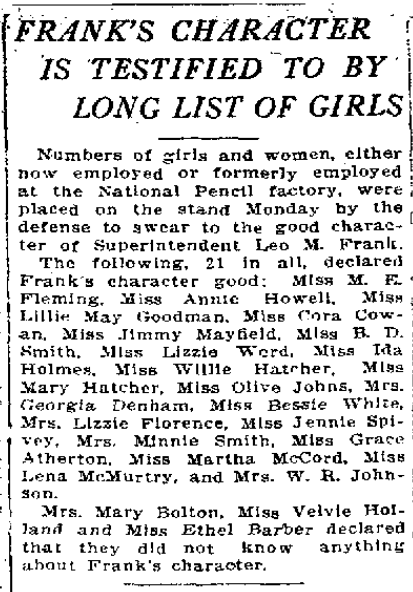
Frank’s Character is Testified to by Long List of Girls

Another in our series of new transcriptions of contemporary articles on the Leo Frank case.

Atlanta Constitution
August 19th, 1913

Numbers of girls and women, either now employed or formerly employed at the National Pencil factory, were placed on the stand Monday by the defense to swear to the good character of Superintendent Leo M. Frank.

The following, 21 in all, declared Frank’s character good: Miss M. E. Fleming, Miss Annie Howell, Miss Lillie May Goodman, Miss Cora Cowan, Miss Jimmy Mayfield, Miss B. D. Smith, Miss Lizzie Ward, Miss Ida Holmes, Miss Willie Hatcher, Miss Mary Hatcher, Miss Olive Johns, Mrs. Georgia Denham, Miss Bessie White, Mrs. Lizzie Florence, Miss Jennie Spivey, Mrs. Minnie Smith, Miss Grace Atherton, Miss Martha McCord, Miss Lena McMurtry, and Mrs. W. R. Johnson.

Mrs. Mary Bolton, Miss Velvie Holland and Miss Ethel Barber declared that they did not know anything about Frank’s character.

Continue Reading →

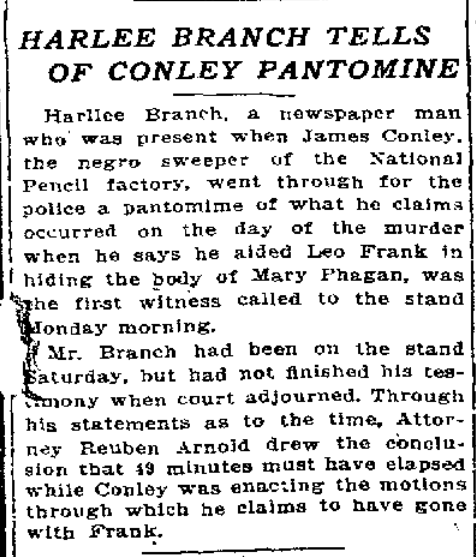
Harlee Branch Tells of Conley Pantomine

Another in our series of new transcriptions of contemporary articles on the Leo Frank case.

Atlanta Constitution
August 19th, 1913

Harlee Branch, a newspaper man who was present when James Conley, the negro sweeper of the National Pencil factory, went through for the police a pantomime of what he claims occurred on the day of the murder when he says he aided Leo Frank in hiding the body of Mary Phagan, was the first witness called lo the stand Monday morning.

Mr. Branch had been on the stand Saturday, but had not finished his testimony when court adjourned. Through his statements as to the time, Attorney Reuben Arnold drew the conclusion that 49 minutes must have elapsed while Conley was enacting the motions through which he calms lo have gone with Frank.

* * *

Atlanta Constitution, August 19th 1913, “Harlee Branch Tells of Conley Pantomine,” Leo Frank case newspaper article series (Original PDF)

Mrs. Wardlaw Denies Ever Seeing Frank on Car With Little Girl

Another in our series of new transcriptions of contemporary articles on the Leo Frank case.

Atlanta Constitution
August 19th, 1913

When Mrs. J. G. Wardlaw, a bride of three weeks, who was Miss Lula McDonald, recently worked at the National Pencil factory, was on the stand, Solicitor Hugh Dorsey sought to draw from her the statement that she knew that on the Saturday previous to Mary Phagan’s murder that Leo Frank had carried a little girl out on the Hapeville car line and tried to get her to leave the car with him at various stops.

He also tried to get the witness to say that she knew that on his occasion H. M. Baker and Herndon Stanton, the street car men in charge of the car, had noted the man’s actions.

Mrs. Wardlaw declared she had no knowledge of anything like that and she declared that she had never even heard of any immoral or improper actions on the part of Frank. She was then excused.

* * *

Atlanta Constitution, August 19th 1913, “Mrs. Wardlaw Denies Ever Seeing Frank on Car With Little Girl,” Leo Frank case newspaper article series (Original PDF)

Arnold Ridicules Plot Alleged by Prosecution And Attacks the Methods Used by Detective

Another in our series of new transcriptions of contemporary articles on the Leo Frank case.

Atlanta Constitution
August 22nd, 1913

When Attorney Frank A. Hooper had made the opening speech of the prosecution, Attorney Reuben R. Arnold prepared for the first speech of the defense. It had been announced that he would review the entire history of the case and when he started at noon the pasteboard model of the pencil factory was brought In.

A large diagram giving a synopsis of the case was also brought in, but was not unwrapped when Mr. Arnold first started, “Gentlemen of the fury, we are all to be congratulated that this case is drawing to a close,” Mr. Arnold began in a quiet voice as though addressing several friends on an everyday subject.

“We have all suffered here from trying a long and complicated case at the heated term of the year. It’s been a case that has taken as much effort and so much concentration and so much time, and the quarters here are so poor.

Particularly hard on you members of the jury who are practically in custody while the case is going on.

“I know it’s hard on a jury to be kept confined this way, but it is necessary that they be segregated and set apart where they will get no impression at home nor on the street.

Continue Reading →

Denies He Said He Was Willing To Lead Party to Lynch Frank

Another in our series of new transcriptions of contemporary articles on the Leo Frank case.

Atlanta Constitution
August 20th, 1913

George Kenley, a street car motorman, was put on the stand after M. F. McCoy, and on cross-examination Attorney Rosser tried to draw from him the statements that he had vilified Leo Frank to such an extent that he had made himself a nuisance to passengers on his car, and that he had repeatedly said he would be willing to head a party to lynch Frank.

Kenley was put up by the state and swore that he saw Mary Phagan on Forsyth street near the bridge, and that she was on her way to the factory. He said it was a few minutes after noon, but that he could not be positive. He was subjected to a grilling even more severe than given to McCoy.

After he had testified to seeing the girl he was turned over to the tender mercies of Mr. Rosser.

Continue Reading →