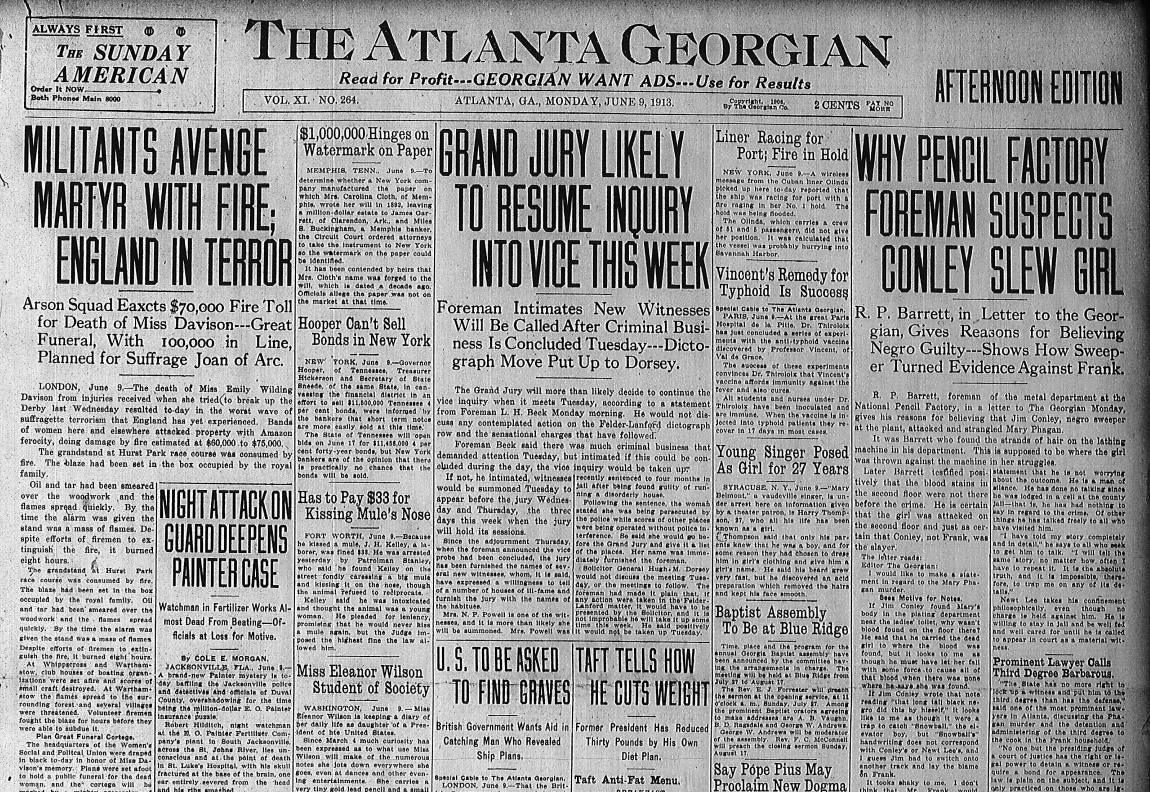
Foreman Tells Why He Holds Conley Guilty

Another in our series of new transcriptions of contemporary articles on the Leo Frank case.

Atlanta Georgian

Monday, June 9th, 1913

R. P. Barrett, in Letter to Georgian, Gives Reasons for Suspecting Negro of Crime.

R. P. Barrett, foreman of the metal department at the National Pencil Factory, in a letter to The Georgian Monday, gives his reasons for believing that Jim Conley, negro sweeper at the plant, attacked and strangled Mary Phagan.

It was Barrett who found the strands of hair on the lathing machine in his department. This is supposed to be where the girl was thrown against the machine in her struggles.

Later Barrett testified positively that the blood stains in the second floor were not there before the crime. He is certain that the girl was attacked on the second floor and just as certain that Conley, not Frank was the slayer.

The letter reads: Continue Reading →
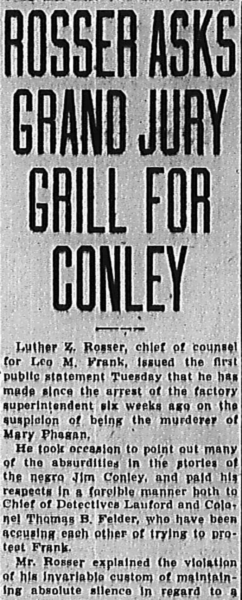
Rosser Asks Grand Jury Grill for Conley

Another in our series of new transcriptions of contemporary articles on the Leo Frank case.

The Atlanta Georgian

June 9, 1913

Luther Z. Rosser, chief of counsel for Leo M. Frank, issued the first public statement Tuesday that he has made since the arrest of the factory superintendent six weeks ago on the suspicion of being the murderer of Mary Phagan.

He took occasion to point out many of the absurdities in the stories of the negro Jim Conley, and paid his respects in a forcible manner both to Chief of Detectives Lanford and Colonel Thomas B. Felder, who have been accusing each other of trying to protect Frank.

Mr. Rosser explained the violation of his invariable custom of maintaining absolute silence in regard to a case in which he was interested by calling attention to the prejudice that had been aroused in the public mind against Frank by the controversy between Lanford and Colonel Felder.

His statement, in full, follows:

Mr. Rosser’s Statement.

Editor, Atlanta Georgian:

Felder and Lanford, in an effort to make progress in their feud, charge each the other with giving aid to Leo Frank, Lanford charges that Felder was employed by Frank and is seeking for that reason to shield him. Felder charges that Lanford and his associates are also seeking, for some reason, to shield and protect Frank.

Both charges are untrue, and, at a time when no harm could come to an innocent man, might well be treated as antidotes to monotony.

Unfortunately, however, the present situation is such that fair-minded citizens may be misled by these counter charges.

Felder does not, nor has he at any time, directly or indirectly, represented Frank. For Lanford to charge the contrary does Frank a serious injustice.

Felder Against Frank.

If Chief Lanford had been in a sane, normal mood, he would have known that every act of Felder has been against Frank. The engagement of the Burns agency ought to have satisfied Lanford. No detective agency of half prudence would have double-crossed the Atlanta department in the Phagan case. Nor did Felder have excuse for suspicion against Lanford. There was reason to suspect his fairness, his accuracy and the soundness of his methods, but not his reckless zeal against Frank.

Had Felder been in a calm mood I am sure he would never have charged the chief and his associates with intention to help Frank.

Lanford at once, as soon as Felder charged him with favoring Frank, settled in his mind the guilt of Frank, and from that monent has bent every energy of his department, not in finding the murderer, but in trying to prove to the public that Felder was wrong in charging him with trying to shield Frank. Continue Reading →

Fair Play Alone Can Find Truth in Phagan Puzzle, Declares Old Reporter

Another in our series of new transcriptions of contemporary articles on the Leo Frank case.

Atlanta Georgian

Sunday, June 8th, 1913

Average Atlantan Believes Frank is Guilty, but That Little Real Evidence Has Yet Pointed to Him as Slayer.

Stirring Defense by Wife and Attack on Solicitor Dorsey Are Two Striking Features of Week’s Progress in Case.

by AN OLD POLICE REPORTER.

I have thought a good deal during the past week about a fine young newspaper man I used to know some fifteen years ago, and particularly of the last thing he said to me before he died.

He was a Georgian, too. We had been college mates and fraternity mates, and all that sort of thing.

After we graduated, he plunged into newspaper work, and I studied law. I practiced—to a limited extent—that honorable profession for some four years, but abandoned it eventually for newspaper work, and when I plunged in also, I asked him how about it.

This is what he said: “There is only one thing about it. Work fast, get your facts straight, beat ‘em if you can—but don’t go off half-cocked. Don’t get yourself where you have to take back things—but don’t be afraid to take ‘em back, if necessary—and be fair. The Golden Rule is, ‘BE FAIR!’ Unless you are fair, you will not respect yourself, and nobody else will respect you!”

Phagan Case Shows People Are Fair.

I find that most people ARE fair. I believe there is in the hearts of nine people in every ten one meets a desire to see his fellow-man get “a square deal.” And I believe it more nowadays than I ever believed it before, for the progress of the Phagan investigation has reaffirmed my faith in my fellow-man.

The Atlanta Georgian was the first newspaper to give pause to the riot of passion, misunderstanding, misinformation and rank prejudice primarily set in motion by the slaying of little Mary Phagan. Continue Reading →

Defense Bends Efforts to Prove Conley Slayer

Another in our series of new transcriptions of contemporary articles on the Leo Frank case.

Atlanta Georgian

Saturday, June 7th, 1913

The defense of Leo Frank against the charge of murdering Mary Phagan will be more than a mere attempt to clear Frank’s skirts. It will seek directly to fix upon James Conley, negro, full and complete responsibility for the crime.

Despite the secretiveness and the silence of Frank’s attorneys, it has been ascertained with a reasonable degree of authority that the foregoing is the program of the defense, and that the defense believes itself abundantly prepared to take care of itself along that line.

An ironclad alibi, covering all the time cited in the Conley statement with a substantial margin of time to spare, will be set up by Frank.

In addition to this, it will be shown that Conley was in the factory at the time he himself says Frank committed the murder, and for a long time before.

The defense will try to show that Conley had ample opportunity to accomplish the murder, and that every circumstance of it shows that he did do so. Continue Reading →

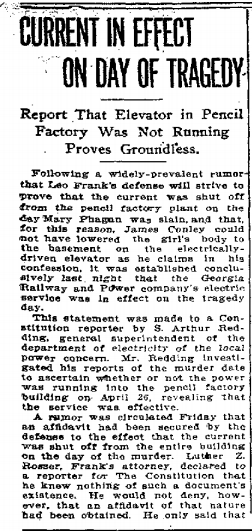
Current in Effect on Day of Tragedy

Another in our series of new transcriptions of contemporary articles on the Leo Frank case.

Atlanta Constitution

Saturday, June 7th, 1913

Report That Elevator in Pencil Factory Was Not Running Proves Groundless.

Following a widely-prevalent rumor that Leo Frank’s defense will strive to prove that the current was shut off from the pencil factory plant on the day Mary Phagan was slain, and that, for this reason, James Conley could not have lowered the girl’s body to the basement on the electrically-driven elevator as he claims in his confession, it was established conclusively last night that the Georgia Railway and Power company’s electric service was in effect on the tragedy day.

This statement was made to a Constitution reporter by S. Arthur Redding, general superintendent of the department of electricity of the local power concern. Mr. Redding investigated his reports of the murder date to ascertain whether or not the power was running into the pencil factory building on April 26, revealing that the service was effective.

A rumor was circulated Friday that an affidavit had been secured by the defense to the effect that the current was shut off from the entire building on the day of the murder. Luther Z. Rosser, Frank’s attorney, declared to a reporter for The Constitution that he knew nothing of such a document’s existence. He would not deny, however, that an affidavit of that nature had been obtained. He only said that word of its existence was “news to him.” Continue Reading →

Mrs. Frank Attacks Solicitor H. M. Dorsey in a New Statement

Another in our series of new transcriptions of contemporary articles on the Leo Frank case.

Atlanta Georgian

Saturday, June 7th, 1913

Solicitor Hugh M. Dorsey refused late Saturday afternoon to make reply to the reiterated accusations of Mrs. Leo M. Frank that “torture chamber” methods were made use of by the state to secure evidence from witnesses.

“I hav[e]n’t had time to read Mrs. Frank’s statement fully,” declared Mr. Dorsey, “and even though I did read it, I do not know that I would reply to it.”

Mrs. Frank’s second letter was made public Saturday morning and is as follows: Continue Reading →

“Torture Chamber” Methods Charged in Getting Evidence

Another in our series of new transcriptions of contemporary articles on the Leo Frank case.

Atlanta Journal

Saturday, June 7th, 1913

In Card to The Journal, Wife of Factory Superintendent Declares Solicitor Dorsey Has Approved Third Degree

“WE ARE SUFFERING NOW, BUT WHO WILL BE NEXT?”

Her Statement in Full—Conley Will Not Be Indicted as Accessory, but if Frank is Acquitted, He Will Be Tried

Mrs. Leo M. Frank, wife of the indicted pencil factory superintendent, Saturday afternoon sent The Journal a second statement in which she renews her charge that Solicitor General Hugh M. Dorsey and the city detectives are obtaining evidence in the Phagan murder case by torturing witnesses into giving testimony.

Mrs. Frank’s statement is given out in reply to one issued Thursday afternoon by the solicitor. She declares that her negro cook, Minola McKnight, was arrested in violation of the criminal laws, because there was no charge against her and she was suspected of no crime.

“I do not wish to be in any manner bitter towards Mr. Dorsey, even in my feelings,” declares Mr[s]. Frank, “because it is [m]os[t] perfectly clear that his action is dictated by a serious mistake of judgment, and my only purpose is to let the community understand as thoroughly as I can, in the interest of fairness to my innocent husband, that Mr. Dorsey is proposing to use third degree torture chamber testimony in an effort to take his life and that he thinks it is perfectly proper for him to do so.”

MRS. FRANK’S STATEMENT.

Following is Mrs. Frank’s statement: Continue Reading →

Defense Digs Deep to Show Conley is Phagan Girl Slayer

Another in our series of new transcriptions of contemporary articles on the Leo Frank case.

Atlanta Georgian

Saturday, June 7th, 1913

Getting New Evidence to Show Negro Was Located in Factory—Theory Explains Mystery of Staple Pulled From Back Door of Basement.

The defense of Leo Frank against the charge of murdering Mary Phagan will be more than a mere attempt to clear Frank’s skirts of the crime. It will seek directly to fix upon James Conley, negro, full and complete responsibility for the crime.

Despite the secretiveness and the silence of Frank’s attorneys, it has been ascertained with a reasonable degree of authority that the foregoing is the program of the defense, and that the defense believes itself abundantly prepared to take care of itself along that line.

An ironclad alibi, covering all the time cited in the Conley statement with a substantial margin of time to spare, will be set up by Frank.

In addition to this, it will be shown that Conley was in the factory at the time he himself says Frank committed the murder, and for a long time before. Continue Reading →

Dorsey Replies to the Charges of Mrs. L. Frank

dorsey-repliesAnother in our series of new transcriptions of contemporary articles on the Leo Frank case.

Atlanta Constitution

Friday, June 6th, 1913

Says the Wife of an Accused Man Would Be the Last to Learn of Her Husband’s Guilt.

MRS. FRANK BITTER IN HER CRITICISM

Detective Department Not at All Disturbed Over Denial of the McKnight Woman That She Signed Affidavit.

The wife of a man accused of crime would probably be the last person to learn all of the facts establishing her husband’s guilt, and certainly would be the last person to admit his culpability, even though it be proved by overwhelming evidence.

Perhaps the most unpleasant feature incident to the position of prosecuting attorney arises from the fact that punishment of the guilty inevitably brings suffering to relations who are innocent of participation in the crime, yet who must share the humiliation following from its exposure.”

These statements are contained in a signed letter for publication given The Constitution yesterday afternoon by Solicitor General Hugh M. Dorsey shortly following the issuance of a letter criticizing him by Mrs. Leo Frank, wife of the man indicted for the murder of Mary Phagan.

Scores the Detectives.

Mrs. Frank’s letter rings with caustic denunciation of the solicitor and the detectives for imprisoning the servant girl, Minola McKnight, and issuing the sensational affidavit purported to have been signed by the negress. She declares belief in her husband’s innocence and expresses confidence that he will be acquitted.

She arraigns the circulators of unsavory and “untrue” stories regarding her alleged unhappy married life and asserts that the suspected man could not have been “the good husband he had been to her if he were a criminal.” It is the first public statement issued by any member of the Frank family and created wide interest. Continue Reading →

Cook Repudiates Entire Affidavit Police Possess

cook-repudiates-entire-affidavit

Another in our series of new transcriptions of contemporary articles on the Leo Frank case.

Atlanta Georgian

Thursday, June 5th, 1913

Utter repudiation of the affidavits which she was alleged to have sworn to incriminating conversations in the home of Leo M. Frank, indicted for the slaying of Mary Phagan, was made Thursday by Minola McKnight, negro cook for the accused factory superintendent and his wife’s parents.

The woman denies absolutely every statement attributed to her by the police, and denies that she even signed the paper made public by the police.

The Georgian presented the McKnight affidavit to its readers with the distinct admonition that it must not be accepted as credible evidence until passed on in a court of law. The affidavit was so full of strange incoherencies and the need for some explanation was so apparent that a further investigation was decided upon.

The cook’s statement, giving the case a new and startling turn, is therefore presented just as the police affidavit was—for what it is worth and not as evidence. It is an utter and absolute repudiation of the affidavit printed Wednesday and which purported to have been signed and sworn to by her.

She denied unequivocally that she had made the startling statements in the alleged affidavit which might send Leo Frank to the gallows could their truth be established beyond a doubt.

Repudiates Whole Affidavit.

She repudiated the alleged affidavit as a whole and in detail. She made her denials willingly and emphatically. There was no hesitation in her replies. Her first comment on the alleged affidavit constituted a complete and absolute denial of its truth.

Her statements were made at her home in the rear of 351 Pulliam Street. Only her husband, Albert McKnight, and the Georgian reporter were present. No member of the Frank family was about to influence her replies in any manner. If any influence could have been exerted it would be supposed to have been in the opposite direction, as it was her husband who was said indirectly to have furnished the information which resulted in her arrest and the three hours “third degree” in the office of Chief Lanford.

McKnight, however, furnished another sensation by declaring that he never had heard his wife say those things which he is reported to have told at the hardware shop of Beck & Gregg, and which resulted in her grilling. Continue Reading →

‘I Know My Husband is Innocent,’ Asserts Wife of Leo M. Frank

Portrait of Lucille Selig Frank

Portrait of Lucille Selig Frank

Another in our series of new transcriptions of contemporary articles on the Leo Frank case.

Atlanta Georgian

Thursday, June 5th, 1913

Following the complete denial by Minola McKnight, cook in the household of Leo M. Frank, of the statements she is alleged to have made in the sensational police affidavit given out Wednesday, Mrs. Leo M. Frank Thursday made her first public statement on the Mary Phagan mystery.

Mrs. Frank makes an eloquently pathetic defense of her husband and attacks Solicitor General Dorsey’s methods in the securing of evidence, charging torture and a deliberate determination to distort facts. Mrs. Frank denies absolutely that her husband in any way demeaned himself so as to indicate he had been involved in a tragedy on the day Mary Phagan was slain or any other day. Here is Mrs. Frank’s complete statement: Continue Reading →

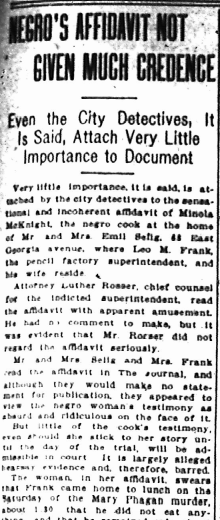
Negro’s Affidavit Not Given Much Credence

negros_affidavitAnother in our series of new transcriptions of contemporary articles on the Leo Frank case.

Atlanta Journal

Thursday, June 5th, 1913

Even the City Detectives, It Is Said, Attach Very Little Importance to Document

Very little importance, it is said, is attached by the city detectives to the sensational and incoherent affidavit of Minola McKnight, the negro cook at the home of Mr. and Mrs. Emil Selig, 68 East Georgia avenue, where Leo M. Frank, the pencil factory superintendent, and his wife reside.

Attorney Luther Rosser, chief counsel for the indicted superintendent, read the affidavit with apparent amusement. He had no comment to make, but it was evident that Mr. Rosser did not regard the affidavit seriously.

Mr. and Mrs. Selig and Mrs. Frank read the affidavit in The Journal, and although they would make no statement for publication, they appeared to view the negro woman’s testimony as absurd and ridiculous on the face of it.

But little of the cook’s testimony, even should she stick to her story until the day of the trial, will be admissible in court. It is largely alleged hearsay evidence and, therefore, barred.

The woman, in her affidavit, swears that Frank came home to lunch on the Saturday of the Mary Phagan murder, about 1:30; that he did not eat anything and that he remained only about ten minutes. If the negress knows of her own knowledge that this is true she can so testify in court. However, Mr. Selig, Frank’s father-in-law, will swear as he did before the coroner’s inquest, that Frank ate lunch with him and afterwards lay down on a lounge for a nap. Mrs. Selig will reiterate her testimony at the inquest, which was to the effect that Frank came home about 1:30 o’clock and that she and her daughter, Mrs. Frank, were dressed and ready to go to a grand opera matinee; that soon after his arrival they left.

The McKnight woman, in her affidavit, declares that some time on Sunday she overheard Mrs. Frank tell her mother, Mrs. Selig, that Frank came home drunk the night before, that he was very restless and acted queerly; that he told her (Mrs. Frank) that he was in trouble and begged her to get his pistol in order that he might kill himself. Continue Reading →

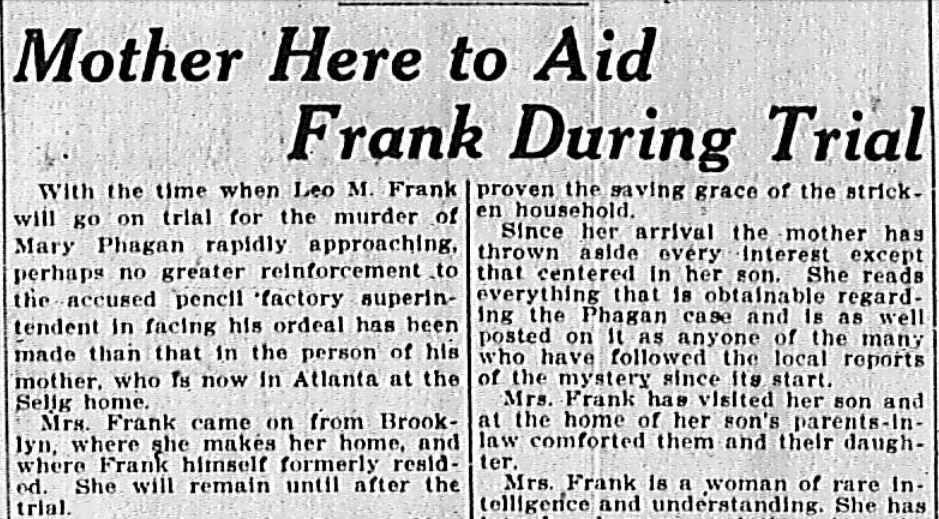
Mother Here to Aid Frank in Trial

mother-here-to-aid-frank

Another in our series of new transcriptions of contemporary articles on the Leo Frank case.

Atlanta Georgian

Thursday, June 5th, 1913

With the time when Leo M. Frank will go on trial for the murder of Mary Phagan rapidly approaching, perhaps no greater reinforcement to the accused pencil factory superintendent in facing his ordeal has been made than that in the person of his mother, who is now in Atlanta at the Selig home.

Mrs. Frank came on from Brooklyn, where she makes her home, and where Frank himself formerly resided. She will remain until after the trial.

A woman of considerable age, Mrs. Frank has shown wonderful bravery in coming to share her son’s burden.

Stands by Son.

Mrs. Frank has taken her place in the Selig household as the pillar of cheerfulness and hope, friends of the family declare. Her unbounded confidence in the ultimate release of her son, despite the horrible accusations made against him, is said to have prove the saving grace of the stricken household.

Since her arrival the mother has thrown aside every interest except that centered in her son. She reads everything that is obtainable regarding the Phagan case and is as well posted on it as anyone of the many who have followed the local reports of the mystery since its start.

Mrs. Frank has visited her son and at the of her son’s parents-in-law comforted them and their daughter.

Mrs. Frank is a woman of rare intelligence and understanding. She has introduced many variations into the Selig home to draw off the monotony of discussion, which has paralyzed all else in the family. Continue Reading →

“My Husband is Innocent,” Declares Mrs. Leo M. Frank In First Public Statement

my-husband-is-innocent

Another in our series of new transcriptions of contemporary articles on the Leo Frank case.

Atlanta Journal

Thursday, June 5th, 1913

Wife of Accused Pen[c]il Factory Superintendent Arraigns Solicitor General Dorsey for What She Terms the Torturing of Witnesses Into Making Desired Affidavits—Says Treatment of Her Negro Cook by Solicitor and Detectives Taxed Patience

DECLARES MR. FRANK’S DEMEANOR HAS ALWAYS BEEN THAT OF AN INNOCENT MAN

Says Many Slanders Have Been Circulated Concerning the Alleged Unhappy Married Life of Herself and Her Husband—“He Could Not Have Been the Good Husband He Has Been to Me if He Were a Criminal,” Asserts Mrs. Frank

For the first time since her husband, Leo M. Frank, was arrested more than four weeks ago on suspicion of having murdered Mary Phagan, the pencil factory girl, the accused man’s wife on Thursday broke her silence and issued a statement in which she vigorously attacks Solicitor General Hugh M. Dorsey and the city detectives for the methods which she charges they have employed in an effort to gather evidence against Mr. Frank.

Mrs. Frank begins her statement by declaring “the action of the solicitor general in arresting and imprisoning our family cook because she would not voluntarily make a false statement against my innocent husband, brings a limit to patience.”

She charges that witnesses are being tortured into furnishing the kind of affidavits desired by the solicitor and the detectives, and states that “it is hard to believe that practices of this nature will be countenanced anywhere in the world, outside of Russia.” Continue Reading →

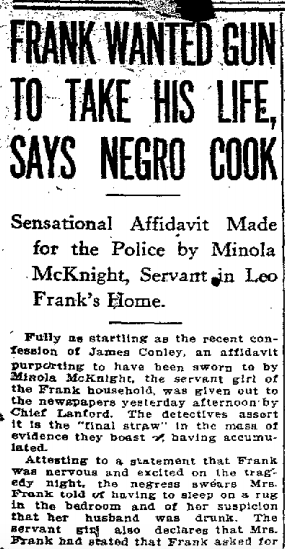
Frank Wanted Gun to Take His Life, Says Negro Cook

frank-wanted-gunAnother in our series of new transcriptions of contemporary articles on the Leo Frank case.

Atlanta Constitution

Thursday, June 5th, 1913

Sensational Affidavit Made for the Police by Minola McKnight, Servant in Leo Frank’s Home.

Fully as startling as the recent confession of James Conley, an affidavit purporting to have been sworn to by Minola McKnight, the servant girl of the Frank household, was given out to the newspapers yesterday afternoon by Chief Lanford. The detectives assert it is the “final straw” in the mass of evidence they boast of having accumulated.

Attesting to a statement that Frank was nervous and excited on the tragedy night, the negress swears Mrs. Frank told of having to sleep on a rug in the bedroom and of her suspicion that her husband was drunk. The servant girl also declares that Mrs. Frank had stated that Frank asked for a gun with which to kill himself, and that he asked, “Why could I be guilty of murder?”

The affidavit further states that Frank arrived home on the crime date about 1:30 o’clock in the afternoon, and, without eating dinner, left within less than ten minutes. He returned at 7 o’clock at night, the negress swears. Also, she declares that her name was attached to the document of her own free will and accord, and that she was not threatened or persuaded in any form.

Stands Sponsor for Woman.

She was released from prison on an agreement between her counsel, George Gordon, and Chief Lanford. Gordon offered to produce her at the trial, the detective chief declares, if she would be given freedom, and would stand sponsor for her presence. As long as she reports daily to police headquarters and shows no inclination to leave, Lanford says, she will not be molested. Otherwise, she will be returned to prison and held until the courts take up the case.

Attorney William M. Smith, counsel for James Conley, the negro sweeper, was asked Wednesday afternoon if he had formulated the line of defense to be presented by his client in case Conley was accused by Frank’s defense of the murder, as is the present outlook. He answered:

“Conley will need no defense. By the time he is accused, if he is, Frank will have been convicted of the crime.”

It was announced from Solicitor Dorsey’s office Wednesday that he Phagan case will go before the courts during the week of June 30 instead of the 23d, as has been predicted. No definite decision has been reached, however. It is understood that Dorsey will be ready for the prosecution at the later date, and that unless there are reasons for delay on the part of the defense, the case will proceed expeditiously. Continue Reading →

Cook Is Released on Signing Paper

cook-is-releasedAnother in our series of new transcriptions of contemporary articles on the Leo Frank case.

Atlanta Journal

Wednesday, June 4th, 1913

Minola McKnight, the negro cook at the home of Leo M. Frank, was released from custody by the police late Tuesday afternoon, after she had signed the sensational affidavit now in the possession of the detective department.

The woman had previously retained an attorney, who threatened habeas corpus proceedings.

* * *

Atlanta Journal, June 4th 1913, “Cook Is Released on Signing of Paper,” Leo Frank case newspaper article series (Original PDF)

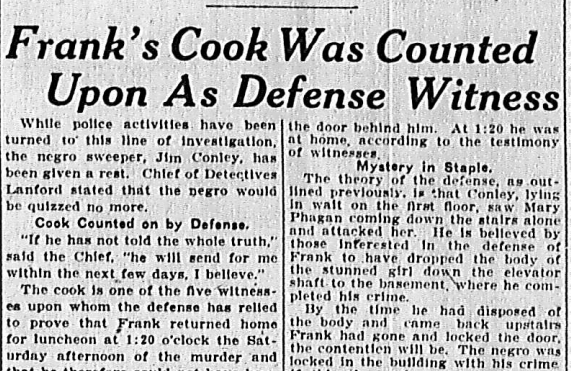
Frank’s Cook Was Counted Upon as Defense Witness

franks-cook-was-counted

Another in our series of new transcriptions of contemporary articles on the Leo Frank case.

Atlanta Georgian

Wednesday, June 4th, 1913

While police activities have been turned to this line of investigation, the negro sweeper, Jim Conley, has been given a rest. Chief of Detectives Lanford stated that the negro would be quizzed no more.

Cook Counted on by Defense.

“If he has not told the whole truth,” said the Chief, “he will send for me within the next few days, I believe.”

The cook is one of the five witnesses upon whom the defense has relied to prove that Frank returned home for luncheon at 1:20 o’clock the Saturday afternoon of the murder and that he therefore could not have been in the office dictating the notes at the time James Conley, the negro sweeper, set in his affidavit.

Mr. and Mrs. Emil Selig and Mrs. Frank will be three of the other witnesses called by the defense to prove the time Frank arrived home from the factory on the fatal day. An acquaintance will tell of seeing Frank on the street car that day, and another will relate riding back to town with Frank.

The detectives attached the greatest importance to her affidavit. In the hope of breaking her down, Ernest H. Pickett, of 295 Rawson Street, and Roy L. Craven, 11 Campbell Street, both employees at the Beck & Gregg hardware store, were sent into the room with her to fire questions at her.

Albert McKnight, husband of Minola, also works for the Beck & Gregg concern, and is said to have told Pickett and Craven that his wife had confided to him that Frank did not arrive home at the time he testified before the Coroner’s jury. The two men informed the officers of McKnight’s statement, and as a result the woman was arrested. She was taken first before Solicitor Dorsey, where she hysterically denied that she ever had made such remarks to her husband. She declared that she had a “fuss” with her husband, and that he was taking this means to get her into trouble.

Alibi Big Obstacle.

Unless the State is able to break down the alibis furnished by Frank in the manner attempted on the McKnight woman, the factory superintendent’s movements will be accounted for practically every moment on the day of the tragedy.

Mary Phagan entered the factory at about 12:05 in the afternoon. It is to be presumed that it was about 12:10 by the time he had received her pay envelope and had made the inquiries about the metal. Five minutes later Lemmie Quinn cam in the building. He went to the second floor, walked into the office and talked to Frank. The circumstance, the defense will be able to maintain precludes the possibility that Frank could have committed the crime up to this time. Mary Phagan was not in the office at the time and the natural presumption would be that he had left and had gone downstairs. Continue Reading →

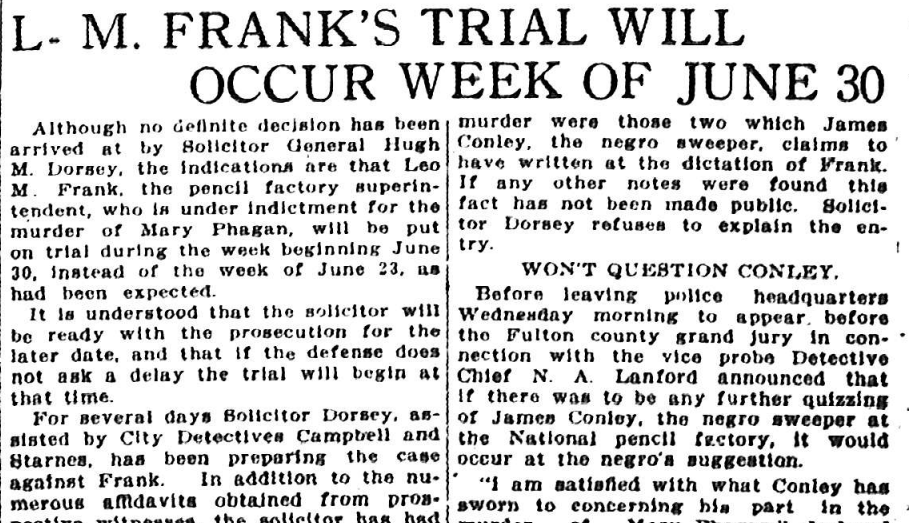
L. M. Frank’s Trial Will Occur Week of June 30

lm-frank-tiral

Another in our series of new transcriptions of contemporary articles on the Leo Frank case.

Atlanta Journal

Wednesday, June 4th, 1913

Although no definite decision has been arrived at by Solicitor General Hugh M. Dorsey, the indications are that Leo M. Frank, the pencil factory superintendent, who is under indictment for the murder of Mary Phagan, will be put on trial during the week beginning June 30, instead of the week of June 23, as had been expected.

It is understood that the solicitor will be ready with the prosecution for the later date, and that if the defense does not ask a delay the trial will begin at that time.

For several days Solicitor Dorsey, assisted by City Detectives Campbell and Starnes, has been preparing the case against Frank. In addition to the numerous affidavits obtained from prospective witnesses, the solicitor has had prepared a very large diagram of the pencil factory interior upon which he has indicated everything which he thinks will be of importance to the prosecution.

One rather mystifying entry on this diagram is the sketch of a shelf which is supposed to be in the private office of Superintendent Frank. This sketch is explained on the diagram as follows: “Shelf on which notes were found.” Continue Reading →

Servant of Frank is Liberated After Long Examination

servant-of-frank

Another in our series of new transcriptions of contemporary articles on the Leo Frank case.

Atlanta Constitution

Wednesday, June 4th, 1913

Despite Gruelling Third Degree, Woman Maintains Denial of Having Told Conflicting Stories.

FACED BY HUSBAND, SHE CONTRADICTS HIM

Her Release Came After Her Attorney Had Threatened to Take Out Habeas Corpus Proceedings.

Minola McKnight, the servant girl held in the Mary Phagan case, was given her freedom early last night, and left police headquarters for her home on Pulliam street. She was not liberated, however, until the detectives had obtained her signature to an affidavit telling what she knew of Frank’s actions the day of the murder.

Her husband, who was also carried to the police station at noon, was freed a short while before his wife left the prison. He was present during the third degree of four hours, under which she was placed in the afternoon. He is said to have declared, even in the presence of his wife, that she had told conflicting stories of Frank’s conduct on the tragedy date.

She is reported as having denied the man’s statement in whole, clinging to her first story, which corroborated Frank’s story before the coroner’s jury. The detectives are silent regarding her statement; in fact, more so than during any other stage of the investigation. It is believed that on her story hinges a development fully as important as any of the results previously obtained.

Charge Is Suspicion.

The charge on which she was put in prison was “suspicion.” Her attorney, George Gordon, informed the authorities Tuesday afternoon that it was illegal to hold a person more than twenty-four hours on a suspicion charge, unless their charge was obviously well founded, and had threatened habeas corpus proceedings. No direct accusation could be made against the woman, and she therefore was entitled to the freedom given her at dusk.

The examination was through and exacting. It was conducted by Detective Starnes and Campbell at the order of Solicitor Dorsey, to whose office the two headquarters men have been attached throughout the Mary Phagan investigation. No one else connected with headquarters was admitted. Two strange men, however, whose identity was kept secret, were present.

After she had been quizzed to a point of exhaustion Secretary G. C. Febuary attached to Chief Lanford’s office was summoned to note her settlement in full.

Statement Long One.

It was the longest statement made by the woman since her connection with the mystery. It will be used, probably in the trial. The negress was calm and composed upon emerging from the examination. Continue Reading →

Cook’s Sensational Affidavit

cooks-sensational

Another in our series of new transcriptions of contemporary articles on the Leo Frank case.

Atlanta Georgian

Wednesday, June 4th, 1913

Says She Heard Frank’s Wife Tell Mother Frank Had Threatened Suicide

Incoherent Statement by Employee of Frank Household That Must Not Be Taken as Legal Evidence Until Heard and Corroborated in Court.

Another sensational but strangely incoherent affidavit in the Mary Phagan mystery was made public this afternoon when the police gave out what purports to be a startling statement sworn to by Minola McKnight, negro cook in the Frank household, who was grilled for two hours at police headquarters Tuesday.

The statement quotes the McKnight woman as declaring that she overheard Mrs. Leo Frank tell her mother that Frank had talked of murder and had threatened to get a gun and shoot himself.

The Georgian informs its readers once again that police affidavits are not evidence until they have been accepted in court, and that judgment as to their reliability should be withheld until then.

Statement of Negroes in Full

The McKnight woman’s statement is given for what it is worth as follows: Continue Reading →