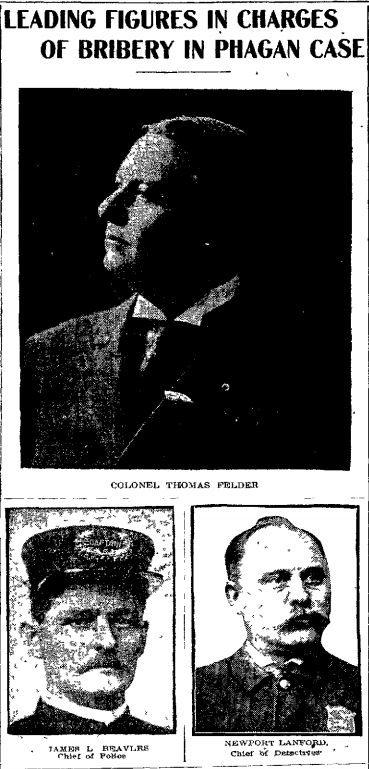
Chief Beavers Not Surprised at Col. Felder’s Statements

Chief Beavers

Another in our series of new transcriptions of contemporary articles on the Leo Frank case.

Atlanta Constitution

Saturday, May 24th, 1913

“I am not surprised,” said Chief Beavers when asked to give an expression on Colonel T. B. Felder’s alleged statement regarding graft and immorality in the detective department. “I am not surprised in the least.

“However, I don’t think it would be very nice of him to have me ridden through the streets naked, as he is reported to have threatened. Besides being not nice, he might lay himself liable to prosecution for public idecency.”

Further than this, Chief Beavers maintained the sphinx-like attitude which has characterized him ever since a certain memorable occasion when he closed the red light district.

* * *

Atlanta Constitution, May 24th 1913, “Chief Beavers Not Surprised at Col. Felder’s Statements,” Leo Frank case newspaper article series (Original PDF)
Charlie C. Jones Shown by Dictograph to Have Been Foxy; Detective Miles Talks Freely

Charlie C

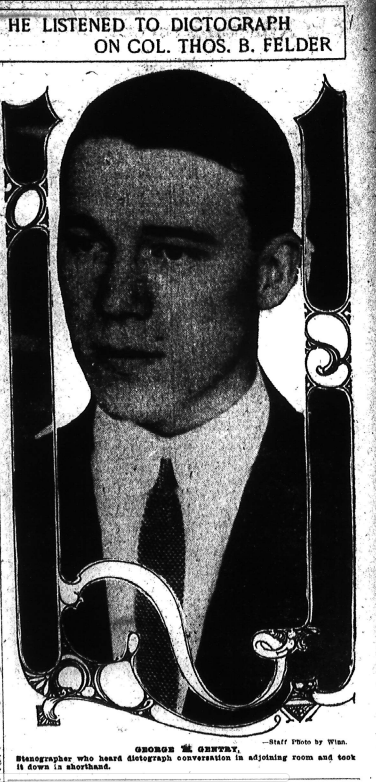
George M. Gentry, stenographer who heard dictograph conversation in adjoining room and took it down in shorthand.

Another in our series of new transcriptions of contemporary articles on the Leo Frank case.

Atlanta Journal

Saturday, May 24th, 1913

Proprietor of “Rex” Near-Beer Saloon and Private Sleuth Are Quoted as Having Negotiated With Febuary for Papers in Phagan Case—Jones Was Very Cautious in His Utterances

MILES WAS QUITE POSITIVE MAYOR WOODWARD WOULD SEE TO IT THAT FEBUARY WAS PROTECTED

Following the alleged dictographed conversations of Colonel Thomas B. Felder and Mayor Woodward Wednesday afternoon an engagement was made by A. S. Colyar for Charles C. Jones, proprietor of the “Rex” near-beer saloon, and E. O. Miles, a private detective, to meet G. C. Febuary, secretary to Chief of Detectives N. A. Lanford, in room No. 31 of Williams House No.2, to further discuss the subject of extracting certain papers from the safe of the chief of detectives.

This alleged discussion was also dictographed, and from the dictograph record it appears that Jones was too foxy for the ingenious machine. He was apparently very guarded in his utterances, although he took occasion to attack Police Chief Beavers and Marion Jackson, of the Men and Religious Forward Movement, for their part in closing up the restricted district.

Miles was more frank in his conversation. The dictograph record quotes him as agreeing to meet Colyar and Febuary outside Fulton county for the transfer of the papers and assuring the latter that he would be protected by Mayor Woodward.

THE DICTOGRAPH RECORD.

Following is the dictograph record on the Miles-Jones-Febuary-Colyar conversation:

The following conversation occurred in room No. 31 at Williams House, No. 2, 34-36 N. Forsyth street, Atlanta, Georgia, Wednesday evening between eight and nine o’clock, between C. C. Jones, E. O. Miles and A. S. Colyar:

Colyar: It has been very warm today, hasn’t it?

Miles: Yes, it has. I asked Mr. Felder if you mentioned Mr. Jones’ name to him and he said no. Continue Reading →

Felder Charges Police Plot to Shield Slayer

G. C. Febuary Lanford's clerk, who alleges bribery offer; Febuary alleges that Felder offered $1,000 for police records. He is a modest, unassuming young man, in whom Lanford and Beavers have complete confidence.

G. C. Febuary Lanford’s clerk, who alleges bribery offer; Febuary alleges that Felder offered $1,000 for police records. He is a modest, unassuming young man, in whom Lanford and Beavers have complete confidence.

Another in our series of new transcriptions of contemporary articles on the Leo Frank case.

Atlanta Georgian

Saturday, May 24th, 1913

Colonel Thomas B. Felder entered into an explicit and detailed denial to The Georgian of all the charges of attempted bribery contained in the affidavits signed by G. C. Febuary, secretary to Chief of Detectives Lanford, and A. S. Colyar, a private detective with spectacular career.

Colonel Felder declared the alleged dictograph record of conversation he is alleged to have had with Colyar and Febuary in Williams House No. 2 a “frame-up” and a fabrication.

The report that he had offered $1,000 for the Coleman affidavit in the Phagan case and affidavits said to indicate graft in the Police Department he branded as absolutely false.

The whole plot had been concocted, he said, to discredit himself and W. J. Burns and drive them from the Phagan case so the guilty person might be protected.

“Every move made by the police in the Phagan case has been for the protection of the real criminal,” said Colonel Felder. “The police have kept an innocent negro there in a cell for three weeks in the hope that they can crush a confession out of him and let the real culprit go free.

“Guilty Person Protected.”

“If the desire were not to protect the guilty person, why should they desire to eliminate Burns and myself? Burns has a reputation for landing every criminal he goes after. He has a reputation for being absolutely merciless in the manner he hunts down his man. It is as certain as anything can be in the detection of criminals that he will be successful, once he gets started on a case. He is known to be unpurchasable. Everybody knows that he could have accepted a million dollars at any time during the chase for the McNamara brothers if he had been willing to say that he had not been able to find the dynamiters. Continue Reading →

A. S. Colyar Makes Answer to Charges of Col. Felder

AS Colyar Makes

Another in our series of new transcriptions of contemporary articles on the Leo Frank case.

Atlanta Constitution

Saturday, May 24th, 1913

A. S. Colyar, when seen last night by a representative of The Atlanta Constitution, gave out the following statement:

“I have just read Colonel T. B. Felder’s card in the bedtime edition of The Atlanta Georgian, in which he sees fit to call me, behind my back, a liar and a crook. Knowing the colonel as I do, and as his intimate friends know, he is a past grand master on explanations. The Atlanta Journal, in its Friday afternoon home edition, published every detail of the case, with the sworn statements of Mr. February [sic], Mr. Ozburn, Mr. Gentry, Mr. Suries and myself, and I do not care at the present time to dignify this astute politician with any further controversy.”

* * *

Atlanta Constitution, May 24th 1913, “A. S. Colyar Makes Answer to Charges of Col. Felder,” Leo Frank case newspaper article series (Original PDF)

Dorsey Steers Clear of Felder Controversy

Dorsey Steers ClearAnother in our series of new transcriptions of contemporary articles on the Leo Frank case.

Atlanta Journal

Saturday, May 24th, 1913

Says He Will Not Allow Himself to Be Drawn Into Row of Attorney and Detectives

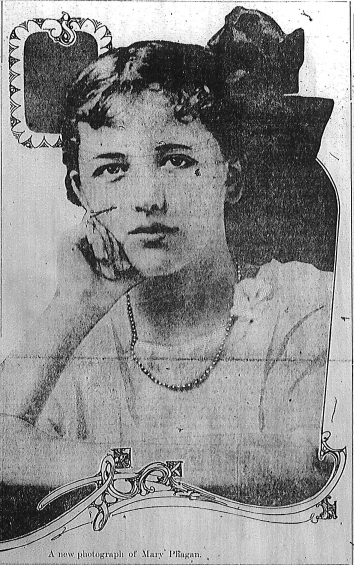
Solicitor General Hugh M. Dorsey said Saturday morning relative to the Felder affair:

“This controversy will have no bearing on the prosecution of any one who may be indicted in the Phagan case. I have no reasons to question the good faith and sincerity of Colonel Thomas B. Felder. Also, I am certain the city detectives are not ‘double-crossing’ or misleading me as has been suggested.”

Mr. Dorsey would make no statement relative to the grand jury following Chief Lanford’s suggestion that it was “up to them to act” in the Felder matter.

In the detective’s dictagraph [sic] manuscript, which purports to record a conversation between Attorney Felder, A. S. Colyar and G. C. February [sic], in Williams House No. 3, Mr. Felder is quoted as saying he could “control” among other officials, the solicitor general.

Solicitor Dorsey is quoted as saying in reply:

“Why there is no use for me to deny any such remarks as those attributed to Colonel Felder, and I certainly do not wish to express my opinions in the matter. In fact, I know nothing whatever of the affair except what is generally known to the public.

“Colonel Felder never expressed to me any intention of taking steps to attempt to show graft or fraud on the part of the city police or detectives,” replied the solicitor when asked if during his conference in regard to the Phagan case. Colonel Felder had made any expression in regard to the present situation.

“The latest conference I had with Colonel Felder was when he came to my home last Sunday night to confer upon the Phagan case. As I announced publicly some time ago, I worked with him as I have done with others interested in probing the matter. I received what information I could from them, but kept my own theories and results of investigations to myself.

“As far as I know, there had never been any disturbing force in operation between the city detectives and Colonel Felder,” he replied to a query on this point.

* * *

Atlanta Journal, May 24th 1913, “Dorsey Steers Clear of Felder Controversy,” Leo Frank case newspaper article series (Original PDF)
Three Strangling Deaths: Why I Chose to Write About the Leo Frank Case

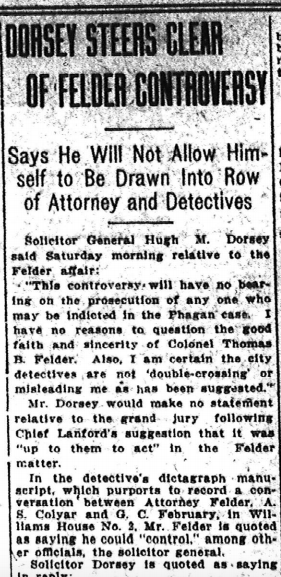
A newly-discovered photograph of Mary Phagan

Mary Phagan

by Scott Aaron

IT MAY WELL BE the greatest murder mystery of all time. Some assert that the Mary Phagan murder case is solved, but those who so assert are of two different and mutually exclusive camps. And those two camps still stand diametrically opposed to this day, four generations later. The case aroused the outrage and ire and vengeance of two great communities. One, the Jewish community, feel overwhelmingly today, and felt to a lesser but still substantial extent in 1913, that Leo Frank was tried and condemned simply because he was a Jew. They believe that Leo Frank is so obviously innocent that he never would have been tried had it not been for endemic anti-Semitism in 1913 Atlanta. And they have been remarkably effective in making  Southern anti-Semitism the leitmotif of virtually all drama, documentary, and other remembrance of this case for the last half century. The other, the largely Christian Southern gentile community, believed overwhelmingly in 1913 — and to an unknown but doubtlessly  large degree still believes today — that justice was done when all the jurors, and every appeal court in the land including the Supreme Court of the United States, after a monumental and impressively-funded defense, agreed that Leo Frank was fairly tried and convicted for the murder of Mary Phagan. And it must rankle Southerners almost beyond words to be accused of anti-Semitism, when no Christian community anywhere on earth has so respected and welcomed Jews, has so openly acknowledged its spiritual roots in Judaism, or has so enthusiastically supported the Jewish state of Israel. Continue Reading →

Miles Says He Had Mayor Go to Room

Miles SaysAnother in our series of new transcriptions of contemporary articles on the Leo Frank case.

Atlanta Georgian

Saturday, May 24th, 1913

Wanted Woodward to See Just What Sort of a Crook Colyar Was, He Declares.

Edward O. Miles, a private detective, assumes the responsibility for the presence of Mayor Woodward at the Williams House, resulting in the dictographing of the Chief Executive of Atlanta. He also says it was at his suggestion Colonel Thomas B. Felder discontinued even his acquaintance with A. S. Colyar, the wild-eyed investigator from Tennessee.

Miles’ statement to a Georgian reporter follows:

“Colonel Felder had already been to see Colyar and he asked me to go and see what he had; to examine any papers, etc.

“I went and as soon as I saw Colyar I was disgusted. The Lord doesn’t make mistakes, and the Lord certainly put the brand of a crook on that fellow’s physiognomy if He ever put it anywhere.

“Colyar wanted Mayor Woodward and asked me to get him. I went to the Mayor and said: ‘I want to take you down to see the greatest freak and crook you ever saw in your life. I want you to hear his line of bunk. You don’t have to say anything—just come along and listen to what he hands out.”

Thought Someone Listened.

“That was Wednesday afternoon. I didn’t think anything about a dictograph, but I knew, or at least thought, that he had somebody listening in the next room. I couldn’t help knowing that, because every now and then Colyar raised his voice so they could hear. Anybody on the streets a block could have heard him had they listened.

“After the conversation, practically as reported in the dictograph, Mayor Woodward left.

“Colyar told me not to forget to bring Colonel Felder and the money next morning at 10 o’clock. I asked him what money, and he said the $1,000 for the papers. I told him I didn’t want to buy any papers; that if Colonel Felder or anybody else did, that was their business, but I didn’t believe they did.

“Then I went back and reported to Colonel Felder and advised him to have nothing more to do with Colyar, not to go back to the Williams House and even not answer his telephone calls.

Felder Quit Negotiations.

“They waited all day Thursday, and Colonel Felder didn’t go back and didn’t answer the telephone calls. That’s why it was published in incompleted form. They saw the jig was up, and I believe Colyar then sold the story.

“I know young Gentry, who took down the dictograph report, and I’ll wager $100 he won’t sign an affidavit it has been published in unexpurgated form. Nothing has been added, but some things have been left out. However, I can’t say that the omissions made any material change.

“Yes, I am the one that caused Mayor Woodward to go there. He is all right. I just wanted him to hear the line of bunk that crook had to hand out.”

* * *

Atlanta Georgian, May 24th 1913, “Miles Says He Had Mayor Go to Room,” Leo Frank case newspaper article series (Original PDF)
Solicitor General Dorsey Talks of the Bribe Charge

Solicitor General

Another in our series of new transcriptions of contemporary articles on the Leo Frank case.

Atlanta Constitution

Saturday, May 24th, 1913

A merry laugh was the first comment made by Solicitor General Hugh Dorsey when told of the reported dictograph evidence in which Colonel T. B. Felder is quoted as saying that he could control the mayor, the criminal court judge and Hugh Dorsey.

Solicitor Dorsey was at his home at the time, endeavoring to find rest and recreation after the morning’s work of placing the evidence in the Phagan case before the grand jury. Hugh Dorsey, Jr., was in his arms at the time and from the lad’s continuous efforts to express his joy in billing and cooing, he was as happy at having his father with him as the solicitor was to be at home and away from the strain of work in the case to which he has devoted his entire time for weeks.

“Why there is no use for me to deny any such remarks as those attributed to Colonel Felder, and I certainly do not wish to express my opinion in the amtter [sic]. In fact, I know nothing whatever of the affair except what is generally known to the public.

“Colonel Felder never expressed to me any intention of taking steps to attempt to show graft or fraud on the part of the city police or detectives,” replied the solicitor when asked if during his conferences in regard to the Phagan case, Colonel Felder had made any expression in regard to the present situation.

“The latest conference I had with Colonel Felder was when he came to my home last Sunday night to confer upon the Phagan case. As I announced publicly some time ago, I worked with him as I have done with others interested in probing the matter. I received what information I could from them, but kept my own theories and results of investigations to myself.

“As far as I know, there had never been any disturbing force in operation between the city detectives and Colonel Felder,” he replied to a query on this point.

“I really would prefer not to discuss the matter at all,” the solicitor insisted. “I have no connection with the affair whatever it may be, and I don’t care to be drawn into it. I want to devote my entire time and thought to the Phagan case and to securing a conviction of the guilty parties.”

* * *

Atlanta Constitution, May 24th 1913, “Solicitor General Dorsey Talks of the Bribe Charge,” Leo Frank case newspaper article series (Original PDF)
Graft and Corruption are Charged to City Detectives and Police by Col. T. B. Felder

Graft and CorruptionAnother in our series of new transcriptions of contemporary articles on the Leo Frank case.

Atlanta Journal

Saturday, May 24th, 1913

Attorney Who Was Dictographed by the Detectives Gives Out a Statement, Additional to the One He Made Friday Afternoon, in Which He Goes After Police and Detective Departments, and Intimates That More Is to Come in the Sunday Papers

SAYS DETECTIVES ARE DESTROYING EVIDENCE AGAINST FRANK IN THE PHAGAN MURDER CASE

Attorney Thomas B. Felder, who has been charged by city detectives with attempted bribery of Chief of Detectives Lanford’s secretary, G. C. Febuary, has made statement additional to one he made Friday afternoon before reading the dictograph records in The Journal.

The attorney’s complete and detailed statement, in which he promises sensational exposures of the police, will be given the Sunday press, he says.

Colonel Felder asserts that the police department is corrupt and vile and that Atlanta is fostering a system like that of New York.

“I had information,” said Mr. Felder, “to the effect that the detectives have been destroying evidence against Leo M. Frank in the Phagan case.

“It was to obtain proof of this that I consented to visit A. S. Colyar’s room at the Williams House on Wednesday afternoon. Continue Reading →

Plot on Life of Beavers Told by Colyar

Plot on LifeAnother in our series of new transcriptions of contemporary articles on the Leo Frank case.

Atlanta Georgian

Saturday, May 24th, 1913

But He Fails to Produce Man to Prove Charge, as He Promised.

A. S. Colyar, Jr. failed entirely to produce the “mysterious man” whom he declared had been hired to “shoot to death” Chief of Police J. L. Beavers.

When Colyar gave the sensational information of the conspiracy to kill the police official he declared that he would bring to police headquarters the man who had been secured to commit the deed; that this person would make affidavit to bear out the plot charges, and would swear also that he had been promised immunity from punishment for his act.

Colyar asserted at the time of his charges that he man was at present in Atlanta and intended remaining here until he had killed Beavers. Colyar also declared that the person had intimated that he might also kill Chief of Detectives Newport Lanford. Colyar then stated that he knew of the person’s whereabouts and would bring him before the police to prove the charges.

Disclosures of the amazing conspiracy came to light Saturday morning. Police officials have been quietly investigating it since the astounding information was given them.

This report created an intense sensation in police circles, and produced one of the greatest sensations of the Phagan mystery.

The name of this mysterious man has not been furnished detectives, but Colyar promised to take him Friday night to the office of Chief Lanford, in the police station, where the affidavit was to be made. Up to a late hour to-day, however, neither he nor Colyar had put in an appearance.

According to the story told by Colyar, this man is not a resident of Atlanta, but has been here several days. He is an old friend of Colyar. He said this man would swear positively that the murder plot proposition was made to him shortly after his arrival here, and that he would give the name of the man who engineered the deal.

* * *

Atlanta Georgian, May 24th 1913, “Plot on Life of Beavers Told by Colyar,” Leo Frank case newspaper article series (Original PDF)

Coleman Affidavit Which Police Say Felder Wanted

Coleman Affidavit

Another in our series of new transcriptions of contemporary articles on the Leo Frank case.

Atlanta Constitution

Saturday, May 24th, 1913

State of Georgia, Fulton County: The affiant, J. W. Coleman and wife, citizens of Atlanta, Ga., who reside at 146 Lindsay street.

The affiant is the stepfather of Mary Phagan, deceased, the child who was foully murdered by a hellish brute on April 26, 1913.

The affiant is in the employ of the City of Atlanta in the Sanitary department.

The affiant, while at the police station during the coroner’s inquest, the exact day he does not remember, was approached by a man somewhat under the influence of liquor, and said to the affiant, “I am working for the law firm of T. B. Felder, and I would like to have you go to his office, as he wants to see you, and I advise you to employ him.” Affiant said, “No, I won’t go to his office.” The Piker then said, “will you talk to Colonel Felder if I bring him here?” whereupon the affiant agreed to see him. He went off and came back in a few minutes with Felder. Colonel Felder then said, “I want you to employ me to prosecute this case, it will not cost you a cent, as certain people have promised to pay me my fee, but I have go to have your consent to the employment before I can get into the coroner’s jury.” The affiant told him he did not want to employ him and did not want to have anything to do with him, as the affiant did not know him and had never seen him before that day, and affiant did not employ him, nor did the affiant’s wife employ him, and the only information the affiant ever had that he was employed was what he read in the newspapers.

Affiant has many good neighbors, and he appreciates their sympathy for him and his broken-hearted wife, but he cannot see how they would come to employ Colonel Felder without his knowledge or consent.

A man met the affiant on the street and offered him one dollar to go upon the fee of this astute counsel, but he declined to accept it and told the party he had not employed Felder.

Affiant is thoroughly satisfied with the great work done by Chief of Police Beavers and Chief of Detectives Lanford and the able men working under them, as he believes, as thousands of others do in Atlanta, that they have the real murderer in jail, and the affiant cannot reconcile himself to the conduct of Colonel Felder, who is posing as a prosecuting attorney, and wanting $5,000 from the people of the city as set out in the afternoon’s papers, to bring a noted detective here, and according to the press of the city, large amounts have been subscribed by people the affiant does not believe are anxious to prosecute the men under arrest. Continue Reading →

The Journal’s Big Story of Dictograph and Alleged Bribe Has Stirred the Whole City

G. C. Febuary, Secretary to Chief of Detectives N. A. Lanford.

G. C. Febuary, Secretary to Chief of Detectives N. A. Lanford.

Another in our series of new transcriptions of contemporary articles on the Leo Frank case.

Atlanta Journal

Saturday, May 24th, 1913

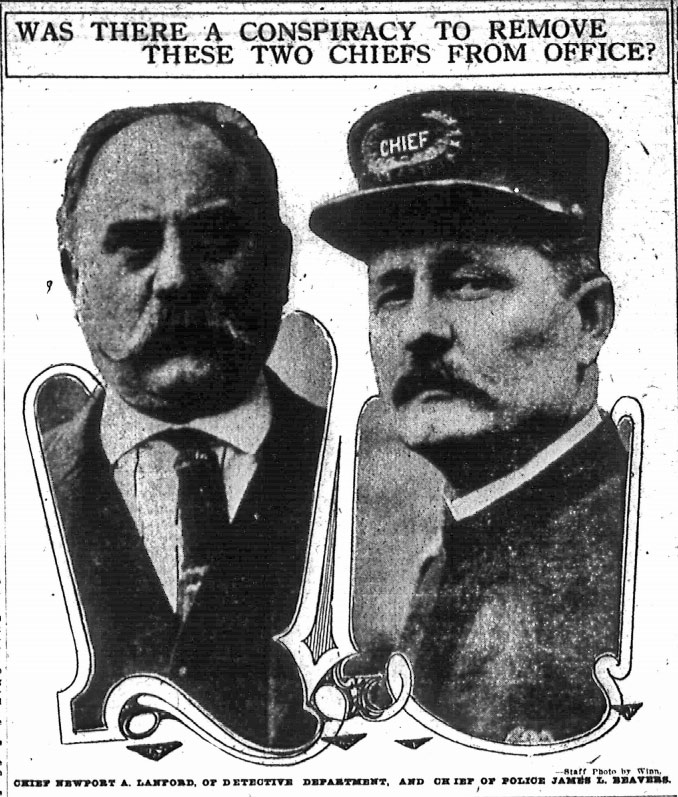
Chief Lanford Stated Saturday That Mayor Woodward, C. C. Jones and Others Were Also Dictographed on the Same Day That Col. Felder Was—The Complete Dictograph Record of These Conversations Appears in Today’s Journal

“I HAVE DONE MY WORK,” DECLARES CHIEF LANFORD, “IT IS NOW UP TO GRAND JURY FOR FURTHER ACTION”

The exclusive story in The Journal’s home edition Friday afternoon, describing how the city detectives and their representatives dictographed Colonel Thomas B. Felder in an alleged offer of $1,000 for the theft of certain papers in the Phagan case from the safe of Detective Chief Newport A. Lanford, has created a sensation in Georgia, South Carolina, Tennessee and Alabama where Colonel Felder is well known.

Atlantians were “put on edge” by this story. Everywhere one turned Friday afternoon and evening he saw persons reading and commenting upon the story in The Journal.

Chief Lanford Saturday morning made it known that Mayor Woodward, Charlie C. Jones, E. O. Miles and others were also dictographed. The record of their conversations are given elsewhere in today’s paper.

Chief Lanford did not discuss the substance of the mayor’s dictographed conversation. He gave it as his opinion that the publication involving Colonel Felder would in no wise hamper or affect the work of the Burns detective in their investigation of the Phagan murder mystery. The chief expressed his confidence in the integrity of the Burns men. Continue Reading →

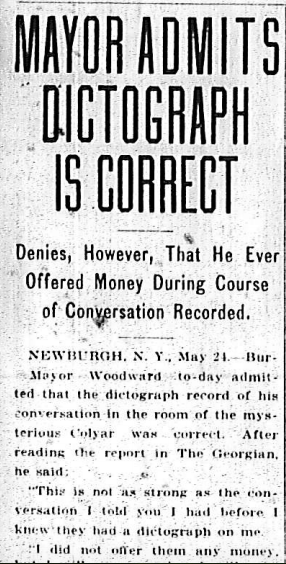
Mayor Admits Dictograph is Correct

Mayor Admits DictographAnother in our series of new transcriptions of contemporary articles on the Leo Frank case.

Atlanta Georgian

Saturday, May 24th, 1913

Denies, However, That He Ever Offered Money During Course of Conversation Recorded.

Mayor Woodward Saturday admitted that the dictograph record of his conversation in the room of the mysterious Colyar was correct. After reading the report in The Georgian, he said:

“This is not as strong as the conversation I told you I had before I knew they had a dictograph on me.

“I did not offer them any money, but I will say now that I will subscribe to a fund that might unearth any graft in any city department. But I haven’t got any $1,000 to give.

Denies Phagan Connection.

“Another thing I want to make clear is that my dealing with those men had nothing whatever to do with the Phagan case. They told me they had evidence of the corruption of Beavers and Lanford. I wanted to see what they had.

“I don’t suppose anyone takes seriously the statement that Colonel Felder controls me. It is just as absurd to believe that he controls Solicitor Dorsey or the Governor.”

“G. C. February [sic], secretary to Detective Chief Newport Lanford, and A. S. Colyar, that long-haired mysterious investigator, talked to me about evidence they had proving that Chief of Police Beavers and Chief Lanford were protecting disorderly houses and blind tigers. They talked of protecting February’s job and the need of $1,000 to pull off the affair.

Told Them to Get Proof.

“My reply was if February could show up any crooks in the police department I did not think the people of Atlanta would stand for him losing his job. I told them to produce the evidence. If it was worth anything I told them I did not think there would be any trouble about a just reward, but that I did not have any $1,000 to give them. Continue Reading →

Mayor Woodward Reported Caught by the Dictograph Seeking Police Evidence

Mayor Woodward Reported

Another in our series of new transcriptions of contemporary articles on the Leo Frank case.

Atlanta Constitution

Saturday, May 24th, 1913

The little dictograph cunningly hidden in Detective Colyar’s room in the Williams House No. 2 is said to have caught a conversation between Mayor James G. Woodward, Secretary G. C. Febuary of the detective department and Edward Miles, Wednesday afternoon, between 3 and 4 o’clock.

Detective Colyar who drew Attorney Thomas B. Felder into the conspiracy was also present at the interview. Colyar sent Miles to the private office of Mayor Woodward in the Empire building, with an invitation that he examine affidavits which Colyar alleged to have in his possession charging police graft.

Mayor Woodward admitted to The Constitution, Friday night, that he went to the room designated by Miles. He charges that Colyar tried to induce him to agree to pay $1,000 for certain information in documentary form which Colyar declared was sufficient to convict the heads of the police department of corruption in receiving money for protections from disorderly houses.

Mayor Had No Money to Give.

They were the only ones who spoke about money, Mayor Woodward said “I told them that if they were looking for money from me I had none to give, but I suggested that if they would make out a list to show just what evidence they had to give there would be no trouble getting up the money to extend the investigation.”

Detective Colyar visited Mayor Woodward’s office in the city hall one day last week, according to Frank Hammond, the mayor’s secretary. He explained that he wanted to see the mayor on important business, and when informed that he would have to wait he became impatient, and declared that there was more red tape in getting to the mayor than to the president of the United States. Continue Reading →

“Dirty Gang” Filled Out Record or Else “Fooled Dictograph” — Mayor Woodward.

Dirty-Gang

Another in our series of new transcriptions of contemporary articles on the Leo Frank case.

Atlanta Journal

Saturday, May 24th, 1913

Big Part of Published Record Absolutely Untrue, Declares Mayor, Though “There’s Nothing In It,” He Says

“WHOLE THING AMOUNTS TO HIRING DETECTIVE”

“It’s all a frame-up of a dirty gang,” declared Mayor James G. Woodward, in commenting Saturday afternoon on the published dictograph record of the conversation alleged to have been held between him, A. S. Colyar, G. C. Febuary and E. O. Miles in Room 31 of the Williams house, No. 2, on Wednesday afternoon.

“The dictograph record has been filled out by some one,” he declared. “I don’t know who. Some one either filled it out or fooled the dictograph after I left.”

Part of the record—almost all the first half of it—was correct, the mayor said. The rest was untrue, he vowed.

“The whole business amounted to employing a detective,” he said. “Certainly I would vote to protect any one who unearthed graft. Certainly I would.

“While there is nothing in this published record, what there is is mostly incorrect. I’m willing to admit anything I said. The record has certainly been filled out after ‘they’ got hold of it.

“I didn’t mention anything about Dozier deserting Beavers. In fact, I didn’t even know he’d ever been with Beavers. I didn’t say anything about any members of the police board. Call it ‘protection’ to Febuary if he unearths graft if you want to. I’d vote to protect any one unearthing graft.

“They told me they could furnish evidence that disorderly houses were protected. I wanted to get it.”

Mayor Woodward declared that the entire portion of the dictograph record from the sub-head “Woodward Says There is Evidence Against Beavers” had been either filled in or spoken by some one after he left “to fool the dictograph.”

Mayor Woodward dictated the following statement to a reporter for The Journal before reading the dictagraph [sic] report: Continue Reading →

Jones Attacks Beavers and Charges Police Crookedness

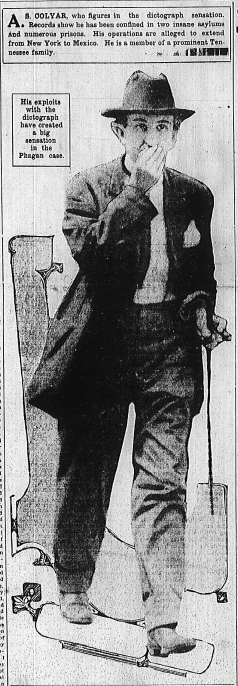
A. S. Colyar, who figures in the dictograph sensation. Records show he has been confined in two insane asylums and numerous prisons. His operations are alleged to extend from New York to Mexico. He is a member of a prominent Tennessee family.

A. S. Colyar, who figures in the dictograph sensation. Records show he has been confined in two insane asylums and numerous prisons. His operations are alleged to extend from New York to Mexico. He is a member of a prominent Tennessee family.

Another in our series of new transcriptions of contemporary articles on the Leo Frank case.

Atlanta Georgian

Saturday, May 24th, 1913

The following conversation occurred in room No. 31, at Williams House No. 2, 34-36 N. Forsyth Street, Atlanta, Ga., Wednesday evening, between 8 and 9 o’clock, between C. C. Jones, E. O. Miles and A. S. Colyar:

Colyar—It has been very warm to-day, hasn’t it?

Miles—Yes, it has. I asked Mr. Felder if you mentioned Mr. Jones’ name to him and he said no.

Colyar—He told me Monday night that Mr. Jones was a friend of his and he thought it an outrage the way they had done him.

Miles—You know I asked you this afternoon why you wanted to see Mr. Jones.

Colyar—If you don’t want to talk, that’s all right.

Jones—In what way?

Colyar—Tom told me they did you pretty dirty down here at the station house.

Jones—Yes. They closed up the houses I had. I had a lot of property.

Colyar—He told me they framed up on you.

Jones—There is no doubt but what it was a frame-up.

Colyar—Tom told me he would like to see the gang out of business.

Jones—The record now is (voice very indistinct just then). They never grafted me. Wouldn’t be any use for me to give them any money.

Miles—You told me you wanted to see Jones. It is not a question of lack of confidence, as what I told you was true as far as I know, but if he knows anything at all about it, I don’t know just what it is.

Jones—I don’t know anything. I just told them to go ahead and build them houses and move them across the street. Even some of them went and paid for them. Three or four days before they closed the houses, the Chief of the City of Atlanta —— —— —— that it would never do to close this district and I was surprised one morning by a telephone message from someone at No. 18, that the Chief had given five or six days notice to get out, I don’t remember which, and I never even went to the trouble to go out to this man to ask him what he meant, as I could not figure it out to save my life what he meant. That is all that I know of. I found out what he was doing. I understand that Jackson was holding conversation with him anywhere from one to three times a day. Continue Reading →

Career of A. S. Colyar Reads Like Some Story In the Arabian Nights

Career of ASAnother in our series of new transcriptions of contemporary articles on the Leo Frank case.

Atlanta Constitution

Saturday, May 24th, 1913

The criminal career of A. S. Colyar reads like a story from the Arabian Nights. Probably no man in Tennessee has imposed so successfully upon the public and has escaped so lightly.

The son of Colonel A. S. Colyar, in his day one of the most prominent citizens of Nashville and a grandson of ex-Governor Albert S. Marks with a family connection that includes many of the aristocrats of this section, he has been exceptionally fortunate in escaping the law although on various occasions he has done time.

He has probably been arrested more than a score of times and for years Alex Barth-[illegible], special agent for the Nashville, Chattanooga and St. Louis railway, did little else but follow his trail.

Two of Colyar’s exploits stand out above the others. The first of these was his impersonation of the son of the late John G. Carlisle. Having forged a check on his father, at that time the controlling spirit of the old Nashville American, Colyar went west and finally drifted into Mexico. A newspaper reporter boarded the train and inquired for the son of John G. Carlisle. As the latter was not aboard, Colyar’s quick mind saw an opportunity for a coup. He introduced himself as Carlisle, was received at Mexico City with great éclat and a big dinner was given in his honor which was attended by the president of Mexico and other notables. The following night Colyar gave a theater party, and later informed the American ambassador that he was embarrassed by the failure of funds to arrive, and secured from him the sum of $10,000. He went out to take a smoke and never came back. Later he returned $7,500 of the money, mailing it from a point in Florida.

On his return here he stopped over at McMinnville, Tenn. and stole a mule which he rode into Nashville selling the animal on the Haymarket. Continue Reading →

“We Have Enough Votes if We Get the Evidence,” the Mayor is Quoted by the Dictograph

We Have 1

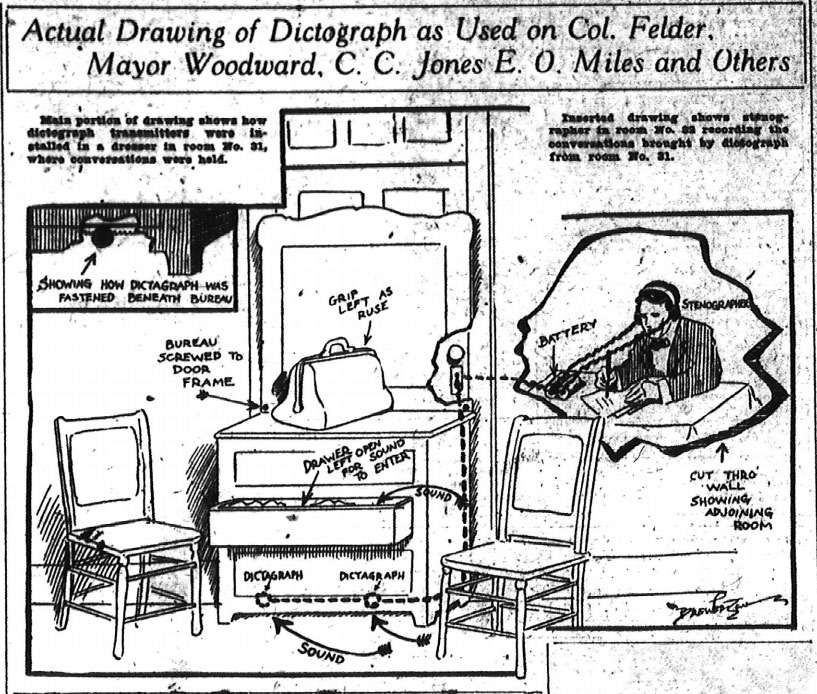
Main portion of drawing shows how dictograph transmitters were installed in a dresser in room No. 31, where conversations were held. Inserted drawing shows stenographer in room No. 32 recording the conversations brought by dictograph from room No. 31.

Another in our series of new transcriptions of contemporary articles on the Leo Frank case.

Atlanta Journal

Saturday, May 24th, 1913

The Journal is Presenting Below the Complete Stenographic Report of the Interview in the Williams House, In Which Mayor Woodward, E. O. Miles, G. C. Febuary and A. S. Colyar Took Part, While the Dictograph Recorded the Conversation

That Mayor James G. Woodward was dictographed by the city detectives on Wednesday afternoon, shortly after Colonel Thomas B. Felder had concluded his interview in Room 31 of Williams House No. 2, 34-36 North Forsyth street, was made public Saturday morning by Chief of Detectives N. A. Lanford.

The Atlanta Journal presents below the complete stenographic report of the conversation imputed to Mayor Woodward by the dictograph. The report also gives in detail the statements accredited to E. O. Miles, the private detective present while the dictograph was at work. Only one or two unprintable words have been omitted from the sworn record which The Journal has secured.

The feature of the interview accredited to Mayor Woodward by the dictograph is the statement by him that he was looking for evidence against the police department and particularly against Chief of Police James L. Beavers. The mayor is also quoted as saying that there were enough votes in the police board to remove Chief Beavers if they could get the evidence.

The sworn statement of Stenographer George M. Gentry, detailing the alleged dictographed conversation in which the mayor figured is given below. Continue Reading →

Colyar Held for Forgery

Colyar Held for Forgery

Another in our series of new transcriptions of contemporary articles on the Leo Frank case.

Atlanta Georgian

Saturday, May 24th, 1913

A. S. Colyar, Jr., author of the alleged dictographing of Mayor Woodward and Colonel Thomas B. Felder, was placed under arrest Saturday afternoon at the request of Chief of Police Edward Connors of Knoxville, Tenn., on the charge of forgery.

The arrest came on a capias from the Criminal Court of Knoxville.

Upon receipt of the request from Connors, Police Chief Beavers ordered Colyar’s arrest. Colyar was located at the corner of Forsyth and Marietta Streets by Detectives Chewning and Norris and taken to the police station. He was taken to Beavers’ office and the charge placed against him. Colyar is now being held at the station awaiting further action from Knoxville.

* * *

Atlanta Georgian, May 24th 1913, “Colyar Held for Forgery,” Leo Frank case newspaper article series (Original PDF)
Bribery Charges False Declares Col. Felder; Calls Them “Frame-Up”

Bribery ChargesAnother in our series of new transcriptions of contemporary articles on the Leo Frank case.

Atlanta Constitution

Saturday, May 24th, 1913

Affidavits and Alleged Dictagraph [sic] Record Are Made Public, Accusing Prominent Lawyer, of Offering Bribe of $1,000 to Secretary Febuary, of Police Department, to Secure Affidavit Made for Police by J. W. Coleman, Stepfather of Mary Phagan, in Regard to Felder’s Connection With Case.

ALLEGATIONS ARE MADE TO FORESTALL A PROBE OF POLICE, SAYS FELDER

Mayor Woodward Also Dictagraphed [sic], According to Report—Admits He Was Called Into Conference by A. S. Colyar, Who Offered Him, He Says, Evidence That the Police Department Is Giving Protection to Disorderly Houses in Atlanta—“I’ve Done My Duty, It’s Up to Grand Jury,” Says Lanford.

Developments came thick and fast yesterday following the publication of affidavits, charging that Colonel Thomas B. Felder—the man who freed Charles Morse, and who used the dictagraph on Governor Cole Blease, of South Carolina—had himself been dictagraphed, and had made an attempt to secure an affidavit in the Mary Phagan murder case now held by the police department, through bribing Secretary February by the offer of $1,000.

Stinging counter charges that the Atlanta detective department is reeking with graft and corruption were hurled at Chief Newport Lanford by Colonel Felder, who asserts that the affidavits now in the possession of Lanford are perjured and the charges prompted by the desire to forestall an investigation of the department.

MY DUTY HAS BEEN DONE AND IT’S UP TO GRAND JURY, SAYS LANFORD

“I have proved Felder to be an attempted briber,” said the chief. “My duty has been done. It’s now up to the grand jury to take action.”

It also developed that Mayor Woodward has himself been dictagraphed, this instrument being used on the mayor during the course of a conversation at the Williams house, held by the mayor, Secretary February, of police department, A. S. Colyar, who worked up the affidavits against Felder, and Ed Miles, head of the Miles detective bureau.

Felder says he has viewed with his own eyes a police “graft” list, containing the names of owners of disorderly houses in the city, which resorts are given police protection in return for money. This, he said, was shown him by G. C. February, stenographer for Chief Lanford, right hand man of that official. Continue Reading →