“You Went to Williams House Like a Lamb to the Slaughter,” Colyar Tells Felder in Letter

You Went To

Another in our series of new transcriptions of contemporary articles on the Leo Frank case.

Atlanta Journal

Sunday, May 25th, 1913

Former Tennesseean [sic] in Open Letter Tells Colonel Felder That He Was Never Caught With Goods Until Last Wednesday—Colyar Says He Strayed From the Path He Should Have Followed When He Went to Wash Attorney’s Political Linen in a State in Which Colonel Felder Could Not Set Foot

A. S. Colyar has addressed the following open letter to Colonel Thomas B. Felder: Continue Reading →
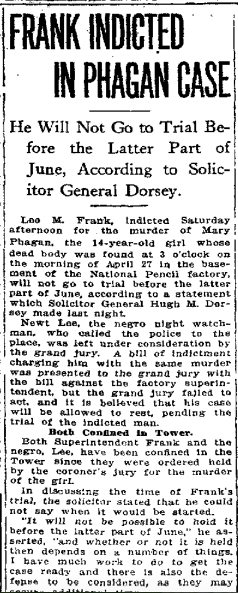
Frank Indicted in Phagan Case

Frank IndictedAnother in our series of new transcriptions of contemporary articles on the Leo Frank case.

Atlanta Constitution

Sunday, May 25th, 1913

He Will Not Go to Trial Before the Latter Part of June, According to Solicitor General Dorsey.

Leo M. Frank, indicted Saturday afternoon for the murder of Mary Phagan, the 14-year-old girl whose dead body was found at 3 o’clock on the morning of April 27 in the basement of the National Pencil factory, will not go to trial before the latter part of June, according to a statement which Solicitor General Hugh M. Dorsey made last night.

Newt Lee, the negro night watchman, who called the police to the place, was left under consideration by the grand jury. A bill of indictment charging him with the same murder was presented to the grand jury with the bill against the factory superintendent, but the grand jury failed to act, and it is believed that his case will be allowed to rest, pending the trial of the indicted man.

Both Confined in Tower.

Both Superintendent Frank and the negro, Lee, have been confined in the Tower since they were ordered held by the coroner’s jury for the murder of the girl.

In discussing the time of Frank’s trial, the solicitor stated that he could not say when it would be started.

“It will not be possible to hold it before the latter part of June,” he asserted, “and whether or not it is held then depends on a number of things. I have much work to do to get the case ready and there is also the defense to be considered, as they may secure additional time. Continue Reading →

The Leo Frank Trial: Week Two

jim-conley-340x264Originally published by the American Mercury on the 100th anniversary of the Leo Frank trial.

The trial of Leo Frank for the murder of Mary Phagan ended its second week 100 years ago today. Join us as we delve into the original documents of the time and learn what the jurors learned.

by Bradford L. Huie

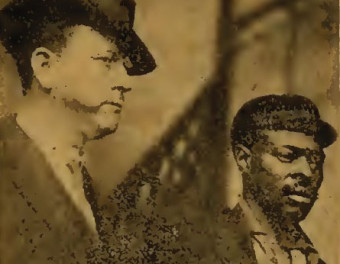
THE EVIDENCE that National Pencil Company Superintendent Leo Frank had murdered 13-year-old child laborer Mary Phagan was mounting up as the second week of Frank’s trial began in Atlanta, and passions were high on both sides as star witness Jim Conley (pictured) took the stand.

The attempt to frame the innocent black  night watchman, Newt Lee, had failed, despite 1) the “death notes” left near the body implicating him, 2) the bloody shirt planted in his trash barrel, and 3) the forged time card supposedly showing that he had left his post for several hours the night the murder was discovered. Although no one of significance suspected Lee at this point, the defense would still try to attack the medical testimony that placed the murder near midday on April 26, and would introduce Lee’s second alleged time card, provided by Frank, purporting to show that Lee had many hours unaccounted for on the night of the 26th and the early morning hours of the 27th of April.

Newt Lee’s testimony of Frank’s peculiar behavior that afternoon and evening was compelling. Another African-American was about to become pivotal in this case: factory sweeper Jim Conley would testify that he had helped Frank by keeping watch while Frank “chatted” with Mary alone in his office, and by assisting Frank in moving her body to the basement after she was accidentally killed. Conley was about to become central to the defense’s case, too — they would allege that Conley was the real killer. (For background on this case, read our introductory article, our coverage of Week One of the trial, and my exclusive summary of the evidence against Frank.) Continue Reading →

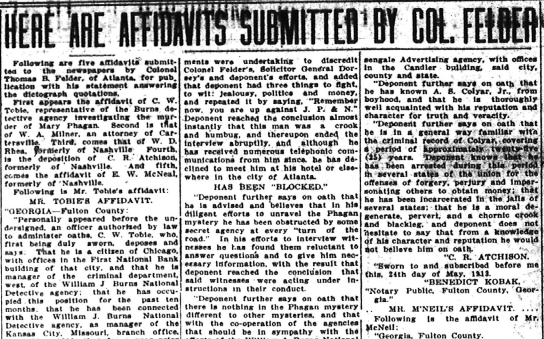
Here Are Affidavits Submitted by Col. Felder

Here are Affidavits

Another in our series of new transcriptions of contemporary articles on the Leo Frank case.

Atlanta Journal

Sunday, May 25th, 1913

Following are five affidavits submitted to the newspapers by Colonel Thomas B. Felder, of Atlanta, for publication with his statement answering the dictograph quotations.

First appears the affidavit of C. W. Tobie, representative of the Burns detective agency investigating the murder of Mary Phagan. Second is that of W. A. Milner, an attorney of Cartersville. Third, comes that of W. D. Rhea, formerly of Nashville. Fourth, is the deposition of C. R. Atchison, formerly of Nashville. And fifth, comes the affidavit of E. W. McNeal, formerly of Nashville.

Following is Mr. Tobie’s affidavit:

MR. TOBIE’S AFFIDAVIT. Continue Reading →

Dorsey to Present Graft Charges if They Stand Up

Dorsey to PresentAnother in our series of new transcriptions of contemporary articles on the Leo Frank case.

Atlanta Georgian

Sunday, May 25th, 1913

Hugh M. Dorsey, Solicitor General, made it plain last night that if investigation develops the fact that there is anything in the charges of graft and corruption in the police department, or that Colonel Felder attempted to bribe public officials to secure evidence in the Phagan case, he most assuredly would present the matter to the Grand Jury.

He said, however, that he does not think the charges and counter charges would amount to anything when sifted to the final analysis, other than a controversy between the city detectives and the man who brought the Burns detectives into the Phagan case.

* * *

Atlanta Georgian, May 25th 1913, “Dorsey to Present Graft Charges if They Stand Up,” Leo Frank case newspaper article series (Original PDF)

Frank the Guilty Man, Declares Chief Lanford

Leo Frank, an undated family photograph

Leo Frank, an undated family photograph

Another in our series of new transcriptions of contemporary articles on the Leo Frank case.

Atlanta Constitution

Sunday, May 25th, 1913

“Frank will be convicted. He is the guilty man, and we will show it beyond a doubt. Evidence that we hold but will not reveal will startle those who believe his innocence into conviction of his guilt. It will not be disclosed until the trial.

“I have been confident throughout the investigation of his guilt. I am satisfied now. Colonel Felder’s charges that we have shielded Frank can find no substantiation. The evidence we have unearthed is proof to the contrary.

“The detectives of police headquarters have solved the mystery of Mary Phagan’s murder. They have combatted against odds heavier than those we ever encountered before. I am proud of my men.

“I know my duty has been done. The murder of the little pencil factory girl has been cleared, and Tom Felder has been shown up in his true colors. That is why the Atlanta detective department sleeps well o’ nights.”

—Chief Newport A. Lanford.

* * *

Atlanta Constitution, May 25th 1913, “Frank the Guilty Man, Declares Chief Lanford,” Leo Frank case newspaper article series (Original PDF)

“Lanford is the Controlling Genius of Conspiracy to Protect the Murderer of Little Mary Phagan”

Thomas B. Felder

Thomas B. Felder

Another in our series of new transcriptions of contemporary articles on the Leo Frank case.

Atlanta Journal

Sunday, May 25th, 1913

So Declares Colonel Thomas B. Felder in Scathing Arraignment of Chief of Detectives and Those Assisting Him. Says Lanford and the Pinkerton Detectives Are Doing All They Can to Hamper the Phagan Investigation — Refers to Lanford as the “Lieutenant Becker” of the Department

CHARGES A. S. COLYAR WITH BEING A SELF-CONFESSED FORGER AND BLACKMAILER

Colonel Felder Says He Met Colyar Two and a Half Years Ago. During His Controversy With Governor Blease, and That Colyar Palmed Off Forged Affidavits on Him — Declares Colyar Came to Him With Tales of Corruption in Police Department and Asked for $1,000 for His Information

Charging Atlanta police officials with a conspiracy to shield and protect the murderers of Mary Phagan and styling Chief Newport Lanford as “the Lieutenant Becker of Atlanta and controlling genius” of the plot, Colonel Thomas B. Felder late Saturday gave out an emphatic statement vehemently denying the attempted bribery and other charges hurled at him by the police in the now famous dictograph records.

That a dictograph was used Colonel Felder doubts, and if one was used in the Williams house, he asserts, the record was changed by the persons using the record. This he tends to establish by showing that the record quotes him now in the first person singular and again in the second person singular. The record, he asserts, was “framed.”

Colonel Felder asserts that the plot was hatched with the day Leo M. Frank was arrested and maintains that since that time the police have done nothing else save protect the two suspects and obstruct the work of the Burns agency and Solicitor Dorsey.

He attacks A. S. Colyar in a half dozen affidavits appended to his lengthy statement. Colyar, he says, is morally and mentally irresponsible and merely a tool in the hands of Lanford and his agents.

He charges that the Coleman affidavit, imputed by the police to be a repudiation of Felder’s connection with the Phagan investigation, was obtained from J. W. Coleman under pressure.

The police plot, he charges, involves the [P]Inkertons and was organized by Chief Lanford and the Atlanta operatives for the Pinkertons employed the day after the Phagan murder by the National Pencil company.

HIS RELATIONS WITH COLYAR.

The statement given out by Colonel Felder, as he had announced Friday, constitutes a narrative of the events leading up to the conferences in Williams House No. 2, where the dictograph was operated by Colyar and G. C. Febuary. Continue Reading →

The Leo Frank Trial: Week One

Newt-lee-custody1-340x264

Originally published by the American Mercury on the 100th anniversary of the Leo Frank trial.

100 years ago today the trial of the 20th century ended its first week, shedding brilliant light on the greatest murder mystery of all time: the murder of Mary Phagan. And you are there.

by Bradford L. Huie

THE MOST IMPORTANT testimony in the first week of the trial of National Pencil Company superintendent Leo Frank for the murder of Mary Phagan was that of the night watchman, Newt Lee (pictured, right, in custody), who had discovered 13-year-old Mary’s body in the basement of the pencil factory during his nightly rounds in the early morning darkness of April 27, 1913. Here at the Mercury we are following the events of this history-making trial as they unfolded exactly 100 years ago. We are fortunate indeed that Lee’s entire testimony has survived as part of the Leo Frank Trial Brief of Evidence, certified as accurate by both the defense and the prosecution during the appeal process. (For background on this case, read our introductory article and my exclusive summary of the evidence against Frank.) Continue Reading →

‘Colyar Arrest Proper End to Plot of Crook’

Mayor James G. Woodward, of Atlanta, accused by dictograph in conversation in A. S. Colyar's room at the Williams House, denies that he offered money to secure evidence of corruption against police and detective departments.

Mayor James G. Woodward, of Atlanta, accused by dictograph in conversation in A. S. Colyar’s room at the Williams House, denies that he offered money to secure evidence of corruption against police and detective departments.

Another in our series of new transcriptions of contemporary articles on the Leo Frank case.

Atlanta Georgian

Sunday, May 25th, 1913

Woodward Brands Dictograph Trap Scheme to Make Him “Goat” Against Beavers.

Mayor Woodward declared Saturday night that the sensational dictograph records were merely the “froth of a plot of a ‘dirty gang,’” and too unworthy and ridiculous to require any official action from him.

“I think the matter reached its proper culmination when the dirty old crook Colyar, seemingly the chief promoter of the plot, was arrested on a charge of forgery.”

Then taking a more serious view of the situation, Mayor Woodward gave some illuminating views on Atlanta police politics.

Mayor Picked for “Goat.”

The filling in of the dictograph statement, purporting to be from me, is a good illustration of the efforts of certain persons to make me the ‘goat’ in their campaign to get rid of Police Chief J. L. Beavers. I have never posed as a sympathizer of Beavers, but I have never made any effort to oust him. Nevertheless, certain persons, some of them posing as his friends and supporters, have continually sought to bring a focus, through me, the fight to fire him.

“I told Beavers I was not going to try to put him out.

Dictograph Report Wrong.

“The first part of my conversation reported in the dictograph statement was correct. But some dirty crook added to the last part—that is unless the mistakes were inadvertently made by the operator. I did not mention Chief Beavers nor Chief Lanford nor any other names. They tald [sic] me—that is, Colyar told me with the assent of February [sic]—they had evidence of graft against Beavers and Lanford and I answered I wanted the evidence, no matter whom it hit.

“I did not offer them any money, but I will say now that I will subscribe to a fund to unearth any graft in any city department. I did not even tell them how strongly I felt on such matters, because I did not like the appearance of their whole dirty affair. Continue Reading →

“Knew It Was Coming,” Declares Cole Blease

Knew it was Coming

Another in our series of new transcriptions of contemporary articles on the Leo Frank case.

Atlanta Constitution

Sunday, May 25th, 1913

Columbia, S. C., May 24.—(Special.—Governor Cole Blease, on whom the dictagraph [sic] was first sprung in the south, and by a strange coincidence through the instrumentality of Colonel T. B. Felder, feels that his time has come, and recent events are pointed to by him as his complete vindication.

“’He that putteth on the sword by the sword he shall perish’—or words to that effect—is my biblical authority for the paraphrase that ‘he who uses the dictagraph against another and fails to prove anything by it, by the dictagraph himself shall be crucified,’” said Governor Blease in talking of the Atlanta situation today.

“And the worst part of it all,” continued Governor Blease, “is that this same man, A. S. Colyar, is the identical sleuth hound turned loose by Felder on me to injure me among my own people—Colyar, this proven criminal and madman. He was the man chosen by Felder to wreck me, and now he turns up by wrecking Felder, and the strangest part of the whole thing is that Felder, now in his own defense, is forced to the dernier resort of proving that the man he sent to get evidence against me is too contemptible to be worthy of either confidence or belief. My own vindication, therefore, comes from Felder himself. Who would have thought it—and this so soon!”

“I do not suppose anybody that knows Tom Felder would be surprised if he is guilty or if this is a scheme worked up by him to get a little cheap notoriety and advertising.

“However, I presume that the members of the Atlanta bar will immediately furnish certificates of character for their darling Tommy and show that he is above suspicion and a gentleman of the highest character, with unblemished reputation as a man and attorney; and if a court of Georgia should order his arrest, that General Anderson will forthwith call out the militia and have him released, as General Anderson, his former partner and lifelong friend, knows of his character and reputation, and will not for a moment allow his Tommy to be interfered with.

“I am satisfied that poor little misled Joe Brown has had his pardon clerk ready fixing up a release for his innocent darling in case of any conviction.

“And as a matter of course the gutter snipes who went over to Augusta from South Carolina will hurry to offer their services to go on sweet Tommy’s bond, and also to appear in the courts, along with ‘Seaboard Bill,’ and his friend, J. L. Lyon, who have heretofore been his bosom friends in his defense; all save Chairman Carlisle, who, I suppose, will be too busy ‘moneying’ to leave his own state just now.

“Consequently, all will be well. Birds of a feather flock together and, of course, if the lead buzzard rings his bell the congregation will assemble.”

* * *

Atlanta Constitution, May 25th 1913, “‘Knew It Was Coming,’ Declares Cole Blease,” Leo Frank case newspaper article series (Original PDF)

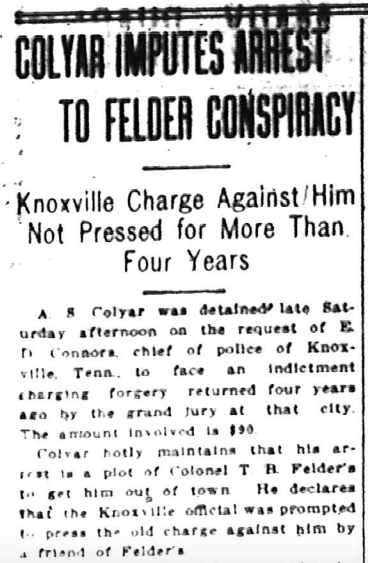
Colyar Imputes Arrest to Felder Conspiracy

Colyar ImputesAnother in our series of new transcriptions of contemporary articles on the Leo Frank case.

Atlanta Journal

Sunday, May 25th, 1913

Knoxville Charge Against Him Not Pressed for More Than Four Years

A. S. Colyar was detained late Saturday afternoon on the request of E. D. Conners, chief of police of Knoxville, Tenn. to face an indictment charging forgery returned four years ago by the grand jury at that city. The amount involved is $90.

Colyar hotly maintains that his arrest is a plot of Colonel T. B. Felder’s to get him out of town. He declares that the Knoxville official was prompted to press the old charge against him by a friend of Felder’s.

Colyar was taken into custody by city detectives on the street and accompanied them to police headquarters. He was closeted with Chief of Police Beavers and Chief of Detectives Lanford for nearly an hour. Later he secured bond and was allowed his liberty.

SAYS FELDER CAUSED ARREST.

“I have been in Knoxville many times since the indictment was returned against me,” Colyar told Chief Beavers, “and there never was any attempt to press the charge or arrest me. If Felder had not devised the plot, no action would have been taken at this time. Continue Reading →

Long Criminal Record of Colyar is Cited

Long Criminal Record

Another in our series of new transcriptions of contemporary articles on the Leo Frank case.

Atlanta Georgian

Sunday, May 25th, 1913

A deluge of statements and affidavits tending to connect him with criminal operations all over the United States and Mexico, and showing that he has served time in half a dozen penitentiaries and been an inmate of a number of insane asylums, poured in Saturday upon the head of A. S. Colyar, the man who has stirred the city with his dictograph plots and his graft and bribery accusations involving Colonel Thomas B. Felder, Mayor James G. Woodward and others.

Twenty-four hours after Colyar fired his first shot he was in jail. He was arrested by detectives at the request of the police of Knoxville, Tenn., who wired Chief Beavers that they hold a Grand Jury indictment against Colyar for forgery. The wire received by Chief Beavers follows:

Knoxville, Tenn.,  May 24, 1913.

J. L. Beavers, Chief of Police, Atlanta, Ga.:

I hold Grand Jury warrant for A. S. Colyar, charge forgery. Age 50 to 55. Six feet high. Long black hair; large Roman nose; smooth shaven; slightly stoop-shouldered. All around crook. Found around hotels. Arrest and wire.

ED D. CONNERS,

A number of affidavits dealing with the character of Colyar and each declaring him to be the last word in crookedness were made yesterday afternoon by various persons, and are in the possession of Colonel Felder. Extracts from a few of them are printed below: Continue Reading →

Says Chief is Able to Care for Himself

Says Chief is AbleAnother in our series of new transcriptions of contemporary articles on the Leo Frank case.

Atlanta Constitution

Sunday, May 25th, 1913

Marion Jackson Has No Comment to Make on Beavers-Felder Controversy.

Marion Jackson and John J. Eagan, leaders of the Men and Forward Religion Movement were seen strolling down Decatur street last night about 9:30 o’clock. With them was N. A. Best, editor of The Continent, a religious journal published in Chicago. That Mr. Jackson and Mr. Eagan should be seen going down Decatur street in the direction of the police headquarters, at this time, when a new attack on the chief has been made, naturally caused considerable comment.

Mr. Jackson denied, however, that his appearance in that locality had any connection with Chief Beavers and the police department.

“The chief is amply able to take care of himself and needs no assistance from me,” said Mr. Jackson. “I have no comment to make on t[h]e controversy between Mr. Beavers and Mr. Felder.”

Mr. Jackson added that he was on Decatur street to show his friend, Mr. Best, something of life among the negroes in a southern city.

* * *

Atlanta Constitution, May 25th 1913, “Says Chief is Able to Care for Himself,” Leo Frank case newspaper article series (Original PDF)

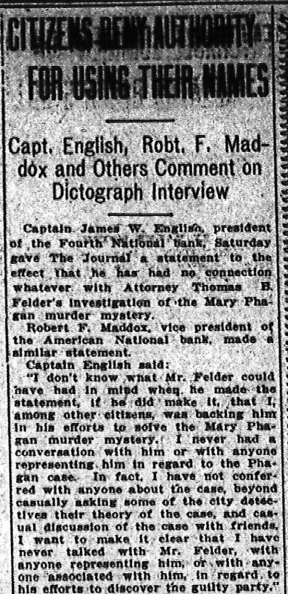
Citizens Deny Authority for Using Their Names

Citizens DenyAnother in our series of new transcriptions of contemporary articles on the Leo Frank case.

Atlanta Journal

Sunday, May 25th, 1913

Capt. English, Robt. F. Maddox and Others Comment on Dictograph Interview

Captain James W. English, president of the Fourth National bank, Saturday gave The Journal a statement to the effect that he has had no connection whatever with Attorney Thomas B. Felder’s investigation of the Mary Phagan murder mystery.

Robert F. Maddox, vice president of the American National bank, made a similar statement.

Captain English said:

“I don’t know what Mr. Felder could have had in mind when he made the statement, if he did make it, that I, among other citizens, was backing him in his efforts to solve the Mary Phagan murder mystery. I never had a conversation with him or with anyone representing him in regard to the Phagan case. In fact, I have not conferred with anyone about the case, beyond casually asking some of the city detectives their theory of the case, and casual discussion of the case with friends. I want to make it clear that I have never talked with Mr. Felder, with anyone representing him, or with anyone associated with him, in regard to his efforts to discover the guilty party.”

Mr. Maddox said: Continue Reading →

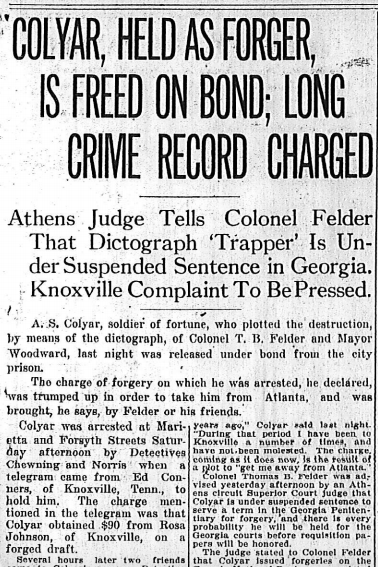
Colyar, Held as Forger, is Freed on Bond; Long Crime Record Charged

Colyar HeldAnother in our series of new transcriptions of contemporary articles on the Leo Frank case.

Atlanta Georgian

Sunday, May 25th, 1913

Athens Judge Tells Colonel Felder That Dictograph ‘Trapper’ Is Under Suspended Sentence in Georgia. Knoxville Complaint To Be Pressed.

A. S. Colyar, soldier of fortune, who plotted the destruction, by means of the dictograph, of Colonel T. B. Felder and Mayor Woodward, last night was released under bond from the city prison.

The charge of forgery on which he was arrested, he declared, was trumped up in order to take him from Atlanta, and was brought, he says, by Felder or his friends.

Colyar was arrested at Marietta and Forsyth Streets Saturday afternoon by Detectives Chewning and Norris when a telegram came from Ed Conners, of Knoxville, Tenn., to hold him. The charge mentioned in the telegram was that Colyar obtained $90 from Rosa Johnson, of Knoxville, on a forged draft.

Several hours later two friends came to Colyar’s rescue. Detective R. S. Ozburn signed the required bond of $1,000 and an unknown friend delivered $200 as a cash bond for the prisoner. Colyar was released.

Chief Beavers said last night that he arrested Colyar as a matter of courtesy to Chief Conners, possessing no warrant authorizing him to take Colyar into custody. It probably will be Thursday, according to the telegram from Chief Conners, before requisition papers can be had.

“The alleged incident occurred four years ago,” Colyar said last night. “During that period I have been to Knoxville a number of times, and have not been molested. The charge, coming as it does now, is the result of a plot to “get me away from Atlanta.” Continue Reading →

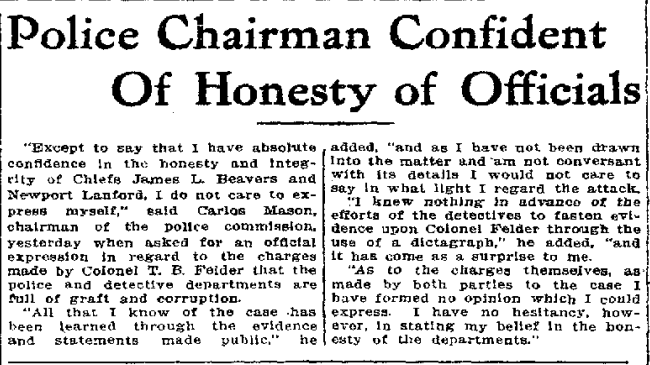
Police Chairman Confident of Honesty of Officials

Police Chairman

Another in our series of new transcriptions of contemporary articles on the Leo Frank case.

Atlanta Constitution

Sunday, May 25th, 1913

“Except to say that I have absolute confidence in the honesty and integrity of Chiefs James L. Beavers and Newport Lanford, I do not care to express myself,” said Carlos Mason, chairman of the police commission, yesterday when asked for an official expression in regard to the charges made by Colonel T. B. Felder that the police and detective departments are full of graft and corruption.

“All that I know of the case has been learned through the evidence and statements made public,” he said added, “and as I have not been drawn into the matter and am not conversant with its details I would not care to say in what light I regard the attack.

“I knew nothing in advance of the efforts of the detectives to fasten evidence upon Colonel Felder through the use of a dictagraph [sic],” he added, “and it has come as a surprise to me.

“As to the charges themselves, as made by both parties to the case I have formed no opinion which I could express. I have no hesitancy, however, in stating my belief in the honesty of the departments.”

* * *

Atlanta Constitution, May 25th 1913, “Police Chairman Confident of Honesty of Officials,” Leo Frank case newspaper article series (Original PDF)

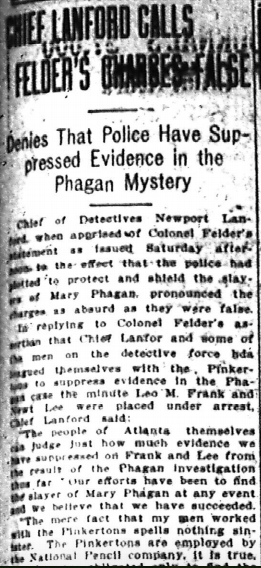
Chief Lanford Calls Felder’s Charges False

Chief LanfordAnother in our series of new transcriptions of contemporary articles on the Leo Frank case.

Atlanta Journal

Sunday, May 25th, 1913

Denies That Police Have Suppressed Evidence in the Phagan Mystery

Chief of Detectives Newport Lanford when apprised of Colonel Felder’s statement as issued Saturday afternoon to the effect that the police had plotted to protect and shield the slayers of Mary Phagan, pronounced the charges as absurd as they were false.

In replying to Colonel Felder’s assertion that Chief Lanofor[d] and some of the men on the detective force hda [sic] leagued themselves with the Pinkertons to suppress evidence in the Phagan case the minute Leo M. Frank and Newt Lee were placed under arrest, Chief Lanford said:

“The people of Atlanta themselves can judge just how much evidence we have suppressed on Frank and Lee from the result of the Phagan investigation thus far. Our efforts have been to find the slayer of Mary Phagan at any event and we believe that we have succeeded.

“The mere fact that my men worked with the Pinkertons spells nothing sinister. The Pinkertons are employed by the National Pencil company, it is true, but they are obligated only to find the murderer of Mary Phagan. Like the city detective department the Pinkertons believe they have succeeded.

“At any event, no matter what Tom Felder may charge against this or any other department of the police, future developments in the Phagan case will vindicate utterly the position of the police.

THE COLEMAN AFFIDAVIT.

On Colonel Felder’s accusation that the affidavit of J. W. Coleman, imputed to repudiate Felder’s employment in the case, was forced from Coleman by Chief Lanford, the head of the detectives said: Continue Reading →

April 26, 2016 Audiobook in Memory of Little Mary Phagan (1899 – 1913)

This is the epic true crime case from early 20th century Atlanta resulting from 13-year-old little Mary Phagan’s murder by Leo M. Frank in 1913 – her employer and superintendent at the National Pencil Company in 1913. Leo Frank’s lynching was inspired by outraged citizens after his death sentence was commuted by his lead trial attorney’s law partner the Governor John M. Slaton; followed by the century-long effort by Frank’s Jewish co-religionists to exonerate him, ending with his pardon in 1986 by the Georgia Board of Pardons and Paroles–which specifically refrained, however, from exonerating Frank.

Please purchase a copy of this book on Amazon or Ebay and follow along while the narrator reads each chapter.

In spite of the fact that the author Mary Phagan (now Mary Phagan Kean) is the great-niece of little Mary Phagan, and naturally has strong emotions about the affair, this book contains the most balanced account of the case so far, as Ms. Kean has gone back to the complete trial record, and studied it extensively. She corrects the false statements that are mendaciously used in most accounts to convince readers or viewers of Frank’s supposed innocence, while acknowledging that it it impossible to know with 100% certainty that Frank was the murderer.

Reference:
https://archive.org/details/TheMurderOfLittleMaryPhaganByMaryPhaganKean1987

Attorney, in Long Statement, Claims Dictograph Records Against Him Padded

Colonel Thomas B. Felder in an earnest attitude, as he denies charges of attempted bribery and sourges Atlanta's police officials.

Colonel Thomas B. Felder in an earnest attitude, as he denies charges of attempted bribery and s[c]ourges Atlanta’s police officials.

Another in our series of new transcriptions of contemporary articles on the Leo Frank case.

Atlanta Georgian

Sunday, May 25th, 1913

Colonel Thomas B. Felder Saturday night issued an exhaustive statement denying once more that he had offered a bribe of $1,000 to Chief Lanford’s clerk, G. C. February [sic], for evidence involving his superiors; charging that the dictograph records of his conversations with February and A. S. Colyar were padded; denouncing Colyar as a proved crook and ex-convict, and charging wholesale corruption in the police department, particularly against Beavers and Lanford. He said he would furnish positive proof of this corruption later.

Here is Colonel Felder’s statement, in full:

To the People of Atlanta:

The publication of the sensational “story” relating to myself and my connection with the Phagan case is but the symptom of manifestation of one of the most diabolical conspiracies ever hatched by a venal and corrupt “system” to protect crime in a civilized community.

To be more specific, this conspiracy was formed just after the arrest of Newt Lee and Leo Frank, charged with the murder of Mary Phagan. The controlling genius of it is Newport Lanford, chief of the city detectives. Its object is to shield and protect the murderers of this innocent child, and in its wicked ramifications it marks our distinguished (?) chief of detectives as the Lieutenant Becker of our “system,” and renders his co-conspirators as dangerous to the lives, liberty, property and reputation of our citizens as the bloody and deadly Society of the Mafia.

Pity it is that the press of the city has been and is being made the innocent, if effective, instrument in their hands to further and effectuate the object of this wicked conspiracy by prostituting their potential columns to the exploitation of the mass of forgeries, and perjuries which has been given to the public through their columns, for it is known that these papers have tacitly sanctioned the utterances of Colyar by reproducing his affidavits in the face of the fact that [t]he editors and proprietors of all would, without hesitation, swear that they would not believe him on oath if called upon to do so.

Says Police Shielded Frank.

Strangely enough, a portion of the criminal record of this man Colyar is reproduced, showing him to be a man steeped in crime and infamy, while in the parallel columns is published his defamatory utterances against me. Continue Reading →

Colyar Tells Where He and Col Felder Ought to be for Good of Society

Colyar Tells Where

Another in our series of new transcriptions of contemporary articles on the Leo Frank case.

Atlanta Journal

Sunday, May 25th, 1913

Editor The Journal:

I herewith hand you a telegram in answer to one that I got Chief of Police Beavers to send, which explains one of Thomas B. Felder’s visions, which appeared in the Morning Eye-Opener of Saturday, and from my relations and connections with this astute and would-be bribe giver, my conscience tells me that society at large would be better off if T. B. Felder and myself were both in Sing Sing.

(Signed) A. S. COLYAR.

The telegram referred to follows:

Ossining, N. Y., May 24, 1914.

J. L. Beavers.

Chief of Police, Atlanta, Ga.

No record of A. S. Colyar can be found in Sing Sing prison.

JOHN S. KENNEDY, Warden.

* * *

Atlanta Journal, May 25th 1913, “Colyar Tells Where He and Col Felder Ought to be for Good of Society,” Leo Frank case newspaper article series (Original PDF)