Now an Audio Book: The Leo Frank Case: The Lynching of a Guilty Man, part 1

by Philip St. Raymond
for The American Mercury

THE AMERICAN MERCURY is proud of its decades-long reputation for seeking the truth without fear or favor. As such, we do not flinch when a part of that truth can best be discovered in the words of those whom the Establishment has deemed “radical” or “controversial” or even “evil.” (When the current murderous regime in Washington, or its Hollywood/New York media machine, says someone is “evil,” we immediately start to suspect that there must be something good about that someone.)

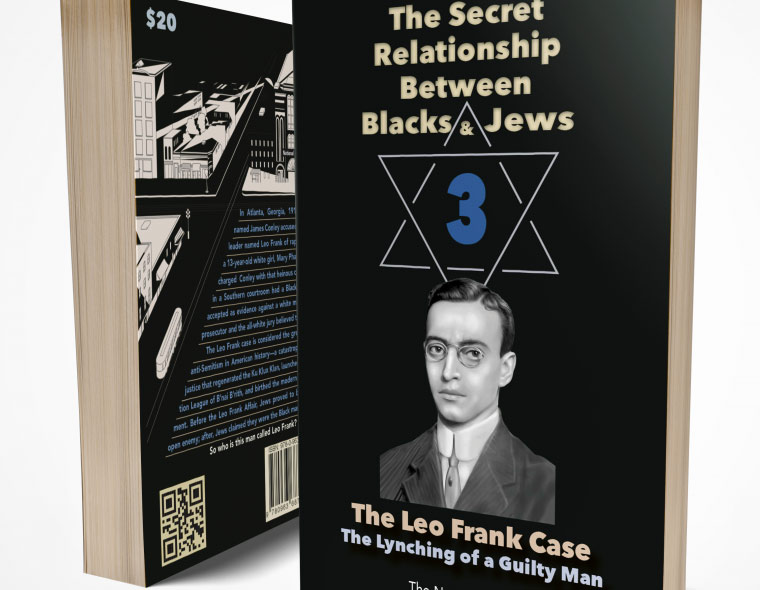
So even if the New York Times or the Anti-Defamation League excoriate us for saying so, it still remains true that the Nation of Islam (NOI) Historical Research Group — yes, that Nation of Islam, headed by Louis Farrakhan — has published the very best book we have seen so far on the Leo Frank case. It’s titled The Secret Relationship Between Blacks and Jews, Vol. 3; The Leo Frank Case: The Lynching of a Guilty Man. It’s a collaborative effort, written by the NOI Historical Research Group, and they have assembled a comprehensive digest of all the known facts surrounding the case, detailed excerpts from the press of the time, relevant (and extremely revealing) passages from books and statements by contemporaries and significant figures in the case, and original research and analysis that will leave you breathless with amazement at how the “mainstream” media have lied to you.

Continue Reading →

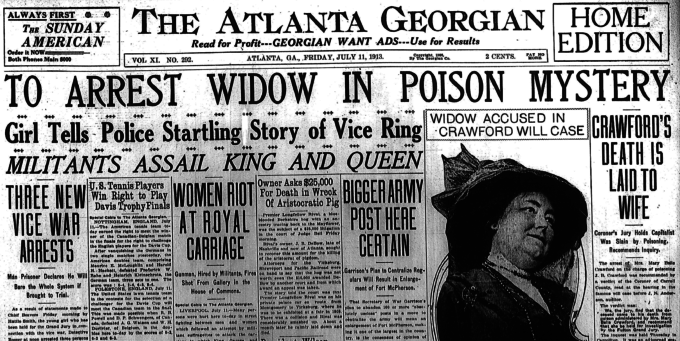
Girl Tells Police Startling Story of Vice Ring

Another in our series of new transcriptions of contemporary articles on the Leo Frank case.

The Atlanta Georgian

Friday, July 11, 1913

THREE NEW VICE WAR ARRESTS

Man Prisoner Declares He Will Bare the Whole System if Brought to Trial.

As a result of statements made to Chief Beavers Friday morning by Hattie Smith, the young girl who has been held for the Grand Jury in connection with the vice war, Detective Rosser at noon arrested three persons—two men and a woman—who were named by the Smith girl as contributing to her downfall and being involved in her white slavery charges.

The persons under arrest are Paul Estes, 52 Queen Street; Hoyt Monroe, Edgewood, and Mrs. Lola White, 768 Marietta Street.

The woman is a cousin of Hattie Smith and lives next door, while both Estes and Monroe are in the employ of the Collier Garage at Cone and James Streets, where the Smith girl says she met Lena Barnhardt, who later took her to the Cumberland Hotel.

Says She Went Joy Riding.

Continue Reading →

Slaying Charge for Conley Is Expected

Another in our series of new transcriptions of contemporary articles on the Leo Frank case.

The Atlanta Georgian

Friday, July 11, 1913

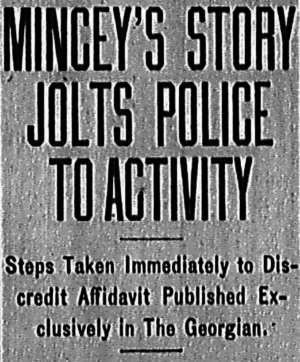
Speedy Indictment of Negro Is Likely Following Publication of Mincey Affidavit.

The speedy indictment of Jim Conley on the charge of murdering Mary Phagan was the strong possibility discussed in court circles Friday following the sensational turn given the strangling mystery by The Georgian’s publication Thursday of the accusation of William H. Mincey, an insurance solicitor, that he had heard the negro boast on the afternoon of the crime of killing a girl.

For nearly two months a self-confessed accessory after the fact of the murder of the little factory girl, Conley has been allowed to go without an attempt at bringing an indictment against him. The startling new evidence which indicates most strongly, if the credibility of the defense’s witness can be established, that Conley was not the accessory after the fact, but the actual principal in the crime, is expected to result in a thorough investigation by the Grand Jury of all the rumors and stories which have been in circulation of the negro’s connection with the pencil factory tragedy.

Counsel Relies on Mincey.

Continue Reading →

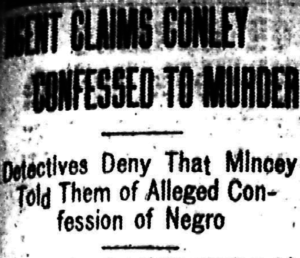
Agent Claims Conley Confessed to Murder

Another in our series of new transcriptions of contemporary articles on the Leo Frank case.

The Atlanta Journal

Friday, July 11, 1913

Detectives Deny That Mincey Told Them of Alleged Confession of Negro

In the possession of the attorneys for the defense of Leo M. Frank is an affidavit of William H. Mincey, formerly an insurance agent working in Atlanta, who declares that the negro, James Conley, while drunk on the afternoon of April 26, admitted and even boasted to him that he had killed a girl that day.

The admission is alleged by Mincey’s affidavit to have been made when he met Conley, whom he knew, in the negro quarter, and attempted to sell him insurance.

The negro became enraged, the affidavit recites, and told him (Mincey) that he (Conley) didn’t want to have to kill another person that day, as he had already killed a little girl.

The affidavit is said to further recite that Mincey offered, a day or two after the killing of Mary Phagan, his information to the city police, who refused to consider it. The affidavit is also said to recite that Mincey visited Conley at police headquarters and there again definitely identified him as the man who boasted on April 26 of having killed the girl.

N. A. Lanford, chief of the city detectives, and Harry Scott, of the Pinkertons, who has been working on the case, declare that they first heard of Mincey on the day of Conley’s second confession of complicity.

Continue Reading →

Conley Not Right Man, Says Mincey

Another in our series of new transcriptions of contemporary articles on the Leo Frank case.

The Atlanta Constitution

Friday, July 11, 1913

Insurance Man Who Made Affidavit Says Conversation Was With Some Other Negro—Saw Conley at Station.

It was disclosed Thursday afternoon that William H. Mincey, the insurance agent who has made an affidavit to the effect that Jim Conley on the date of the Phagan murder drunkenly admitted that he had slain a girl had appeared at police headquarters during Conley’s grilling and had positively failed to identify the negro.

This was told a Constitution reporter by Detective Harry Scott of the Pinkertons and Detective Chief Newport Lanford. The insurance agent, they declared, had come to the police station while Conley was being cross-examined and had asked to see the prisoner.

He wanted to see if he could identify Conley as the negro whom he had seen drunk at the corner of Electric and Carter streets on the afternoon of Saturday, April 26. He was admitted to Conley’s presence. After asking the negro a number of questions pertaining to a conversation he had held with the black encountered at Electric and Carter streets, Mincey, the detectives assert, declared he could not identify the suspect.

He’s not the man I saw, Lanford and Scott say the insurance man declared.

Conley was asked by Mincey on that date if he had not talked with him about the issuance of a life insurance policy. Conley denied having ever seen the man. Mincey, the detectives say, was positive in his declaration that Conley was not the negro with whom he had held the conversation.

Did Not Approach Detectives

Continue Reading →

No Finger Prints Found by Expert on Phagan Envelope

Another in our series of new transcriptions of contemporary articles on the Leo Frank case.

The Atlanta Journal

Thursday, July 10, 1913

Examination of Portion of Slain Girl’s Pay Envelope Fails to Throw Any Light on the Murder Mystery

FLETCHER, AT FEDERAL PEN MAKES EXAMINATION

Fight for Release of Newt Lee on Habeas Corpus Resumed and Hearing Will Be Given Saturday Morning

That the murderer of Mary Phagan can never be identified by finger prints on the pay envelope found in the factory, and the “re-setting” of Newt Lee’s habeas corpus for 10 o’clock. Saturday morning, were two important developments of the sensational murder mystery Thursday.

According to Attorney Bernard L. Chappell, of Graham & Chappell, counsel for the negro night watchman, fifty witnesses among them the negro James Conley, confessed accomplice, and Leo M. Frank, accused of the crime, will be subpenaed for the habeas corpus hearing.

It is known that the solicitor general, Hugh M. Dorsey, will oppose the release from the Tower of Lee on the ground that he is a material witness.

Counsel for Frank will take no part in the fight to secure the release of Lee, but Attorney Reuben R. Arnold stated when the case was postponed that he would oppose any effort to bring Frank into the court for the habeas corpus hearing.

It is said that the counsel for Frank will oppose bringing him to the court on the ground that it is not lawful to force a defendant to give any testimony which relates to or bears on the crime for which he is to be tried.

This, as a result, will prevent the much talked of meeting of Frank and Conley.

According to the attorney for Lee, subpenas will be issued to the many detectives who have worked on the case, to the solicitor general and to the foreman of the grand jury that failed to indict Lee.

EXAMINED BY EXPERTS.

Continue Reading →

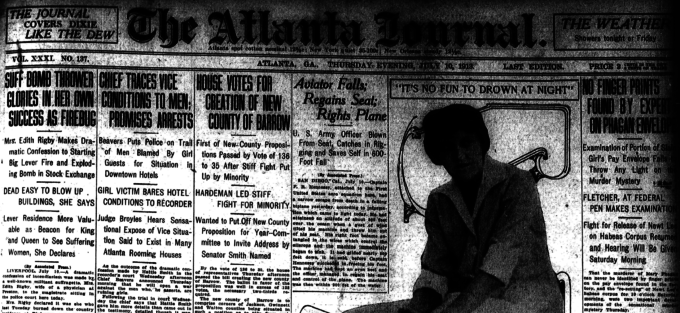
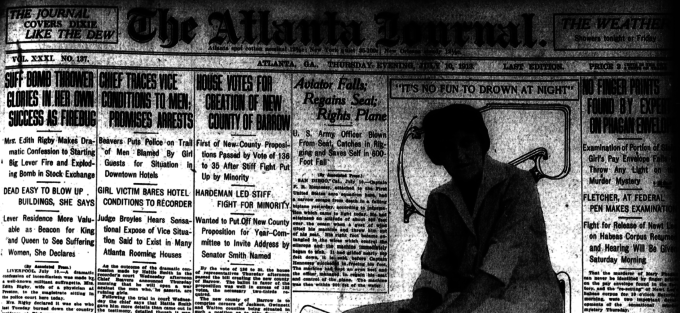
Chief Traces Vice Conditions to Men; Promises Arrests

Another in our series of new transcriptions of contemporary articles on the Leo Frank case.

The Atlanta Journal

Thursday, July 10, 1913

Beavers Puts Police on Trail of Men Blamed By Girl Guests for Situation in Downtown Hotels

GIRL VICTIM BARES HOTEL CONDITIONS TO RECORDER

Judge Broyles Hears Sensational Expose of Vice Situation Said to Exist in Many Atlanta Rooming Houses

As the outcome of the dramatic confession made by Hattie Smith in the recorder’s court Wednesday afternoon Chief Beavers announced Thursday morning that he will open a war against the men who, he asserts, are ruining girls.

Following the trial in court Wednesday the chief says that Hattie Smith gave him more details than came out in the testimony, detailed though it was. He says that he now has the names of several men whom the Smith girl says she had taken auto rides with. The chief says that he will take steps against these men.

In beginning his campaign, the chief makes the statement that he holds the men responsible for the life led by the wayward woman. Poor girls, without even the necessities of life, have no show against men who are always on the watch to prey upon them, declared Beavers.

SMITH GIRL TELLS STORY.

Continue Reading →

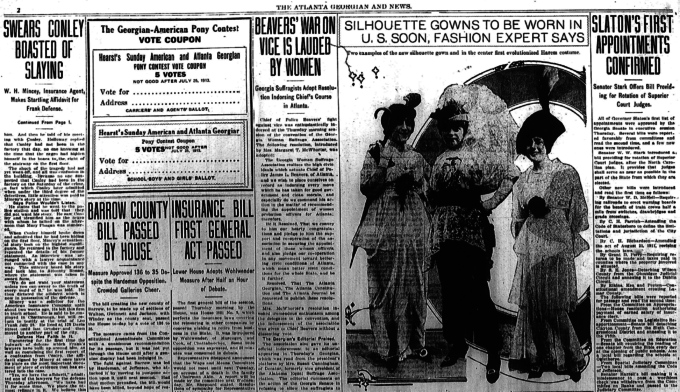
Beavers’ War on Vice is Lauded by Women

Another in our series of new transcriptions of contemporary articles on the Leo Frank case.

The Atlanta Georgian

Thursday, July 10, 1913

Georgia Suffragists Adopt Resolution Indorsing Chief’s Course in Atlanta.

Chief of Police Beavers’ fight against vice was enthusiastically indorsed at the Thursday morning session of the convention of the Georgia Woman Suffrage Association. The following resolution, introduced by Mrs. Margaret T. McWhorter, was adopted:

The Georgia Woman Suffrage Association realizes the high civic ideals which actuate Chief of Police James L. Beavers, of Atlanta, and we wish to place ourselves on record as indorsing every move which he has taken for good government and clean morals, and especially do we commend his action in the matter of recommending the appointment of women probation officers for Atlanta; therefore,

Be it Resolved, That we convey to him our hearty congratulations and pledge to him the support and co-operation of the association in securing the appointment of these women officers, and also pledge our co-operation in any movement toward bettering civic conditions of Atlanta, which mean better civic conditions for the whole State, and be it further

Resolved, That The Atlanta Georgian, The Atlanta Constitution and The Atlanta Journal be requested to publish these resolutions.

Mrs. McWhorter’s resolution invoked tremendous enthusiasm among the delegates to the convention, and the indorsement of the association was given to Chief Beavers without a dissenting vote.

The Georgian’s Editorial Praised.

Continue Reading →

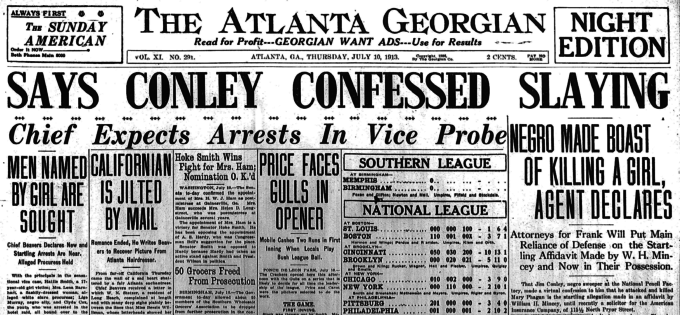
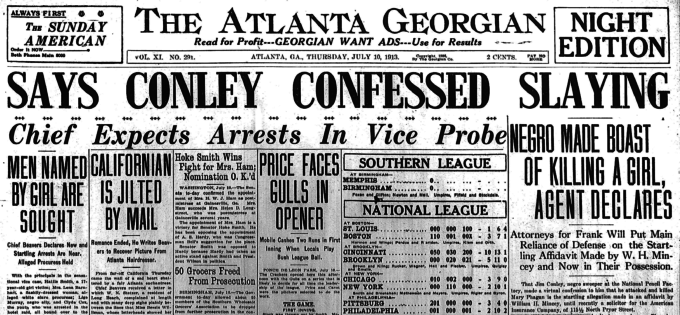
Says Conley Confessed Slaying

Another in our series of new transcriptions of contemporary articles on the Leo Frank case.

The Atlanta Georgian

Thursday, July 10, 1913

*Editor’s Note: Articles with the titles “Tells of Conley Confession” and “Says Conley Confessed” also appeared in other editions of the Georgian.

NEGRO MADE BOAST OF KILLING A GIRL, AGENT DECLARES

Attorneys for Frank Will Put Main Reliance of Defense on the Startling Affidavit Made by W. H. Mincey and Now in Their Possession.

That Jim Conley, negro sweeper at the National Pencil Factory, made a virtual confession to him that he attacked and killed Mary Phagan is the startling allegation made in an affidavit by William H. Mincey, until recently a solicitor for the American Insurance Company, of 115 1/2 North Pryor Street.

It became known Thursday that this affidavit, which is in the hands of the defense, will be the principal reliance, aside from the alibis which have been established for Frank, in bringing an acquittal of the accused man and obtaining a conviction against the negro.

No other evidence, in all of the more than two months’ investigation of the mystery, has been so damning and so direct. The defense has practically only to establish the credibility of Mincey to assure itself of victory.

Said He Had Killed Girl.

Continue Reading →

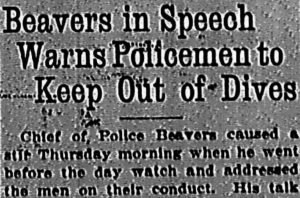
Beavers in Speech Warns Policemen to Keep Out of Dives

Another in our series of new transcriptions of contemporary articles on the Leo Frank case.

The Atlanta Georgian

Thursday, July 10, 1913

Chief of Police Beavers caused a stir Thursday morning when he went before the day watch and addressed the men on their conduct. His talk resulted from the recent scandal in which several policemen were found guilty of visiting a resort in the rear of 127 Auburn Avenue.

“Any man who hangs around a negro dive has no place on the police force of Atlanta,” the Chief said, addressing the men. “If you get positive evidence that any of your brother officers are engaged in discreditable practices and frequenting disreputable places, it is your duty to report it.”

The Chief will make a similar speech to the night and morning watches.

* * *

The Atlanta Georgian, July 10th 1913, “Beavers in Speech Warns Policemen to Keep Out of Dives,” Leo Frank case newspaper article series (Original PDF)

Chief Expects Arrests in Vice Probe

Another in our series of new transcriptions of contemporary articles on the Leo Frank case.

The Atlanta Georgian

Thursday, July 10, 1913

MEN NAMED BY GIRL ARE SOUGHT

Chief Beavers Declares New and Startling Arrests Are Near. Alleged Procuress Held

With the principals in the sensational vice case, Hattie Smith, a 17-year-old girl victim; Mrs. Lena Barnhart, a flashily-dressed woman, alleged white slave procuress; Lige Murray, negro ally, and Clyde Cox, the youth who was arrested in the hotel raid, all bound over to the higher courts, the police Thursday turned the full flare of a searching investigation directly on the hotels and alleged immoral resorts, with the result that new arrests and startling developments were expected during the day.

Chief Beavers Thursday morning declared that his crusade would include the men principals in the vice system as well as the women.

A number of names were given him by Hattie Smith. He will use these as a start along this line of his investigation, and sensational results are expected.

Girl Tells Story in Court.

Continue Reading →

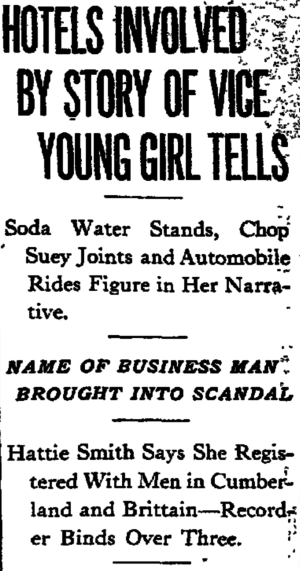
Hotels Involved By Story of Vice Young Girl Tells

Another in our series of new transcriptions of contemporary articles on the Leo Frank case.

The Atlanta Constitution

Thursday, July 10, 1913

Soda Water Stands, Chop Suey Joints and Automobile Rides Figure in Her Narrative.

NAME OF BUSINESS MAN BROUGHT INTO SCANDAL

Hattie Smith Says She Registered With Men in Cumberland and Brittain—Recorder Binds Over Three.

A story of vice that is unprecedented even in the sorbid [sic] history of police court, was poured into the ears of Judge Broyles Wednesday afternoon, when Hattie Smith, the 17-year-old “Girl of the Streets,” was called to the stand.

She made no attempt to withhold anything. She gave names and addresses with startling willingness, and told of her own crimson career with a frankness so bold that color was drawn to even the cheeks of the most morbid courtroom frequenter.

As a result, Lena Barnhart, alias Lena Levison, the good looking young woman whom the girl accused of being a white slave procuress, was bound over to higher courts under bond of $500, and Lige Murry, who was charged with having been the woman’s ally, was bound over bond of $100.

Three Hotels in Case.

Continue Reading →

Mary Phagan’s Pay Envelope is Found

Another in our series of new transcriptions of contemporary articles on the Leo Frank case.

The Atlanta Constitution

Thursday, July 10, 1913

Discovery Made by Detectives Weeks Ago, But Is Just Announced

The discovery of the pay envelope given Mary Phagan on the day of her murder is believed by detectives to furnish the missing link in the chain of circumstancial [sic] evidence they declare they have forged.

The envelope was found by Detectives Harry Scott and John Black. It is now in possession of the solicitor general. It was discovered on the first floor of the plant building behind a radiator that is situated in immediate vicinity to the spot at which James Conye [sic], the negro sweeper, says he sat in waiting for his superintendent’s summons.

The production of the envelope as evidence will be a strong point in behalf of Frank’s defense according to his friends, however. It is rumored that his counsel is already preparing to use it as a basis of one of their many attacks upon the negro’s story.

The envelope was found three weeks after the discovery of the girl’s body. It was not made public, however, until Wednesday.

Solicitor Hugh M. Dorsey won his point Wednesday and will keep Newt Lee, the negro night watchman, in the tower until the trial of Leo M. Frank for the murder of Mary Phagan is held on July 28. Attorneys Graham and Chappell for Leo had secured an order directing that the sheriff show cause why he should hold their client but the solicitor held a conference with the negro’s lawyers shortly before the hearing and by mutual consent the affair was indefinitely postponed.

* * *

The Atlanta Constitution, July 10th 1913, “Mary Phagan’s Pay Envelope is Found,” Leo Frank case newspaper article series (Original PDF)

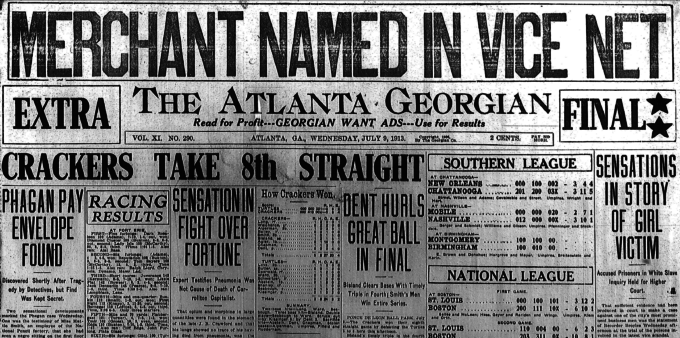
Sensations in Story of Girl Victim

Another in our series of new transcriptions of contemporary articles on the Leo Frank case.

The Atlanta Georgian

Wednesday, July 9, 1913

Accused Prisoners in White Slave Inquiry Held for Higher Court.

That sufficient evidence had been produced in court to make a case against one of the city’s most prominent business men was the statement of Recorder Broyles Wednesday afternoon at the trial of the persons involved in the latest vice scandal.

Lena Barnhardt, alleged white sliver [sic] and procuress, was bound over to the higher court under a bond of $500.

Hattie Smith, who claimed in court to be a white slave victim of the Barnhardt woman, was placed under $100 bond for the higher court.

Clyde Cox, who is alleged to have been trapped with the Smith girl, was put under the same bond.

Elijah Murray, colored bellboy at the Cumberland Hotel, who, the Smith girl testified, had arranged dates for the woman inmates of the hotel, was held in default of $100 bond.

Hattie Smith repeated the sensational story she previously had told to the detectives in regard to her meeting with the Barnhardt woman, and of the manner in which she was lured into a life of shame.

Aside from the sensational revelations of a systematic white slavery business carried on in some of the city’s hotels, the girl’s most startling testimony had to do with the prominent business man whose name she mentioned in open court.

Continue Reading →

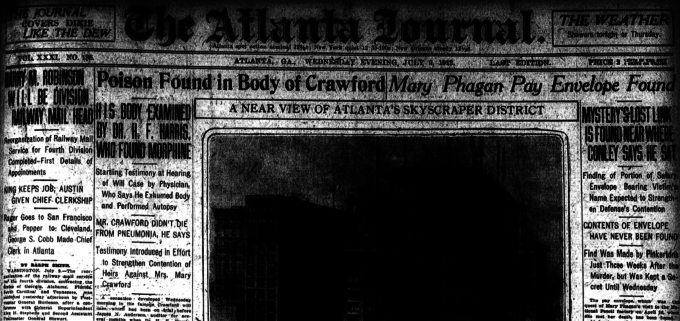
Mary Phagan Pay Envelope Found

Another in our series of new transcriptions of contemporary articles on the Leo Frank case.

The Atlanta Journal

Wednesday, July 9, 1913

MYSTERY’S LOST LINK IS FOUND NEAR WHERE CONLEY SAYS HE SAT

Finding of Portion of Salary Envelope Bearing Victim’s Name Expected to Strengthen Defense’s Contention

CONTENTS OF ENVELOPE HAVE NEVER BEEN FOUND

Find Was Made by Pinkertons Just Three Weeks After the Murder, but Was Kept a Secret Until Wednesday.

The pay envelope, which was the quest of Mary Phagan’s visit to the National Pencil factory on April 26, when she met her death, has been found.

At least enough of the envelope to definitely identify it is in the hands of the authorities.

The upper corner of the pay envelope, bearing the name of the victim of the sensational murder mystery, was found on the first floor of the factory by Pinkerton detectives three weeks after the commission of the crime.

While attorneys for the defense and the prosecution have known of the find for weeks, the fact only became public Wednesday.

The corner of the pay envelope was found on the first floor of the factory, behind a radiator, about 15 feet from the stairway and about 8 feet from the place, where James Conley, the negro sweeper, says he sat for more than an hour on the day of the tragedy.

Continue Reading →

New Evidence in Phagan Case Found

Another in our series of new transcriptions of contemporary articles on the Leo Frank case.

The Atlanta Georgian

Wednesday, July 9, 1913

iGrl [sic] Called to Tell of Negro She Saw in Pencil Factory—Lee Stays in Jail.

A sensation in the Phagan murder mystery developed Wednesday afternoon when Solicitor Dorsey summoned Miss Mattie Smith under a special subpena to question her in regard to a negro she saw in the National Pencil Factory the morning of the Saturday that Mary Phagan was murdered.

Miss Smith told a Georgian reporter that she saw a negro there that morning and believed it was between 9 and 10 o’clock. She thought she might be asked to identify Conley. If she identifies the negro, it will disprove Conley’s statement that he did not go to the factory until after he had met Frank Saturday.

Judge W. D. Ellis Wednesday morning postponed indefinitely the hearing on the application for a writ of habeas corpus to liberate Newt Lee, material witness in the Phagan murder mystery.

The action came as a result of an agreement reached between Graham & Chappell, attorneys for Lee, and Solicitor General Hugh M. Dorsey. It is believed to mark the end of all efforts to gain the negro’s freedom before the trial of Leo M. Frank July 28.

The most unconcerned person in the courtroom was Newt Lee. He was brought before Judge Ellis by Deputy Sheriff Miner.

Lee is Unconcerned.

Continue Reading →

Girl Springs Sensation in Phagan Case

Another in our series of new transcriptions of contemporary articles on the Leo Frank case.

The Atlanta Georgian

Wednesday, July 9, 1913

PART OF PAY ENVELOPE FOUND

Discovered Shortly After Tragedy by Detectives, but Find Was Kept Secret.

*Editor’s Note: The following headlines also appeared:

(Night Edition):

NEW PHAGAN EVIDENCE FOUND

PART OF PAY ENVELOPE HELD BY POLICE

(Extra Final Edition):

PHAGAN PAY ENVELOPE FOUND

Two sensational developments marked the Phagan case Wednesday. One was the testimony of Miss Mattie Smith, an employee of the National Pencil factory, that she had seen a negro sitting on the first floor of the factory betwen [sic] 9 and 10 o’clock, at a time when Conley had denied being there. The second was the announcement of the finding of a part of a pay envelope declared to be the envelope of Mary Phagan.

A piece of an envelope bearing Mary Phagan’s number was found on the first floor of the National Pencil factory behind a radiator, only a few feet from where Jim Conley, negro sweeper at the plant, was sitting on the day the little factory girl was murdered, according to information made public Wednesday afternoon.

Robbery Again Suspected.

Continue Reading →

Vice Scandal Probe Postponed for a Day

Another in our series of new transcriptions of contemporary articles on the Leo Frank case.

The Atlanta Constitution

Wednesday, July 9, 1913

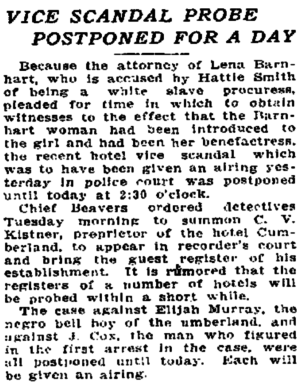
Because the attorney of Lena Barnhart, who is accused by Hattie Smith of being a white slave procuress, pleaded for time in which to obtain witnesses to the effect that the Barnhart woman had been introduced to the girl and had been her benefactress, the recent hotel vice scandal which was to have been given an airing yesterday in police court was postponed until today at 2:30 o’clock.

Chief Beavers ordered detectives Tuesday morning to summon C. V. Kistner, proprietor of the Hotel Cumberland, to appear in recorder’s court and bring the guest register of his establishment. It is rumored that the registers of a number of hotels will be probed within a short while.

The case against Elijah Murray, the negro bell boy of the umberland [sic], and against J. Cox, the man who figured in the first arrest in the case, were all postponed until today. Each will be given an airing.

* * *

The Atlanta Constitution, July 9th 1913, “Vice Scandal Probe Postponed for a Day,” Leo Frank case newspaper article series (Original PDF)

Caught Drinking, Three Policemen Fired Off Force

Another in our series of new transcriptions of contemporary articles on the Leo Frank case.

The Atlanta Constitution

Wednesday, July 9, 1913

Three Officers Are Suspended for Ninety Days, and Two Exonerated and Their Pay for Lost Time Restored.

WOOD, BORN, FOLDS DISCHARGED BY BOARD

Mayor Intimated He Would Ask Charges Be Preferred Against Moon, Who Said He Drank to Secure Evidence.

The scandal in the police department which grew out of revelations that eight policemen visited the resort of Ola Bradley, a negress, at No. 129 Auburn street resulted in the dismissal of three, exoneration of two, and suspension of three for ninety days, by the police board, at 1:30 o’clock this morning.

The policemen discharged were Robert A. Wood, J. P. Born and E. C. Folds.

Patrolmen J. E. McDaniels and L. W. Evans, who were under charges for neglect of duty for failure to report the visits of their partners to the resort, were found not guilty and were restored to the ranks with pay for lost time during suspension.

Three Are Suspended.

Continue Reading →

Newt Lee’s Attorneys Seeking His Freedom

Another in our series of new transcriptions of contemporary articles on the Leo Frank case.

The Atlanta Journal

Tuesday, July 8, 1913

Habeas Corpus Proceedings May Bring Frank and Conley Face to Face

Petition for a writ of habeas corpus in behalf of Newt Lee, the negro night watchman at the National Pencil factory who has been held in jail since the Mary Phagan murder as a suspect, has been drawn up at 2 o’clock Tuesday afternoon by the negro’s attorneys, Graham and Chappell, and the firm then was seeking the signature of the nearest available judge of the Fulton superior court to a writ fixing the time and place for a hearing upon the matter and directing Newt Lee be brought into court.

It is by this method that the negro is said to seek his freedom from jail, contending that there is no reason for confining him for any part in the matter. The solicitor is expected to vigorously fight the habeas corpus and insist that Lee be held as a material witness.

Should the petition be signed both the state and the attorneys for Leo M. Frank will be notified and this brings up the possibility of Frank and the negro sweeper, Conley, being brought face to face in court.

At 2 o’clock it was said that the habeas corpus hearing would probably be set for Wednesday morning at 9:30 o’clock.

The following is Newt Lee’s petition:

Continue Reading →