Policeman Says Body Was Dragged From Elevator

Policeman Says Body Was Dragged From ElevatorAnother in our series of new transcriptions of contemporary articles on the Leo Frank case.

Atlanta Georgian

Wednesday, April 30th, 1913

R. M. Lasseter [sic], the policeman on the morning watch past the pencil factory, was called at 3 o’clock in the afternoon. He was questioned as follows:

Q. Were you in the pencil factory Saturday night or Sunday morning?—A. I was there at 4:45 Sunday morning.

Q. What did you find?—A. A parasol.

Q. Where did you find it?—A. At the bottom of the elevator shaft. I found there also a big ball of red wrapping twine that never had been opened. (Here the witness was shown the cord that had strangled the girl and asked if that was the kind of cord he had found. He said it was not. The cord he found was very much smaller.)

Body Had Been Removed.

Q. Had the body been removed when you were in the building?—A. Yes.

Q. Where was the elevator?—A. I don’t remember; it was on the second or third floor.

Q. Is the bottom of the elevator shaft of concrete, or wood, or what?—A. I don’t know. It was full of trash and I couldn’t see.

Q. Did you look for signs of a struggle?—A. Yes, I saw where something had been dragged along the ground, and I traced it back to the elevator shaft.

Q. Did you find anything to indicate that the body came down the ladder?—A. No, sir; the dragging signs went past the foot of the ladder. I saw them between the elevator and the ladder.

Dragged From Elevator.

Q. You think, then, that the body was dragged from the elevator?—A. Yes, sir; I think from the evidence that it was dragged from the elevator.

Q. Where was the umbrella?—A. In the center of the elevator shaft, closed.

Before the witness was dismissed he said that he had passed the pencil factory at 1 o’clock Sunday morning and saw that the back door was closed. He said he did not pass the place again until after the body was removed. This was a voluntary statement from the witness and was not made in answer to any question.

* * *

Atlanta Georgian, April 30th 1913, “Policeman Says Body Was Dragged From Elevator,” Leo Frank case newspaper article series (Original PDF)

Confirms Lee’s Story of Shirt

Confirms Lee's Story of ShirtAnother in our series of new transcriptions of contemporary articles on the Leo Frank case.

Atlanta Georgian

Wednesday, April 30th, 1913

Negro Woman Says Man Accused of Phagan Crime Was Not Home Saturday Night.

If Newt Lee, the watchman, went home on Saturday night and discarded a bloody, stained shirt, Lorena Townes, the negro woman with whom he boarded, knows it. Lorena says Lee was not home on Saturday night.

Detectives found the blood-stained shirt in an old barrel in Lee’s room, and around this point has been built the theory that after committing the crime the man went home, changed his shirt, returned to the factory and then telephoned the police. Supporting this belief are the alleged omissions in Lee’s time clock checks during the night.

Lee lived in a little back room at 46 Henry Street; Lorena Townes sleeps in the front room opening on the porch. There is no hallway. There is a side door to Lee’s room, but it is always locked from the inside, according to Corinne Holsey, who lives in the other half of the house. Continue Reading →

Business Men Protest Sensational “Extras”

Business Men Protest Sensational Extras

Another in our series of new transcriptions of contemporary articles on the Leo Frank case.

Atlanta Journal

Wednesday, April 30th, 1913

Following an interview between Mayor Woodward and Chief of Police Beavers and Chief of Detectives Lanford, in which the mayor protested that extras on the Phagan murder case which were based on information alleged to have been given out by the officers and the detectives and which were liable to unduly inflame the public, a petition has been circulated among local business men asking the newspapers not to issue so many sensational extras.

The petition states that extras such as have been issued are hurting business and will hurt it still further, that the community is being aroused to a dangerous degree by them, and that they may bring extremely unfortunate conditions. Continue Reading →

Reward of $1,000 Urged by Mayor

Reward of a Thousand Dollars Urged by MayorAnother in our series of new transcriptions of contemporary articles on the Leo Frank case.

Atlanta Georgian

Wednesday, April 30th, 1913

Brown Offers $200 for Capture of Slayer—C. C. Jones Also Gives $100.

Governor Joseph M. Brown to-day offered a reward of $200 for the apprehension and conviction of the murderer of little Mary Phagan and Mayor James G. Woodward issued a call for a special meeting of Council for tomorrow morning at 10 o’clock, urging a $1,000 reward.

Governor Brown’s decision was reached on receipt of the following letter from Solicitor Hugh M. Dorsey:

“From the best information obtainable, it is my belief that the circumstances surrounding the death of little Miss Mary Phagan indicate a most brutal murder, probably attended with another horrible and detestable crime.

“The officers of the local police and detective departments seem to be using their best efforts toward the solution of the mystery, but I believe it advisable to ask that you offer a reward for the apprehension, with evidence to convict, of the guilty party.” Continue Reading →

City Offers $1,000 as Phagan Case Reward

City Offers Thousand Dollar RewardAnother in our series of new transcriptions of contemporary articles on the Leo Frank case.

Atlanta Georgian

Wednesday, April 30th, 1913

At Special Council Meeting Called by Mayor Only One Man Opposes Action.

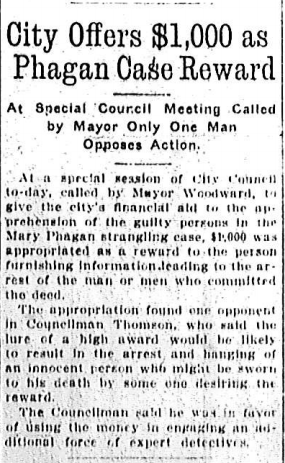
At a special session of city council to-day, called by Mayor Woodward, to give the city’s financial aid to the apprehension of the guilty persons in the Mary Phagan strangling case, $1,000 was appropriated as a reward to the person furnishing information leading to the arrest of the man or men who committed the deed.

The appropriation found one opponent in Councilman Thomson, who said the lure of a high award would be likely to result in the arrest and hanging of an innocent person who might be sworn to his death by some one desiring the reward.

The Councilman said he was in favor of using the money in engaging an additional force of expert detectives.

* * *

Atlanta Georgian, April 30th 1913, “City Offers $1,000 as Phagan Case Reward,” Leo Frank case newspaper article series (Original PDF)

Went Down Scuttle Hole on Ladder to Reach Body

Went Down Scuttle Hole to Reach BodyAnother in our series of new transcriptions of contemporary articles on the Leo Frank case.

Atlanta Georgian

Wednesday April 30th, 1913

Previous to Watchman Newt Lee’s testimony, three police officers, who were called to the pencil factory when Mary Phagan’s body was found, testified. Their testimony, with the exception of such parts as were unfit to print, follows:

W. T. Anderson, police call officer on duty Sunday morning, was first witness.

“We went over in an automobile to the pencil factory and the negro took us into the cellar where the body was found,” he said.

Anderson told of the location of the scuttle hole, from which a ladder led to the basement, and of the location of the body. Continue Reading →

Newt Lee’s Testimony as He Gave It at the Inquest

Newt Lee's Testimony as He Gave it at the Inquest

Another in our series of new transcriptions of contemporary articles on the Leo Frank case.

Atlanta Georgian

Wednesday, April 30th, 1913

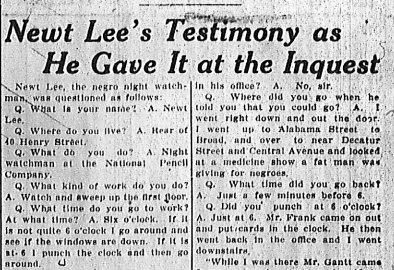
Newt Lee, the negro night watchman, was questioned as follows:

Q. What is your name? A. Newt Lee.

Q. Where do you live? A.  Rear of 40 Henry Street.

Q. What do you do? A. Night watchman at the National Pencil Company.

Q. What kind of work do you do? A. Watch and sweep up the first floor.

Q. What time do you go to work? At what time? A. Six o’clock. If it is not quite 6 o’clock I go around and see if the windows are down. If it is at 6 I punch the clock and then go around. Continue Reading →

Inquest This Morning.

Inquest This Morning.Another in our series of new transcriptions of contemporary articles on the Leo Frank case.

Atlanta Constitution

Wednesday, April 30th, 1913

Coroner Donehoo last night set the time for the inquest at this morning at 8:45 o’clock. It will be held in Bloomfield’s undertaking establishment on South Pryor street. A thorough investigation will be made into the mystery. It will then be determined if the evidence at hand is sufficient to commit Frank and the negro watchman to higher courts.

* * *

Atlanta Constitution, April 30th 1913, “Inquest This Morning,” Leo Frank case newspaper article series (Original PDF)
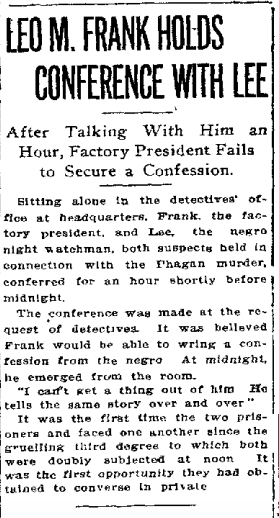
Leo M. Frank Holds Conference With Lee

Leo M Frank Holds Conference with LeeAnother in our series of new transcriptions of contemporary articles on the Leo Frank case.

Atlanta Constitution

Wednesday, April 30th, 1913

After Talking With Him an Hour, Factory President Fails to Secure a Confession.

Sitting alone in the detectives’ office at headquarters, Frank, the factory president, and Lee, the negro night watchman, both suspects held in connection with the Phagan murder, conferred for an hour shortly before midnight.

The conference was made at the request of detectives. It was believed Frank would be able to wring a confession from the negro. At midnight, he emerged from the room.

“I can’t get a thing out of him. He tells the same story over and over.”

It was the first time the two prisoners [had] faced one another since the [grueling] third degree to which both were doubly subjected at noon. It was the first opportunity they had obtained to converse in private.

* * *

Atlanta Constitution, April 30th 1913, “Leo M. Frank Holds Conference With Lee,” Leo Frank case newspaper article series (original PDF)

Tells Jury He Saw Girl and Mullinax Together

Tells Jury He Saw Girl and Mullinax TogetherAnother in our series of new transcriptions of contemporary articles on the Leo Frank case.

Atlanta Georgian

Wednesday April 30th, 1913

Edgar L. Sentell, the man who identified Mullinax as being the man he saw with Mary Phagan Saturday night was the first witness to take the stand when the coroner’s jury convened at 2:30 o’clock.

The witness said that he worked at Kamper’s grocery store, starting to work there last Thursday. He was questioned as follows:

Q. How late did you work Saturday night? A. To about 10:30 o’clock.

Q. What is your work? A. I drive a wagon.

Q. What time did you get in with your wagon Saturday night? A. About 9:30 or 10 o’clock. Continue Reading →

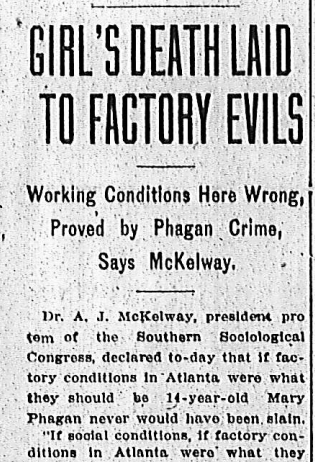
Girl’s Death Laid to Factory Evils

Girl's Death Laid to Factory EvilsAnother in our series of new transcriptions of contemporary articles on the Leo Frank case.

Atlanta Georgian

Wednesday, April 30th, 1913

Working Conditions Here Wrong, Proved by Phagan Crime, Says McKelway.

Dr. A. J. McKelway, president pro tem of the Southern Sociological Congress, declared to-day that if factory conditions in Atlanta were what they should be 14-year-old Mary Phagan never would have been slain.

“If social conditions, if factory conditions in Atlanta were what they should be here, if children of tender years were not forced to work in shops this frightful tragedy could not have been enacted,” he asserted.

Dr. McKelway’s remarks came in the course of a conversation in which he discussed at length the evils of child labor in industrial plants and the absolute necessity of rigid child labor legislation.

A reception at the Piedmont Driving Club yesterday marked the close of the four-day sessions of the sociological congress in Atlanta, Delegates left last night and to-day for their homes.

* * *

Atlanta Georgian, April 30th 1913, “Girl’s Death Laid to Factory Evils,” Leo Frank case newspaper article series (Original PDF)

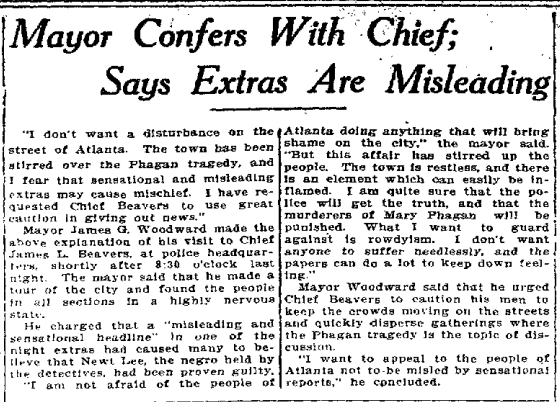
Mayor Confers with Chief; Says Extras are Misleading

Mayor Confers with Chief Says Extras are Misleading

Another in our series of new transcriptions of contemporary articles on the Leo Frank case.

Atlanta Constitution

Wednesday, April 30th, 1913

“I don’t want a disturbance on the street of Atlanta. The town has been stirred over the Phagan tragedy, and I fear that sensational and misleading extras may cause mischief. I have requested Chief Beavers to use great caution in giving out news.”

Mayor James G. Woodward made the above explanation of his visit to Chief James L. Beavers, at police headquarters, shortly after 8:30 o’clock last night. The mayor said that he made a tour of the city and found the people in all sections in a highly nervous state.

He charged that a “misleading and sensational headline” in one of the night extras had caused many to believe that Newt Lee, the negro held by the detectives had been proven guilty. Continue Reading →

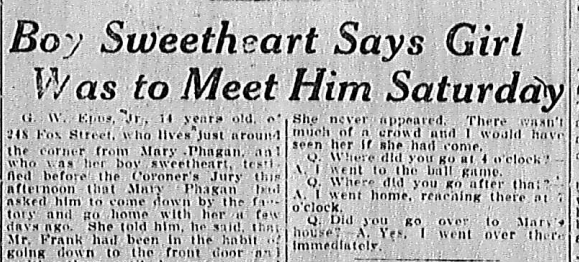
Boy Sweetheart Says Girl Was to Meet Him Saturday

Boy Sweetheart Says Girl Was to Meet Him Saturday

Another in our series of new transcriptions of contemporary articles on the Leo Frank case.

Atlanta Georgian

Wednesday April 30th, 1913

G. W. Epps, Jr., 14 years old, of 248 Fox Street, who lives just around the corner from Mary Phagan, and who was her boy sweetheart, testified before the Coroner’s Jury this afternoon that Mary Phagan had asked him to come down by the factory and go home with her a few days ago. She told him, he said, that Mr. Frank had been in the habit of going down to the front door and waiting there until she came out and looked suspicious at her and winked. He was asked:

Q. When did you see Mary Phagan last?—A. Saturday morning. We came to town on the car together. We got to town at 12 o’clock. When we got off the car she told me that she was going to the pencil factory to get her pay and would meet me at the (Falkin?) Drug Store at Five Points to see the parade at 2 o’clock. I looked for her all around at that time. I could not find her. I stayed there until about 4 o’clock selling papers. She never appeared. There wasn’t much of a crowd and I would have seen her if she had come.

Q. Where did you go at 4 o’clock?—A. I went to the ball game.

Q. Where did you go after that?—A. I went home, reaching there at 7 o’clock.

Q. Did you go over to Mary’s house?—A. Yes, I went over there immediately.

* * *

Atlanta Georgian, April 30th 1913, “Boy Sweetheart Says Girl Was to Meet Him Saturday,” Leo Frank case newspaper article series (Original PDF)
City to Offer $1,000 for Slayer’s Arrest

City to Offer 1000 for Slayer's ArrestAnother in our series of new transcriptions of contemporary articles on the Leo Frank case.

Atlanta Constitution

Wednesday, April 30th, 1913

Mayor Woodward Declares the Stain of Blood Must Be Wiped Out.

Atlanta, April 29, 1913

To the General Council,

City of Atlanta:

The general council of the city of Atlanta is hereby called to convene in special session tomorrow morning at 10 o’clock, April 30, 1913, to take cognizance, in an official way, of that most brutal crime that was committed in this city on last Saturday night.

I think it proper that the city government should take some befitting action as regards this most deplorable matter, which, as it is, is liable to cast unenviable criticism upon the name of our fair city, and I would suggest that your honorable body offer a suitable reward of not less than $1,000 for the capture of the brute or brutes that could so far forget themselves as to commit such an outrageous crime. I feel satisfied that every taxpayer of this city will heartily co-operate in endorsing the action of the mayor and general council in offering this reward. Respectfully submitted,

(Signed) JAMES G. WOODWARD

The murder of poor little Mary Phagan, in the dark basement of the National Lead Pencil company’s factory, Saturday night, will be considered by Atlanta’s city council, today. Continue Reading →

Gantt Turned Over to Sheriff of Fulton

Gantt Turned Over to Sheriff of FultonAnother in our series of new transcriptions of contemporary articles on the Leo Frank case.

Atlanta Constitution

Wednesday, April 30th, 1913

After a hearing before Judge George L. Bell of the superior court in which his attorney George T. [1 word illegible] gave a scathing denouncement of the police and detective department for what he termed the grilling system. J. M. Gantt, held on a warrant charging the murder of Mary Phagan was taken from the police and turned over to the sheriff to be held in the Tower.

Judge Gober stated that he would arrange for a hearing early today before Justice F. M. Powers before whom the original warrant was sworn out. The coroner’s inquest is set for 9 o’clock and Judge Gober declared that if possible he would have a hearing on the warrant before that time and if not he would have it immediately after that.

* * *

Atlanta Constitution, April 30th 1913, “Gantt Turned Over to Sheriff of Fulton,” Leo Frank case newspaper article series (Original PDF)

Net Closing About Lee, Says Lanford

Net Closing About Lee Says LanfordAnother in our series of new transcriptions of contemporary articles on the Leo Frank case.

Atlanta Georgian

Wednesday, April 30th, 1913

Chief of Detectives Lanford was confident this morning that he and his department had completed a strong case to present to the Grand Jury for indictment. He said that the evidence against the negro night-watchman at the National Pencil Factory had grown stronger since yesterday.

He declared, however, that there still appeared the strongest indications that another person, in all probability a white man, was involved in some manner in the crime.

Many puzzling questions have arisen, since the closing of the net around Lee began.

The detectives have been utterly unable to trace the girl from the factory after she arrived there Saturday noon to obtain her pay from Leo Frank, the superintendent. They have interviewed every friend and every acquaintance of the girl. None of them saw her at any time Saturday afternoon.

If she was kept in the factory from Saturday noon, it was not Lee who kept her in the building or induced her to stay, for he was not in the building at noon. Continue Reading →

Mother Prays That Son May Be Released

Mother Prays that Son May Be ReleasedAnother in our series of new transcriptions of contemporary articles on the Leo Frank case.

Atlanta Georgian

Wednesday, April 30th, 1913

Gantt’s Mother, for Whom Mary Phagan Was Named, Weeps for Son.

In an easy chair in front of an open fireplace in a little Cobb County farm house, sat an aged mother, with lines of suffering marking her face and her white head bowed in sorrow, praying that her son may be found innocent of the terrible crime for which he is held by the Atlanta police.

For two days she sat in the same chair, staring constantly with dry eyes into the embers of the dying fire, seeing in the clouds of smoke as they swirl upward into the chimney, visions of her son caged in a felon’s cell—her mind filled with terrible pictures of her boy struggling with the horrors of the “third degree.”

The mother is Mrs. Mary Lou Gantt. Her son is James Milton Gantt, the young bookkeeper who is held by the police as a suspect in the terrible murder of little Mary Phagan. Mrs. Gantt was prostrated when the news of her son’s arrest was brought to her Monday morning. Her boy had been away from home for three long weeks, and during that time had narrowly escaped death in an accident at Copper Hill, Tenn., where he had been working. Continue Reading →

Tells of Watchman Lee ‘Explaining’ the Notes

Tells of Watchman Lee 'Explaining' the NotesAnother in our series of new transcriptions of contemporary articles on the Leo Frank case.

Atlanta Georgian

Wednesday April 30th, 1913

Sergeant L. S. Dobbs was the third witness. He said he answered the call to the pencil company plant Sunday morning.

Q.—Did you find an umbrella? A.—No. Lassiter did.

Q.—Did you find the notes there? A.—One of them.

He then identified the two notes.

Q.—Were you at the plant when Lassiter found the umbrella? A.—No; he found them about 7 o’clock.

Q.—Where did you find the body? A.—About 150 feet from the elevator shaft.

Q.—Did you examine the body? Continue Reading →

Sister’s New Story Likely to Clear Gantt as Suspect

Sister's New Story May Clear Gantt

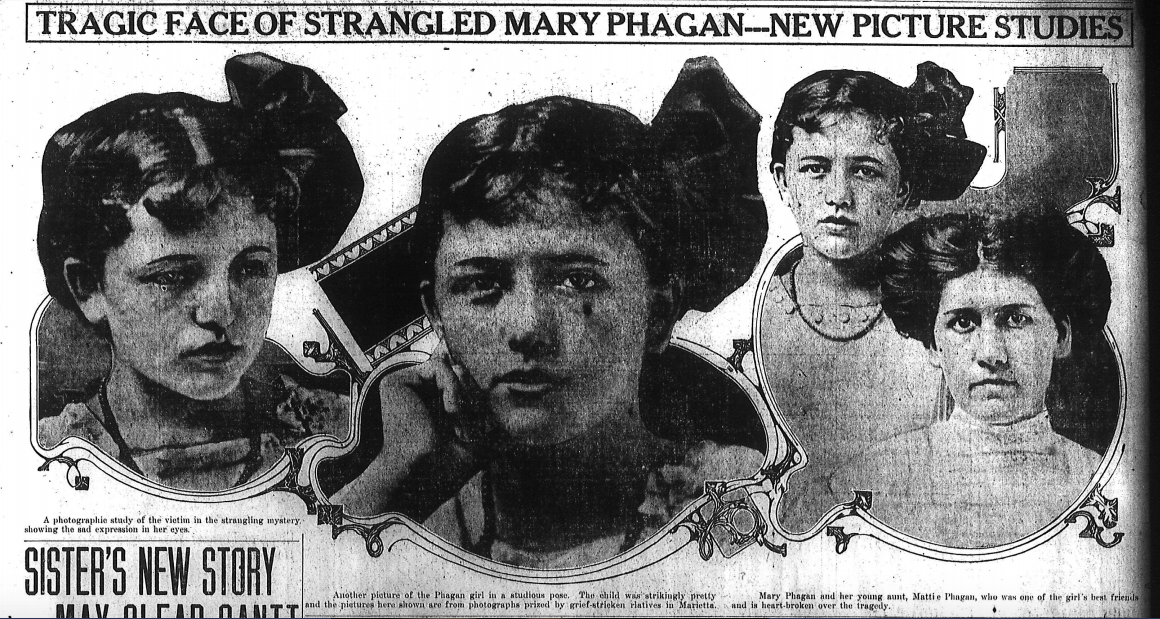
A photographic study of the victim in the strangling mystery showing the sad expression in her eyes. Another picture of the Phagan girl in a studious pose. The child was strikingly pretty and the pictures here shown are from photographs prized by grief-stricken relatives in Marietta. Mary Phagan and her young aunt, Mattie Phagan, who was one of the girl’s best friends and is heart-broken over the tragedy.

Another in our series of new transcriptions of contemporary articles on the Leo Frank case.

Atlanta Georgian

Wednesday, April 30th, 1913

F. C. Terrell, 284 East Linden Avenue, told a Georgian reporter to-day that his wife had declared to him that she did not tell the truth to the detectives and Georgian reporters to whom she had said that she did not know where J. M. Gantt, accused of the murder of pretty Mary Phagan, was on Saturday night.

When seen soon after the discovery of the deed, Mrs. Terrell stated that Gantt, who is her half brother, had left her home where he had been for the past seven years, three weeks ago, presumably to go to California and that she had not seen him since.

“Most certainly he was in his room here Saturday night,” declared Mrs. Terrell to a Georgian reporter to-day. “He came in at 11 o’clock.” Continue Reading →

Murder Analyzed By Dr. M’Kelway

Murder Analyzed by Dr MkelwayAnother in our series of new transcriptions of contemporary articles on the Leo Frank case.

Atlanta Constitution

Wednesday, April 30th, 1913

“If Children of Such Tender Years Were Not Forced to Work, Mary Phagan Might Be Living,” He Says

“If social conditions in Atlanta were of the best—if conditions in factories were of the best and lastly if children of such tender years were not forced to work little Mary Phagan would probably never have been murdered,” declared Dr. A. J. McKelway, president pro tem of the Southern Sociological congress speaking at the final meeting held in Wesley Memorial church last night.

“Let us take this murder and analyze it. A little child of tender years is forced to work. Think of the heavy toll which she undergoes and the physical conditions under which she labors.

“Why is it that such is allowed in our fair land? The sociological congress must do its share of enlightenment. It has shown these evils to the world.” Continue Reading →