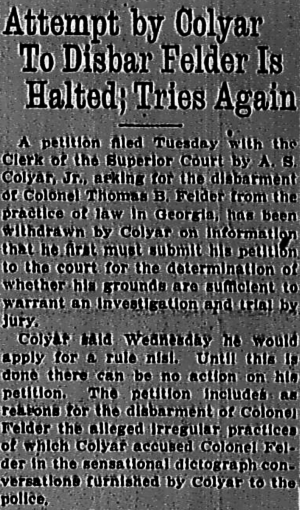
Attempt by Colyar To Disbar Felder Is Halted; Tries Again

Another in our series of new transcriptions of contemporary articles on the Leo Frank case.

The Atlanta Georgian

Thursday, July 3, 1913

A petition filed Tuesday with the Clerk of the Superior Court by A. S. Colyar, Jr., asking for the disbarment of Colonel Thomas B. Felder from the practice of law in Georgia, has been withdrawn by Colyar on information that he first must submit his petition to the court for the determination of whether his grounds are sufficient to warrant an investigation and trial by jury.

Colyar said Wednesday he would apply for a rule nisi. Until this is done there can be no action on his petition. The petition includes as reasons for the disbarment of Colonel Felder the alleged irregular practices of which Colyar accused Colonel Felder in the sensational dictograph conversations furnished by Colyar to the police.

* * *
The Atlanta Georgian, July 3rd 1913, “Attempt by Colyar To Disbar Felder Is Halted; Tries Again,” Leo Frank case newspaper article series (Original PDF)

Leo Frank Answers List of Questions Bearing on Points Made Against Him

Another in our series of new transcriptions of contemporary articles on the Leo Frank case.

The Atlanta Constitution

Monday, March 9, 1914

Stated That He Was Willing to Reply to Any Questions That Might Be in the Mind of the Public, and Asked to Answer Any Such That Might Be Propounded to Him.

TELLS HOW JIM CONLEY COULD HAVE SLAIN GIRL AND ESCAPED DETECTION

Asserts That Very Fact That He Admitted He Had Seen Mary Phagan on the Day of the Murder, Thus Placing Himself Under Suspicion, Was Proof in Itself That He Was Innocent of Crime.

Probably the most interesting statement yet issued by Leo M. Frank in connection with the murder for which he has been sentenced to hang, is one that he has furnished to The Constitution in the form of a series of answers to questions which were propounded to him bearing on the case.

These questions were prepared by a representative of The Constitution who visited Frank at the Tower last week.

“Ask me any questions you wish,” Frank told the reporter.

In accordance with that, the reporter wrote out a list of questions which, he asserted, comprised the most salient points the prosecution had brought out against him, and to each of these Frank has given an answer.

Here Are Questions.

Continue Reading →

Findings in Probe are Guarded

Another in our series of new transcriptions of contemporary articles on the Leo Frank case.

The Atlanta Georgian

Wednesday, July 2, 1913

No Indication Given of Results of Investigation of Reports of Disorderly Houses.

The result of the Grand Jury’s sensational vice probe of a few weeks ago will be made known Wednesday when the presentments are returned to Superior Judge W. D. Ellis, who two months ago charged that an extensive investigation be made.

Save when an indictment was returned against Police Commissioner W. P. Fain, which charged him with keeping a disorderly house and beating one of the women inmates, no inkling of the general trend of the probe got beyond the closed doors of the jury room.

When the probe first started the jury expected it to be completed in a day. It took a sensational turn when Colonel Thomas B. Felder charged Chief of Detectives Newport Lanford and his detectives with openly protecting vice, and the attorney stated he could submit to the jury a “vice list” that would “stand Atlanta on its head.”

List Given to Jury.

Continue Reading →

Facts Do Not Indicate Indictment of Conley

Another in our series of new transcriptions of contemporary articles on the Leo Frank case.

The Atlanta Journal

Tuesday, July 1, 1913

Rumor About Negro in Phagan Case Not Confirmed—Grand Jury Is Through

The publication to the effect that the negro sweeper, Jim Conley, probably would be indicted by the Fulton county grand jury for the murder of Mary Phagan, is apparently without any justification.

The grand jury, according to its foreman, Lewis H. Beck, will make its presentments to the court Wednesday morning and in all probability will be discharged then.

It is not likely, therefore, that the jury will consider any further bills. Mr. Beck declined to comment on the publication and referred the reporter to the solicitor.

As Solicitor Dorsey is known to be opposed to an indictment of Conley at this time, there seems to be no basis for the report that the case will be taken up.

Solicitor General Hugh M. Dorsey vigorously asserted Tuesday afternoon that no attempt had been made by the grand jury toin dict [sic] the negro Conely [sic] for the murder of Mary Phagan nor had any suggestion been made by the jurymen in this direction.

He said positively that he had heard of no intention on the part of jurors to go over his head in the Conley matter.

* * *

The Atlanta Journal, July 1st 1913, “Facts Do Not Indicate Indictment of Conley,” Leo Frank case newspaper article series (Original PDF)

“No” Bill Is Returned Against A. S. Colyar

Another in our series of new transcriptions of contemporary articles on the Leo Frank case.

The Atlanta Georgian

Tuesday, July 1, 1913

Grand Jury Declines to Indict Colyar for Reply to Attack of Colonel Felder

[…]charging A. S. Colyar, of Nashville, with libel, the Fulton county grand jury at its session on Tuesda ymorning [sic] refused to indict the Tennessean, returning a “no bill” in the case. Mr. Colyar has been in the limelight recently as a principal in the sensational dictograph episode, and has been engaged in a heated controversy with Colonel Thomas B. Felder.

The Tennessean was charged specifically with libelling Mr. Felder in a card published over his signature in The Journal of June 8, in which he excoriated the Atlanta lawyer.

The grand jury had the bill drawn of its own initiative, it is said, and considered it Tuesday morning. The only witness called before the grand jury was John Paschall, city editor of The Atlanta Journal.

In answer to questions of the grand jurors, Mr. Paschall stated that the card was furnished for publication by Mr. Colyar. Colyar has been given an opportunity to reply to an attack on his character, which Mr. Felder had embodied in a card, addressed to the editor of The Journal and which was published on the same day, the newspaper man told the jury in answer to further questions.

Attached to the bill, which was drawn against Mr. Colyar, was a copy of his card.

The grand jury was in session more than an hour considering the bill, before its decision not to return an indictment was reached.

* * *

The Atlanta Georgian, July 1st 1913, “”No” Bill Is Returned Against A. S. Colyar,” Leo Frank case newspaper article series (Original PDF)

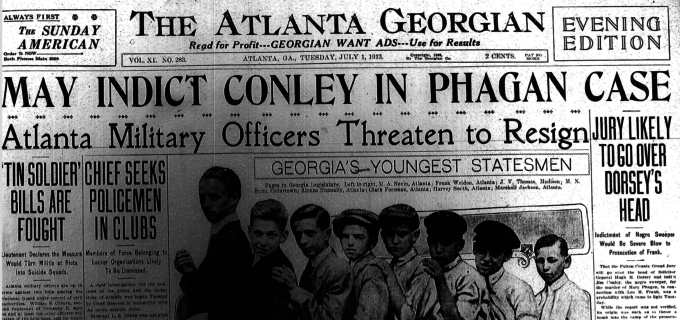
May Indict Conley in Phagan Case

Another in our series of new transcriptions of contemporary articles on the Leo Frank case.

The Atlanta Georgian

Tuesday, July 1, 1913

JURY LIKELY TO GO OVER DORSEY’S HEAD

Indictment of Negro Sweeper Would Be Severe Blow to Prosecution of Frank.

That the Fulton County Grand Jury will go over the head of Solicitor General Hugh M. Dorsey and indict Jim Conley, the negro sweeper, for the murder of Mary Phagan, in connection with Leo M. Frank, was a probability which came to light Tuesday.

While the report was not verified, its origin was such as to throw a bomb into the camp of the prosecution, as it will mean the indictment of the star witness in the State’s case against Frank.

In the event that Conley is indicted it will mean also that he will be taken from the custody of the police, where he has been carefully guarded from the defense, and will be placed in the county jail, where Frank is being held.

Rumors that Newt Lee, negro night watchman at the National Pencil factory, had made sensational disclosures to his attorney, Bernard L. Chappell, and would be one of the State’s most important witnesses in the trial of Leo M. Frank, were set at rest Tuesday by Mr. Chappell.

The negro’s attorney said after the inquest that he would make no effort to procure the release of Lee, as he believed his client was a vital witness and it would be the wisest plan for him to remain in the protection of the State.

His statements at this time and up to the date of the indictment found against Frank led to the impression that Lee had confided in his lawyer significant circumstances which he had told neither to the detectives nor to the members of the Coroner’s jury.

Denies Confession Reports.

Continue Reading →

Colyar Indicted as Libeler of Col. Felder

Another in our series of new transcriptions of contemporary articles on the Leo Frank case.

The Atlanta Georgian

Tuesday, July 1, 1913

Grand Jury Develops Sensational Sequel to Famous Dictograph Scandal.

A. S. Colyar, Jr., dictographer of Colonel Thomas B. Felder, Mayor Woodward and C. C. Jones, was indicted by the Grand Jury on the charge of criminal libel Tuesday forenoon.

Colyar is the man who sought to trap Colonel Felder by means of the dictograph into offering a bribe of $1,000 for certain affidavits in the Phagan case in the possession of the police. The dictograph records as furnished an afternoon newspaper by Colyar contained the offer.

Colonel Felder swore the records were padded. Largely on Colonel Felder’s representations, the indictment was procured. John Pascal, of The Journal, was the only witness called by the Grand Jury in considering Colyar’s case.

Chief of Detectives Lanford and Colonel Felder, indicted last week by the Grand Jury, obtained their freedom by making a $500 bond. It was expected that the same bond would be imposed upon Colyar.

Much of the time Tuesday was occupied by members of the Grand Jury in probing into police affairs. Without calling any witnesses, the scandal which has shaken the department was given serious consideration for nearly two hours. The result of the discussion was not made public.

* * *

The Atlanta Georgian, July 1st 1913, “Colyar Indicted as Libeler of Col. Felder,” Leo Frank case newspaper article series (Original PDF)

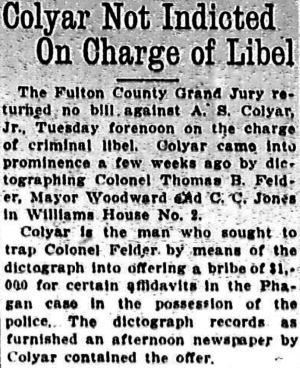
Colyar Not Indicted On Charge of Libel

Another in our series of new transcriptions of contemporary articles on the Leo Frank case.

The Atlanta Georgian

Tuesday, July 1, 1913

The Fulton County Grand Jury returned no bill against A. S. Colyar, Jr., Tuesday forenoon on the charge of criminal libel.  Colyar came into prominence a few weeks ago by dictographing Colonel Thomas B. Felder, Mayor Woodward and C. C. Jones in Williams House No. 2.

Colyar is the man who sought to trap Colonel Felder by means of the dictograph into offering a bribe of $1,000 for certain affidavits in the Phagan case in the possession of the police. The dictograph records as furnished an afternoon newspaper by Colyar contained the offer.

* * *

The Atlanta Georgian, July 1st 1913, “Colyar Not Indicted On Charge of Libel,” Leo Frank case newspaper article series (Original PDF)

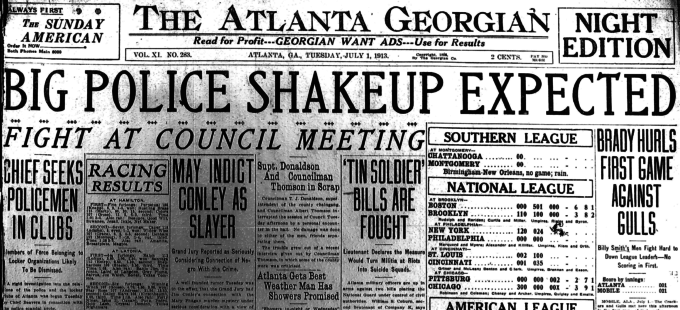
May Indict Conley as Slayer

Another in our series of new transcriptions of contemporary articles on the Leo Frank case.

The Atlanta Georgian

Tuesday, July 1, 1913

Grand Jury Reported as Seriously Considering Connection of Negro With the Crime.

A well founded rumor Tuesday was to the effect that the Grand Jury had Jim Conley’s connection with the Mary Phagan murder mystery under serious consideration with a view of finding an indictment against the negro on the charge of causing the death of the little factory girl.

Announcement was made after the close of Tuesday’s session that the present Grand Jury would hold its last session Wednesday, and it was reported that if action were not taken on Conley’s case before adjournment, recommendations would be left with the next Grand Jury suggesting that the negro’s connection with the crime be rigidly investigated.

If the indictment is returned against the negro it will mean that he will be taken from the custody of the detectives and placed in the Tower. He also will bear a different relation to the case in the future, being a defendant instead of a material witness. Attorneys interested in the case said they had heard nothing of the proposed action by the Grand Jury.

Rumors that Newt Lee, negro night watchman at the National Pencil factory, had made sensational disclosures to his attorney, Bernard L. Chappell, and would be one of the State’s most important witnesses in the trial of Leo M. Frank, were set at rest Tuesday by Mr. Chappell.

The negro’s attorney said after the inquest that he would make no effort to procure the release of Lee, as he believed his client was a vital witness and it would be the wisest plan for him to remain in the protection of the State.

His statements at this time and up to the date of the indictment found against Frank led to the impression that Lee had confided in his lawyer significant circumstances, which he has told neither to the detectives nor to the members of the Coroner’s jury.

Denies Confession Reports.

Continue Reading →

Frank Is Willing for State to Grill Him

Another in our series of new transcriptions of contemporary articles on the Leo Frank case.

The Atlanta Georgian

Tuesday, July 1, 1913

Accused Man Declares He’s Anxious Even for Prosecution to Cross-Examine.

Surpassing in interest any of the other testimony at the trial of Leo M. Frank will be the story related on the stand by the accused man himself. That Frank will make a detailed statement of his movements on the day that Mary Phagan was murdered is regarded as one of the certainties of the trial.

It was learned Wednesday that Frank was desirous of going even further than this by being sworn and submitting to a cross-examination by the attorneys for the prosecution. He will request his lawyers, Luther Z. Rosser and Reuben R. Arnold, that the privilege of cross-examination be extended the State.

Continue Reading →

New Frank Evidence Held by Dorsey

Another in our series of new transcriptions of contemporary articles on the Leo Frank case.

The Atlanta Georgian

Friday, June 27, 1913

Solicitor Closely Guards Data of Which City Detectives Have No Knowledge.

New activity was injected into the Phagan case Friday when James Conley, negro sweeper at the National Pencil Factory, was removed secretly from his cell in police station and closely questioned by Frank Hooper, who will aid Solicitor Dorsey in the prosecution of Leo Frank.

The move was surrounded with the utmost secrecy. The negro was taken from his cell by Detective Starnes, and behind locked doors questioned anew in the room used by the Police Commissioners. He had been in for many minutes before the action became known.

Mr. Hooper asked Conley various new questions, and after the quizzing was over hurried away from the police station.

Dorsey Has New Evidence.

Continue Reading →

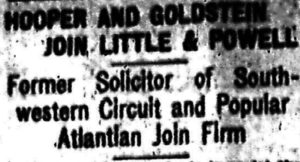
Hooper and Goldstein Join Little & Powell

Another in our series of new transcriptions of contemporary articles on the Leo Frank case.

The Atlanta Journal

Saturday, June 28, 1913

Former Solicitor of Southwestern Circuit and Popular Atlantlan [sic] Join Firm

Frank A. Hooper, who is to assist the solicitor general in the prosecution in the Phagan case, and M.F. Goldstein, a well known young attorney, will join the law firm of Little & Powell on July 1.

The senior members of the firm are John D. Little and Judge Arthur Powell. After July 1 the firm will be styled Little, Powell, Hooper & Goldstein.

Mr. Hooper served in the southwestern circuit for twelve years as solicitor general, but removed from Americus to Atlanta a few years ago to become general counsel for the Empire Life Insurance company.

In connection with the formation of the new firm, Mr. Hooper states that his new association will in no way affect his connection with the Phagan case, and he will continue to personally assist the solicitor general in the prosecution, while his firm will have no connection with the case.

Mr. Goldstein, the junior member of the new firm, is a graduate of the University of Georgia and of Yale. In four years’ practice here he has established an enviable record at the local bar.

* * *

The Atlanta Journal, June 28th 1913, “Hooper and Goldstein Join Little & Powell,” Leo Frank case newspaper article series (Original PDF)

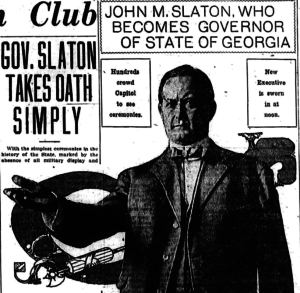
Gov. Slaton Takes Oath Simply

Another in our series of new transcriptions of contemporary articles on the Leo Frank case.

The Atlanta Georgian

Saturday, June 28, 1913

With the simplest ceremonies in the history of the State, marked by the absence of all military display and red tape, John Marshall Slaton becomes Governor of the State of Georgia in the hall of the House of Representatives of the State Capitol Saturday at 12 o’clock noon, succeeding Governor Joseph M. Brown.

The joint committee on inaugural arrangements selected from the memberships of the Senate and the House has conformed to the expressed desires of Governor-elect Slaton in preparing for his induction into office, and there is none of the pomp and excitement attending previous gubernatorial inaugurations. Within an hour or an hour and a half after the ceremonies begin, Governor Joseph M. Brown will have relinquished his office and made preparations to retire to his Cobb County farm, and His Excellency John Marshall Slaton will take his place as head of the State Government.

Governor Slaton will give voice to certain distinct policies of his own in his inaugural address, which also will be his message to the Legislature. He will recommend certain legislation and condemn certain other legislation, but there will not be that tense, nervous feeling that usually characterizes a change of administration, though it be usually hidden behind a mask of pomp and display.

Great Crowds Attend.

Continue Reading →

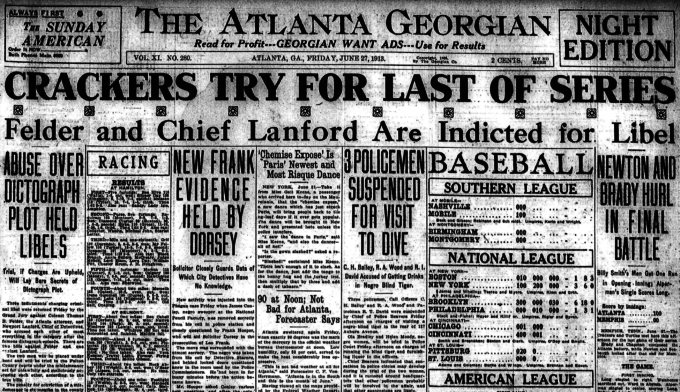
Lanford and Felder Are Held for Libel

Another in our series of new transcriptions of contemporary articles on the Leo Frank case.

The Atlanta Georgian

Friday, June 27, 1913

Grand Jury Indicts Lawyer and Head of Detectives for Attacks on Each Other.

Three indictments charging criminal libel were returned Friday by the Grand Jury against Colonel Thomas B. Felder, the Atlanta attorney, and Newport Lanford, Chief of Detectives, who accused each other of most everything in the category after the famous dictograph episode. There are two bills against Felder and one against Lanford.

The two men will be placed under bond and will be tried in the Fulton County courts under the misdemeanor act for unlawfully and maliciously accusing each other, according to the true bills.

The penalty for conviction of a misdemeanor is six months in the county jail, twelve months in the penitentiary, a fine not exceeding $1,000, either or all three.

Colonel Felder appeared at the Solicitor’s office about 2 o’clock and furnished the $500 bond required. Chief Lanford had not been located at that time, but was expected to do likewise.

The accusation against both men is based on recriminations issued against each other and published in the Sunday newspapers of May 25 and June 8.

In those statements Colonel Felder attacked Lanford bitterly, hurling a line of invectives that the greatest of the Roman orators might have envied. He attacked Lanford’s private and public character, accusing him of “hideous crimes.”

Lanford in Full Denial.

Continue Reading →

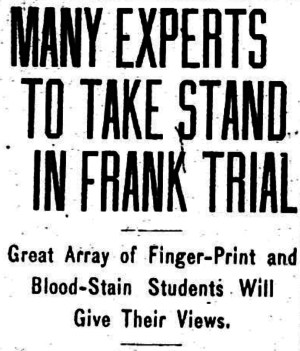
Many Experts to Take Stand in Frank Trial

Another in our series of new transcriptions of contemporary articles on the Leo Frank case.

The Atlanta Georgian

Sunday, June 29, 1913

Great Array of Finger-Print and Blood-Stain Students Will Give Their Views.

The trial of Leo M. Frank will bring forth the most prominent array of criminal and medical experts ever grouped in a Southern court room.

This became known Saturday when Solicitor Hugh M. Dorsey began making preparations to have the skilled investigators who have worked in the Phagan case return to Atlanta for the trial, July 28.

The defense has not been idle and is prepared to have an expert on almost every conceivable angle to introduce in rebuttal.

Fingerprint experts were brought into the case almost immediately after it was taken from the hands of the police by Solicitor Dorsey. One of the most prominent of these, who has figured in solving many New York mysteries, was the first to be brought South. He spent several days in a minute investigation of the scene of the crime, articles of clothing and the fingerprints of every suspect in the case. Other experts in the same line followed him.

Solicitor Dorsey did not trust wholly to the examination of Dr. Hurt, the Coroner’s physician, who could not qualify as an expert in the Appelbaum trial, but sent with him some of the most prominent of the Atlanta medical men.

Blood Stains Important.

Continue Reading →

State Secures New Phagan Evidence

Another in our series of new transcriptions of contemporary articles on the Leo Frank case.

The Atlanta Georgian

Saturday, June 28, 1913

[HOOPER SECURES NEW EVIDENCE FROM CONLEY]*

[NEW FACTS GIVEN BY NEGRO]

[Admissions to Prosecutor’s Aide Strengthens Rumor That He Saw Girl Just Before Crime.]

Conley’s Admission Strengthens Rumor That He Saw Child Just Before Slaying.

Frank A. Hooper, associated with Solicitor Dorsey in the prosecution of Leo M. Frank on the charge of strangling Mary Phagan, admitted Saturday that Jim Conley, negro sweeper at the National Pencil Factory, had made important additions to the story of his part in the murder mystery and had told of circumstances on the day of the crime which he had revealed in none of his previous statements.

A persistent report that Conley had made the startling admission that he had seen Mary Phagan enter the factory on the day she was slain arose at the time the negro was questioned more than an hour by Solicitor Dorsey early in the week, and this rumor was heightened after Attorney Hooper’s interview with the negro Friday.

In all of his statements to the detectives Conley denied he saw the girl at all on the day of the crime until he was horrified by the sight of her dead body lying in the rear of the second floor where he was directed by Leo Frank. Solicitor Dorsey is believed to have wrung the statement from him that he did see Mary Phagan when she came in the door of the factory and went to the second floor to Frank’s office.

Hooper Mum on Topic.

Continue Reading →

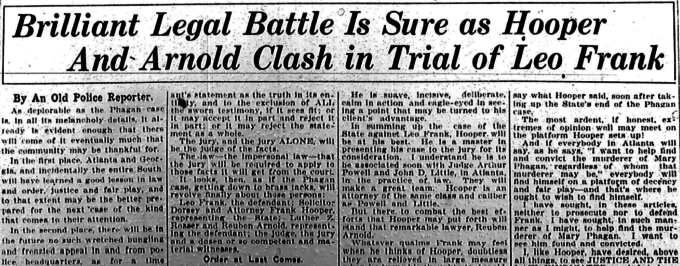
Brilliant Legal Battle Is Sure as Hooper And Arnold Clash in Trial of Leo Frank

Another in our series of new transcriptions of contemporary articles on the Leo Frank case.

The Atlanta Georgian

Sunday, June 29, 1913

[BRILLIANT BATTLE SURE IN FRANK TRIAL IN CLASH OF HOOPER AND ARNOLD]*

[Order Has at Last Been Rested and Indications Are That Struggle of Attorneys Will Be Waged in the Most Ethical Manner.]

* Alternate headline from another page is shown in brackets above.

By An Old Police Reporter.

As deplorable as the Phagan case is in all its melancholy details, it already is evident enough that there will come of it eventually much that the community may be thankful for.

In the first place, Atlanta and Georgia, and incidentally the entire South will have learned a good lesson in law and order, justice and fair play, and to that extent may be the better prepared for the next case of the kind that comes to their attention.

In the second place, there will be in the future no such wretched bungling and frenzied appeal in and from police headquarters, as for a time marked the Phagan case unique among its kind.

It looks now as if the decks have been pretty well cleared for action and that Leo Frank’s trial may be expected to proceed in dignity and order, and that in its final analysis the truth of Mary Phagan’s murder may be established, at least to the extent of Frank’s real or suspected participation therein.

If Frank should be convicted, that would mean the subsequent indictment and conviction of the negro Conley, as an accessory after the fact.

Continue Reading →

Conley Tale Is Hope of Defense

Another in our series of new transcriptions of contemporary articles on the Leo Frank case.

The Atlanta Georgian

Monday, June 30, 1913

DEFENSE PLANS TO TEAR DOWN CONLEY TALE*

* This headline appeared on Page 3 of the Georgian.

Expect to Prove Frank Innocent By Discrediting Negro’s Story Of Phagan Crime.

Warned that the State is basing practically all of its expectations of sending Leo M. Frank to the gallows on the dramatic story told by Jim Conley, the defense this week is completing the collection of a strong line of evidence with which it is planned utterly to discredit the negro’s statements and his testimony in court.

Conley again has insisted on confronting Frank. He says he is certain if he can meet the factory superintendent face to face he can make him “tell the whole story.” The negro has told the detectives he not only is willing, but is eager to repeat in the presence of Frank the story of the disposal of Mary Phagan’s body just as he has related it a dozen times since he first made the sensational acknowledgment that he had a part in the crime.

It is regarded as most unlikely that the two will be brought together. Luther Z. Rosser, attorney for Frank, has refused to make any definite statement of his attitude in the matter, but it is known he looks with suspicion on every word and every act of the negro. He has given the impression that he is not unwilling for his client to face the negro, but that he regards the court room as the proper place for the meeting and the actual trial of Frank as the proper time. For this reason, the dramatic moment when accuser and accused confront each other in all probability will be saved for the time when the legal battle is in progress for Frank’s life.

Continue Reading →

Lanford and Felder Indicted for Libel

Another in our series of new transcriptions of contemporary articles on the Leo Frank case.

The Atlanta Constitution

Saturday, June 28, 1913

Indictments Grew Out of the Dictagraph Episode and the Letters Which Followed.

Formal investigation into the invectives hurled between Colonel Thomas B. Felder and Detective Chief Newport Lanford resulted yesterday in indictments of criminal libel being returned by the grand jury against each of them for their cards and interviews in the daily papers in which they attacked each other’s character, after the dictagraph row.

Colonel Felder is held under two indictments on a bond of $500, while Chief Lanford has one indictment against him, and is free on the same bond.

The offenses charged against each are misdemeanors, and the punishment, in case of conviction, is six months in the county jail, twelve months in the penitentiary or a fine of not more than $1,000. It is in the discretion of the judge to impose any or all of these penalties after conviction.

In order to come clear at the trial it will be necessary for the man indicted for criminal libel to prove that the charges he made were true, and it is expected that the cases will develop into the most bitterly fought in the history of the Fulton courts.

Felder Will Not Talk.

Continue Reading →

Hooper Sees Conley for the First Time

Another in our series of new transcriptions of contemporary articles on the Leo Frank case.

The Atlanta Journal

Friday, June 27, 1913

Attorney Who Will Aid Solicitor Hears Negro Sweeper Recite His Story

Frank A. Hooper, the attorney who will assist Solicitor Hugh M. Dorsey in the prosecution of the case against Leo M. Frank, indicted for the murder of little Mary Phagan, interviewed James Conley, the negro sweeper, for the first time on Friday morning.

The attorney talked with the negro in the office of the police board for nearly an hour. Detective Starnes, who has been working under the direction of the solicitor, was the only officer with him.

Mr. Hooper simply made the trip to hear from Conley’s own lips his story of the crime, and the interview is said not to have been occasioned by any new developments in the case.

Mr. Hooper said that he had the negro tell him the “whole story.”

“The negro talks in a clear, straight-forward manner,” the attorney declared, “and his statement had the earmarks of the truth on it.” Mr. Hooper characterized the negro as a “good witness.”

While Solicitor Dorsey has interviewed Conley a number of times, he has never made any statement relative to the value of the negro’s story in a court room nor has he said anything relative to the manner in which the negro tells his story. Continue Reading →