Mincey Ready to Tell Story to Grand Jury

Another in our series of new transcriptions of contemporary articles on the Leo Frank case.

The Atlanta Georgian

Sunday, July 20, 1913

Man Who Says He Heard Negro Confess Now Is at Rising Fawn, Ga.

W.H. Mincey, the school teacher who made an affidavit declaring Jim Conley confessed to him on the afternoon of the murder of Mary Phagan that he killed a girl, will appear before the Grand Jury to repeat his startling story when that tribunal convenes Monday to consider the Phagan matter, it was reported Saturday night.

Mincey, who is now at Rising Fawn, Ga., has expressed his willingness to come to Atlanta for this purpose. His evidence, which has proved the most important of all that has come to light since Conley’s affidavit directing guilt at Frank, is considered of the greatest weight in bringing the Grand Jury to its consideration of indicting Conley.

Hugh Dorsey, Solicitor General, insisted Saturday that his every effort would be directed against the indictment of Conley.

The Solicitor will not fight in Conley’s defense except as a last resort. His chief desire is that the Grand Jury postpone action in regard to the negro until after the Frank trial.

“Conley can be indicted after the Frank trial is disposed of much more properly than at present,” said the Solicitor Saturday. “And by the delay, there will be no danger of a miscarriage of justice.”

The chief contention of the Solicitor is that with Conley indicted for the murder, and with uncertainty thus engendered, much of the force of the State’s case against Leo M. Frank will be lost. It is the insistent declaration by police, city detectives and the Solicitor’s force that a chain of direct and apparently conclusive evidence has been forged against Frank.

It is mostly for this reason that Dorsey will request the Grand Jury to keep its hands off the Conley case. The Solicitor also hinted that he holds evidence, revelation of which would prevent the Grand Jury from indicting the negro. He feels also, as he announced, that a consideration of the Phagan case at this time will bring about an indiscreet exploitation of the State’s evidence, thus revealing essential features of the prosecution’s case to the defense.

All this he will present to the Grand Jury, it is expected.

Other phases of the case discussed Saturday included the intimation that the Frank defense will ask for a trial jury drawn from the Grand Jury box, and not from the petit jury box. The legality of this procedure, according to the Solicitor, is a matter of conjecture.

The Grand Jury will meet Monday at 10 o’clock, at the call of the foreman. The body has only twenty members, and by statute a quorum of eighteen is necessary to consider the indictment or exoneration of a person. The fact that a small margin thus is left for probable absence seems to strengthen the Solicitor’s forecast that no indictment will be returned against Conley at this time.

* * *

The Atlanta Georgian, July 20th 1913, “Mincey Ready to Tell Story to Grand Jury,” Leo Frank case newspaper article series (Original PDF)

Mincey Story Declared Vital To Both Sides in Frank Case

Another in our series of new transcriptions of contemporary articles on the Leo Frank case.

The Atlanta Georgian

Sunday, July 20, 1913

By AN OLD POLICE REPORTER.

The most important and interesting development of the week in the Phagan case was the Mincey affidavit, directing suspicion more surely in the direction of James Conley than ever before, if the affidavit is that of a credible witness.

If what Mincey says is true—if his evidence can be made to “stand up” in court—then he is far and away not only the most important witness yet discovered, but his testimony will serve to clear up the mysterious Phagan case in its most obscure phases.

Solicitor General Hugh Dorsey has attacked Mincey’s credibility. Naturally, he would do that.

If Mincey is worthy of belief and is speaking the truth, he has dealt the State’s case against Frank a deadly blow, from which it can not hope to recover.

If he does not speak the truth, and that can be established, it will redound fo [sic] the hurt of the defense, for it will have a bracing-up effect upon Conley’s other story.

But Who Is Mincey?

Continue Reading →

Counsel of Frank Says Dorsey Has Sought to Hide Facts

Another in our series of new transcriptions of contemporary articles on the Leo Frank case.

The Atlanta Georgian

Sunday, July 20, 1913

Attorneys Rosser and Arnold, in a Statement to the Press, Make Bitter Attack on Solicitor for His Conduct of Phagan Case.

Call Attention to Secrecy Maintained by Prosecution, and Declare Action of State’s Attorney Has Inflamed Public Opinion.

Luther Z. Rosser and Reuben R. Arnold, attorneys for Leo M. Frank, who will be tried July 29 on the charge of killing Mary Phagan, joined Saturday in a bitter attack upon the policy of Solicitor Hugh M. Dorsey, whose procedure in the case, they said, had inflamed public opinion and had placed the Solicitor far below the dignity of his office.

In a formal statement, they charged that Dorsey had ignored his constitutional and legal functions and had sought to usurp those of the Grand Jury by his attempt to block the indictment of Jim Conley by that body.

They described his action as unprecedented and dangerous in the extreme, and represented Dorsey and Conley as partners in “a harmonious concert.”

The document, which is one of the few public statements issued by the defense, is bristling with criticism of the Solicitor’s conduct throughout the investigation of the murder mystery, and charges that Dorsey has maintained his belief in Frank’s guilt apparently for no other purpose than to convict Frank.

Call Attention to Secrecy.

Continue Reading →

Prison System of Georgia Attacked by Episcopalians

Another in our series of new transcriptions of contemporary articles on the Leo Frank case.

The Atlanta Constitution

Sunday, July 20, 1913

The Episcopalian diocese of Georgia, at its annual convention, appointed a social service commission, which has since met and formulated the following special report on prison and child labor conditions in this state.

“Resolved, That the prison system of the state of Georgia, and the methods of punishment now in use and as commonly administered, are unworthy of an enlightened and progressive state.

“Resolved, That we hereby indorse the splendid efforts of the Prison Reform association of this state, and offer to them our hearty co-operation in securing needed reforms.

“Resolved, That we send copies of these resolutions to as many members of our legislature as possible, and urge them to support those bills now pending which bear on the subject of prison reform in the state of Georgia and which are advocated by the prison association.

“Resolved, That we also urge upon our representatives their support of the child labor bill, advocated and indorsed by the National Child Labor association.”

Copies of these resolutions are being mailed to the legislators, and many of them have already expressed themselves strongly in favor of the measures reerred [sic] to. The three general prison reform measures have already been recommended for passage by the house committee. They are the bill to legalize the suspension of sentence and appoint probation officers; the bill to establish a home for wayward girls; the bill providing for jail inspections and enlarging the powers and responsibilities of the prison commission.

The chairman of the commission which formulated the above report is Rev. G.S. Whitney, of Augusta. The commission is authorized to represent the Episcopal church in the southeastern section of the state in all esforts [sic] for social betterment. It represents some 5,000 communicants or about 7,500 baptized members of the Episcopal church residing in the southeastern half of the state of Georgia.

Colonel G.A. Gordon and Miss Helen Pendleton, of Savannah, are among the prominent members of the commission.

* * *

The Atlanta Constitution, July 20th 1913, “Prison System of Georgia Attacked by Episcopalians,” Leo Frank case newspaper article series (Original PDF)

Grim Justice Pursues Mary Phagan’s Slayer

Another in our series of new transcriptions of contemporary articles on the Leo Frank case.

The Atlanta Constitution

Sunday, July 20, 1913

As Famous Murder Case Nears Trial the Public Mind Again Reverts to the Discovery of the Crime; and Again the Great Question Comes Up:

“What Happened in the Pencil Factory Between Noon Saturday and 3:15 Sunday Morning?”

By Britt Craig.

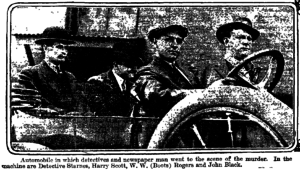
Automobile in which detectives and newspaper men went to the scene of the murder. In the machine are Detective Starnes, Harry Scott, W. W. (Boots) Rogers and John Black.

There are things that happen right before our eyes that defy the pen of a god to describe. The mind of a master would find itself lamentably incompetent, and the words of a Demosthenes would become panic-stricken in the attempt.

One of these was the night Mary Phagan’s body was found. It was a night as dramatic as the fury of a queen and poignant as her sorrow. It wrote the first thrilling chapter of Atlanta’s greatest criminal case, and it will live forever in the minds of those who knew it.

This story is no effort at description, because description is impossible. It is just a plain, ordinary story of the happenings that night when Newt Lee went down into the basement to wash his hands and emerged, overcome with fear, the discoverer of a crime that put an entire state in mourning.

A week from tomorrow, Leo Frank, manager of the pencil factory, where Mary Phagan’s body was found, will be placed on trial charged with the murder of the young girl, and interest in this mysterious crime again goes back to the night when Newt Lee startled police headquarters with news of his grewsome find.

Finding the Body.

Continue Reading →

Mrs. Nina Formby Will Not Return for Trial

Another in our series of new transcriptions of contemporary articles on the Leo Frank case.

The Atlanta Constitution

Sunday, July 20, 1913

Woman Swore That Leo M. Frank Tried to Engage Room on Night of Murder

Mrs. Nina Formby, who signed an affidavit in the Frank case in which she swore the superintendent has endeavored to engage a room at her house, 400 Piedmont avenue, during the Phagan murder night to which he might bring a girl has fled to Chattanooga and will not appear at the coming trial on July 28. This announcement was made to a Constitution reporter last night by the woman’s legal representative, John Gossett. Gossett states that she is fearful of facing cross examination on some phases of her story.

A letter has been placed on file in Gossett’s office in which the Formby woman asks for a continuance of a trial in which she will be arraigned before a justice court. August or September are the months to which she asks the case be put. The letter says that she will not be in Atlanta until that time. She has obtained a position in the Tennessee city, she says, and intends making Chattanooga her future home.

At first it was intimated that the state would put credence in the affidavit, but on account of the woman’s character it was later considered of but little value.

* * *

The Atlanta Constitution, July 20th 1913, “Mrs. Nina Formby Will Not Return for Trial,” Leo Frank case newspaper article series (Original PDF)

Frank’s Lawyers Score Dorsey for His Stand

Another in our series of new transcriptions of contemporary articles on the Leo Frank case.

The Atlanta Constitution

Sunday, July 20, 1913

Luther Rosser and Reuben Arnold Declare He Is Going Out of His Way to Dictate to the Grand Jury.

EXCEEDS PROVINCE OF SOLICITOR GENERAL

Grand Jury Will Meet at 10 O’Clock Monday Morning to Take Up Conley Case. Call Is Sent Out.

In reply to Solicitor General Hugh M. Dorsey’s statements in regard to the proposed indictment by the grand jury of James Conley, the negro who has confessed complicity in the murder of Mary Phagan, Attorneys Reuben R. Arnold and Luther Z. Rosser issued a statement Saturday afternoon in which they openly attacked the stand taken by the solicitor in protesting against the indictment of the negro.

That the solicitor is exceeding his legal functions as a state officer is one point that the lawyers defending Leo M. Frank make in their statement, and they also severely criticise the solicitor for his detective work in the Phagan murder.

The card also contains a reference to the statement made in The Constitution Saturday morning by Attorney William M. Smith, representing the negro Conley. The card of the Frank defense takes Attorney Smith to task for rushing to the aid of the solicitor.

Solicitor General Dorsey also issued a statement in which he declared that he no more believed that the grand jury, when it meets Monday, would indict James Conley than he believes that Judge J.T. Pendleton will accede to the request of Frank attorneys to draw the venire for the trial jury from the box containing names of grand jury veniremen.

Roan Out of City.

Continue Reading →

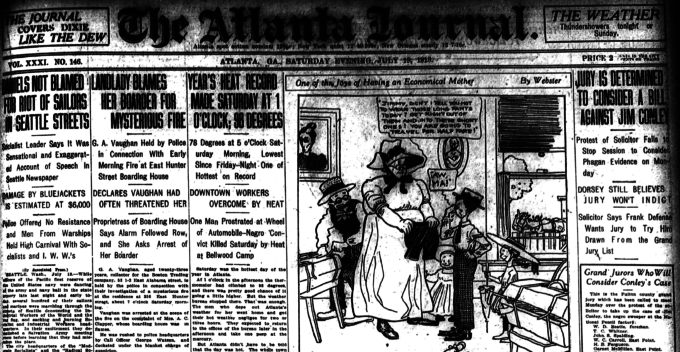
Jury Is Determined to Consider a Bill Against Jim Conley

Another in our series of new transcriptions of contemporary articles on the Leo Frank case.

The Atlanta Journal

Saturday, July 19, 1913

Protest of Solicitor Fails to Stop Session to Consider Phagan Evidence on Monday

DORSEY STILL BELIEVES JURY WON’T INDICT

Solicitor Says Frank Defense Wants Jury to Try Him Drawn From the Grand Jury List

Grand Jurors Who Will Consider Conley’s Case

This is the Fulton county grand jury which has been called to meet Monday over the protest of the solicitor to take up the case of Jim Conley, the negro sweeper at the National Pencil factory:
W.D. Beatie, foreman.
T.C. Whitner.
John S. Spalding.
W.C. Carroll, East Point.
H.B. Ferguson.
Garnet McMillan, East Point.
Edward H. Inman.
A.W. Farlinger.
M.A. Fall.
Julius M. Skinner.
Oscar Elsas.
George Bancroft.
W.H. Glenn.
S.E. McConnell.
Thomas J. Buchanan.
Sameuel A. Carson.
Eugene Oberdorfer.
A.Q. Adams.
W.O. Stamps.
W.T. Ashford.

There are only twenty citizens on the grand jury which has been called to meet Monday by Foreman W.D. Beattie to consider indicting James Conley, the negro sweeper, for the murder of Mary Phagan.

Continue Reading →

Natural Crank, Mayor’s Shot at Broyles

Another in our series of new transcriptions of contemporary articles on the Leo Frank case.

The Atlanta Georgian

Saturday, July 19, 1913

“Dyspeptic, Fanatic, Stoneheart, Monomaniac” Are Other Terms in “Final” Retort.

Mayor Woodward Saturday said he was finally dismissing Recorder Nash R. Broyles from his mind with the statement:

“He is a natural dyspeptic, crank and a fanatic. If he ever had a heart it was turned to stone. Therefore, it is natural that he should become a monomaniac over the subject of using his czar-like authority in his own petty sphere. I don’t care anything more about him.”

Mayor Woodward again went over the head of Recorder Broyles Friday when he reduced the sentence of George Poulos, a restaurant keeper on Alabama street, who had been fined $100 and sentenced to 30 days in the Stockade fo [sic] violating the prohibition law.

The Mayor said he was much surprised that the Recorder did not make the fine $49 and the sentence 29 days so as to stay outside the jurisdiction of the Mayor.

It was expected that Mayor Woodward would issue a full pardon but he didn’t. He just reduced the fine to $49 and the sentence to 29 days.

* * *

The Atlanta Georgian, July 19th 1913, “Natural Crank, Mayor’s Shot at Broyles,” Leo Frank case newspaper article series (Original PDF)

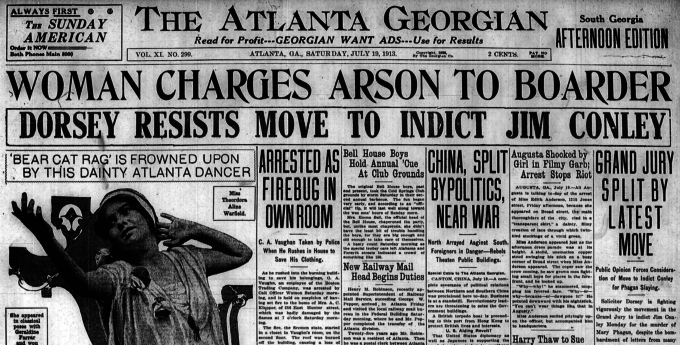
Dorsey Resists Move to Indict Jim Conley

Another in our series of new transcriptions of contemporary articles on the Leo Frank case.

The Atlanta Georgian

Saturday, July 19, 1913

GRAND JURY SPLIT BY LATEST MOVE

Public Opinion Forces Consideration of Move to Indict Conley for Phagan Slaying.

Solicitor Dorsey is fighting vigorously the movement in the Grand Jury to indict Jim Conley Monday for the murder of Mary Phagan, despite the bombardment of letters from many citizens and by the sentiment of some of its own members.

It is for the consideration of these letters and petitions, asking the reopening of the Phagan matter, that the meeting has been called. That it will result in the indictment of the negro is thought certain.

It was in the face of Solicitor Dorsey’s bitterest opposition that the meeting was called at all. Foreman Beattie issued his den [sic] after a previous Grand Jury had been defeated in its efforts to reopen the case with a view of indicting Jim Conley and after Dorsey explicitly had expressed his strongest disapproval of such a move.

Crucial Battle Coming.

Continue Reading →

Woodward Uses Clemency Again

Another in our series of new transcriptions of contemporary articles on the Leo Frank case.

The Atlanta Constitution

Saturday, July 19, 1913

Asserting That He Considers Recorder Mentally Irresponsible, the Mayor Announces Controversy Closed.

With the declaration that no utterance by Recorder Nash R. Broyles will induce him to resort to blackguardism or swerve him in the matter of exercising clemency, Mayor James G. Woodward yesterday reduced the sentence of George Poulas, a Greek retsaurant [sic] keeper, who was fined $100 or thirty days in the stockade for alleged violation of the near beer laws.

The extent of the mayor’s clemency was to reduce the fine assessed against Poulas to $49 or twenty-nine days in jail. Poulas was tried and convicted before W.H. Preston, acting recorder.

Considers Testimony Weak.

Mayor Woodward stated that his reason for pardoning Poulas was because the only witness against him was a 12-year-old negro boy.

“The testimony shows,” said the mayor, “that the negro boy had been in the employ of Poulas, and was discharged. By his own admission his testimony was biased and prejudiced, and hardly worthy of credit against the word of a white man.

V. Mazafladl, Greek consul, and a number of influential men of the Greek colony appeared before the mayor in behalf of Poulas, and made a strong plea for clemency.

Must Be Some Error.

Mayor Woodward said:

Continue Reading →

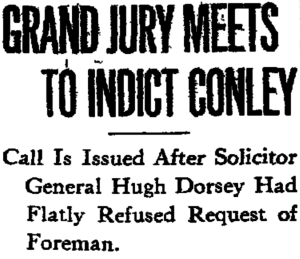
Grand Jury Meets to Indict Conley

Another in our series of new transcriptions of contemporary articles on the Leo Frank case.

The Atlanta Constitution

Saturday, July 19, 1913

Call Is Issued After Solicitor General Hugh Dorsey Had Flatly Refused Request of Foreman.

A call for the Fulton grand jury to meet at 10 o’clock Monday to take steps leading to the indictment of James Conley, the negro sweeper of the National Pencil factory who accuses Leo M. Frank, its superintendent, of the Mary Phagan murder was issued yesterday by Foreman W.D. Beatie [sic] after Solicitor General Hugh M. Dorsey had flatly refused the foreman’s request to call the meeting.

The move to indict Conley is wrong and should not be made, the solicitor told the grand jury foreman when discussing the matter with him and the call which went out was over the head of the state’s legal representative in Fulton county.

Smith Attacks Action

Continue Reading →

Scott Believes Conley Innocent, Asserts Lanford

Another in our series of new transcriptions of contemporary articles on the Leo Frank case.

The Atlanta Constitution

Saturday, July 19, 1913

Chief’s Statement Follows the Publication of Report That Pinkertons Are Now of the Opinion Sweeper Is Guilty.

“OPEN TO CONVICTION,” SCOTT TELLS REPORTER

“Our Testimony in Case Will Be Fair and Impartial,” He Says—Grand Jury Called to Consider Indicting Conley.

DEVELOPMENTS OF DAY IN MARY PHAGAN CASE

Meeting of grand jury called to take steps leading to indictment of James Conley on the charge of murder, over protest of Solicitor General Hugh Dorsey, who declares that indictment of Conley will be useless procedure.

Reported on Friday that the Pinkertons have changed their opinion in case, and now believe Conley guilty of murder, and Leo M. Frank innocent.

Harry Scott, field manager of Pinkertons, is denied permission to see Conley in his cell and subject him to quiz, although always allowed this privilege in past.

“Scott told me he still believes Conley innocent and Frank guilty,” says Chief of Detectives Lanford. “Pinkertons will give fair and impartial testimony at coming trial,” Scott tells Constitution. “Whether it affects Frank or the negro is no concern of ours; we were employed to find the murderer.”

“Conley is dealing fairly with the state of Georgia,” says his attorney, William M. Smith, in making attack on action of the grand jury.

That Harry Scott, field manager for the Pinkertons, came to police headquarters yesterday afternoon immediately following the publication of a story to the effect that the Pinkertons now believed in Conley’s guilt, and declared that he still held to the theory that the negro was innocent and Frank guilty, was the assertion made by Newport Lanford, chief of detectives, last night.

“Scott told me,” said the chief last night, “that there was no truth in the article so far as he personally was concerned, and that he continued firm in the belief that Conley was innocent.

“He has maintained throughout the investigation that Frank is guilty, and that Conley had nothing more to do with the crime than the complicity to which he confessed. He came to me Friday especially to deny the story.

Why Scott Was Barred.

Continue Reading →

Pinkertons Now Declare Leo M. Frank Is Innocent

Another in our series of new transcriptions of contemporary articles on the Leo Frank case.

The Atlanta Journal

Friday, July 18, 1913

*Editor’s Note: Small sections of text are missing due to scanning near a crease.

NOTED SLEUTHS WHO HAD ACCUSED FRANK NOW CHANGE THEORY

Harry Scott, Field Chief of the Pinkertons, Refuses to Discuss the Agency’s Change of Theory.

AGENTS HAVE WORKED ON CASE ALONG WITH POLICE

The Pinkertons Were Employed by the National Pencil Factory Immediately Following the Murder

That the Pikerton [sic] detectives, who for so many weeks held to the theory that Leo M. Frank is guilty of the Mary Phagan murder, now lay the crime to the door of Jim Conley, is a recent development of interest to the students of the murder mystery.

While Harry Scott, the field chief of the Pinkerton operatives, who have been working on the case practically from the first, employed by the National pencil factory to find Mary Phagan’s murderer, regardless of who the criminal might be, refuses to discuss the case, the Journal has learned from unquestioned authority that the theory of the Pinkertons has undergone a change.

Continue Reading →

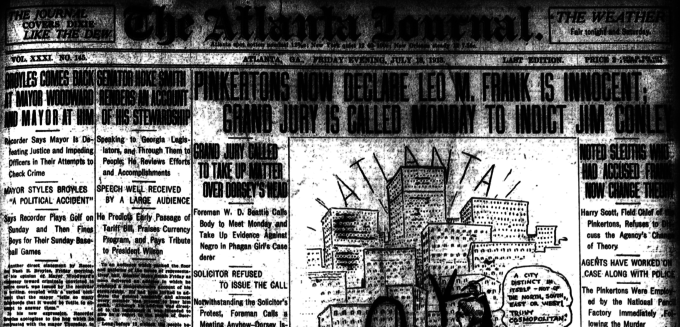
Grand Jury Is Called Monday to Indict Jim Conley

Another in our series of new transcriptions of contemporary articles on the Leo Frank case.

The Atlanta Journal

Friday, July 18, 1913

*Editor’s Note: Small sections of text are missing due to scanning near a crease.

GRAND JURY CALLED TO TAKE UP MATTER OVER DORSEY’S HEAD

Foreman W.D. Beattie Calls Body to Meet Monday and Take Up Evidence Against Negro in Phagan Girl’s Case derer [sic]

SOLICITOR REFUSED TO ISSUE THE CALL

Notwithstanding the Solicitor’s Protest, Foreman Calls a Meeting Anyhow—Dorsey Issues a Statement

Over the vigorous protest of Solicitor General Hugh M. Dorsey, the foreman of the grand jury has called a meeting for Monday for the specific purpose of considering an indictment against James Conley, the negro sweeper, who claims that he assisted Superintendent Leo M. Frank in disposing of the body of Mary Phagan, after she had been murdered in the National pencil factory on April 26.

The solictior [sic] general was approached Friday morning by W. D. Beattie, real estate dealer, who is the foreman of the present jury. Mr. Beattie asked Mr. Dorsey to call a meeting of the jury, and the solicitor flatly refused. Then Mr. Beattie informed the county’s highest prosecuting official that he, as foreman of the grand jury, would call the body together to consider the Conley [m]atter.

After the conference Solicitor Dorsey authorized one of the few statements which he has made since he took up the Phagan case. He said that he told Mr. Beattie that the move to indict Conley was […] should not be […]

“Its only purpose,” the solicitor said, “will be to exploit the evidence and embarrass the state, and I hope the grand jury when it meets will decide to leave the matter alone.

“The indictment of Conley at this time will be a useless procedure that will not stop the trial of Frank. It will only have a mild, but undesirable effect on the state’s case.

“Conley is in jail and is going to stay there for some time. He is where the authorities can put their hands on him, and he can be indicted much more properly after the Frank case has been disposed of than before, and by the delay there is no danger of a miscarriage of justice.”

It has long been known that the defense of Frank will be in a measure the prosecution of Conley, and naturally it is of importance to the defense to have the man it will accuse under a grand jury indictment.

AS THE MURDERER.

Continue Reading →

Broyles Comes Back at Mayor Woodward and Mayor at Him

Another in our series of new transcriptions of contemporary articles on the Leo Frank case.

The Atlanta Journal

Friday, July 18, 1913

*Editor’s Note: Small sections of text are missing due to scanning near a crease.

Recorder Says Mayor Is Defeating Justice and Impeding Officers in Their Attempts to Check Crime

MAYOR STYLES BROYLES “A POLITICAL ACCIDENT”

Says Recorder Plays Golf on Sunday and Then Fines Boys for Their Sunday Baseball Games

Another direct statement by Recorder Nash R. Broyles, Friday morning, of his opinion of Mayor Woodward’s clemency toward criminals convicted in police court, was issued by the recorder in writing, coupled with a verbal comment that the mayor “tells so many falsehoods that it would be futile to attempt to answer them.”

In his new expression, Recorder Broyles apologizes to the hog which he contrasted with the mayor Thursday, in [which he] says that the mayor knows less about law than a hog does about political economy.

Following is the recorder’s written statement:

“I care nothing for the mayor’s abuse. Condemnation from such a character should be considered praise. But when he says that the court of appeals on May 23, 1913, reversed me in ten cases and sustained me in seven, he tells such a ridiculous and absurd falsehood that I now apologize to the hog to which I referred yesterday when I said that the mayor knows less about law than the hog knows about economy.

“The idea of the court of appeals passing in one day on seventeen cases appealed from the recorder’s court of Atlanta! The records of that court will show that on the average there are not seventeen cases a year carried from my court to the court of appeals, and they will show also that that court has sustained me in ten cases where it has reversed me in one.

“But the mayor is, as usual, trying to side-step the issue between us. That issue is not my ability as a lawyer or a judge. I am content to let my record speak for me. The issue is that the mayor, in protecting and pardoning the […] criminals of […] and defeating justice in our courts and impeding the officers of the law in their attempt to check crime in our city; and that is the issue on which the people at the next election will call him to account.”

WHAT MAYOR SAYS.

Continue Reading →

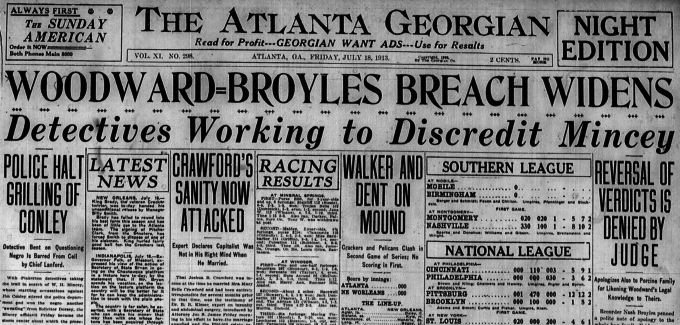
Woodward-Broyles Breach Widens

Another in our series of new transcriptions of contemporary articles on the Leo Frank case.

The Atlanta Georgian

Friday, July 18, 1913

REVERSAL OF VERDICTS IS DENIED BY JUDGE

Apologizes Also to Porcine Family for Likening Woodward’s Legal Knowledge to Theirs.

Recorder Nash Broyles penned a polite note of apology to the whole hog family Friday.

With the same hand he picked up the cudgels with which again to belabor his honor, Mayor Woodward.

The Mayor, quoth the recorder, was the author of a ridiculous and absurd falsehood and it was a regrettable libel upon Mr.Hog to have to submit to a comparison with Atlanta’s Mayor.

As for the Mayor, he declared he was tired of wasting verbiage on the Recorder and that he would have nothing more to say in their quarrel. He intimated, however, that he had it in his mind to override the Recorder again by pardoning another prisoner.

Here are Recorder Broyles’ comments on the Mayor:

Continue Reading →

Detectives Working to Discredit Mincey

Another in our series of new transcriptions of contemporary articles on the Leo Frank case.

The Atlanta Georgian

Friday, July 18, 1913

POLICE HALT GRILLING OF CONLEY

Detective Bent on Questioning Negro Is Barred From Cell by Chief Lanford.

With Pinkerton detectives taking the trail in search of W.H. Mincey, whose startling accusations against Jim Conley stirred the police department and won the negro another “sweating” from Solicitor Dorsey, the Mincey affidavit Friday became the storm center about which the prosecution and defense in the Frank case waged their battle.

Despite the degree of indifference with which the detectives and prosecuting officials affected to look upon the remarkable statements of Mincey, it became known Friday that every effort was being bent toward locating him and turning the light on his past history.

Pinkertons Have Clew.

Continue Reading →

Many Rumors Afloat Regarding Grand Jury

Another in our series of new transcriptions of contemporary articles on the Leo Frank case.

The Atlanta Constitution

Friday, July 18, 1913

Among These Is One That Effort Will Be Made to Indict Conley.

That the grand jury would meet possibly today or tomorrow and take steps toward indicting James Conley, the negro sweeper of the National Pencil factory, was a persistent rumor in circulation Thursday. From Foreman W.D. Beattie came the statement that he had not called for a meeting of the grand jury and that as far as he knew there would be no such action taken. Solicitor Hugh M. Dorsey also declared that he had issued no call for the grand jury and knew nothing of any such action.

“I have not issued a call for a meeting,” explained Mr. Beattie, “and as far as I am concerned the grand jury will not take steps to indict Conley. Of course, the members of the grand jury have the right to come together and to take any steps they may desire, and I am speaking only for myself in saying that no steps will be taken to start an investigation of Conley’s alleged connection.”

“There is nothing new in the Mary Phagan murder case, as far as I know,” said the solicitor, “and I have issued no call for the grand jury. The state is continuing its work and will be ready on July 28 for the trial of Leo M. Frank.”

Attorneys Reuben R. Arnold and Luther Z. Rosser held a consultation Thursday afternoon in Mr. Arnold’s office at which they discussed the phases of their case, according to Mr. Arnold. At the courthouse it was said that Judge L.S. Roan, who is due to preside over the Frank trial, was in consultation with lawyers on both sides and that there was a possibility of the case being postponed.

Both Solicitor Dowrsey [sic] and Attorney Arnold denied this, and Attorney Arnold stated that the only consultation was that between him and Mr. Rosser.

* * *

The Atlanta Constitution, July 18th 1913, “Many Rumors Afloat Regarding Grand Jury,” Leo Frank case newspaper article series (Original PDF)

Wordy War Over, Says Woodward

Another in our series of new transcriptions of contemporary articles on the Leo Frank case.

The Atlanta Constitution

Friday, July 18, 1913

In Final Fling at Broyles the Mayor Declares He Is Through With Controversies With City Officials.

The word war raging between Mayor James G. Woodward and Judge Nash R. Broyles, police magistrate, which grew out of the mayor’s use of the pardon prerogative, grew tense yesterday, when both sides hurled bitter excoriations at the other.

Mayor Woodward took a final fling at Recorder Broyles in a statement last night.

“I sympathize with Broyles,” Mayor Woodward said. “He is, in my opinion, a political accident. No one takes him seriously. He is mad with the courts for reversing him, and he is trying to take it all out on me. Really, I am sorry for the fellow.”

The mayor announced that he is through with controversies with any city officer. He stated that in the future he will welcome criticism when it is made to him, face to face.

“And when I have anything to say to Judge Broyles I’ll tell it to him.”

What Each Thinks of Other.

Both Mayor Woodward and Recorder Broyles burned up a choice collection of adjectives in their debates in the newspapers Thursday.

“He’s ignorant.

“He knows about as much of law as a hog does of political economy.

“He’s a menace to civilization.”

Those are some of the harsh things Recorder Broyles said about the mayor.

And—

Continue Reading →