Mrs. Wardlaw Denies Ever Seeing Frank on Car With Little Girl

Another in our series of new transcriptions of contemporary articles on the Leo Frank case.

Atlanta Constitution
August 19th, 1913

When Mrs. J. G. Wardlaw, a bride of three weeks, who was Miss Lula McDonald, recently worked at the National Pencil factory, was on the stand, Solicitor Hugh Dorsey sought to draw from her the statement that she knew that on the Saturday previous to Mary Phagan’s murder that Leo Frank had carried a little girl out on the Hapeville car line and tried to get her to leave the car with him at various stops.

He also tried to get the witness to say that she knew that on his occasion H. M. Baker and Herndon Stanton, the street car men in charge of the car, had noted the man’s actions.

Mrs. Wardlaw declared she had no knowledge of anything like that and she declared that she had never even heard of any immoral or improper actions on the part of Frank. She was then excused.

* * *

Atlanta Constitution, August 19th 1913, “Mrs. Wardlaw Denies Ever Seeing Frank on Car With Little Girl,” Leo Frank case newspaper article series (Original PDF)

Arnold Ridicules Plot Alleged by Prosecution And Attacks the Methods Used by Detective

Another in our series of new transcriptions of contemporary articles on the Leo Frank case.

Atlanta Constitution
August 22nd, 1913

When Attorney Frank A. Hooper had made the opening speech of the prosecution, Attorney Reuben R. Arnold prepared for the first speech of the defense. It had been announced that he would review the entire history of the case and when he started at noon the pasteboard model of the pencil factory was brought In.

A large diagram giving a synopsis of the case was also brought in, but was not unwrapped when Mr. Arnold first started, “Gentlemen of the fury, we are all to be congratulated that this case is drawing to a close,” Mr. Arnold began in a quiet voice as though addressing several friends on an everyday subject.

“We have all suffered here from trying a long and complicated case at the heated term of the year. It’s been a case that has taken as much effort and so much concentration and so much time, and the quarters here are so poor.

Particularly hard on you members of the jury who are practically in custody while the case is going on.

“I know it’s hard on a jury to be kept confined this way, but it is necessary that they be segregated and set apart where they will get no impression at home nor on the street.

Continue Reading →

Police Think Negro Watchman Can Clear Murder Mystery; Four Are Now Under Arrest

Police Think Negro Watchman Can Clear Mystery 1

Mary Phagan [Interestingly, according to testimony given before the Coroner’s Jury by Mary’s boy sweetheart, George W. Epps, Mary had requested that George walk her home from the factory after work a few days before the murder as the superintendent, Leo M. Frank, had a habit of watching for her from the front door, looking suspicious, and winking at her. — Ed.]

Another in our series of new transcriptions of contemporary articles on the Leo Frank case.

Atlanta Journal

Monday, April 28th, 1913

Developments in Case Have Come Thick and Fast Monday but No Evidence Has Yet Been Developed Which Fixes the Atrocious Crime — Mullinax Seems to Have Proved Alibi

SUPERINTENDENT FRANK AIDS POLICE IN TRYING TO SOLVE THE MYSTERY

He Was Closely Questioned for Several Hours Monday but Left Headquarters in Company With His Attorneys and Friends—Crime Was Committed in Metal Room on Second Floor—Sleeping Compartment Found in Factory Basement

Detectives expect to wring the secret of Mary Phagan’s murder from Newt Lee, negro night watchman at the National Pencil factory, 37-39 South Forsyth street.

Their theory is that he is innocent of the crime itself, but that he knows the murderer of the fourteen-year-old girl, and is shielding the man who strangled Mary Phagan with a piece of hempen cord on Saturday and dragged her body into the pitch black cellar of the factory.

The negro will tell nothing, but from him and from J. M. Gantt, the discharged bookkeeper, detectives expect to draw the story of how Mary Phagan was beaten into unconsciousness, assaulted, and then strangled to death.

FOUR ARE UNDER ARREST.

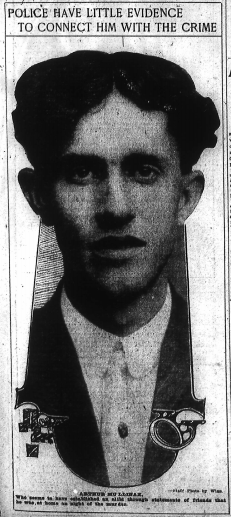
Four men are under arrest: Lee, the negro night watchman; Gantt, who was discharged three weeks ago by the company; Arthur Mullinax, of 62 Poplar street, and Gordon Bailey, a negro elevator boy at the pencil factory.

L. M. Frank, superintendent of the pencil factory, was questioned by the police, and spent the better part of Monday morning at [the] police station. But he was not placed under arrest, and at noon returned home.

An alibi has practically been established for Mullinax by Jim Rutherford, with whom he boarded, and the police have no direct evidence against Gordon Bailey, the elevator boy. Continue Reading →

Negro Watchman Tells Story of Finding Girl’s Body and Questions Fail to Shake Him

Negro Watchman Tells Story of Finding Girl's Body and Questions Fail to Shake Him

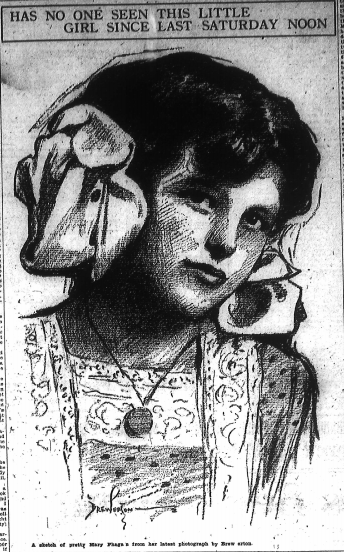
A sketch of pretty Mary Phagan from her latest photograph by Brewerton.

Another in our series of new transcriptions of contemporary articles on the Leo Frank case.

Atlanta Journal

Wednesday April 30th, 1913

Newt Lee, Negro Who Notified Police of Mary Phagan Murder, Tells Coroner Girl’s Body Was Lying Face Up With Head Toward West When He Found It — But Officers Declare They Found It Lying Face Down, Head Toward East, Knew She Was White, Said He, by Her Hair

SAYS MR. FRANK DID UNUSUAL THINGS, BUT DOES NOT DIRECTLY IMPLICATE ANYONE

Mr. Frank Met Him Outside Office Saturday Afternoon and Let Him Off for Two Hours, After Having Insisted That He Be There at 4 o’Clock—Mr. Frank Was Scared When He Saw Gantt, Says Negro—Telephoned Him That Night for First Time—Inquest Resumed at 2:15

That he found the body of Mary Phagan face up with its head toward the back of the building, was the startling evidence given at the coroner’s inquest Wednesday morning by Newt Lee, the negro night watchman at the National Pencil factory in which the child was murdered.

This evidence, by which the negro has stuck without wavering is in direct conflict with the evidence of all the police officers and others who answered the negro’s alarm. Continue Reading →

Three Handwriting Experts Say Negro Wrote the Two Notes Found by Body of Girl

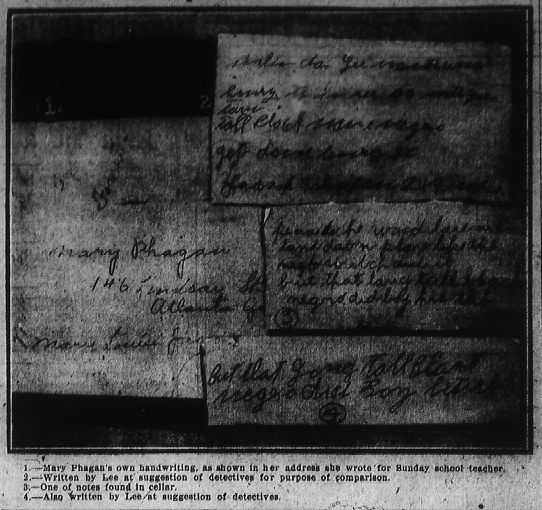
At the top is a photograph of writing done by Newt Lee, the negro night watchman after his arrest. At the bottom is a photograph of two lines of a note found beside the body of Mary Phagan in the pencil factory cellar. Three handwriting experts—Frank M. Berry, assistant cashier of the Fourth National bank; Andrew M. Bergstrom, assistant cashier of the Third National bank and

At the top is a photograph of writing done by Newt Lee, the negro night watchman after his arrest. At the bottom is a photograph of two lines of a note found beside the body of Mary Phagan in the pencil factory cellar. Three handwriting experts—Frank M. Berry, assistant cashier of the Fourth National bank; Andrew M. Bergstrom, assistant cashier of the Third National bank and Pope O. Driver, chief bookkeeper and head of mail departments, of the American National bank, unhesitatingly declare that the same hand penned them both. Detectives are satisfied that Lee knows all about the killing of the girl. The only question in their minds is whether he is alone involved.

Another in our series of new transcriptions of contemporary articles on the Leo Frank case.

Atlanta Journal

Tuesday, April 29th, 1913

Frank M. Berry, of the Fourth National Bank, Andrew M. Bergstrom of Third National, and Pope C. Driver, of the American National, Examined Notes at Journal’s Request And Found Same Person Wrote Both

ALL THREE ARE EXPERTS AND MADE MICROSCOPICAL EXAMINATIONS

Their Investigation Shows He Wrote Both Notes and Seems to Prove Conclusively That Either the Negro Committed the Crime or Knows Who the Guilty Party Is

Through its own investigations The Atlanta Journal has proven conclusively that Newt Lee, the negro night watchman for the National Pencil company, either himself mistreated and murdered pretty Mary Phagan, or that he knows who committed the crime and is assisting the perpetrator to conceal his identity. Continue Reading →

L. M. Frank, Factory Superintendent, Detained By Police

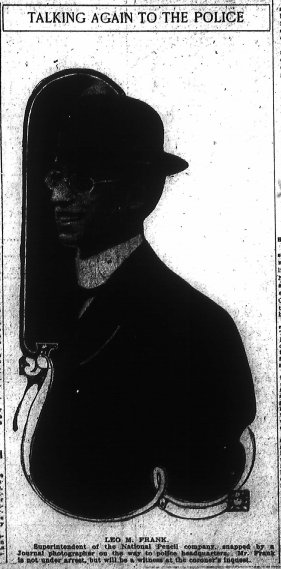
Leo M. Frank. Superintendent of the National Pencil company, snapped by a Journal photographer on the way to police headquarters. Mr. Frank is not under arrest, but will be a witness at the coroner's inquest.

Leo M. Frank. Superintendent of the National Pencil company, snapped by a Journal photographer on the way to police headquarters. Mr. Frank is not under arrest, but will be a witness at the coroner’s inquest.

Another in our series of new transcriptions of contemporary articles on the Leo Frank case.

Atlanta Journal

Tuesday, April 29th, 1913

Detectives Building Case on Theory that Frank and Negro Can Clear Mystery

Chief Lanford Believes That Testimony of the Superintendent and Negro Night Watchman May Lead to the Arrest of the Person Guilty of the Atrocious Crime That Has Shocked the Whole City—No Further Arrests Expected Soon

MRS. FRANK IN TEARS AT POLICE STATION WHILE HUSBAND IS UNDER EXAMINATION

Frank Was Confronted by Negro Night Watchman—His Attorney, Luther Z. Rosser, Present at Inquiry, Which Was Conducted by Chief Beavers, Chief Lanford and Detectives Behind Closed Doors—Conference Still in Progress at 2

At 1:35 o’clock Tuesday afternoon Chief of Detectives N. A. Lanford, announced that L. M. Frank, superintendent of the National Pencil company’s factory, where Mary Phagan was found murdered early Sunday morning, would be detained by the police until after the coroner’s inquest. The inquest will be resumed Wednesday morning at 9 o’clock.

Chief Lanford made this statement when he emerged from a conference which had been in progress in his office on the third floor of the police station since shortly after 1 o’clock. Continue Reading →

Denies He Said He Was Willing To Lead Party to Lynch Frank

Another in our series of new transcriptions of contemporary articles on the Leo Frank case.

Atlanta Constitution
August 20th, 1913

George Kenley, a street car motorman, was put on the stand after M. F. McCoy, and on cross-examination Attorney Rosser tried to draw from him the statements that he had vilified Leo Frank to such an extent that he had made himself a nuisance to passengers on his car, and that he had repeatedly said he would be willing to head a party to lynch Frank.

Kenley was put up by the state and swore that he saw Mary Phagan on Forsyth street near the bridge, and that she was on her way to the factory. He said it was a few minutes after noon, but that he could not be positive. He was subjected to a grilling even more severe than given to McCoy.

After he had testified to seeing the girl he was turned over to the tender mercies of Mr. Rosser.

Continue Reading →

Dr. Clarence Johnson Is Called To Corroborate Dr. Roy Harris

Another in our series of new transcriptions of contemporary articles on the Leo Frank case.

Atlanta Constitution
August 20th, 1913

Dr. Clarence Johnson, a well-known specialist, who was put up by the prosecution in rebuttal of the testimony offered by the defense in attacking that of Dr. Roy Harris, was the final witness during the afternoon session.

His testimony was stopped in the middle of its narration in order to give the solicitor time to investigate authorities on a medical subject on which Mr. Dorsey was questioning the witness at the time a discussion arose between the prosecution and defense.

“What is your business?” he was asked by the solicitor.

“I am a practitioner of medicine, with a specialty of stomach diseases.”

Continue Reading →

Saw Mary Phagan on Her Way To Pencil Factory, Says McCoy

Another in our series of new transcriptions of contemporary articles on the Leo Frank case.

Atlanta Constitution
August 20th, 1913

M. E. McCoy, of Bolton, who stated that he worked part of the time as a painter and part as a farmer, was put on the stand after McEwen, the motorman. He swore that he saw Mary Phagan on Forsyth street going to the National Pencil factory at a very few minutes after the noon hour of the day she was killed.

Before he had left the stand the defense had made a bitter but unsuccessful effort to break him down and confuse him and Attorney Rosser had asked him something like a hundred questions about the days before he saw the girl.

“Did you know Mary Phagan?” asked Dorsey.

“Yes.”

“Did you see her on April 26, Iast?”

“Yes.”

“Where?”

Continue Reading →

Sideboard in Leo Frank’s Home Moved, Asserts Husband of Cook

Another in our series of new transcriptions of contemporary articles on the Leo Frank case.

Atlanta Constitution
August 20th, 1913

Albert McKnight, husband of Minola McKnight, the negro cook for the family of Emil Selig, with whom Leo Frank and his wife made their home, was introduced to the stand following E. H. Pickett.

Mr. Hooper drew from the negro the statement that since the day he stood in the kitchen door and saw Leo Frank’s reflection in the dining room sideboard glass that the sideboard had been moved.

The negro was made to go over a blue print diagram of the Selig home and show what he claimed was the location of the sideboard on the day of the murder and at the time he claims he saw that Frank ate po dinner and remained only a few minutes at the dinner table.

Continue Reading →

Witness Swears He Saw Frank Forcing Unwelcome Attentions Upon the Little Phagan Girl

Another in our series of new transcriptions of contemporary articles on the Leo Frank case.

Atlanta Constitution
August 20th, 1913

The most sensational testimony of the entire morning session was produced when Willie Turner, a young farmer of Sandy Springs, Georgia, an ex-employee of the pencil factory, was called by the prosecution.

He testified that Frank knew Mary Phagan, and that on one occasion he had seen the superintendent and the victim in the metal room, when the girl was striving to get away from him and return to her work.

He was questioned directly by the solicitor.

“Where did you work in March, 1913?”

“National Pencil factory.”

“Did you know Leo Frank?”

“Yes, sir.”

“Did you know Mary Phagan?”

“Yes, sir.”

Continue Reading →

Frank Hooper Opens Argument In Leo Frank Case This Morning

Another in our series of new transcriptions of contemporary articles on the Leo Frank case.

Atlanta Constitution
August 21st, 1913

The opening argument in the Frank trial will be made at 9 o’clock this morning by Attorney Frank B. Hooper, associate counsel for the defense.

Two hours probably will be occupied by each man in the closing arguments. Judge Roan, in a short talk to the attorneys for each side, cautioned them against long argument, and insisted that each man dwell only on the facts of the case and the evidence.

No time limit was set, although the prediction is widespread that no more than two hours will be occupied by each man.

* * *

Frank A. Hooper’s Closing Arguments: https://leofrank.info/trial-and-evidence/prosecution/mr-hooper/

Audiobook of Hooper’s Closing Arguments: https://leofrank.info/new-audio-book-the-american-mercury-on-leo-frank-hoopers-closing-arguments/

* * *

Atlanta Constitution, August 21st 1913, “Frank Hooper Opens Argument in Leo Frank Case This Morning,” Leo Frank case newspaper article series (Original PDF)

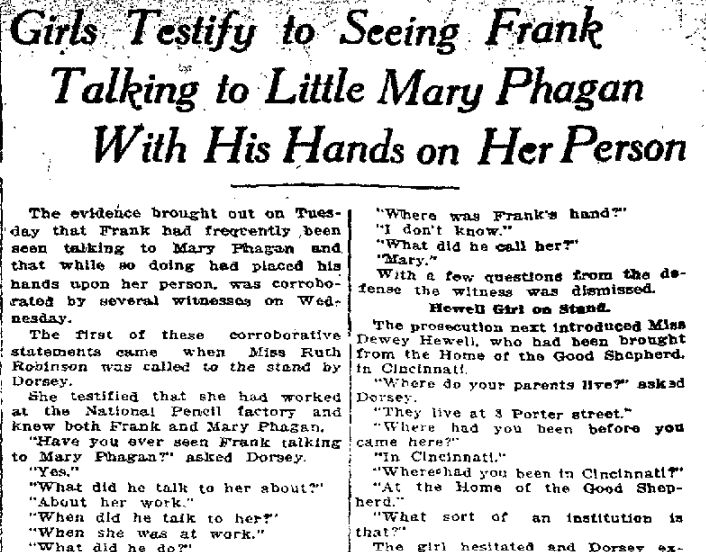
Girls Testify to Seeing Frank Talking to Little Mary Phagan With His Hands on Her Person

Another in our series of new transcriptions of contemporary articles on the Leo Frank case.

Atlanta Constitution
August 21st, 1913

The evidence brought out on Tuesday that Frank had frequently been seen talking to Mary Phagan and that while so doing had placed his hands upon her person, was corroborated by several witnesses on Wednesday.

The first of these corroborative statements came when Miss Ruth Robinson was called to the stand by Dorsey.

She testified that she had worked at the National Pencil factory and knew both Frank and Mary Phagan.

“Have you ever seen Frank talking to Mary Phagan?” asked Dorsey.

“Yes.”

“What did he talk to her about?”

“About her work.”

“When did he talk to her?”

Continue Reading →

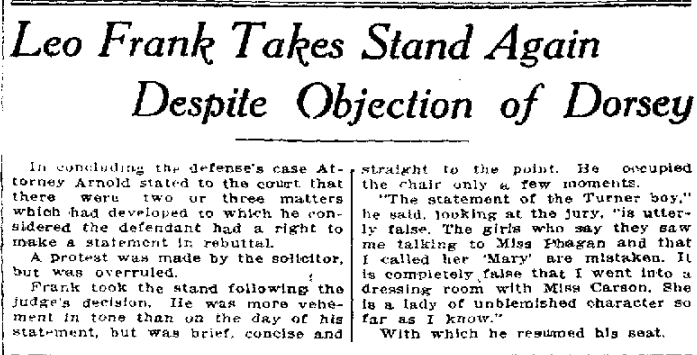
Leo Frank Takes Stand Again Despite Objection of Dorsey

Another in our series of new transcriptions of contemporary articles on the Leo Frank case.

Atlanta Constitution
August 21st, 1913

In concluding the defense’s case Attorney Arnold stated to the court that there were two or three matters which had developed to which he considered the defendant had a right to make a statement in rebuttal.

A protest was made by the solicitor, but was overruled.

Frank took the stand following the judge’s decision. He was more vehement in tone than on the day of his statement, but was brief, concise and straight to the point. Ha occupied the chair only a few moments.

“The statement of the Turner boy,” he said, looking at the jury, “is utterly false. The girls who say they saw me talking to Miss Phagan and that I called her ‘Mary’ are mistaken. It is completely false that I went into a dressing room with Miss Carson. She is a lady of unblemished character so far as I know.”

With which he resumed his seat.

* * *

Atlanta Constitution, August 21st 1913, “Leo Frank Takes Stand Again Despite Objection of Dorsey,” Leo Frank case newspaper article series (Original PDF)

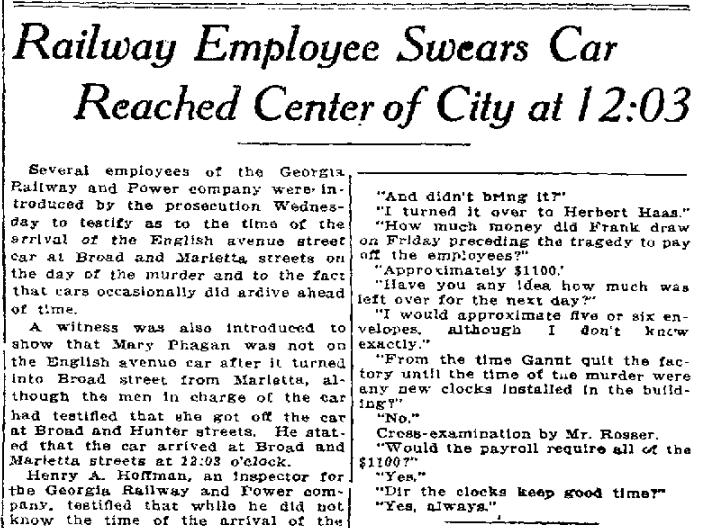
Railway Employee Swears Car Reached Center of City at 12:03

Another in our series of new transcriptions of contemporary articles on the Leo Frank case.

Atlanta Constitution
August 21st, 1913

Several employees of the Georgia Railway and Power company were introduced by the prosecution Wednesday to testify as to the time of the arrival of the English avenue street car at Broad and Marietta streets on the day of the murder and to the fact that cars occasionally did arrive ahead of time.

A witness was also introduced to show that Mary Phagan was not on the English avenue car after it turned into Broad street from Marietta, although the men in charge of the car had testified that she got off the car at Broad and Hunter streets. He stated that the car arrived at Broad and Marietta streets at 12:03 o’clock.

Henry A. Hoffman, an inspector for the Georgia Railway and Power company, testified that while he did not know the time of the arrival of the car that Mary Phagan was on on the day of the murder, he did know that the same car on other occasions had come in ahead of scheduled time.

Motorman Mathews of the English avenue car, hand testified that the car was due to arrive at Broad and Marietta streets at 12:07½. Inspector Hoffman testified that there was no such schedule and that the car was due to arrive at 12:07 sharp.

Continue Reading →

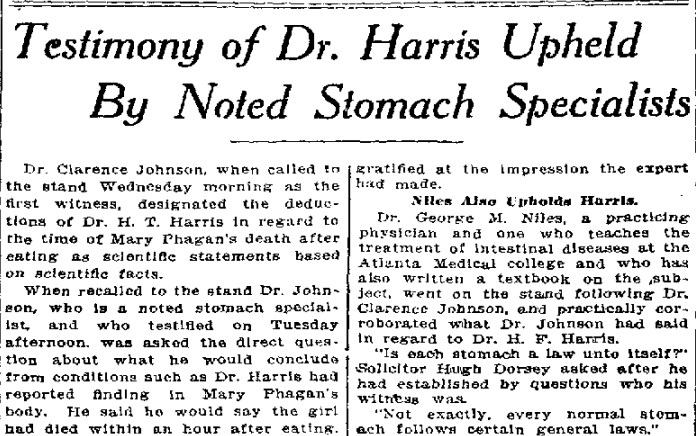
Testimony of Dr. Harris Upheld By Noted Stomach Specialists

Another in our series of new transcriptions of contemporary articles on the Leo Frank case.

Atlanta Constitution
August 21st, 1913

Dr. Clarence Johnson, when called to the stand Wednesday morning as the first witness, designated the deductions of Dr. H. T. Harris in regard to the time of Mary Phagan’s death after eating as scientific statements based on scientific facts.

When recalled to the stand Dr. Johnson, who is a noted stomach specialist, and who testified on Tuesday afternoon, was asked the direct question about what he would conclude from conditions such as Dr. Harris had reported finding in Mary Phagan’s body. He said he would say the girl had died within an hour after eating.

It was not until Solicitor Hugh Dorsey had made a bitter fight that Judge L. S. Roan allowed him to ask Dr. Johnson the particular question which bolstered up Dr. Harris, and when the trial judge granted it he stated that it was not a right of the state’s, but that the matter was at his discretion, and that he was giving the solicitor the benefit of it.

The defense claimed that to allow Dr. Johnson to tell what he thought of the Harris deductions would be to open the entire matter, and the solicitor declared that he had the right to reply to the attack the defense had made on Dr. Harris.

Continue Reading →

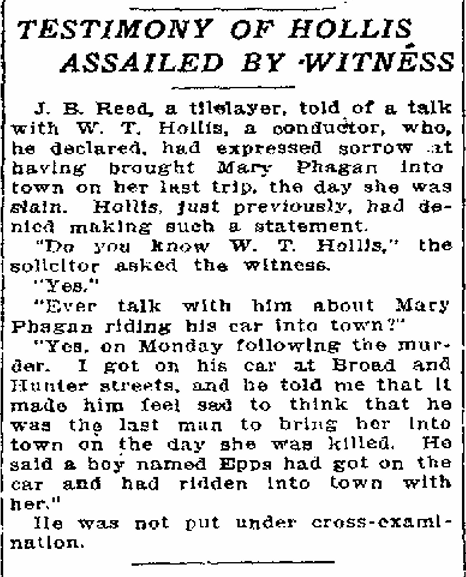
Testimony of Hollis Assailed by Witness

Another in our series of new transcriptions of contemporary articles on the Leo Frank case.

Atlanta Constitution
August 21st, 1913

J. B. Reed, a tilelayer, told of a talk with W. T. Hollis, a conductor, who, he declared, had expressed sorrow at having brought Mary Phagan into town on her last trip, the day she was slain. Hollis, just previously, had denied making such a statement.

“Do you know W. T. Hollis,” the solicitor asked the witness.

“Yes.”

“Ever talk with him about Mary Phagan riding his car into town?”

“Yes, on Monday following the murder. I got on his car at Broad and Hunter streets, and he told me that it made him feel sad to think that he was the last man to bring her into town on the day she was killed. He said a boy named Epps had got on the car and had ridden into town with her.”

He was not put under cross-examination.

HE SAW DALTON ENTER FACTORY WITH WOMEN

A mild sensation was sprung in the courtroom when D. B. Maynard, a salesman for the Swift company, went to the stand, testifying that he had seen C. B. Dalton go into the pencil plant on Saturday afternoons with women.

“When did you see Dalton go into the factory with a woman?” he was asked by Dorsey.

“In July, 1912, on Saturday afternoon,” was his reply.

* * *

Atlanta Constitution, August 21st 1913, “Testimony of Hollis Assailed by Witness,” Leo Frank case newspaper article series (Original PDF)

Starnes Tells How Affidavit From Negro Cook Was Secured

Another in our series of new transcriptions of contemporary articles on the Leo Frank case.

Atlanta Constitution
August 21st, 1913

John Starnes, prosecutor of Leo Frank, was put up to tell about the Minola McKnight affidavit.

“Did you Investigate the scuttle hole around the elevator? was Dorsey’s first question.

An objection by the defense was overruled.

“See any blood spots there?

“No.”

“Now, tell the jury about the Minola McKnight affidavit.”

Continue Reading →

Swears That Frank Prepared Sheets in Less Than Two Hours

Another in our series of new transcriptions of contemporary articles on the Leo Frank case.

Atlanta Constitution
August 21st, 1913

J. M. Gantt, who has been an important figure in the state’s case, was called during the afternoon to testify to the length of time in which he has seen Frank make out the financial sheet and to the inaccuracy of the ‘punch-clock on the second floor.

“Did you ever see Frank make out the financial sheet?” Mr. Dorsey put.

“Yes.”

“How long did it take him to make it?”

“With the data at hand, I have seen him make it out in an hour and a half.”

“About this punch-clock-—was it accurate?”

“No.”

Continue Reading →

Girls Testify to Seeing Frank Enter Dressing Room With Woman

Another in our series of new transcriptions of contemporary articles on the Leo Frank case.

Atlanta Constitution
August 21st, 1913

Following the introduction of the telegram Solicitor Hugh Dorsey began another attack on the character of Leo Frank and after a bitter wrangle secured the right to ask factory girls in regard to Frank’s character in his relations to women.

This was argued with the jury excused from the room and was the subject of a bitter fight, the state saying that when Frank on the stand had claimed himself to have always lived a virtuous life, he had opened up the way for the state to prove he was not of a virtuous character.

Judge Roan had already ruled that the state could not introduce witnesses said by the solicitor to be prepared to swear that Frank had made improper proposals to them and that this was about the same thing. Solicitor Dorsey argued that it was not and finally got the ruling in his favor. The defense entered a formal protest and had it go on record.

Continue Reading →