
Another in our series of new transcriptions of contemporary articles on the Leo Frank case.
Atlanta Journal
August 17th, 1913
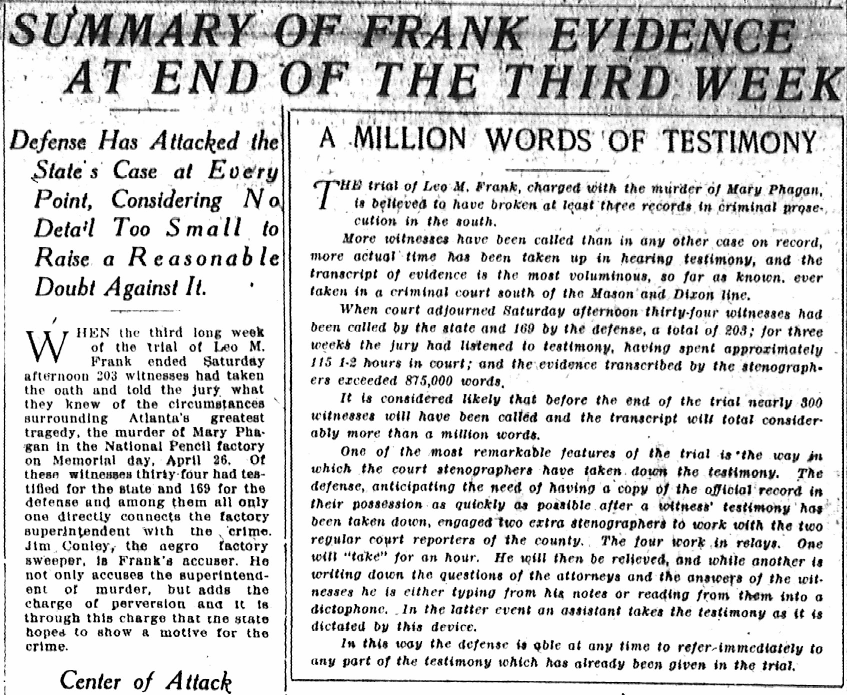
Defense Has Attacked the State’s Case at Every Point, Considering No Detail Too Small to Raise a Reasonable Doubt Against It.
When the third long week of the trial of Leo M. Frank ended Saturday afternoon 203 witnesses had taken the oath and told the jury what they knew of the circumstances surrounding Atlanta’s greatest tragedy, the murder of Mary Phagan in the National Pencil factory on Memorial day, April 26. Of these witnesses thirty-four had testified for the state and 169 for the defense and among them all only one directly connects the factory superintendent with the crime. Jim Conley, the negro factory sweeper, is Frank’s accuser. He not only accuses the superintendent of murder, but adds the charge of perversion and it is through this charge that the state hopes to show a motive for the crime.
Center of Attack
Much of the most determined work done by the defense during the third week, just finished, has been concentrated upon the testimony given by H. F. Harris, secretary of the state board of health, and upon the testimony of C. B. Dalton, both of whom were introduced by the prosecution.
In attacking Dr. Harris’ testimony, the defense introduced several physicians who characterized Dr. Harris’ conclusion as guesses and said that they attached no importance to them and believed them to be without scientific foundation. It will be remembered that Dr. Harris’ testimony fixed the time of Mary Phagan’s death, in the opinino of the witness, at not more than 45 minutes after she ate her last meal of cabbage and bread at home and started for town to meet her death. This was based upon the stage of digestion attained by the contents of her stomach and arrested by death.
Dr. Harris testified further regarding other details which had convinced him that violence of some nature was inflicted upon the girl, and that she was rendered unconscious from the blow upon the back of her head, being choked to death later by cord around her neck. The defense assailed each of the conclusions, combating most vigorously the one that Mary Phagan was killed within a specified number of minutes after her last meal.
Witnesses from Walton county were introduced one after another to swear that they know C. B. Dalton and that they would not believe him on oath. Dalton’s own experiences with the criminal law were revealed, the defense lawyers securing his admissions of them. Dalton’s testimony was menacing to the defense because it purported to corroborate in incidental particulars the general story told by Jim Conley—whose evidence is the center of the whole attack by the defense.
Points at Issue
The state has sought to prove that Mary Phagan met her death in the metal room on the second floor of the pencil factory before 1 o’clock on April 26.
The defense has sought to refute this with testimony that it is impossible to determine the hour in which the girl died, and that there are chances that she met her death in another part of the building.
The state clings to the theory that the girl was struck on the head, rendered unconscious by falling against a piece of machinery, then was strangled to death by a cord.
The defense has put its witnesses up to testify that the wound on the back of the dead girl’s head may not have caused unconsciousness and that the manner in which she met death is a question which possibly no physician can answer correctly.
The state has sought to prove that Frank was the last person to see the girl alive. So far nothing has developed in the trial to show that the girl was seen after she drew her pay from the factory superintendent.
By the testimony of Monteen Stover, who swore that she found Frank’s office vacant at 12:05 o’clock on the afternoon of the tragedy, and waited five minutes, and left then without having seen or heard anyone, the state got before the jury the allegation that just after Mary Phagan was supposed to have entered the factory neither she nor the factory superintendent was seen around the office by the witness. On this too the defense directed a heavy attack, introducing witnesses who swear they saw Mary Phagan get off a trolley car as late as 12:10—thus tending to make immaterial Frank’s absence from his office while Monteen Stover was there.
The state has produced a witness (Conley) who says he heard a girl scream after Mary Phagan entered the factory, but this same witness says that Mary entered ahead of Monteen Stover, and the latter swears she entered at 12:05, and then too according to the defense’s witness Mary Phagan was seen outside of the factory after that time.
The state has sought to prove that violence was done the girl before her death. The defense has put its experts on the stand to swear that testimony that violence was done is only guess work; and many well known Atlantians witnesses have testified to the good character of Frank.
The state has sought to prove that when Frank went about to get lunch on the day of the tragedy he left immediately without eating, but the defense produces witnesses who swear that Frank remained in his home at least forty minutes at that time.
The state has sought to prove that the accused was very nervous on the day, following the tragedy, and that has admitted by the defense; like defense has put up witnesses who swear that Frank was not nervous on the night of the tragedy and did not become so until he was informed by the detectives that a girl had been murdered in his place of business.
Attack Is General
In every detail, no matter how minute, the defense had attacked the state’s case against Leo M. Frank. No particular been considered too small to the efforts of Attorneys Arnold and Rosser to a responsible doubt against it if they could and no particular had been too small for Solicitor Dorsey and his assistant Attorney Hooper to permit an attack upon it to go unchallenged and unresisted. From one angle then another, the defense aligned its bombardment, and at one angle then another, state’s attorneys have striven to fend off any damage in their case, impugning a witness when they could, striving to ridicule him or her, endeavoring to show interest, excessive for Frank, or other controlling motive have been on guard at every argument against the determined onslaughts of the attorneys for the accused.
Week’s Developments
Whether the defenses continued its attack on the testimony given by Dr. H. F. Harris that Mary Phagan died within a half or three quarters of an hour after calling for midday lunch and that there were evidences of violence immediately preceding death. Dr. Leroy Childs began the attack on the evidence of the secretary of the state board of health on Saturday week, and on Monday Drs. George Bachman, Willis Westmoreland, T. H. Hancock and J. C. Olmstead testified and were followed and substantiated on Wednesday by Dr. W. S. Kendrick.
In nearly every instance where a physician testified for the defense the testimony, or parts of it, as given by Dr. Harris was refuted. When the evidence give by the physicians for the defense is boiled down to an essence, it is up to the effect that in their opinion the statements by Dr. Harris that the girl died within the time limit set by him is but a mere guess, and that his testimony that violence preceded death is a second guess.
The jury heard medical testimony that it could be impossible for any physician to examine cabbage from the stomach of any patient and state the correct length of time the food had remained in the stomach. To substantiate this, several jars of partially digested cabbage taken from the stomach of several patients were exhibited to the jury with the statements of a physician that no one could tell exactly how long any of the exhibits had remained in the stomach.
Was Violence Committed?
Some of the evidence given by these physicians termed Dr. Harris’ statements that violence had been committed on the girls shortly before as a mere guess. It was testified that the distended condition of the blood vessels might have resulted from numerous causes.
It will be recalled that Dr. Harris testified that he examined parts of the body after nine days after death, and that Dr. J. W. Hurt, the coroner’s physician, testified he had made an examination prior to that by Dr. Harris. The jury was told that the first examination might have caused the conditions noted under microscope by the state board of health’s secretary. As to the distended condition of the blood vessels, it was testified that the injection of the examining fluid and several other causes might have produced the same conditions.
That Frank’s work on the financial sheet, which it has been testified required expert work running into decimals, could not have been done by any one committing such a crime as is charged to the factory superintendent immediately following the commitment, and the is to quote by the testimony of expert who were put on the stand. Joel Hunter, the last witness to inquiry Monday, gave his opinion that the work does on the made out on April 26 was the work of Leo M. Frank, and in substance was correct.
Dalton’s Story Eliminated
Twenty-two witnesses took the stand on Tuesday and six of them gave testimony impeaching C. B. Dalton, one of the witnesses put up by the State to corroborate Jim Conley in his testimony that he frequently acted as lookout for Frank on Saturdays and holidays when women visited the superintendent at the factory. Dalton was pictured by the witnesses as anything but a truthful witness. His past was exposed in the news and when he himself was recalled to the stand admitted portions of the testimony derogatory to his character.
These witnesses against Dalton were brought to Atlanta by the defense from places where Dalton had formerly lived. They told of his indictment by a grandy jury of a for a certain crime and stated that they would not believe him under oath. Dalton, it will be remembered, was expected to prove a strong witness for the state in its corroboration of the negro’s story. He admitted visiting the factory after work hours with certain women employees of the place and stated in the jury that Frank frequently had women visitors at the time he made his visits. His impeachment by witnesses from his further homes, eliminates, to a certain extent, his testimony as material.
The defense scored again on Tuesday when Miss Magnolia Kennedy was on the stand. Her testimony refuted that given by Helen Ferguson that she asked for Mary Phagan’s pay on the Friday before the murder and it was refused. Miss Kennedy works in the pencil factory and declares that she knew both Mary Phagan and Helen Ferguson. She told the jury that she followed the Ferguson girl to the pay window and that nothing was said about Mary Phagan’s pay. She also declared that she went out of the factory immediately behind Helen Ferguson and both walked on down the street in the same direction.
Cook Denies Affidavit
Minola McKnight, the negro cook in the Selig home where Mr. and Mrs. Frank live was also on the stand Tuesday and denied the truthfulness of her affidavit made to the police concerning the notions of the aroused immediately following the tragedy. The negroes declared that she had been forced to sign the paper and that most of the allegations were false.
Mr. and Mrs. Emil Selig, the father and mother-in-law of the secured, took the stand in defense of the factory superintendent on Tuesday and corroborated the statement made by Frank to the coroner concerning his moves on the day of the tragedy before and after the hour in which the girl met her death. They denied any knowledge of certain matters mentioned in the Minola McKnight affidavit, reflecting on the behavior of the accused on the Saturday of the tragedy and Sunday following.
Charles W. Bernhardt and Henry Wood were called to the stand to tell the results of their examinations of the Selig home and explain the blue prints of the home to the jury. Albert McKnight, husband of the Selig cook, had stated that he was sitting in the kitchen and saw Frank enter the dining room on the afternoon of the tragedy, go to the sideboard and leave without eating. According to export testimony it would be impossible for any one sitting in the kitchen at the point where the McKnight negro claims he was sitting to see the parts of the dining room as testified by him.
Character Evidence
On Wednesday the defense put the character of the accused to issue and no sooner had the character evidence started well when the real evidence started well when the real sensation of the week occurred in the court room. It was Frank’s mother, Mrs. Rae Frank, of Brooklyn, N. Y. who startled judge, jury, counsel, and spectators by shouting her denunciation of Solicitor General Hugh M. Dorsey when he asked a question of a character witness reflecting strongly on the character of the defendant.
John Ashley Jones, an insurance man, had been put up by the defense and had just told the court that after investigation, his company had found the character of the accused man to be good. When the solicitor began his cross-examination he asked several questions concerning the investigation made by the insurance company and then began a series of questions, all of which the witnesses answered to the negative, but caused the jury to lean forward and caused the mother of the accused man to give the so indignation by of denial, of a certain question the witness on the stand could answer in the negative.
The solicitor asked the witness if he never heard of Frank’s familiarity with little girls around the factory. To this Mrs. Rae Frank shouted: No, and you haven’t either!” Following new outrage, she left the room.
The solicitor used the names of several with whom he intimated the factory superintendent had been familiar. He is expected to call them in rebuttal to the witnesses who have testified for the state.
Can Dorsey Supply Link?
What evidence the solicitor has to use in rebuttal is indicated only by his questions to the witness Jones and by the sudden appearance in Atlanta of the former inmate of the Home of the Good Shepherd, in Cincinnati, in company with the police matron. The only evidence derogatory to the accused’s character was given by the negro Jim Conley who charged perversion to the factory superintendent. While the state was having its innings no evidence was given to corroborate this charge because the character of the defendant had not then been put in by the defense. Now that the defense put up witnesses to prove the accused’s good character, the state can put up testimony to prove the contrary.
It is understood that the solicitor will call the girl, who has just returned from Cincinnati, and other witnesses, who will be ready to blast the character of the defendant if they are asked the questions by the defendant’s own counsel.
Judge Roan permitted the solicitor to ask defense witnesses questions reflecting on Frank’s character Wednesday, and on Thursday refused a request of the accused’s counsel to have the questions stricken from the secured. The trial judge held that the prosecutor had a right to question character witnesses as to whether they had heard certain things derogatory to the defendant’s character.
Frank’s Story Corroborated
On Thursday the defense put up witnesses which by their testimony, accounted for the presence of Frank at almost every hour during the day of the tragedy. The story of his movements as he told it to the corner immediately after the murder was fully corroborated. He was trailed from his home in the morning to the factory, from his office over to Montag’s offices and back to the factory; from his office to where he took a car, and from the time he stepped from the car in front of his home until he left again to less than an hour. He was also seen on Whitehall street after getting off the car on his return to the office for his afternoon’s work.
The members of the card club whose party was being given at the Selig home on the night of the tragedy took the stand and accounted for his presence that night. The state has proven, and to a certain extent it is admitted by the defense, that Frank was nervous on Sunday after being informed of the murder. The state contends that this was the nervousness of a guilty man, while the defense contends that under the same circumstances most anyone would have been very much agitated.
Those who attended the card party on the night of April 26 declare that Frank was his natural self; that his actions indicated anything but nervousness, and that he sat in the hall and read for at least two hours during there visit to the Selig home. By this testimony the defense hopes to show that Frank had no knowledge of the crime until informed by the detectives and consequently not nervous until after he learned that a little girl had been slain in the factory of which he was superintendent.
Court Records Broken
When Thursday’s morning session of the trial exposed all court records for Georgia had been broken. The testimony from Wednesday night amounted to 600,000 words, enough matter to fill 500 columns of newspaper print.
One feature of the developments which stands out significantly in the loyalty of the defendant’s classmates from Cornell. Several of the young men who attended college with him came from their homes in the east to testify to his good character. With them came two professors at the university.
Friday was taken up with testimony by Atlantians hearing on the good character of Frank and by evidence given by factory employee against the character of Jim Conley, the negro who accuses Frank of the crime and who admits having disposed of the body after the girl’s death.
Members of Conley’s own race declared that they would not believe the negro on oath, that he could not be trusted and that from what they knew little dependence could be put in what he said. White women who knew both the negro and Frank told the jury that the negro was unreliable and that from what they knew Frank’s character was good.
Forty-one witnesses, many of them prominent Atlantians, bore testimony to Frank’s good character on Friday and were followed on the stand by the accused’s own mother. Mrs. Rae Frank, of Brooklyn, occupied the chair Friday afternoon and resumed it Saturday. Nothing of great interest was developed and resumed it Saturday. Nothing of great interest was developed by her testimony except that portion referring in the letter which her son wrote up the day of the tragedy and mailed to his uncle in New York. This letter was introduced as evidence. Its contents referred to Memorial day and to grand opera, in Atlanta.
Saturday’s Testimony
Fifteen girls who work or have worked in the pencil factory were on the witness stand Saturday and of the number, only one cast a slur on the character of the factory superintendent. Miss Irene Jackson, the daughter of Policeman A. W. Jackson, who has quit the employ of the factory since the murder, while under cross-examination declared that Frank had looked into the dressing room of the factory while some of the girls were in only half attire.
Solicitor Dorsey made an attack on the Pinkerton detectives Saturday while W. D. McWorth, one of the agency’s men was testifying concerning a bloody bludgeon found in the factory. The solicitor charged that the Pinkertons had not worked in harmony with the city police and held withheld evidence from them. Harlee Branch, a Journal reporter, was the last witness on the stand and court adjourned while he was under the solicitor’s examination. He told of Jim Conley’s re-enactment of the tragedy in the presence of detectives and newspaper men.
[Below is a transcription of this article’s inset]
A MILLION WORDS OF TESTIMONY
The trial of Leo M. Frank, charged with the murder of Mary Phagan, is believed to have broken at least three records in criminal prosecution in the south.
More witnesses have been called than in any other case on record, more actual time has been taken up in hearing testimony, and the transcript of evidence is the most voluminous, so far as known, ever taken in a criminal court south of the Mason and Dixon line.
When court adjourned Saturday afternoon thirty-four witnesses had been called by the state and 169 by the defense, a total of 203; for three weeks the jury had listened to testimony, having spent approximately 115 1-2 hours in court; and the evidence transcribed by the stenographers exceeded 875,000 words.
It is considered likely that before the end of the trial nearly 300 witnesses will have been called and the transcript will total considerably more than a million words.
One of the most remarkable features of the trial is the way in which the court stenographers have taken down the testimony. The defense, anticipating the need of having a copy of the official record in their possession as quickly as possible after a witness’ testimony has been taken down, engaged two extra stenographers to work with the two regular court reporters of the county. The four work in relays. One will “take” for an hour. He will then be relieved, and while another is writing down the questions of the attorneys and the answers of the witnesses he is either typing from his notes or reading from them into a dictophone. In the latter event an assistant takes the testimony as it is dictated by this device.
In this way the defense is able at any time to refer immediately to any part of the testimony which has already been given in the trial.
* * *