Frank Makes His Own Best Witness Telling Direct Detailed Story

Another in our series of new transcriptions of contemporary articles on the Leo Frank case.

Atlanta Georgian
August 18th, 1913

The eyes of Leo Frank’s wife and his mother-in-law, Mrs. Emil Selig, were constantly upon him as he sat in the witness chair talking conversationally with the jurors. His mother seldom looked at him, maintaining her usual attitude, looking slightly downward and toward the judge’s bench.

Frank had been talking only 10 minutes when they unexpectedly was interrupted by a heated argument between the opposing attorneys over Frank’s explaining the time slips, including the one which the defense claims was taken from the time clock Sunday morning following the finding of Mary Phagan’s body.

Continue Reading →
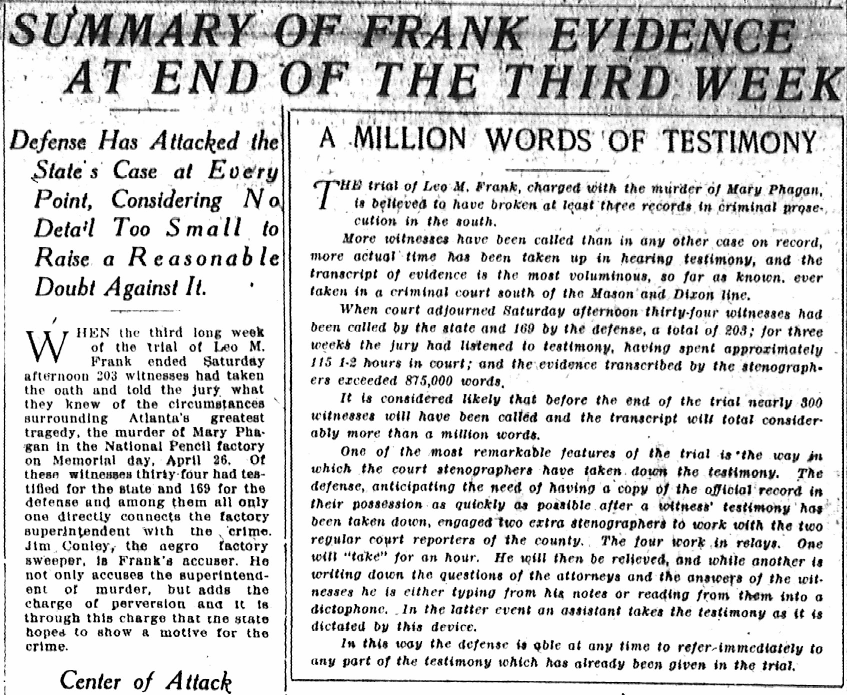
Summary of Frank Evidence at End of the Week

Another in our series of new transcriptions of contemporary articles on the Leo Frank case.

Atlanta Journal
August 17th, 1913

Defense Has Attacked the State’s Case at Every Point, Considering No Detail Too Small to Raise a Reasonable Doubt Against It.

When the third long week of the trial of Leo M. Frank ended Saturday afternoon 203 witnesses had taken the oath and told the jury what they knew of the circumstances surrounding Atlanta’s greatest tragedy, the murder of Mary Phagan in the National Pencil factory on Memorial day, April 26. Of these witnesses thirty-four had testified for the state and 169 for the defense and among them all only one directly connects the factory superintendent with the crime. Jim Conley, the negro factory sweeper, is Frank’s accuser. He not only accuses the superintendent of murder, but adds the charge of perversion and it is through this charge that the state hopes to show a motive for the crime.

Continue Reading →

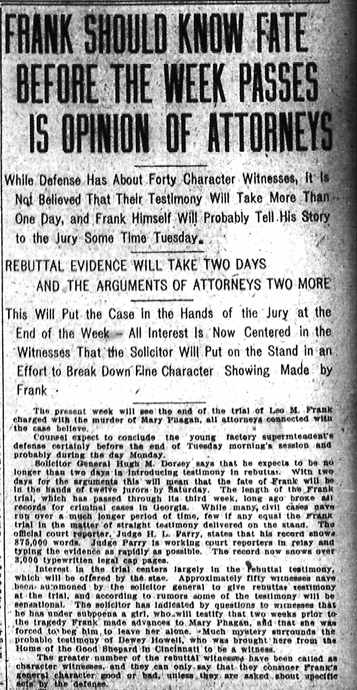
Frank Should Know Fate Before the Week Passes is Opinion of Attorneys

Another in our series of new transcriptions of contemporary articles on the Leo Frank case.

Atlanta Journal
August 17th, 1913

While Defense Has About Forty Character Witnesses, It’s Not Believed That Their Testimony Will Take More Than One Day, and Frank Himself Will Probably Tell His Self to the Jury Some Time Tuesday.

REBUTTAL EVIDENCE WILL TAKE TWO DAYS AND THE ARGUMENTS OF ATTORNEYS TWO MORE

This Will Put the Case In the Hands of the Jury at the End of the Week – All Interest is Now Centered in the Witnesses That the Solicitor Will Put on the Stand In an Effort to Break Down Fine Character Showing Made by Frank.

The present week will see the end of the trial of Leo M. Frank charged with the murder of Mary Phagan, all attorneys connected with the case believe.

Counsel expect to conclude the young factory defense certainly before the end of Tuesday morning’s and probably during the day Monday.

Continue Reading →

The Murder of Little Mary Phagan: New Blockbuster Book, Second-Revised, 2025 Edition. Vastly Expanded After 38 Years! Available for Purchase:

The Murder of Little Mary Phagan
Phagan-Kean, Mary

by Claire Randall

WITH OVER 500 pages, more than twice the length of the first (1987) edition, the newly-revised and expanded second edition of The Murder of Little Mary Phagan is now available for purchase via the link on www.LittleMaryPhagan.com

The author, Mary Phagan-Kean, states: “This book is the great work of my lifetime, a compelling personal journey, a tale of the shocking sex murder and abuse of my great-aunt, 13-year-old Mary Phagan — and it’s the story that the ADL and other shadowy forces don’t want you to read.”

This is the monograph that finally, and definitively brings the truth about the murder of Mary Phagan by her killer, sweatshop boss and B’nai B’rith official Leo Frank, to light. It’s available now! Click the link or scan the QR code to get your copy at a discount price today.

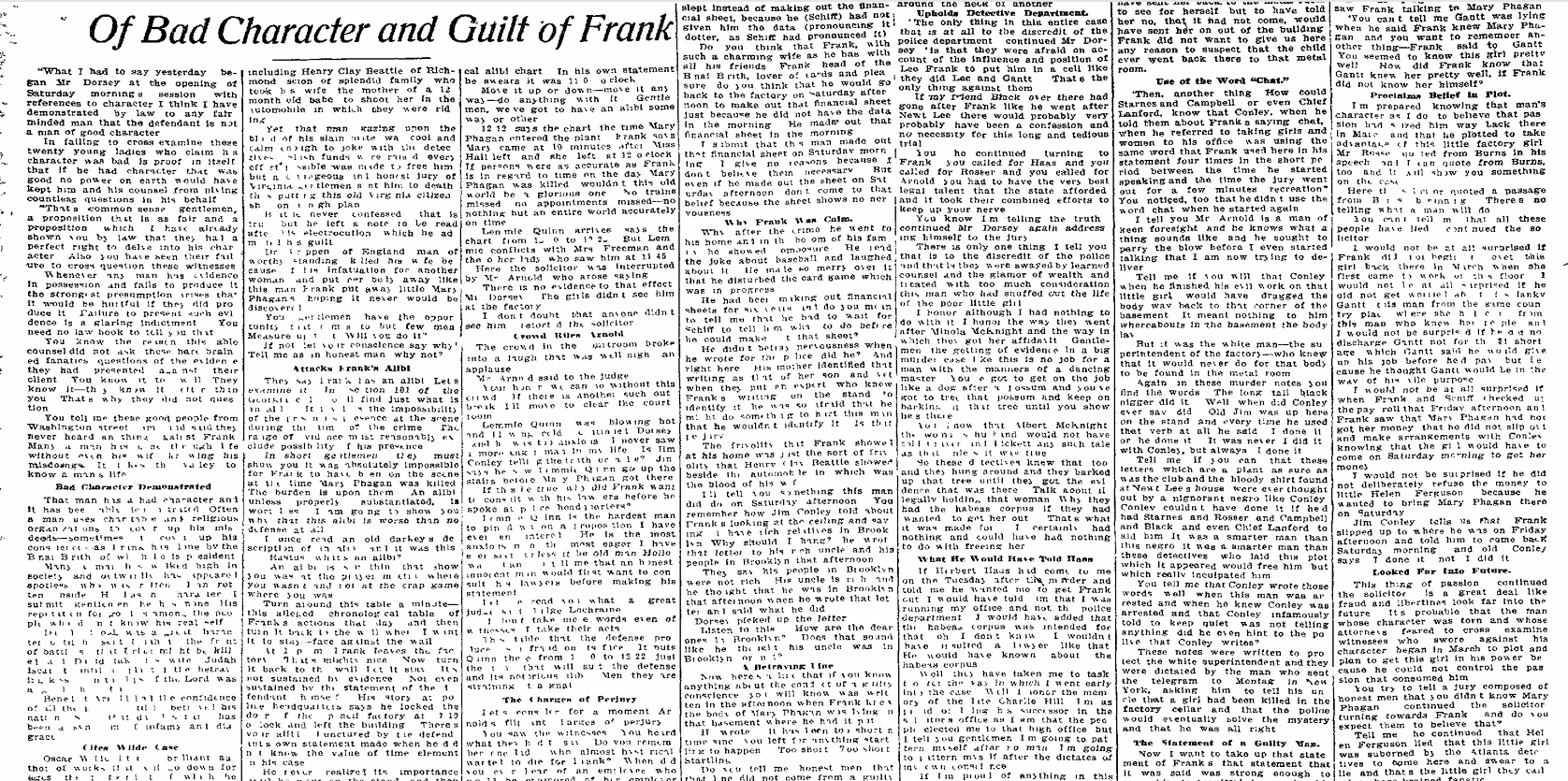
Solicitor Reasserts His Conviction Of Bad Character and Guilt of Frank

Another in our series of new transcriptions of contemporary articles on the Leo Frank case.

Atlanta Constitution
August 24th, 1913

“What I had to say yesterday,” began Mr. Dorsey at the opening of Saturday morning’s session, “with references to character, I think I have demonstrated by law to any fair-minded man that the defendant is not a man of good character.”

“In failing to cross-examine these twenty young ladies who claim his character was bad, is proof, of itself, that if he had character that was good, no power on earth would have kept him and his counsel from plying countless questions in his behalf.”

“That’s common-sense, gentlemen, a proposition that is as fair and a proposition which I have already shown you by law that they had a perfect right to delve into his character. Also, you have seen their failure to cross-question these witnesses.”

“Whenever any man has evidence in possession and fails to produce it, the strongest presumption arises that it would he hurtful if they did produce it. Failure to present such evidence is a glaring Indictment. You need no law book to tell you that.”

“You know the reason, his able counsel did not ask these ‘hare-brained fanatics’ questions of the evidence they had presented against their client. You know it too well, they know it—they know it better than you. That’s why they did not question.”

“You tell me those good people from Washington Street came and said they never heard anything against Frank. Many a man has gone through life, without even his wife knowing his misfortune. It takes the valley to know a man’s life.”

Continue Reading →

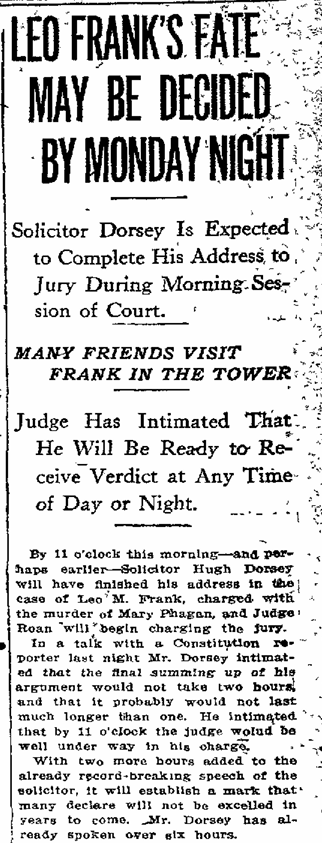
Leo Frank’s Fate May Be Decided by Monday Night

Another in our series of new transcriptions of contemporary articles on the Leo Frank case.

Atlanta Constitution
August 25th, 1913

Solicitor Dorsey Is Expected to Complete His Address to Jury During Morning Session of Court

MANY FRIENDS VISIT FRANK IN THE TOWER

Judge Has Intimated That He Will Be Ready to Receive Verdict at Any Time of Day or Night

By 11 o’clock this morning—and perhaps earlier—Solicitor Hugh Dorsey will have finished his address in the case of Leo M. Frank, charged with the murder of Mary Phagan, and Judge Roan ‘will’ begin charging the jury.

In a talk with a Constitution reporter last night, Mr. Dorsey intimated that the final summing up of his argument would not take two hours, and that it probably would not last much longer than one. He intimated that by 11 o’clock the judge would be well under way in his charge.

With two more hours added to the already record-breaking speech of the solicitor, it will establish a mark that many declare will not be excelled in years to come. Mr. Dorsey has already spoken over six hours.

Because of exhaustion, resulting from his speech of over four hours Saturday afternoon, the solicitor spent a quiet Sunday, getting ready for the end of his argument today.

Rosser at Warm Springs.

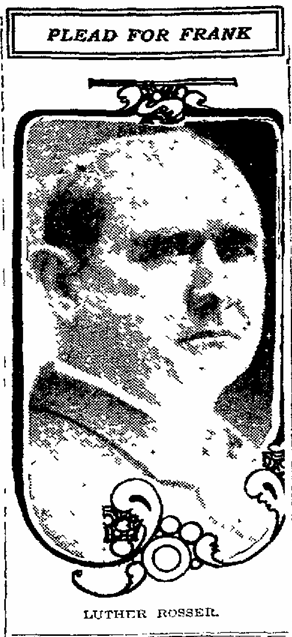
Luther Z. Rosser, senior attorney for the defense, spent Sunday and Sunday night in Warm Springs and Woodbury, which he visited with his wife. At Warm Springs during the day, he was besieged by a host of admirers.

Leo Frank spent a typical Sunday in jail. Throughout the day his cell was a mecca for callers. His wife and mother came late in the afternoon, remaining with him for considerable while. On these trips, he is permitted to see them in the jailer’s dining room on the first floor.

Continue Reading →

As Bells Tolled, Dorsey Closed Magnificent Argument Which Fastened Crime on Frank

Another in our series of new transcriptions of contemporary articles on the Leo Frank case.

Atlanta Constitution
August 26th, 1913

As the big bell in the Catholic church tolled the hour of 12 o’clock Solicitor Dorsey concluded his remarkable plea for the conviction of Leo Frank with the dreadful words— “Guilty, guilty, guilty!”

It was just at this hour, more than four months ago that little Mary Phagan entered the pencil factory to draw her pittance of $1.20.

The tolling of the bell and the dread sound of the words cut like a chill to the hearts of many who shivered involuntarily.

It was the conclusion of the most remarkable speech which has ever been delivered in the Fulton County courthouse—a speech which will go down in history stamping Hugh Dorsey as one of the greatest prosecuting attorneys of this age.

Arnold Makes Protest.

Only after Attorney Reuben R. Arnold had registered a vigorous protest against the action of the spectators, who clapped their hands in tumultuous applause as Solicitor Hugh Dorsey entered the courtroom. Monday morning the solicitor was allowed to continue his speech, which was interrupted by adjournment Saturday.

When court convened at 9 o’clock, there were more people outside of the courthouse unable to gain admission, than there were inside, and about two minutes before the hour of opening court, a roar of cheers told the spectators inside that the solicitor general was coming. His entrance was the signal for the outbreak of approval of his wonderful effort Saturday.

Continue Reading →

Frank Convicted, Asserts Innocence

Another in our series of new transcriptions of contemporary articles on the Leo Frank case.

Atlanta Constitution
August 26th, 1913

WAITS WITH WIFE IN TOWER FOR NEWS FROM COURTROOM; FRIENDS TELL HIM VERDICT

“I Am as Innocent Today as I Was One Year Ago,” He Cries—“The Jury Has Been Influenced by Mob Law”— “I Am Stunned by News,” Declares ‘Rabbi Marx, One of Prisoner’s Closest Friends—Defense Plans to Carry Case to Supreme Court in Order to Secure New Trial—Judge Roan Will Defer Sentence For a Few Days.

OVATION FOR JURY AND SOLICITOR GIVEN BY CROWD WAITING ON STREET

Judge Roan Thanks Jurymen for Services During Four Long, Hard Weeks, and Tells Members He Hopes They Will Find Their Families Well—Courtroom Was Cleared by Order of Judge Before Jury Was Brought in to Give Its Verdict—“’I’m Sorry for Frank’s Wife and His Mother,” Says Solicitor Dorsey.

 Leo M. Frank, superintendent of the National Pencil factory; president of the B’nai B’rith, graduate of Cornell university, student of literature, and until recently regarded as a man of unblemished character and reputation, and a leader among his people, has been declared guilty of the murder of Mary Phagan, a 13-year-old employee of the factory which Frank is the head.

Continue Reading →

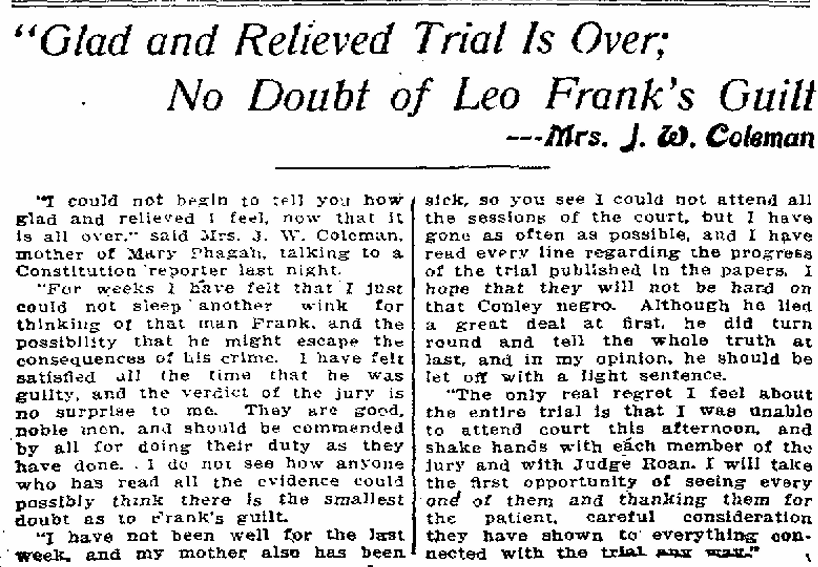
Glad and Relieved Trial Is Over; No Doubt of Leo Frank’s Guilt

Another in our series of new transcriptions of contemporary articles on the Leo Frank case.

Atlanta Constitution
August 26th, 1913

“I could not begin to tell you how glad and relieved I feel, now that it is all over.” said Mrs. J. W. Coleman, mother of Mary Phagan, talking to a Constitution reporter last night.

“For weeks I have felt that I just could not sleep another wink for thinking of that man Frank, and the possibility that he might escape the consequences of his crime. I have felt satisfied all the time that he was guilty, and the verdict of the jury is no surprise to me. They are good, noble men, and should be commended by all for doing their duty as they have done. I do not see how anyone who has read all the evidence could possibly think there is the smallest doubt as to Frank’s guilt.”

“I have not been well for the last week, and my mother also has been sick, so you see I could not attend all the sessions of the court, but I have gone as often as possible, and I have read every line regarding the progress of the trial published in the papers. I hope that they will not be hard on that Conley negro. Although he lied a great deal at first, he did turn round and tell the whole truth at last, and in my opinion, he should be let off with a light sentence.”

“The only real regret I feel about the entire trial is that I was unable to attend court this afternoon, and shake hands with each member of the Jury and with Judge Roan, I will take the first opportunity of seeing every one of them and thanking them for the patient, careful consideration they have shown to everything connected with the trial any way.”

* * *

Atlanta Constitution, August 26th 1913, “Glad and Relieved Trial is Over; No Doubt of Leo Frank’s Guilt,” Leo Frank case newspaper article series (Original PDF)

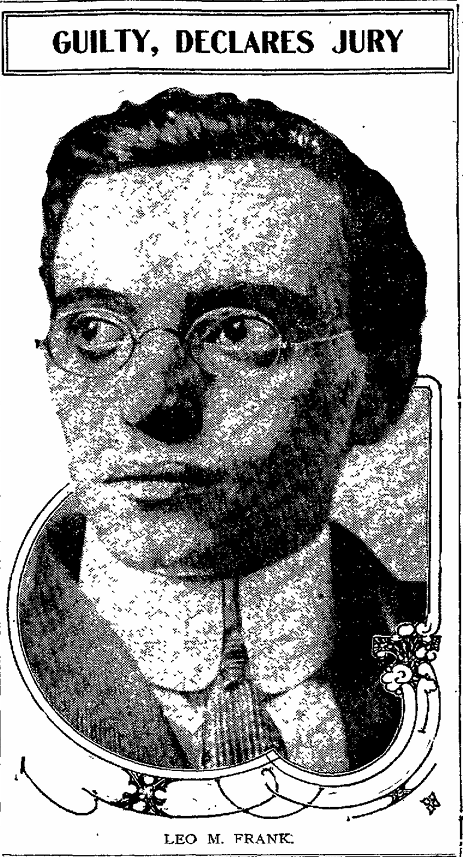
Guilty, Declares Jury

Another in our series of new transcriptions of contemporary articles on the Leo Frank case.

Atlanta Constitution
August 26th, 1913

LEO FRANK’S LIFE HISTORY.

The following chronological history of the life of Leo Max Frank is taken from his statement to the jury, made Monday, August 18, 1913:

April 17, 1884, born in Paris, Texas.

July, 1884, taken by parents to live in Brooklyn, New York.

June, 1902, graduated from Pratt Institute, a Brooklyn high school.

September, 1902, entered Cornell university, Ithaca, New York. 

June, 1906, graduated from Cornell.   

July, 1906, accepted position as draftsman with B. F. Sturtevant company, of High Park, Mass.

Continue Reading →

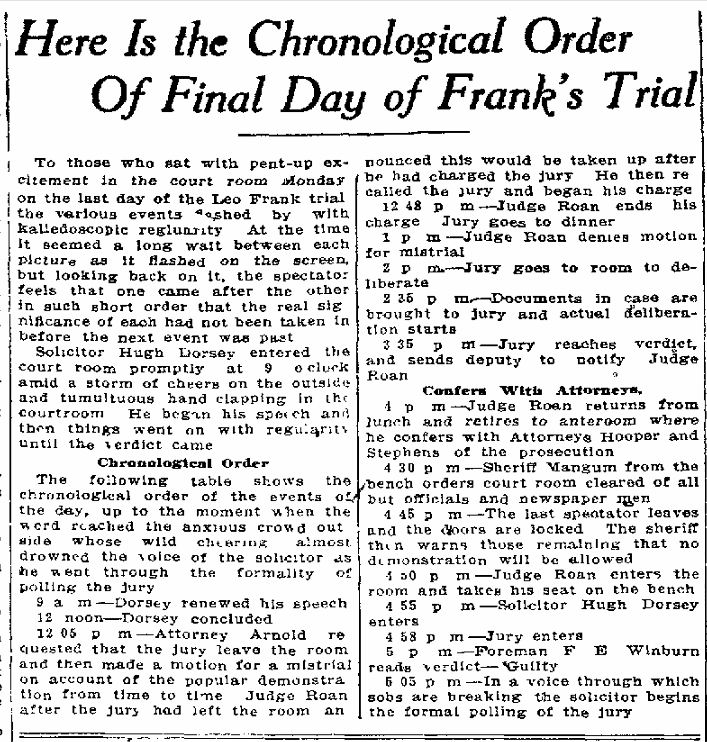
Here Is the Chronological Order Of Final Day of Frank’s Trial

Another in our series of new transcriptions of contemporary articles on the Leo Frank case.

Atlanta Constitution
August 26th, 1913

To those who sat with pent-up excitement in the court room Monday on the last day of the Leo Frank trial, the various events called the Jury and began his charge. The various events flashed by with kaleidoscopic regularity. At the time it seemed a long wall between each picture as it flashed on the screen, but looking back on it, the spectator feels that one came after the other in much short order that the real significance of each had not been taken in before the next event was past.

Solicitor General Hugh Dorsey entered the court room promptly at 9 o’clock amid a storm of cheers on the outside and tumultuous hand-clapping in the courtroom. He began his speech and then things went on with regularity until the verdict came.

Continue Reading →

Leo Frank Received Fair Trial Declares Chief Newport Lanford

Another in our series of new transcriptions of contemporary articles on the Leo Frank case.

Atlanta Constitution
August 26th, 1913

Chief Newport Lanford made the following statement Monday night in talking with a Constitution reporter:

“It is very gratifying to the members of my department that the jury, after their undoubtedly careful deliberation, found Frank guilty. I am not in the least surprised, nor do I think are any of the detectives, who have been associated with me in this case.”

“Frank was given one of the fairest trials it has ever been my lot to figure in. A body of twelve honorable gentlemen of high standing in the community have found him guilty, as charged, of the murder of Mary Phagan, and I am of the opinion that nearly everyone who is familiar with the case believes him guilty.”

“We, the other detectives and myself, have worked very hard on the case and have been untiring in our efforts to get at the truth regarding this terrible crime. We have been severely condemned by a few persons, most of whom are unfamiliar with the case, and with police methods of obtaining evidence, for the manner in which the city detectives have handled the Frank case, but the verdict rendered by the jury comes as a complete vindication of our department. In my opinion, and we feel that we have received the greatest reward possible, namely, the conviction of the man responsible for the little Phagan girl’s death.”

* * *

Atlanta Constitution, August 26th 1913, “Leo Frank Received Fair Trial Declares Chief Newport Lanford,” Leo Frank case newspaper article series (Original PDF)

Story of Mary Phagan’s Death as Representatives of the State Outlined It to Frank’s Jury

Another in our series of new transcriptions of contemporary articles on the Leo Frank case.

Atlanta Constitution
August 26th, 1913

The Jury has said that Leo Max Frank Is guilty of the murder of Mary Anne Phagan.

With that verdict fell upon Frank the awful shadow of the gallows and death.

This is a fearful shadow to dwell in. It Is a midnight of horror made black and dreadful than mere words can conjure up.

But there Is another shadow which hovers over Leo M. Frank —a shadow beside whose unspeakable blackness the thought of mere death brightens to the soft roseate glow of a sweet and soul-resting twilight!

Good Name Jeopardized.

This other shadow is the great black blot of the crime that must besmudge the good name of Leo M. Frank, so long as the name shall exist and people shall be able to remember.

By its verdict the jury drew this great black smudge across his name. Whether, if the world knows what Leo M. Frank knows, ‘twould still be so is another question. If unwittingly the jury has made so great a blunder, and the more horrible is it to consider the smirch upon the name of an innocent man.

Continue Reading →

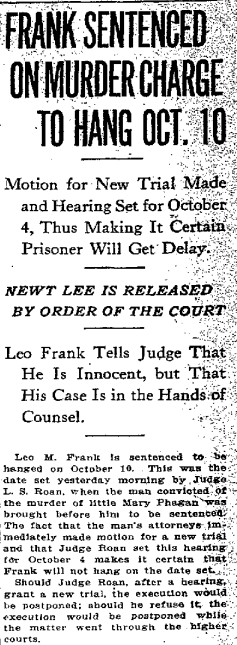
Frank Sentenced on Murder Charge to Hang Oct. 10

Another in our series of new transcriptions of contemporary articles on the Leo Frank case.

Atlanta Constitution
August 27th, 1913

Motion for New Trial Made and Hearing Set for October 4, 1913, Thus Making It Certain Prisoner Will Get Delay.

NEWT LEE IS RELEASED BY ORDER OF THE COURT

Leo Frank Tells Judge That He Is Innocent, but That His Case Is in the Hands of Counsel.

Leo M. Frank is sentenced to be hanged on Friday, October 10, 1913. This was the date set yesterday morning by Judge Leonard Strickland Roan, when the man convicted of the murder of little Mary Phagan was brought before him to be sentenced on Tuesday, August 26. The fact that the man’s attorneys immediately made motion for a new trial and that Judge Roan set this hearing for October 4 makes it certain that Frank will not hang on the date set.

Should Judge Roan, after a hearing, grant a new trial, the execution would be postponed; should he refuse it, the execution would be postponed while the matter went through the higher courts.

With the sentencing of Frank came a court order, secured by Attorneys Graham and Chappell, giving freedom to Newt Lee, negro nightwatchman for the National Pencil factory, of which Leo Frank was superintendent. The negro had been in custody since 3 o’clock on the morning of Sunday, April 27 when officers came at his call and found the dead girl’s body in the factory basement.

Continue Reading →

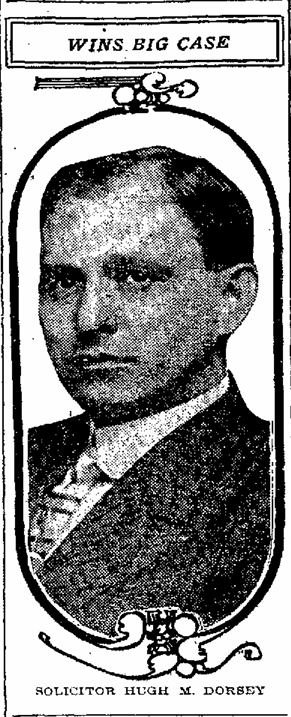
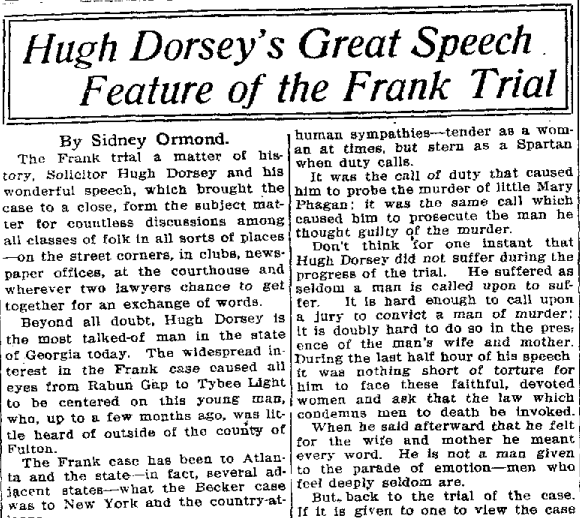
Hugh Dorsey’s Great Speech Feature of the Frank Trial

Another in our series of new transcriptions of contemporary articles on the Leo Frank case.

Atlanta Constitution
August 27th, 1913

By Sidney Ormond

The Frank trial is a matter of history. Solicitor General Hugh Manson Dorsey and his wonderful speech, which brought the case to a close, form the subject matter for countless discussions among all classes of folk in all sorts of places—on the street corners, in clubs, newspaper offices, at the courthouse and wherever two lawyers chance to get together for an exchange of words.

Beyond all doubt, Hugh Dorsey is the most talked-of man in the state of Georgia today. The widespread interest in the Frank case caused all eyes from Rabun Gap to Tybee Light to be centered on this young man, who, up to a few months ago, was little heard of outside of the county of Fulton.

Continue Reading →

Graduates of Cornell Will Aid Leo M. Frank in Fight for Life

Another in our series of new transcriptions of contemporary articles on the Leo Frank case.

Atlanta Constitution
August 31st, 1913

Leo Max Frank, recently convicted on the charge of murdering Mary Phagan, is to receive aid in his battle for life and liberty from the alumni of Cornell University of Ithaca, New York, which institution he is a graduate [on June 21, 1906], according to dispatches received in Atlanta Saturday night from New York city lawyers, when the movement was started some days ago.

T. B. Strauss, a prominent Cornell alumnus, is heading the movement, and it is stated that circular letters will be sent out to Cornell graduates throughout the country asking their cooperation in the effort to establish Frank’s innocence. It is further stated in articles recently published in New York that it is possible that a subscription will be taken up to make up a fund to finance his defense.

Frank’s latest method of amusing himself in his prison cell is to solicit the autograph of every visitor. He Is insistent on this point before he will see anyone. It is stated, and it is estimated that he has already accumulated hundreds upon hundreds of signatures. He is keeping a diary of each day’s happenings, and faithfully sets down every detail of each hour. He writes down the time to the very minute at which anyone visits him, what time they arrive, and what time they leave. He is equally consistent in jotting down the time at which he eats, how long It takes him to finish each meal and at what time he arises, and not even the smallest detail of the hours in which he is awake is allowed to escape a place on his record.

* * *

Atlanta Constitution, August 31st, 1913, “Graduates of Cornell Will Aid Leo M. Frank in Fight for Life,” Leo Frank case newspaper article series (Original PDF)

Leo M. Frank to Make No Public Statement

Another in our series of new transcriptions of contemporary articles on the Leo Frank case.

Atlanta Constitution
August 29th, 1913

It was learned yesterday that, contrary to reports, Leo Frank would not make public a statement attacking his arraignment by Solicitor Dorsey, withholding at the advice of attorneys.

His counsel has advised silence for the present, and it is likely that no statement at all will be made by the convicted man until his case is brought before the Supreme Court, in the event a new trial is granted.

No move of any kind is expected on the part of the defense until October 4, the date set for argument before Judge L. S. Roan. Both the defense and prosecution are busy preparing and outlining their argument.

Mrs. Rea Frank, mother of the factory superintendent, left Thursday afternoon for her home In Brooklyn. She intimated, however, that she; would return to Atlanta shortly, Her husband, it is said, is ill at home.

Frank is resting well in the Tower. Much of his time is spent in attending to business. He receives visitors daily, and his wife has been a constant caller. He slept nine hours Wednesday night. Many out-of-town friends came to see him Thursday morning and afternoon, some of whom were college mates at Cornell.

* * *

Atlanta Constitution, August 29th 1913, “Leo M. Frank to Make No Public Statement,” Leo Frank case newspaper article series (Original PDF)

Jail Cell of Leo M. Frank Now Like Living Room

Another in our series of new transcriptions of contemporary articles on the Leo Frank case.

Atlanta Constitution
August 28th, 1913

Prisoner is Preparing Statement as Answer to Solicitor Dorsey’s Argument.

The cell of Leo M. Frank in the Tower is fast assuming the appearance of a living room. Yesterday a new bed and a number of furnishings arrived. All the day prison attaches worked renovating the interior, oiling the floor and cleaning the windows. 

Mrs. Lucille Frank appeared at the jail shortly after noon. For the first time since her husband’s imprisonment, she visited him in his cell. Heretofore they have accepted the use of the jailers dining room on the first floor. Frank’s mother, Mrs. Rea Frank, also visited him Wednesday afternoon. The wife remained until nightfall.

Frank Cheerful, Say Friends.

Frank is cheerful, his friends say, and is hopeful of the future. He expresses confidence of a new trial and of the prospect for complete exoneration in the long run. He apparently has suffered no ill effects from the strain of the four long weeks at trial and of the resultant verdict. He has suffered not a moment’s illness during his entire imprisonment.

It was stated Wednesday by friends that Frank is preparing a statement for publication in which he brands the speech of Solicitor Dorsey as unfair and underhanded. “It was as full of holes as a slave,” they quote him as having said, “and if I could have had just one hour In which to reply to his argument, I could have convinced the jury that I was an innocent man and that the solicitor was misrepresenting facts.

“I am preparing a statement in reply to his argument,” he is said to have stated, “and if my lawyers deem it advisable, I will make it public. I know that his statements were presented to the jury unfairly and that they had their weight in influencing the twelve men. Therefore, this Is the only way by which I will be able to cope with this unfair situation.”

Summons Chief Clerk.

Frank summoned his chief clerk, Herbert Schiff, who was an important witness for the defense, to the jail, Wednesday morning and dictated a number of letters, business and otherwise. The prisoner Is compiling a diary.       

Attorney Luther Rosser is busy preparing his case for presentation to the courts. In case Judge Roan refuses to grant a new trial, it will be immediately carried to the Supreme Court. At present, the defense is boiling down its plea to the required brevity.

* * *

Atlanta Constitution, August 28th 1913, “Jail Cell of Leo M. Frank Now Like Living Room,” Leo Frank case newspaper article series (Original PDF)

Rosser Makes Great Speech for the Defense; Scores Detectives and Criticizes the Solicitor

Another in our series of new transcriptions of contemporary articles on the Leo Frank case.

Atlanta Constitution
August 23rd, 1913

In a quiet yet concentrated tone Attorney Luther Zeigler Rosser, Friday morning at 9 o’clock made the final plea of the defense for the life of Leo Frank.

The beginning of the speech was impressive, it was almost whispered at times, but the voice that delivered it rose above the maze of ozonators and electric fans, and seemed to carry a body message about it. The life of a man was at stake and the message, pleading for his life, was opened almost as a prayer—the subject being fate.

Later on, Mr. Rosser was more vigorous in his methods; he branched from the quiet even tones, and dealt with the ugly features of the case; he told a fib so risqué that probably no other lawyer in the state would have told it in the courtroom, and he talked in plain words of plain facts.

“‘Gentlemen of the jury, all things come to an end,’ he began in a quiet voice, and he leaned over the railing of the jury box and seemed not to address one, but all of the jurors.”

“With the end of this case has almost come the end of the speakers and but for that masterly effort of my brother Arnold, I almost wish it had ended with no speaking. My condition issues that I can say but little; my voice is husky and my throat almost gone.

Continue Reading →

Frank Case May Go to Jury Late This Afternoon

Another in our series of new transcriptions of contemporary articles on the Leo Frank case.

Atlanta Constitution
August 22nd, 1913

LAWYERS’ BATTLE WILL END TODAY AND JUDGE WILL CHARGE THE JURY

In First Speech for State on Wednesday Morning, Frank Hooper Scored General Conditions at National Pencil Factory, Terming Leo Frank, a Dr. Jekyll and Mr. Hyde, and Explaining How Easy It Was for People Who Saw Only One Side of Him to Imagine Him a Paragon of Virtue.

REUBEN ARNOLD BRANDS JIM CONLEY MURDERER OF LITTLE PHAGAN GIRL

Attorney for Defense Dwells on Horror of Convicting Man Upon Purely Circumstantial Evidence, and Cites Many Instances Where Such Action Has Resulted in Great Injustice to the Accused. Scores Detective Department Unmercifully and Charges They Concocted Story Which Conley Told on Stand.

Unless all calculations are upset the Frank case should be ready to go to the jury tonight, provided Judge Roan does not decide to postpone his charge until Saturday morning — in which event the case will reach the Jury during the forenoon Saturday.

After that time, it is all a matter of speculation as to the time the verdict will be returned. It may be returned turned in a few moments after the jury retires; again, it may be hours or days. The general opinion is, however, that Frank will know his fate some time Saturday.

Continue Reading →