Mythology of the Antisemitic Lynching Threat at Leo Frank’s Trial. Debunked.

Gone Viral: “Hang the Jew, or We’ll Hang You!” The Theatrical Mob Coercion and Intimidation Mythology in Leo Frank Trial Literature. Tracing the Sources and Chronology of the Alleged Mob Lynching Ultimatum Shouted at Leo Frank’s Jury: The Disputed Story’s Mutation, Publicity, and Historical Authority, 1913–2026

By Will Connor, Forensic Historian

Presented for the Mary Phagan Kean Legacy Project • September 26, 2026

Abstract: Tracing Citogenesis and Citation Laundering in Leo Frank Historiography

This forensic-historical inquiry examines a long-contested assertion arising from the 1913 trial of Leo M. Frank, Atlanta B’nai B’rith president and factory superintendent: that mobs allegedly threatened the twelve jurors with death unless they convicted the Jewish defendant. The investigation traces the citogenesis of this unsubstantiated claim, showing how related mutations of the alleged threat entered print, shifted in wording and setting, and acquired apparent authority through prolific citation laundering and oral repetition by prominent people.

The genealogy and comparison-audit herein places contemporary reporting alongside Connolly’s and Rascoe’s December 1914 articles, judicial records, historical scholarship, and later public narratives. The evidence supports several overlapping accounts, with some demonstrable paths of transmission. Within the examined sources, no verified trial-period record establishes the exact conditional mob-to-jury threat. The published story can be traced more securely than its alleged utterance or supposed inventor. Documented prejudice and other threats remain part of the record.

Definitions: Citogenesis, Citation Laundering and Forensic Historiography

Citogenesis describes how an unsupported claim is born and cultivates an appearance of authenticity and factuality through circular citation or reporting. Once repeated in a publication, the claim may later be treated as credible or received as part of the accepted historical account because it appears in print under a publisher’s imprint and an author’s name, even though the printed account may ultimately trace back through a lineage to an unsubstantiated and unverified origin.
Continue Reading →

The George Epps Affair in the Aftermath of Leo Frank’s Verdict

A job promise dangled. A private detective using an alias. A pugilist ruse. Characters in a charade. A wild goose chase by train. A New Orleans cover story. Four days in Birmingham. A newsboy witness falsely accused. Affidavit repudiations. The Frank appeals chaos. And George Epps’s 1968 libel suit against Harry Golden. From Saturday, April 26, 1913, to Saturday, December 14, 1968: a story with bookends spanning nearly fifty-five years.

BY HENRY HOLLAND

September 24th, 2026

Epps’s Bookends in the Mary Phagan Case

The background to the distant bookends of George Washington Epps’s involvement in the Mary Phagan case, including his long fight for his own truth, seemingly spanned almost a lifetime.

Once upon a time, George W. Epps Jr. was a newsie who lived around the corner from Mary Phagan in the Bellwood neighborhood of Atlanta, Georgia. Little did he know that the fight over his own story would follow him for the next fifty-five years.

Continue Reading →

Leo Frank’s Post-Verdict Defense Campaign Targeted Negro Witnesses

Negro Witnesses Under Pressure

Witness Tampering, False Pretexts, Money, Jobs, Disputed Affidavits, Manufactured Confession Allegations, Witness Removal, and the Campaign to Break Jim Conley

By Arthur Daniels

Historical terminology note: The newspapers, affidavits, court papers, and testimony from 1913 and 1914 commonly used Negro, Negress, and colored. This article uses Negro in its narration for historical clarity. Source quotations preserve original wording, even when a quotation uses words or grammar I would not otherwise use.

Contents

Master Chronology at a Glance

How the Evidence Is Classified

Why the Chronology Matters

Continue Reading →

William Manning Smith, the Turncoat Lawyer

How Jim Conley’s Attorney Became His Accuser, Joined the Burns Investigation, and Turned His Own Knowledge Against His Former Client

By Arthur Daniels

William Manning Smith’s conduct in the Leo Max Frank case is one of the most troubling reversals in the history of the Mary Phagan murder investigation.

Smith was not an outsider who studied the case years later and changed his opinion. He was Jim Conley’s lawyer. He accepted Conley’s trust. He controlled access to him. He defended him in public. He fought attempts to accuse him of Mary Phagan’s murder. He warned about outside investigators getting access to his client. He warned about trades. He warned about supposed Conley confession stories. He said he believed Conley was telling the truth. He represented him after Leo Frank had already been convicted. He fought William J. Burns when Burns wanted access to Conley.

Continue Reading →

Jim Conley Likely to Be Indicted Friday

Another in our series of new transcriptions of contemporary articles on the Leo Frank case.

Atlanta Journal
September 2nd, 1913

New Grand Jury Organized, Nineteen True Bills on First Day

Solicitor Hugh M. Dorsey stated Tuesday morning that in all probability Jim Conley, the negro on whose evidence the state mainly rested its case in the trial of Leo M. Frank, will be indicted Friday at the next meeting of the grand jury. The charge, said the solicitor, will be accessory after the crime.

The new grand jury met Tuesday morning, organized and transacted routine business.

Nineteen true bills were returned, most of them being against negroes.

Chapter 4 in Phagan Mystery

Another in our series of new transcriptions of contemporary articles on the Leo Frank case.

[This is a newly transcribed article that was previously missed during transcription. Here is Chapter 4 from the chapter series the Atlanta Georgian had printed in July of 1913 over the course of several days.]

Atlanta Georgian
July 25th, 1913

Inquest Into Slaying of Factory Girl and First Sensational ‘Confession’ of Negro Sweeper Jim Conley.

CHAPTER IV.

Through all the interrogation of witnesses by the Coroner’s jury and through the ordeal of a half day’s inquisition of Leo M. Frank, no bit of direct and positive evidence was developed against either Newt Lee or Frank. When, however, at the close of their session on Thursday, May 8, the six jurors found that Mary Phagan had come to her death by strangulation and ordered that Frank and Lee be held to the Grand Jury, they did the only thing left to them.

So far as they knew at that time Frank and Lee were the only persons who could have had the opportunity to commit the crime. They knew that they were unequal to the mystery, the baffling elements of which mounted in numbers and proportions as the case progressed. They passed it on to the Grand Jury.

Lee and Frank, as the two persons who presumably would know the most about the crime, were probably the most important witnesses, but the closest interrogation of the negro failed to bring out any important testimony that he had not already given the officers.

Continue Reading →

Open Letter to PBS Regarding its Biased Documentary Segment on the Leo Frank Case

Dear PBS Board of Directors:

Paula Kerger, President

Chair Catherine Robb,

Co-Chair Geoff Sands and Jayme Swain

Members: Delores Fernandez Alonso, Mark G. Contreras, Bob Culkeen, Mildred Garcia, Anne Gates, Susan Goldberg, Chuck Hagel, Shae Hopkins, Marvin Irby, Larry Irving, Michael Isip, Gunjan Kedia, Becky Magura, Carla McCage, Sandra Cordova Micek, Luis Patino, Greg Petrowich, Vivian Riefberg, Tina Sharkey, Amy Shaw, Holden Thorp, and Ed Ulman

My name is Mary Phagan-Kean (@PhaganKean). I am the great-niece and namesake of little Mary Phagan (1899 – 1913), the thirteen-year-old girl murdered at the National Pencil Company in Atlanta on April 26, 1913. [1]

Continue Reading →

The Truth Is on the March

part detective, part PR man: William J. Burns

William J. Burns and the Great Leo Frank Case Carnival

Introduction

IN 1914, six days short of the first anniversary of the strangulation-murder of 13-year-old Mary Phagan by Jewish businessman and B’nai B’rith official Leo M. Frank on Confederate Memorial Day, 1913, the Frank case entered its most frenetic public phase. A major legal decision was slated to be dropped in a few days. By then, Frank had already been convicted of the gruesome murder of Mary. But Frank’s defense team, flush with money from a national publicity campaign, was furiously working to get witnesses to reverse their testimony, and get Frank a new trial or exonerated one way or another — an exoneration effort that still continues today, led by Jewish groups including the ADL (Anti-Defamation League).

Continue Reading →

Leo Frank’s Own Story to Add Final Touch to State’s Greatest Trial

Another in our series of new transcriptions of contemporary articles on the Leo Frank case.

Atlanta Georgian
August 18th, 1913

By JAMES B. NEVIN.

It is rather an extraordinary thing that on this Monday, the beginning of the fourth week of the most remarkable murder trial ever held in Georgia, the interest should be in nowiseabated or lessened, and that the opening of court to-day saw the biggest, hungriest and most insistent crowd of curious spectators yet on hand at the opening of court.

Far from letting go the Phagan mystery, the public to-day seems to be gripping it even more eagerly than ever before.

Opinion still is widely divided as to the guilt or innocence of Leo Frank, and there have been many switches of conclusion and reversals of theory, pro and con, within the past week, and no doubt there is much more of the same sort of thing to come.

People to-day believe Frank guilty who started out believing him innocent, and the rule is working right around the other way, moreover!

Continue Reading →

Leo Frank Testifies

Another in our series of new transcriptions of contemporary articles on the Leo Frank case.

Atlanta Georgian
August 18th, 1913

That his married life has been very happy; that his office safe door was open and he could not see Mary Phagan as she spoke to him on leaving after drawing her pay; that he was in his office from 12 until just before going home to lunch.

PROFOUND IMPRESSION MADE BY PRISONER’S REMARKABLE STORY

FRANK LOOKS STRAIGHT AT JURY AND TELLS STORY DELIBERATELY

During his statement, Frank looked straight into the faces of the jurymen and talked very distinctly and deliberately. His voice was not very strong and the deputies had to rap frequently to keep down the noise.

From the lips of the man accused of the murder of Mary Phagan, came a remarkable story Monday afternoon, August 18, 1913.

Continue Reading →

Frank Makes His Own Best Witness Telling Direct Detailed Story

Another in our series of new transcriptions of contemporary articles on the Leo Frank case.

Atlanta Georgian
August 18th, 1913

The eyes of Leo Frank’s wife and his mother-in-law, Mrs. Emil Selig, were constantly upon him as he sat in the witness chair talking conversationally with the jurors. His mother seldom looked at him, maintaining her usual attitude, looking slightly downward and toward the judge’s bench.

Frank had been talking only 10 minutes when they unexpectedly was interrupted by a heated argument between the opposing attorneys over Frank’s explaining the time slips, including the one which the defense claims was taken from the time clock Sunday morning following the finding of Mary Phagan’s body.

Continue Reading →

Minds.com now features the full Leo Frank Trial Brief of Evidence from July to August 1913, making this crucial primary source publicly accessible for study, reference, and historical research.


Pssst. Hey you. Want to listen to an audiobook of the Leo Frank trial testimony? If so, please like, repost, and bookmark this for later.

The complete Leo Frank Trial Brief of Evidence from 1913 is now fully uploaded to Minds.com and is fully available to view with a free Minds account. You can find the full archive on the Crime Time Capsule channel at www.minds.com/crimetimecapsule.

This collection contains the full and official Trial Brief of Evidence from July through August 1913, originally presented in the Fulton County Superior Court Annex in Atlanta, Georgia. The entire record has been published as 202 narrated transcript clipping video segments, preserving the verbatim testimony and courtroom proceedings exactly as they were heard by the jury. Taken together, this material represents one of the most important primary sources for understanding the Leo Frank case in its original legal context.

The archive can be accessed here: Crime Time Capsule on Minds, www.minds.com/crimetimecapsule.
Please note that while the content is free, you must create a free Minds account to view the full series of 202 clipping videos.

Minds was chosen intentionally. It presents itself as a platform committed to First Amendment principles and open discussion. In the past, whenever newly transcribed Leo Frank legal records were published on my independent websites, those sites were quickly targeted by repeated denial of service attacks and hacking attempts. These incidents often originated from foreign IP addresses and resulted in servers being knocked offline or compromised. The clear pattern suggested an effort to prevent the public from examining the trial record in full.

Those attacks reinforced an important point. When fair minded readers are allowed to study the original evidence, testimony, and legal arguments for themselves, they may reach conclusions similar to those reached by the jurors in 1913 and by the Georgia Supreme Court in 1914. That court explicitly affirmed that the evidence presented at trial was sufficient to support Leo Frank’s conviction.

To prevent future disruption, the project has shifted toward diversification, distribution, and decentralization. Rather than relying on a single website, the official trial documents, transcripts, audiobooks, and clipping videos are now distributed across free speech oriented platforms that are more resistant to coordinated suppression. Minds offers a stable environment where the full Brief of Evidence can remain accessible without interference.

The trial testimony itself unfolded between Monday, July 28, 1913, and Thursday, August 21, 1913. Closing arguments began on August 21 and concluded at midday on August 25. Later that same afternoon, the jury returned a unanimous verdict of guilty. On August 26, 1913, Judge Leonard Strickland Roan formally affirmed the verdict and sentenced Leo Max Frank to death by hanging. The execution was delayed as Frank’s attorneys pursued a lengthy series of appeals that extended the case for nearly two years.

If you want to study these records for yourself, you can watch all 202 narrated segments of the Leo Frank Trial Brief of Evidence by visiting Crime Time Capsule on Minds at www.minds.com/crimetimecapsule. A free Minds account is required to access the full archive.

This release represents one of the most complete public presentations of the trial’s primary evidence ever assembled. Its purpose is simple. Preserve the record. Make it accessible. Allow independent study beyond censorship, suppression, or selective quotation.

If you would like to support this work, I invite you to purchase the 2025 second revised and expanded edition of The Murder of Little Mary Phagan, now available on Amazon. Each copy helps fund ongoing transcription, digitization, and preservation of historical material connected to this case. These efforts are aimed at ensuring future generations can examine the original legal record in full, rather than relying on summaries or interpretations.

Permission has been granted by Mary Phagan Kean to repost her statement from X regarding this project.

#Minds #LeoFrank #LeoFrankTrial #MaryPhagan #TrialTranscript #FultonCounty #Atlanta #Georgia #TrueCrime #CrimeTimeCapsule

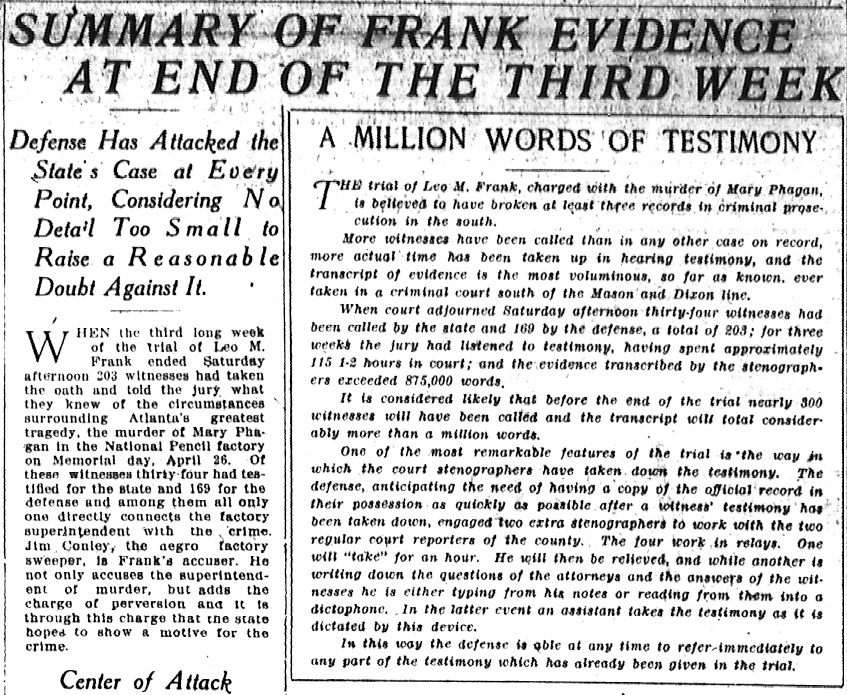
Summary of Frank Evidence at End of the Week

Another in our series of new transcriptions of contemporary articles on the Leo Frank case.

Atlanta Journal
August 17th, 1913

Defense Has Attacked the State’s Case at Every Point, Considering No Detail Too Small to Raise a Reasonable Doubt Against It.

When the third long week of the trial of Leo M. Frank ended Saturday afternoon 203 witnesses had taken the oath and told the jury what they knew of the circumstances surrounding Atlanta’s greatest tragedy, the murder of Mary Phagan in the National Pencil factory on Memorial day, April 26. Of these witnesses thirty-four had testified for the state and 169 for the defense and among them all only one directly connects the factory superintendent with the crime. Jim Conley, the negro factory sweeper, is Frank’s accuser. He not only accuses the superintendent of murder, but adds the charge of perversion and it is through this charge that the state hopes to show a motive for the crime.

Continue Reading →

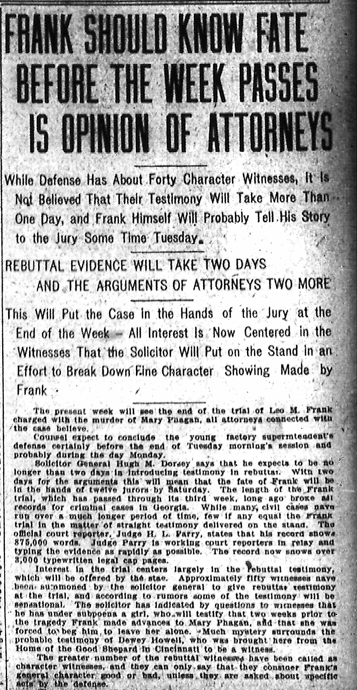
Frank Should Know Fate Before the Week Passes is Opinion of Attorneys

Another in our series of new transcriptions of contemporary articles on the Leo Frank case.

Atlanta Journal
August 17th, 1913

While Defense Has About Forty Character Witnesses, It’s Not Believed That Their Testimony Will Take More Than One Day, and Frank Himself Will Probably Tell His Self to the Jury Some Time Tuesday.

REBUTTAL EVIDENCE WILL TAKE TWO DAYS AND THE ARGUMENTS OF ATTORNEYS TWO MORE

This Will Put the Case In the Hands of the Jury at the End of the Week – All Interest is Now Centered in the Witnesses That the Solicitor Will Put on the Stand In an Effort to Break Down Fine Character Showing Made by Frank.

The present week will see the end of the trial of Leo M. Frank charged with the murder of Mary Phagan, all attorneys connected with the case believe.

Counsel expect to conclude the young factory defense certainly before the end of Tuesday morning’s and probably during the day Monday.

Continue Reading →

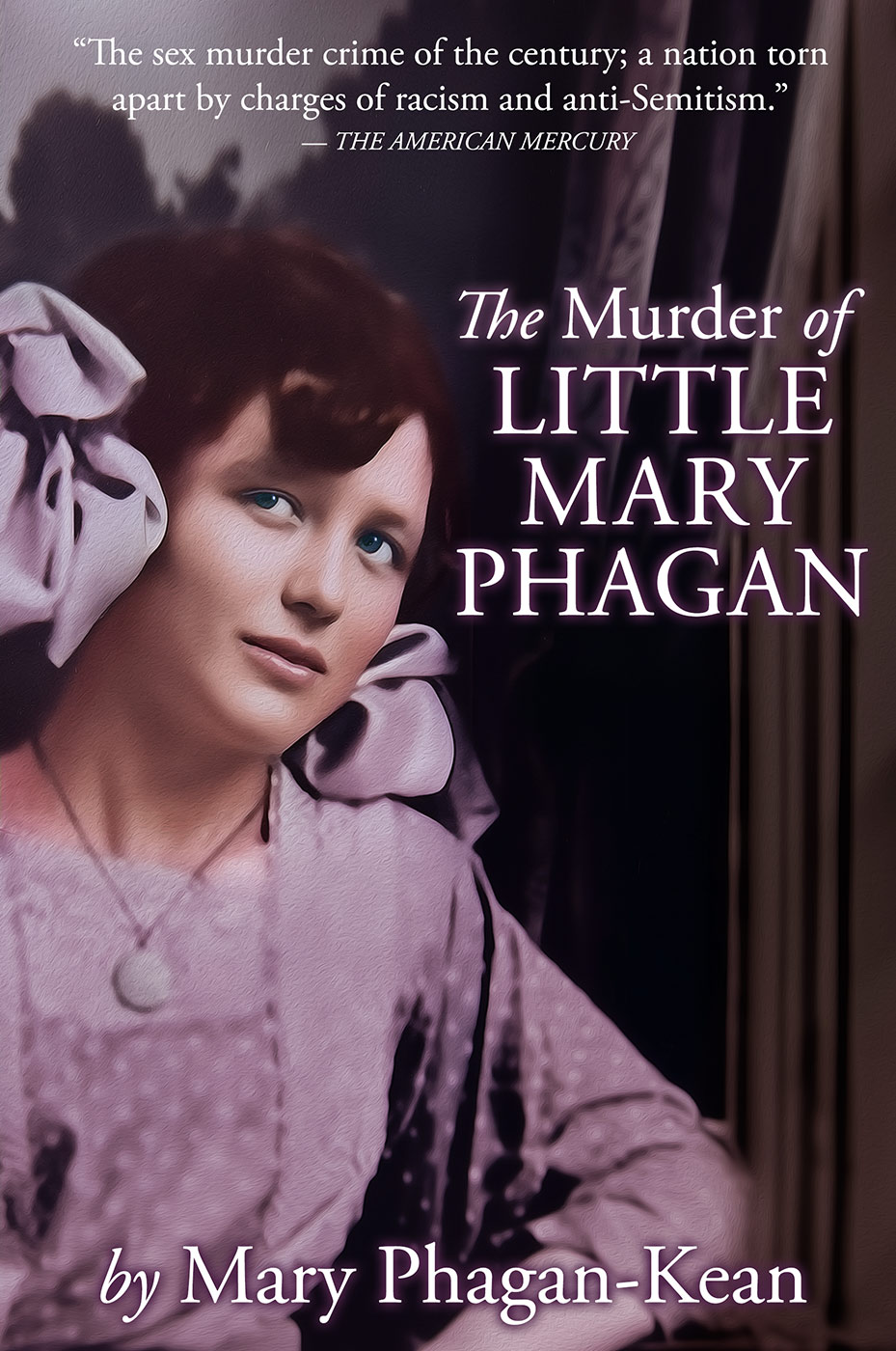
The Murder of Little Mary Phagan: New Blockbuster Book, Second-Revised, 2025 Edition. Vastly Expanded After 38 Years! Available for Purchase:

The Murder of Little Mary Phagan
Phagan-Kean, Mary

by Claire Randall

WITH OVER 500 pages, more than twice the length of the first (1987) edition, the newly-revised and expanded second edition of The Murder of Little Mary Phagan is now available for purchase via the link on www.LittleMaryPhagan.com

The author, Mary Phagan-Kean, states: “This book is the great work of my lifetime, a compelling personal journey, a tale of the shocking sex murder and abuse of my great-aunt, 13-year-old Mary Phagan — and it’s the story that the ADL and other shadowy forces don’t want you to read.”

This is the monograph that finally, and definitively brings the truth about the murder of Mary Phagan by her killer, sweatshop boss and B’nai B’rith official Leo Frank, to light. It’s available now! Click the link or scan the QR code to get your copy at a discount price today.

Uncovering the Past: Mary Phagan-Kean on Family, Memory, and the Controversy of Leo Frank

by Alexander Sullivan

In a rare and deeply personal interview, Mary Phagan-Kean, the grand-niece and namesake of Mary Phagan, shared her family’s perspective, her personal journey, and why she remains firmly convinced of Leo Frank’s guilt.

Mary Phagan’s murder at the National Pencil Company in Atlanta set off a chain of events that would culminate in Leo Frank’s conviction, a contentious commutation of his sentence, and ultimately, a lynching by a group of vigilantes. Over a century later, her descendant Mary Phagan-Kean is determined to make sure her family’s voice is heard in a narrative that she says has been distorted by powerful forces.

Continue Reading →

Mary Phagan 112: May Her Life Not Be in Vain

Mary Phagan

by Dale Bennett

ON THIS, the 112th anniversary of the rape and strangulation murder of 13-year-old Mary Phagan by her sweatshop boss — and Atlanta B’nai B’rith president — Leo Max Frank, let us remember her young life and reflect on the massive Jewish propaganda machine that has been attempting to whitewash her killer’s reputation for more than a century.

Besides the victim, Mary Phagan, there were five people in the National Pencil Company building when she was killed on 26 April 1913. We know that four of them didn’t do it. That leaves Leo Frank.

Continue Reading →

Mary Phagan-Kean Interview Blitz Continues: Ryan Dawson

Introduction to Mary Phagan-Kean’s Insights into the Murder of Her Great Aunt

HERE ARE SOME of the key points offered by Mary Phagan-Kean in her latest interview with social media activist Ryan Dawson. (video above)

Mary Phagan-Kean’s journey into the dark and complex narrative surrounding the murder of her great aunt, Mary Phagan, began unexpectedly. Her father first shared the story after her name was recognized by a teacher, sparking a lifelong quest for truth and justice. The tale, as recounted by her father, painted a grim picture of Leo Frank, the man convicted of Mary Phagan’s murder. According to testimony, Frank was a sexual pervert who molested numerous young girls and even boys, earning him the moniker “the B’nai B’rith pedophile” — a reference to the fact that he was president of the Atlanta chapter of the Jewish fraternal order B’nai B’rith, the organization which gave birth to the powerful ADL, or “Anti-Defamation League.” Frank was even re-elected president of the group after his conviction for murdering little Mary.

Continue Reading →

Mary Phagan-Kean Interviewed on Stew Peters Program

by Benjamin Smith
Edited by John Anderson

ON 11 MARCH 2025, Mary Phagan-Kean — great-niece of 13-year-old Mary Phagan, who was brutally murdered by Jewish B’nai B’rith official Leo Frank in 1913 — was interviewed on the Stew Peters television program. You can watch that interview by clicking the video link above.

Continue Reading →

Georgia Supreme Court Records

State of Georgia, Fulton County.

Be it remembered that at the July Term, 1913, of Fulton Superior Court, – His Honor, L. S. Roan, one of the judges of the Superior Court of the State of Georgia presiding – there came on to be tried the case of the State of Georgia vs. Leo M. Frank, – same being an indictment for murder. On the trial of said case, the jury found the defendant guilty without any recommendation to life imprisonment and the court imposed the death sentence upon the defendant.

At the same term at which said verdict was rendered, and in due and legal time, defendant made a motion for new trial upon the grounds therein stated, and said motion came on to be …. regularly passed, on the 31st day of October, 1913.

Upon the hearing of said motion for new trial, said […], Leo M. Frank, presented a proper brief of the evidence in […] which was approved by the court as true and correct, and which is here and now stated to be true and correct in this […] exceptions.

[…vent] at the hearing of said case, else presented on […] motion for new trial, and the court certified that the recital of fact contained in both the original and the amended motions for new trial were true and approved the grounds of both the original and the amended motions for new trial, and here and now states that the recitals contained in the grounds of both said original and amended motions for new trial are true.

Continue Reading →